Electromagnetic spectrum
NCERT Class 12 Physics Chapter 8 Section 8.4
Quick answer
The electromagnetic spectrum is the classification of electromagnetic waves by frequency or wavelength: in order of decreasing wavelength, radio waves, microwaves, infrared, visible light (700–400 nm), ultraviolet, X-rays and gamma rays. All travel through vacuum at the same speed, with c = νλ, and the boundaries between bands are not sharp; the bands differ in how they are produced and detected and in how they interact with matter. The photon energy, E = hν, rises from radio waves to gamma rays.
With your textbook
NCERT Physics Part I (Class 12), Chapter 8 “Electromagnetic Waves”, Section 8.4 “Electromagnetic Spectrum”, pages 208–211.
Open the official NCERT chapter (PDF, 1.4 MB, ncert.nic.in) (opens in a new tab)
Checked against the 2026-27 reprint on .
What is the electromagnetic spectrum?
Electromagnetic spectrum
The electromagnetic spectrum is the classification of electromagnetic waves by frequency (or wavelength). It includes radio waves, microwaves, infrared waves, visible light, ultraviolet rays, X-rays and gamma rays (NCERT Section 8.4, page 208). In NCERT’s words:
There is no sharp division between one kind of wave and the next.
NCERT Physics Part I (Class 12), Section 8.4, page 208
The classification is based roughly on how the waves are produced and detected. All of them travel through vacuum at the same speed c; they differ in wavelength and frequency, and so in the way they interact with matter (NCERT pages 208 and 213).
In plain words: radio waves, light and X-rays are the same kind of thing, an electromagnetic wave, only with very different wavelengths. A radio wave can be longer than a building; a gamma ray’s wavelength is far smaller than an atom. The names mark rough stretches of one continuous range.
How to use the ranges: boundaries are conventions and overlap; wavelengths below are vacuum wavelengths. Source lists give common examples, not exclusive production mechanisms. “Heat waves” is a traditional name for infrared: any radiation that is absorbed can heat matter. In applications, intensity, exposure and material response matter as well as photon energy.
The spectrum at a glance
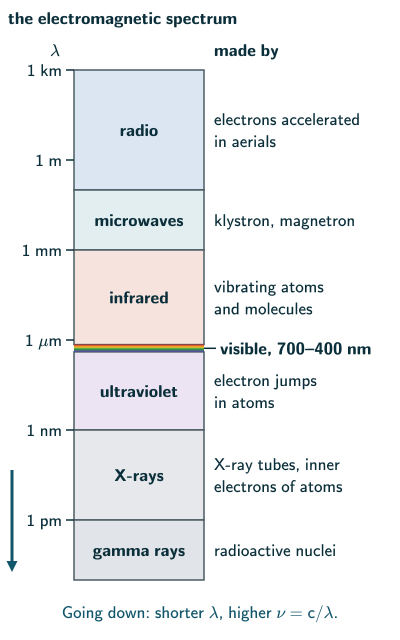
- In order of decreasing wavelength, and so increasing frequency (ν = c/λ), NCERT Table 8.1 (page 211) gives:
- radio waves: longer than 0.1 m;
- microwaves: 0.1 m to 1 mm;
- infrared: 1 mm to 700 nm;
- visible light: 700 nm to 400 nm;
- ultraviolet: 400 nm to 1 nm;
- X-rays: 1 nm to 10−3 nm;
- gamma rays: shorter than 10−3 nm.
- NCERT’s text in Section 8.4 gives different limits for some bands (for example, ultraviolet down to 0.6 nm, X-rays from 10 nm and gamma rays from 0.1 nm). As NCERT says, the regions overlap and their edges are not sharp, so use Table 8.1 unless a question gives other values (NCERT pages 210–211).
- NCERT Figure 8.4 (page 209) draws the spectrum with common names for its parts. NCERT Table 8.1 (page 211) lists the detectors:
- radio: the receiver’s aerial;
- microwaves: point-contact diodes;
- infrared: thermopiles, bolometers, infrared photographic film;
- visible light: the eye, photocells, photographic film;
- ultraviolet: photocells, photographic film;
- X-rays and gamma rays: photographic film, Geiger tubes, ionisation chambers.
Radio waves
- Radio waves are produced by the accelerated motion of charges in conducting wires. They are used in radio and television communication, generally from 500 kHz to about 1000 MHz (NCERT page 209).
- NCERT quotes the following textbook broadcasting ranges; actual allocations vary by country and date. Its AM (amplitude modulated) band is 530 kHz to 1710 kHz; frequencies up to 54 MHz are used for short-wave bands; TV waves range from 54 MHz to 890 MHz; and the FM (frequency modulated) band is 88 MHz to 108 MHz. Cellular phones use radio waves in the ultrahigh frequency (UHF) band (NCERT page 209).
- A receiver picks out one station by resonance in its tuning circuit (NCERT Section 7.6.2).
- NCERT slip: page 209 says how these waves are transmitted and received “is described in Chapter 15”. The current book has no Chapter 15: Part II ends with Chapter 14.
Microwaves
- Microwaves are short-wavelength radio waves, with frequencies in the gigahertz (GHz) range. They are produced by klystrons and magnetrons, which are special vacuum tubes, and by Gunn diodes (NCERT page 209).
- NCERT slip: page 209 calls all three vacuum tubes, but a Gunn diode is a semiconductor device (NASA technical report N72-13 930, discussion of Gunn-effect semiconductor crystals).
- Their short wavelengths suit radar, used in aircraft navigation. Radar is also the basis of the speed guns that time fast balls, tennis serves and cars (NCERT page 209).
- In a microwave oven the waves pass their energy to the molecules of the food, mainly water, raising its temperature (NCERT page 209).
- NCERT error: page 209 says the oven’s frequency is chosen to match the resonant frequency of water molecules. That is a common misconception. Polar molecules, mainly water, absorb microwaves over a wide range of frequencies: the field turns them to and fro and they pass the energy on as heat (dielectric heating). Many domestic ovens operate near 2.45 GHz, within an industrial, scientific and medical band; practical penetration and heating considerations also matter (University of Reading, Maxwell2D microwave-oven demonstration; ITU Radio Regulations, provision 5.150). There is no special water-molecule resonance at 2.45 GHz.
Infrared waves
- Infrared waves are produced by hot bodies and molecules. The band lies next to the low-frequency, long-wavelength (red) end of the visible spectrum (NCERT page 210).
- They are sometimes called heat waves: water molecules, present in most materials, readily absorb infrared (so do CO2, NH3 and other molecules), and their thermal motion increases, so they heat up and heat their surroundings (NCERT page 210). Infrared can excite molecular rotations and vibrations; absorbed energy can become heat (NCERT Points to Ponder 3, page 213). At everyday temperatures, most of the radiation by which heat crosses empty space is infrared.
- Greenhouse effect: visible light passes fairly easily through the atmosphere, is absorbed by the earth’s surface and is re-radiated as infrared, which greenhouse gases such as carbon dioxide and water vapour trap. Greenhouse gases absorb and re-emit infrared in all directions, including towards the surface, reducing the rate at which energy escapes at a given surface temperature (NCERT page 210).
- Uses: infrared lamps in physical therapy; infrared detectors in earth satellites, for military purposes and to watch crop growth; and infrared LEDs in the remote controls of TVs and other household electronics (NCERT page 210).
Visible rays
- Visible light is the most familiar form of electromagnetic waves, the part of the spectrum the human eye detects: about 4 × 10¹⁴ Hz to 7 × 10¹⁴ Hz, or wavelengths of about 700 nm to 400 nm (NCERT page 210).
- Light emitted or reflected by objects around us gives us information about the world. Other animals are sensitive to other ranges: some snakes have organs that detect infrared, and the “visible” range of many insects extends well into the ultraviolet (NCERT page 210).
- The eye is most sensitive in the visible region where the sun emits strongly; the peak depends on whether one plots emission per unit wavelength or per unit frequency (NCERT Points to Ponder 4, page 213).
Ultraviolet rays
- Ultraviolet (UV) covers wavelengths from about 4 × 10⁻⁷ m (400 nm) down to 6 × 10⁻¹⁰ m (0.6 nm). It is produced by special lamps and very hot bodies, and the sun is an important source (NCERT page 210).
- The ozone layer absorbs much of the sun’s UV. Large amounts of UV harm humans; exposure makes the skin produce more melanin, causing tanning (NCERT page 210).
- Welders wear special glass goggles or face masks with glass windows to protect their eyes from the large amount of UV from welding arcs (NCERT page 210).
- Its short wavelength lets UV be focused into very narrow beams, as in LASIK eye surgery, and UV lamps kill germs in water purifiers (NCERT page 210).
- The ozone layer protects us, so its depletion by chlorofluorocarbons (CFCs) such as freon is a matter of international concern (NCERT page 210).
- NCERT error: page 210 places the ozone layer about 40–50 km up. The region of highest ozone concentration lies roughly 15–35 km up in the stratosphere, varying with location and season. It absorbs almost all the shorter-wavelength, most harmful UV, but most of the UV nearest to visible light reaches the ground (NOAA/WMO, Twenty Questions and Answers About the Ozone Layer, Q1–Q2).
- NCERT error: page 210 says ordinary glass absorbs UV, so one cannot get tanned or sunburnt through glass windows. Ordinary clear glass generally blocks much of UVB but can transmit substantial UVA; transmission depends strongly on glass type, coatings and thickness (Duarte and colleagues, Photodermatology, Photoimmunology & Photomedicine 25, 181–184, 2009). Thus glass cannot be treated as a universal barrier to tanning or UV skin effects (US FDA, Ultraviolet Radiation).
X-rays
- X-rays lie beyond ultraviolet, from about 10−8 m (10 nm) down to 10−13 m (10−4 nm). A common way to make them is to bombard a metal target with high-energy electrons (NCERT page 211).
- They are used to diagnose illness and to treat some cancers. Because they damage or destroy living tissue, unnecessary or over-exposure must be avoided (NCERT page 211).
- Characteristic X-rays come from inner-electron transitions, often in heavy target atoms; accelerated electrons also produce the continuous bremsstrahlung spectrum (NCERT Table 8.1 and Points to Ponder 2).
Gamma rays
- Gamma rays lie at the upper-frequency end of the spectrum, with wavelengths from about 10−10 m to less than 10−14 m. They are produced in nuclear reactions and emitted by radioactive nuclei, and are used in medicine to destroy cancer cells (NCERT page 211).
- NCERT error: NCERT Points to Ponder 2 (page 213) gives gamma rays from a nucleus wavelengths of 10−14 m to 10−15 m, about the nucleus’s size. That means photons of about 120 MeV to 1200 MeV. The wavelength need not match nuclear size. For example, the 661.66 keV gamma photon from barium-137m following caesium-137 decay has λ ≈ 1.87 × 10⁻¹² m, much larger than the nucleus (Canadian Nuclear Safety Commission, Radionuclide Information Booklet, Cs-137). This is a concrete counterexample to treating source size as the gamma wavelength.
- Where X-rays and gamma rays overlap in wavelength, the school-level origin convention distinguishes nuclear gamma transitions from electronic X-rays (reasoned from NCERT Table 8.1, page 211).
Solved examples
Example 1: What they share (NCERT Exercise 8.3)
What physical quantity is the same for X-rays of wavelength 10−10 m, red light of wavelength 6800 Å and radio waves of wavelength 500 m?
Answer: their speed in vacuum, c = 3 × 10⁸ m/s. Their frequencies differ: ν = c/λ gives 3 × 10¹⁸ Hz, about 4.4 × 10¹⁴ Hz and 6 × 10⁵ Hz (NCERT Exercise 8.3, page 214; Eq. [8.9(b)], page 207).
Example 2: The visible band in hertz
Convert the visible range of 700 nm to 400 nm into frequencies.
Answer: ν = c/λ: 3 × 10⁸/(700 × 10−9) ≈ 4.3 × 10¹⁴ Hz and 3 × 10⁸/(400 × 10−9) = 7.5 × 10¹⁴ Hz, in line with NCERT’s “about 4 × 10¹⁴ Hz to about 7 × 10¹⁴ Hz” (NCERT page 210).
Example 3: The FM band
The FM radio band runs from 88 MHz to 108 MHz. What wavelengths are these?
Answer: λ = c/ν: 3 × 10⁸/(88 × 106) ≈ 3.4 m and 3 × 10⁸/(108 × 106) ≈ 2.8 m (NCERT page 209; Eq. [8.9(b)], page 207).
Example 4: Photon energies (NCERT Exercise 8.9)
Using E = hν, find the photon energy in eV for each part of the spectrum, and relate the energy scales to the sources.
Answer: E = hc/λ, and hc = 6.63 × 10−34 × 3 × 108 J m; with 1 eV = 1.6 × 10⁻¹⁹ J, hc ≈ 1240 eV nm. With the NCERT Table 8.1 ranges (page 211):
- radio: below about 1.2 × 10⁻⁵ eV;
- microwaves: 1.2 × 10⁻⁵ to 1.2 × 10⁻³ eV;
- infrared: 1.2 × 10⁻³ to 1.8 eV;
- visible: 1.8 to 3.1 eV;
- ultraviolet: 3.1 eV to 1.2 keV;
- X-rays: 1.2 keV to 1.2 MeV;
- gamma rays: above about 1.2 MeV.
These are illustrative boundaries from this particular table, not exclusive energy limits: the 661.66 keV nuclear gamma ray above lies below its nominal gamma boundary. The rough energy scales reflect source transitions: tiny for electrons in aerials, a fraction of an eV for vibrating molecules, a few eV for electrons in atoms, keV for inner electrons of heavy atoms and MeV for nuclei (NCERT Exercise 8.9, page 214).
Common mistakes to avoid
Common mistake
Thinking different kinds of waves travel at different speeds in vacuum
All electromagnetic waves travel through vacuum at the same speed c; they differ in wavelength and frequency (NCERT Points to Ponder 1, page 213).
Common mistake
Treating the band edges as exact
There is no sharp division between one kind of wave and the next, and NCERT’s own ranges overlap (NCERT pages 208 and 211).
Common mistake
Mixing up infrared and ultraviolet
Infrared lies beyond red, at longer wavelengths than visible light; ultraviolet lies beyond violet, at shorter wavelengths (NCERT page 210).
Common mistake
Telling X-rays from gamma rays by wavelength alone
Their ranges overlap. Nuclear transitions produce gamma rays and electronic processes produce X-rays in the school convention; high-energy astrophysics also uses gamma-ray labels for other processes, including electron–positron annihilation (NASA Universe Glossary) (reasoned from NCERT Table 8.1, page 211).
Quick revision summary
- In order of decreasing wavelength: radio, microwaves, infrared, visible, ultraviolet, X-rays, gamma rays; the frequency rises in the same order.
- NCERT Table 8.1 ranges: radio > 0.1 m; microwaves 0.1 m to 1 mm; infrared 1 mm to 700 nm; visible 700 nm to 400 nm; ultraviolet 400 nm to 1 nm; X-rays 1 nm to 10−3 nm; gamma rays < 10−3 nm.
- Sources: aerials (radio), klystrons and magnetrons (microwaves), hot bodies and vibrating molecules (infrared), atoms (light and ultraviolet), X-ray tubes (X-rays), nuclei (gamma rays).
- Detectors (NCERT Table 8.1): aerials (radio), point-contact diodes (microwaves), thermopiles and bolometers (infrared), the eye and photocells (light), photocells (ultraviolet), Geiger tubes and ionisation chambers (X-rays, gamma rays).
- All travel at c in vacuum; the boundaries are not sharp; photon energy E = hν rises from radio to gamma rays.
Formula sheet
- c = νλ
- E = hν = hc/λ
- hc ≈ 1240 eV nm
Questions students ask
What is the difference between radio waves and microwaves?
Microwaves are short-wavelength radio waves, the high-frequency end of the radio range, so the two differ in wavelength and in the devices that make and use them (NCERT page 209). NCERT Table 8.1 puts radio waves above 0.1 m and microwaves from 0.1 m to 1 mm (page 211), about 3 GHz to 300 GHz by ν = c/λ. Radio waves come from charges accelerated in aerials, microwaves from klystrons, magnetrons and Gunn diodes (pages 209 and 211). Beyond the NCERT text, many microwave bands pass through haze, cloud and smoke, which is why communication and earth-observation satellites use them (NASA Science, Tour of the Electromagnetic Spectrum: Microwaves).
Why does a microwave oven heat food unevenly?
A microwave oven heats food unevenly partly because the microwaves, reflected to and fro by its metal walls, form standing waves: the field is strong at the antinodes and weak at the nodes, so some parts heat fast and others slowly (beyond the NCERT text, reasoned). At the usual 2.45 GHz the wavelength is c/ν ≈ 12.2 cm (NASA gives about 12 cm), so hot spots lie roughly half a wavelength, about 6 cm, apart in a simple standing-wave model; real three-dimensional mode patterns and food loading alter the spacing. Thick food also heats from the outside in, its centre warming mostly by conduction (US FDA, Microwave Ovens); the turntable and stirring help to even out both effects.
Why are X-rays and gamma rays more dangerous than microwaves and radio waves?
X-ray and gamma photons can cause ionisation, whereas radio and microwave photons cannot; overall hazard also depends on intensity, exposure duration and absorption: at their high frequencies each quantum, E = hν, can knock electrons out of atoms, damaging tissue and DNA (beyond the NCERT text: US EPA, Radiation Basics; see Example 4). NCERT warns that X-rays damage or destroy living tissue (page 211). Radio waves and microwaves are non-ionising: strong microwaves can harm by heating, causing burns or cataracts, and the US FDA caps a microwave oven’s leakage at 5 mW per square centimetre about 5 cm away (US FDA, Microwave Ovens).
What is the difference between UVA, UVB and UVC rays?
UVA, UVB and UVC are the three bands of the sun’s ultraviolet, UVA from 315 nm to 400 nm, UVB from 280 nm to 315 nm and UVC from 100 nm to 280 nm, with the energy rising as the wavelength falls (beyond the NCERT text: NOAA/WMO, Twenty Questions and Answers About the Ozone Layer, 2022, Q2). The atmosphere, including oxygen and ozone, absorbs the sun’s UVC and most UVB while transmitting much more UVA, so the UV at the ground is mostly UVA with some UVB; NCERT says only that the ozone layer absorbs most of the sun’s UV (page 210). UVB raises the risk of skin cancer and cataracts, while UVA reaches deeper into the skin and is linked to premature ageing and some skin cancers (same source; US FDA, Ultraviolet (UV) Radiation).
Why are X-rays used to see bones, and why do bones look white on an X-ray?
X-rays are used to see bones because they pass through soft tissue but are strongly absorbed by bone, which contains calcium, an element of higher atomic number than most of those in tissue (beyond the NCERT text: NIH NIBIB, X-rays fact sheet). On the detector behind the patient, the places that bone shades get few X-rays and look white, fat and muscle look grey, and air-filled spaces such as the lungs, which let most X-rays through, look dark (NIH MedlinePlus, X-Rays). The image is a shadow picture of the body; NCERT notes that X-rays are used as a diagnostic tool in medicine (page 211).
Are the electromagnetic spectrum and X-rays in the JEE Main and NEET syllabus?
Yes, the electromagnetic spectrum, X-rays included, is in both syllabuses and has not been deleted: Unit 15 of the JEE Main syllabus lists the “electromagnetic spectrum (radio waves, microwaves, infrared, visible, ultraviolet, X-rays, Gamma rays), applications of electromagnetic waves”, and Unit 15 of NEET (UG) 2026 the same seven bands and “Applications of e.m. waves.” In NCERT it is Section 8.4 of Chapter 8 in Class 12 Physics Part I (2026–27, pages 208–211), with Table 8.1 of ranges, sources and detectors on page 211. Neither syllabus names the UVA, UVB and UVC bands or how X-ray images form, which are beyond the NCERT text.
Practice questions
Try each question first, then open the answer to check your working.
-
Q1. Arrange in order of increasing wavelength: infrared, gamma rays, radio waves, visible light.
Show answerHide answer
Gamma rays, visible light, infrared, radio waves (NCERT Table 8.1, page 211).
-
Q2. Which electromagnetic waves are used in radar, and why?
Show answerHide answer
Microwaves: their short wavelengths make them suitable for radar (NCERT page 209).
-
Q3. Why are infrared waves called heat waves?
Show answerHide answer
Water and other molecules in most materials readily absorb infrared; their thermal motion increases, so the material heats up (NCERT page 210).