Reflection of light by spherical mirrors
NCERT Class 12 Physics Chapter 9 Section 9.2
Quick answer
For paraxial rays at a spherical mirror, f = R/2 and 1/v + 1/u = 1/f, with Cartesian signs. Magnification is m = h′/h = −v/u; for a real object a convex mirror gives a virtual, erect, diminished image, while a concave mirror’s image depends on the object distance.
With your textbook
NCERT Physics Part II (Class 12), Chapter 9 “Ray Optics and Optical Instruments”, Section 9.2 “Reflection of Light by Spherical Mirrors”, pages 222–228.
Open the official NCERT chapter (PDF, 3.4 MB, ncert.nic.in) (opens in a new tab)
Checked against the 2026-27 reprint on .
What is reflection by spherical mirrors?
Reflection by spherical mirrors
A spherical mirror is part of a reflecting sphere: concave if it reflects on the inside of the sphere, convex if on the outside. Light reflects from it by the ordinary laws of reflection, which hold at every point of the surface (NCERT Section 9.2, page 222):
These laws are valid at each point on any reflecting surface whether plane or curved.
NCERT Physics Part II (Class 12), Section 9.2, page 222
With the Cartesian sign convention, one mirror equation, 1/v + 1/u = 1/f, gives the image position for every case, the focal length is half the radius of curvature, f = R/2, and the magnification is m = −v/u (NCERT Eqs. (9.3), (9.7) and (9.9), pages 224–226).
In plain words: at each point a curved mirror behaves like a tiny flat mirror tilted along the curve. A concave mirror bends parallel light inward to a focus; a convex mirror spreads it out. Once you measure every distance from the mirror with the right sign, one short formula finds the image.
Scope: the spherical-mirror formulas are paraxial approximations, with small aperture and small angles. Standard object-position tables assume a real object; a converging beam supplies a virtual object and can change the usual real/virtual conclusions. Partial covering preserves the complete geometric image only while every object point can still send rays through the remaining aperture.
Laws of reflection
- The angle of reflection equals the angle of incidence, both measured from the normal to the surface. The incident ray, the reflected ray and the normal at the point of incidence lie in the same plane (NCERT page 222, Figure 9.1).
- On a spherical mirror the normal at any point is along the radius: the line joining the centre of curvature to the point of incidence (NCERT page 222).
- The geometric centre of a spherical mirror is its pole P. The line through the pole and the centre of curvature C is the principal axis (NCERT page 222).
Sign convention
- NCERT uses the Cartesian sign convention. All distances are measured from the pole of the mirror (or the optical centre of a lens). Distances in the same direction as the incident light are positive; distances opposite to it are negative (NCERT Section 9.2.1, page 222, Figure 9.2).
- Heights measured upwards from the principal axis are positive, and heights measured downwards are negative (NCERT page 223).
- For a real object, u is negative; converging incident rays can instead define a virtual object with u positive (see the FAQ). A concave mirror has a negative f and a convex mirror a positive f; a real image, in front of the mirror, has a negative v, and a virtual image, behind it, a positive v. Flipping the diagram does not change these signs (reasoned from NCERT page 222, Figure 9.2).
- With an agreed convention, a single formula for mirrors handles all the different cases (NCERT page 223).
Focal length of spherical mirrors
- We take the rays to be paraxial: they meet the mirror close to the pole and make small angles with the principal axis (NCERT Section 9.2.2, page 223).
- A parallel beam reflected by a concave mirror converges to a point F on the axis; from a convex mirror it appears to diverge from a point F behind it. F is the principal focus, and its distance from the pole is the focal length f. For a concave mirror, a parallel beam at a small angle to the axis converges to a point in the focal plane, through F and normal to the axis (NCERT page 223, Figure 9.3).
- To find f, take a ray parallel to the axis meeting the mirror at M, with angle of incidence θ, and drop MD perpendicular to the axis. Then ∠MCP = θ and ∠MFP = 2θ, so tan θ = MD/CD and tan 2θ = MD/FD (NCERT Eq. (9.1), page 224).
- For small θ, measured in radians, tan θ ≈ θ and tan 2θ ≈ 2θ, so FD = CD/2 (NCERT Eq. (9.2)). For paraxial rays D is very close to P, so FD = f and CD = R (NCERT Eq. (9.3), page 224):
Focal length (NCERT Eq. 9.3)
The mirror equation
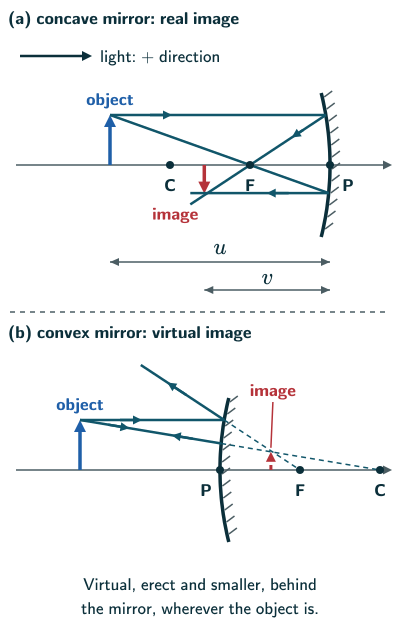
- If rays from a point actually meet at another point after reflection, that point is a real image; if they only appear to diverge from it when produced backwards, it is a virtual image (NCERT page 224).
- Any two of these rays from a point of the object locate its image: a ray parallel to the axis reflects through the focus; a ray through the centre of curvature retraces its path; a ray through the focus reflects parallel to the axis; and a ray striking the pole reflects by the laws of reflection (NCERT page 224, Figure 9.5).
- From the similar right triangles in NCERT Figure 9.5, B′F/FP = B′P/BP (NCERT Eq. (9.6), page 225). With the signs B′P = −v, FP = −f and BP = −u, this gives (v − f)/f = v/u, that is v/f − 1 = v/u. Dividing by v gives the mirror equation (NCERT Eq. (9.7), page 225):
Mirror equation (NCERT Eq. 9.7)
- NCERT derives it for a real, inverted image formed by a concave mirror, but with the signs used properly it holds for every case of reflection by a spherical mirror, concave or convex, real image or virtual (NCERT page 226, Figure 9.6).
Linear magnification
- The linear magnification m is the ratio of the image height h′ to the object height h, each taken with its sign (NCERT Eq. (9.8), page 225). The similar triangles A′B′P and ABP give −h′/h = −v/(−u) (NCERT Eq. (9.9), pages 225–226):
Magnification (NCERT Eq. 9.9)
-
A negative m means an inverted image (real, for a single mirror and a real object); a positive m means an erect image (virtual for a real object). If |m| > 1 the image is magnified (reasoned from NCERT Eq. (9.9) and Example 9.3).
-
For a convex mirror, f > 0 and u < 0 give v = fu/(u − f) between 0 and f, and 0 < m < 1: the image is always virtual, erect and diminished, between the pole and the focus (NCERT Exercise 9.15, page 250; reasoned from NCERT Eq. (9.7)).
-
For a concave mirror, the mirror equation gives these standard cases (reasoned from NCERT Eqs. (9.7) and (9.9)):
| Object | Image | Nature |
|---|---|---|
| Distant on-axis point | Near F | Real point image; an extended distant object has a finite angular image |
| Beyond C | Between F and C | Real, inverted, diminished |
| At C | At C | Real, inverted, same size |
| Between C and F | Beyond C | Real, inverted, magnified |
| At F | At infinity (limiting case) | Reflected rays are parallel; no finite screen image |
| Between F and P | Behind the mirror | Virtual, erect, magnified |
- Covering half of a mirror does not cut the image in half: the rest of the mirror still forms the image of the whole object, only less bright (NCERT Example 9.1, page 226).
- An object lying along the axis, such as a phone, gives a distorted image, because different parts of it are at different distances u and so are magnified differently (NCERT Example 9.2, pages 226–227).
Solved examples
Example 1: A concave mirror, two object positions (NCERT Example 9.3)
An object is placed (i) 10 cm and (ii) 5 cm in front of a concave mirror of radius of curvature 15 cm. Find the position, nature and magnification of the image in each case.
Answer: f = −15/2 = −7.5 cm. (i) u = −10 cm: 1/v = 1/f − 1/u = −1/7.5 + 1/10, so v = −30 cm, in front of the mirror; m = −v/u = −3: magnified, real and inverted. (ii) u = −5 cm: 1/v = −1/7.5 + 1/5, so v = +15 cm, behind the mirror; m = +3: magnified, virtual and erect (NCERT Example 9.3, page 227).
Example 2: The jogger in a side mirror (NCERT Example 9.4)
A jogger runs at 5 m/s towards a parked car whose convex side-view mirror has R = 2 m. How fast does the image move when the jogger is 39 m away?
Answer: f = +1 m and v = fu/(u − f). At u = −39 m, v = 39/40 m; one second later u = −34 m and v = 34/35 m. The image shifts by 39/40 − 34/35 = 1/280 m, so its average speed is 1/280 m/s. Starting at 29 m, 19 m and 9 m it is 1/150, 1/60 and 1/10 m/s: the image speeds up sharply as the jogger comes close, although the jogger’s speed is steady (NCERT Example 9.4, pages 227–228). At the instant the jogger is 39 m away, m = 1/40, and the image moves at m2 × 5 m/s = 1/320 m/s; NCERT’s 1/280 m/s is the average over the next second (reasoned from NCERT Eq. (9.7), which gives dv/du = −m2).
Example 3: A candle and a screen (NCERT Exercise 9.1)
A candle 2.5 cm tall is 27 cm in front of a concave mirror of radius of curvature 36 cm. Where should a screen be placed for a sharp image? Describe the image. How must the screen move if the candle is brought closer?
Answer: f = −18 cm, u = −27 cm: 1/v = −1/18 + 1/27 = −1/54, so v = −54 cm: the screen goes 54 cm in front of the mirror. m = −(−54)/(−27) = −2, so the image is real, inverted and 5.0 cm tall. As the candle moves closer, towards F, the image moves farther from the mirror, so the screen must be moved away from it; as the candle reaches F the image goes off to infinity, and once the candle is inside F the image is virtual and cannot be caught on a screen (NCERT Exercise 9.1, page 249; answer on page 346).
Example 4: Half a mirror (NCERT Example 9.1)
The lower half of a concave mirror is covered with an opaque, non-reflecting material. What happens to the image of an object in front of it?
Answer: the image is still that of the whole object, because every point of the uncovered half still reflects light from every point of the object by the laws of reflection. Only the reflecting area is smaller, so the image is less bright, about half as bright for uniform illumination and no additional obstruction (NCERT Example 9.1, page 226).
Common mistakes to avoid
Common mistake
Taking the focal length of a concave mirror as positive
In the Cartesian convention the focus of a concave mirror lies against the incident light, so its f is negative; a convex mirror has a positive f (NCERT pages 222 and 227).
Common mistake
Thinking a half-covered mirror shows half the object
The remaining half forms the image of the whole object; the image only becomes dimmer (NCERT Example 9.1, page 226).
Common mistake
Using f = R/2 for wide rays
The result holds for paraxial rays, close to the axis and at small angles to it; it uses tan θ ≈ θ (NCERT pages 223–224).
Quick revision summary
- Laws of reflection: angle of reflection = angle of incidence, and both rays and the normal lie in one plane; they hold at every point of a curved mirror, where the normal is along the radius.
- Cartesian signs: distances from the pole, positive along the incident light; heights positive upwards.
- For paraxial rays the focal length is half the radius of curvature: f = R/2.
- Mirror equation 1/v + 1/u = 1/f and magnification m = h′/h = −v/u hold for all cases with signs; negative m means inverted and positive m erect; real/virtual associations stated here assume a real object.
- For a real object, a convex mirror always gives a virtual, erect, diminished image between the pole and the focus.
Formula sheet
- f = R/2
- 1/v + 1/u = 1/f
- m = h′/h = −v/u
Questions students ask
Why do the mirror formula and the lens formula have different signs?
The mirror formula, 1/v + 1/u = 1/f, and the thin lens formula, 1/v − 1/u = 1/f (NCERT Eq. (9.23), page 235), differ in sign because a mirror sends light back while a lens lets it through, and the Cartesian sign convention takes the direction of the incident light as positive for both (NCERT page 222). A mirror forms a real image on the object’s side, so its v is negative like u; a lens forms a real image beyond itself, so its v is positive. The same sign flip gives m = −v/u for a mirror but m = v/u for a lens, and in both a negative m means a real, inverted image of a real object.
Can the mirror formula be used for a plane mirror?
Yes, the mirror formula holds for a plane mirror, which is a spherical mirror of infinite radius of curvature: as R → ∞, f = R/2 → ∞ and 1/f → 0, so 1/v = −1/u and v = −u (reasoned from NCERT Eqs. (9.3) and (9.7), pages 224–225). The image is therefore as far behind the mirror as the object is in front, and m = −v/u = +1: virtual, erect and of the same size, the plane-mirror image described in NCERT Science Class 10, Chapter 9 (page 135). What the formula does not show is that this image is laterally inverted, which Class 10 also notes.
Does the derivation of the mirror formula also work for a convex mirror?
Yes, the same two pairs of similar triangles prove the mirror formula for a convex mirror, as NCERT asks you to verify with its Figure 9.6(b) (page 226). Here the image and the focus both lie behind the mirror, so the triangles give h′/h = (|f| − |v|)/|f| = |v|/|u| in place of NCERT Eq. (9.6) (page 225). Putting in the signs of this case, v and f positive and u negative, turns this into 1/v + 1/u = 1/f again. The same check works for a concave mirror with the object inside F, which is why one formula with signs covers every case.
Why are convex mirrors used as rear-view mirrors in vehicles?
Convex mirrors are used as rear-view (wing) mirrors because they always give an erect, diminished image and a wider field of view than a plane mirror of the same size (NCERT Science Class 10, Chapter 9, page 142); NCERT Class 12 Exercise 9.15 (page 250) shows that the image of a real object is always virtual, diminished and between the pole and the focus. The cost is that vehicles look smaller, and so farther away, than they are. Beyond the NCERT text, the US standard FMVSS 111 makes a convex passenger-side mirror carry the warning that objects in it are closer than they appear, with a radius of curvature of 889–1651 mm, so f = R/2 is about 0.44–0.83 m (49 CFR 571.111, S5.4).
Can a convex mirror ever form a real image?
Yes, a convex mirror forms a real image when its object is virtual: light already converging towards a point behind the mirror, closer to it than the focus, is reflected to a real point in front (reasoned from NCERT Eq. (9.7), page 225). With f = +34 cm, light heading for a point 17 cm behind the mirror (u = +17 cm) gives 1/v = 1/34 − 1/17 = −1/34, so v = −34 cm: a real image 34 cm in front. If that point lies beyond F the image stays virtual, and a real object always gives a virtual image (NCERT Exercise 9.15(b), page 250). The convex secondary mirror of a Cassegrain telescope works on a virtual object of this kind.
Is the Cartesian sign convention the same as the New Cartesian sign convention?
Yes, the Cartesian sign convention of NCERT Class 12 and the New Cartesian Sign Convention of NCERT Science Class 10, Chapter 9 (page 142) are the same rules: distances are measured from the pole, positive in the direction of the incident light and negative against it, and heights are positive upwards (NCERT Class 12 Physics Part II, pages 222–223). Class 10 always puts the object on the left, so the light travels left to right and the direction of the incident light is simply the positive x-direction. Both books therefore write the same mirror formula, 1/v + 1/u = 1/f, with the same signs.
Practice questions
Try each question first, then open the answer to check your working.
-
Q1. A concave mirror has a radius of curvature of 30 cm. What is its focal length, with sign?
Show answerHide answer
R = −30 cm, because C lies against the incident light, so f = R/2 = −15 cm (NCERT Eq. (9.3), page 224).
-
Q2. A 4.5 cm needle is 12 cm from a convex mirror of focal length 15 cm. Find the image position and the magnification.
Show answerHide answer
1/v = 1/15 + 1/12 = 9/60, so v ≈ +6.7 cm, behind the mirror; m = −v/u ≈ 0.56, so the image is virtual, erect and about 2.5 cm tall. Moving the needle away makes the image smaller and moves it towards F (NCERT Exercise 9.2, page 249).
-
Q3. What is the magnification when an object stands at the centre of curvature of a concave mirror?
Show answerHide answer
Then u = 2f = R (both negative), and 1/v = 1/f − 1/(2f) gives v = 2f too, so m = −v/u = −1: a real, inverted image of the same size (reasoned from NCERT Eqs. (9.7) and (9.9)).