Refraction
NCERT Class 12 Physics Chapter 9 Section 9.3
Quick answer
Refraction is the bending of a ray as it passes obliquely from one transparent medium into another. Snell’s law gives sin i/sin r = n21, the refractive index of the second medium with respect to the first, with the angles measured from the normal; the ray bends towards the normal on entering an optically denser medium, and n12 = 1/n21. A parallel slab shifts a ray sideways without deviating it, and an object under a liquid seen from directly above looks raised: apparent depth h1 = h2/n.
With your textbook
NCERT Physics Part II (Class 12), Chapter 9 “Ray Optics and Optical Instruments”, Section 9.3 “Refraction”, pages 228–229.
Open the official NCERT chapter (PDF, 3.4 MB, ncert.nic.in) (opens in a new tab)
Checked against the 2026-27 reprint on .
What is refraction?
Refraction
When light enters a different transparent medium its phase speed changes. At oblique incidence its direction usually changes too: this is refraction; no bending occurs at normal incidence or between index-matched media, and total internal reflection can prevent a propagating transmitted ray (NCERT Section 9.3, page 228). Snell found its laws by experiment:
The ratio of the sine of the angle of incidence to the sine of angle of refraction is constant.
NCERT Physics Part II (Class 12), Section 9.3, page 228
The constant is the refractive index n21 of the second medium with respect to the first: sin i/sin r = n21. The incident ray, the refracted ray and the normal lie in one plane (NCERT Eq. (9.10), page 228).
In plain words: light changes speed when it crosses into glass or water, and a ray that meets the boundary at a slant turns as it crosses. Going into a medium where light is slower, it turns towards the normal; coming out, it turns away. That bending lifts the bottom of a pool and shifts a ray passing through a window.
Scope: homogeneous, isotropic, transparent media and stationary interfaces at a fixed light frequency. The speeds in n = c/v are phase speeds. Use n sin i = n sin r at normal incidence, where the sine ratio is 0/0. The apparent-depth formula uses the index of the object medium relative to the viewing medium; n is approximately the absolute index only when the observer is in air. Near-normal viewing is essential.
Snell’s law and refractive index
- Snell’s laws of refraction (NCERT page 228, Figure 9.8): (i) the incident ray, the refracted ray and the normal at the point of incidence all lie in the same plane; (ii) the ratio of the sines of the angles of incidence and refraction is constant. The angles are measured from the normal (NCERT Eq. (9.10), page 228):
Snell’s law (NCERT Eq. 9.10)
- n21 belongs to the pair of media. It depends on the wavelength of the light, but not on the angle of incidence (NCERT page 228).
- If n21 > 1, then r < i: the ray bends towards the normal, and medium 2 is optically denser than medium 1. If n21 < 1, then r > i: the ray bends away from the normal, as when light passes from a denser to a rarer medium (NCERT pages 228–229).
- The refractive index of one medium with respect to another equals the ratio of the speeds of light in them, n21 = v1/v2 (NCERT Section 8.3.2, page 207, and page 229).
- With the absolute refractive index n = c/v of each medium, Snell’s law reads n1 sin i = n2 sin r, and n21 = n2/n1 (NCERT Eqs. (10.4)–(10.6), Section 10.3.1, page 259). In a denser medium the speed and wavelength fall, but the frequency stays the same (NCERT page 260).
- Optical density is not mass density. Turpentine is less dense than water by mass, but it is optically denser (NCERT page 229).
- Swapping the media inverts the index, n12 = 1/n21 (NCERT Eq. (9.11), page 229), and indices chain: n32 = n31 × n12 (NCERT page 229).
- Glass slab: a ray refracts at two parallel faces, air to glass and glass to air. It leaves at the angle it entered, so the emergent ray is parallel to the incident ray: there is no deviation, only a lateral shift (NCERT page 229, Figure 9.9).
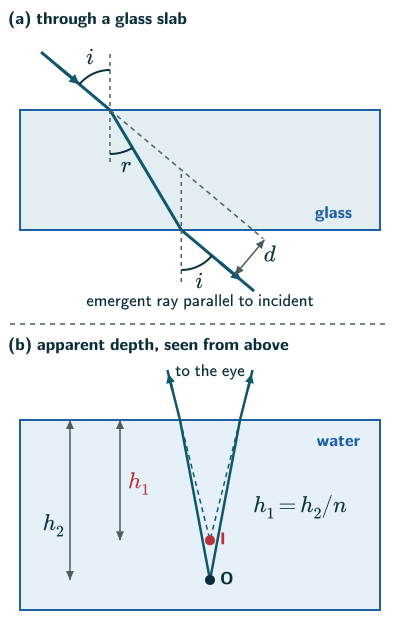
Real and apparent depth
- The bottom of a tank of water seems raised. Viewed near the normal, the apparent depth h1 is the real depth h2 divided by the refractive index of the medium (NCERT page 229, Figure 9.10):
Apparent depth (near-normal viewing)
- Why: a ray from the object O reaches the surface a small distance x from the point above O. In water it makes angle i with the normal, with tan i = x/h2; in air it leaves at angle r, and seems to come from a point at depth h1, with tan r = x/h1. For small angles tan ≈ sin ≈ the angle in radians, so h2/h1 ≈ sin r/sin i = n (reasoned from NCERT Eq. (9.10)).
- So the object seems raised by h2 − h1 = h2(1 − 1/n). A glass slab of thickness t likewise raises what is seen through it by t(1 − 1/n), wherever the slab sits between the eye and the object, for small angles (NCERT Exercise 9.16 and its answer, pages 250 and 347).
- NCERT gives this result only for viewing near the normal (page 229). Viewed at a slant, the bottom looks raised even more, because the apparent depth falls below h2/n as the viewing angle grows (reasoned from NCERT Eq. (9.10); NCERT’s Figure 9.10(b) does not draw this difference).
Solved examples
Example 1: A needle in a tank (NCERT Exercise 9.3)
A tank holds water 12.5 cm deep. A microscope finds the apparent depth of a needle on the bottom to be 9.4 cm. Find the refractive index of water. If the water is replaced by a liquid of refractive index 1.63 to the same height, by how much must the microscope move to focus on the needle again?
Answer: n = real depth/apparent depth = 12.5/9.4 ≈ 1.33. In the liquid the apparent depth is 12.5/1.63 ≈ 7.67 cm, so the needle seems higher, and the microscope must be raised by 9.4 − 7.67 ≈ 1.7 cm (NCERT Exercise 9.3, page 249; answer on page 346).
Example 2: A pin seen through a slab (NCERT Exercise 9.16)
A pin on a table is viewed from 50 cm above. By how much does it appear raised when a glass slab 15 cm thick (n = 1.5) is held parallel to the table between the eye and the pin? Does it depend on where the slab is?
Answer: the shift is t(1 − 1/n) = 15 × (1 − 1/1.5) = 5.0 cm, and it does not depend on where the slab is held, for small angles of incidence (NCERT Exercise 9.16, page 250; answer on page 347).
Example 3: From one medium to another (NCERT Exercise 9.4)
In NCERT Figure 9.27, a ray in air at 60° to the normal refracts to 35° in glass (a) and to the printed 47° in water (b); the answer key instead corresponds to about 41° in water. Find the angle of refraction in glass for a ray in water striking a water–glass boundary at 45° (c).
Answer using the printed 47°: nga = sin 60°/sin 35° ≈ 1.51 and nwa = sin 60°/sin 47° ≈ 1.18. Hence sin r = sin 45° × nwa/nga ≈ 0.555, giving r ≈ 33.7°, or about 34°. Using an alternative water angle of 41° instead gives r ≈ 38.2° (reasoned from NCERT Eq. (9.10); Exercise 9.4, page 249, and answer on page 346).
NCERT slip: NCERT’s Figure 9.27(b) prints the angle in water as 47°. Taken literally, that gives nwa = sin 60°/sin 47° ≈ 1.18, far below water’s 1.33, and r ≈ 34°. Keep the printed data when answering that version: it gives about 34°. If the water angle is instead taken as about 41°, the alternative result is about 38°, consistent with the answer key; state which data you use rather than silently changing them.
Example 4: Lateral shift
A ray strikes a glass slab 6.0 cm thick (n = 1.5) at 60°. Find the angle inside the glass and the lateral shift.
Answer: sin r = sin 60°/1.5 ≈ 0.577, so r ≈ 35.3°. The ray travels t/cos r inside and is displaced sideways by d = t sin(i − r)/cos r = 6.0 × sin 24.7°/cos 35.3° ≈ 3.1 cm (reasoned from NCERT Eq. (9.10) and Figure 9.9).
Common mistakes to avoid
Common mistake
Measuring angles from the surface
In Snell’s law i and r are the angles with the normal, not with the boundary (NCERT page 228).
Common mistake
Calling the denser liquid optically denser
Optical density is about the speed of light, not mass per volume: turpentine is lighter than water but optically denser (NCERT page 229).
Common mistake
Using h = h/n for oblique viewing
NCERT gives the result for viewing near the normal only (page 229); seen at a slant, the bottom looks raised even more (reasoned from NCERT Eq. (9.10)).
Quick revision summary
- Snell’s law: sin i/sin r = n21, with the angles from the normal and the two rays and the normal in one plane.
- n21 > 1: bends towards the normal (into a denser medium); n21 < 1: away from it. n21 = v1/v2, and optical density is not mass density.
- n12 = 1/n21 and n32 = n31 × n12.
- A parallel-sided slab with the same surrounding medium on both sides gives no angular deviation, only a lateral shift.
- Apparent depth near the normal: h1 = h2/n; a slab of thickness t raises an object by t(1 − 1/n).
Formula sheet
- sin i/sin r = n21
- n1 sin i = n2 sin r
- n12 = 1/n21
- n32 = n31 × n12
- apparent depth h1 = h2/n
- shift through a slab = t(1 − 1/n)
Questions students ask
Why is the refractive index greater than 1, and can it ever be less than 1?
The absolute refractive index, n = c/v, is greater than 1 for visible light in ordinary transparent materials, because light is slower in them than in vacuum; as a ratio of speeds it has no unit (dimensionless). For visible light in air near standard atmospheric pressure it is about 1.0003 (NCERT Science Class 10, Table 9.3, page 149; beyond the NCERT text, NIST gives 1.00027 for dry air at 20 °C). A relative index n21 is below 1 from a denser to a rarer medium, such as glass to air (NCERT pages 228–229). Beyond the NCERT text, X-rays meet an index just below 1 in matter (Center for X-Ray Optics, Berkeley Lab), though no signal then outruns c.
How does the refractive index depend on the wavelength of light?
In the normal-dispersion visible range of ordinary glass, the refractive index is larger for shorter wavelengths, so violet is bent more than red (NCERT Science Class 10, Chapter 10, page 167); NCERT Class 12 notes that n21 depends on the wavelength (page 228) but gives no values. Beyond the NCERT text, SCHOTT’s data for N-BK7 crown glass give n ≈ 1.530 at 405 nm (violet), 1.517 at 588 nm and 1.514 at 656 nm (red), so the critical angle is slightly smaller for violet. This spread, dispersion, gives thick lenses coloured images (NCERT page 248); white light split by a prism, and the rainbow, are now only in NCERT Science Class 10, Chapter 10 (pages 166–167).
What is the difference between apparent depth, normal shift and lateral shift?
Apparent depth, normal shift and lateral shift are three different lengths. Viewed near the normal, an object under a slab or liquid looks raised: the apparent depth is the real depth divided by n (NCERT page 229), and the normal shift is how far it seems raised, t(1 − 1/n) for a thickness t (reasoned from NCERT page 229). The lateral shift is the sideways gap between an oblique ray and the parallel ray leaving a slab, t sin(i − r)/cos r, zero at normal incidence (reasoned from NCERT Figure 9.9, page 229). For a slab 2.8 cm thick with n = 1.5, the normal shift is about 0.93 cm, while a ray meeting it at 70° is shifted sideways by about 1.86 cm.
Is real and apparent depth deleted from NCERT Class 12 and the JEE and NEET syllabus?
No, real and apparent depth is not deleted: the 2026–27 NCERT Class 12 Physics Part II keeps it at the end of Section 9.3 (page 229, Figure 9.10), stating that for viewing near the normal the apparent depth is the real depth divided by the refractive index, and NCERT Exercises 9.3 and 9.16 (pages 249–250) use it. It comes under “Refraction of light at plane and spherical surfaces” in Unit 16 of both the JEE Main syllabus and NEET (UG) 2026. Both syllabuses also list, as item 15 of Unit 20, the experiment built on it: the refractive index of a glass slab using a travelling microscope.
Who discovered Snell’s law of refraction?
Snell’s law is named after Willebrord Snell, who, NCERT says, obtained the laws of refraction by experiment (page 228). Beyond the NCERT text, Snell, a Dutch astronomer, found the law in 1621 but never published it, and Ibn Sahl, a mathematician in Baghdad, had used it around 984 to design lenses (Roshdi Rashed, Isis, 1990). Thomas Harriot had it in England around 1602, also unpublished, and René Descartes printed it in 1637 and made it widely known, hence the name Snell–Descartes law (Kwan, Dudley and Lantz, Physics World, 2002). Huygens later derived it from waves.
Practice questions
Try each question first, then open the answer to check your working.
-
Q1. Light goes from air into glass of refractive index 1.5 at an angle of incidence of 30°. Find the angle of refraction.
Show answerHide answer
sin r = sin 30°/1.5 = 0.333, so r ≈ 19.5° (NCERT Eq. (9.10), page 228).
-
Q2. The refractive index of glass with respect to air is 1.5. What is the refractive index of air with respect to glass?
Show answerHide answer
nag = 1/nga = 1/1.5 ≈ 0.67 (NCERT Eq. (9.11), page 229).
-
Q3. A coin lies at the bottom of a pool 2.0 m deep (n = 4/3). How deep does it look from directly above?
Show answerHide answer
h1 = h2/n = 2.0 × 3/4 = 1.5 m (NCERT page 229).