Experiment: angle of deviation against angle of incidence for a prism
Beyond NCERT In the JEE Main and NEET syllabus; the Class 12 book has no section for it.
Quick answer
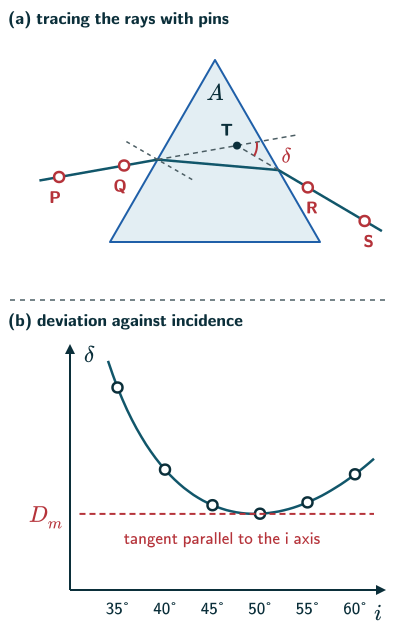
In the prism experiment, rays are traced through a glass prism with pins for angles of incidence from 35° to 60°: pins mark the incident and emergent rays, and the angle where the two lines, produced, meet is the deviation, δ = i + e − A. A smooth curve of δ against i has a flat minimum; the tangent parallel to the i axis at the lowest point gives the angle of minimum deviation Dm, where i = e (in an equilateral prism the ray inside then runs parallel to the base). Then n = sin[(A + Dm)/2]/sin(A/2).
What is this experiment?
The principle behind it
The deviation of a ray by a prism, δ = i + e − A, depends on the angle of incidence, and is least, Dm, when i = e (NCERT Section 9.6, pages 239–240). That is why the deviation is measured for many angles of incidence:
Thus, the angle of deviation depends on the angle of incidence.
NCERT Physics Part II (Class 12), Section 9.6, page 239
In the laboratory, rays are traced through the prism with pins for several angles of incidence, and the graph of δ against i gives Dm. With the prism angle A, NCERT Eq. (9.38) then gives the refractive index (NCERT page 240).
The aim is to find the angle of minimum deviation of a glass prism by plotting the angle of deviation against the angle of incidence.
Both the JEE Main 2027 and the NEET (UG) 2026 syllabuses list this under Unit 20, Experimental Skills, as item 14: “The plot of the angle of deviation vs angle of incidence for a triangular prism.” The method below follows the NCERT Laboratory Manual (Physics, Class 12), Experiment 13, pages 99–104.
Experimental scope: the usual 35°–60° range is suitable for an approximately 60° ordinary-glass prism in air; choose another range if the prism or material differs (reasoned). Use the same wavelength or colour for all comparisons, since the index is dispersive. The plotted sample readings below are illustrative, not real measurements.
Tracing rays through a prism with pins
- Fix a white sheet on a drawing board, draw a straight line XY on it, and draw normals to XY at points about 8 to 10 cm apart. Draw incident rays meeting the normals at 35°, 40°, 45°, 50°, …, 60°, measured with a protractor (Laboratory Manual, Experiment 13, page 100).
- Place the prism with its face AB on XY, the first point in the middle of AB, and draw round the prism with a sharp pencil (Laboratory Manual, page 100).
- Fix two pins P and Q upright on the incident ray, about 10 cm apart. Looking through the prism from the other side with one eye, fix two more pins R and S about 10 cm apart, so that their tips line up with the images of P and Q (Laboratory Manual, page 101).
- Remove the pins, join R and S to get the emergent ray, and produce it backwards to meet the incident ray produced forwards at T. The angle there is the angle of deviation δ; measure it, and the angle A of the prism, with the protractor (Laboratory Manual, page 101).
- Repeat for each angle of incidence and record i and δ in a table (Laboratory Manual, page 101).
- Take i from about 35° upwards (Laboratory Manual, page 103). Below a limiting angle the ray is totally reflected at the second face, because Snell’s law cannot be satisfied there. The limit is about 29° for n = 1.52 (Example 3), but about 35.6° for a denser glass with n = 1.60 (reasoned).
- Check each reading: measure the angle of emergence e too, and check that i + e = A + δ (NCERT Eq. (9.35); Laboratory Manual, pages 103–104).
- Laboratory Manual slip: page 103 lists as a source of error that if the three angles between adjacent pairs of faces are not equal, then A + δ ≠ i + e. As stated, that is not right: NCERT Eq. (9.35) holds for any prism, provided A is the angle between the two faces the light passes through. What does go wrong is taking A as 60° without measuring it, so measure the angle between the faces you use.
- Precautions (Laboratory Manual, page 102): keep the pins vertical; keep P and Q, and R and S, about 10 cm apart, which fixes each ray’s direction more accurately; use the same angle of the prism for all readings; do not disturb the prism during a set.
The i–δ graph and the minimum deviation
- Plot i along the x-axis and δ along the y-axis, and draw a smooth free-hand curve passing practically through all the plotted points. Draw the tangent at the lowest point parallel to the x-axis; where it meets the δ-axis is Dm (Laboratory Manual, page 102).
- The curve is not linear and has no sharp minimum: nearly the same deviation is found over a range of i near the minimum. So take extra readings there, for example every 1° or 2° from 45° to 55° (Laboratory Manual, page 103).
- At minimum deviation the ray passes through the prism symmetrically, with i = e and r = r′, and inside an equilateral prism the ray runs parallel to its base (Laboratory Manual, pages 100 and 103; NCERT page 240). The Laboratory Manual gives the advantage of this position: “the image is brightest in this position” (page 100). Strictly, brightness alone is not a universal test, because illumination, polarisation and absorption also matter (reasoned).
- From the measured A and Dm, the refractive index is n = sin[(A + Dm)/2]/sin(A/2) (NCERT Eq. (9.38), page 240; Laboratory Manual, page 104).
Refractive index from the experiment (NCERT Eq. 9.38)
Solved examples
Example 1: Reading the minimum
For a 60° prism the readings (i, δ) are (35°, 43.8°), (40°, 40.6°), (45°, 39.3°), (50°, 38.9°), (55°, 39.4°) and (60°, 40.5°). Estimate Dm and the refractive index.
Answer: the lowest points lie near i = 50°, where the smooth curve flattens at about 38.9°: Dm ≈ 38.9°. Then (A + Dm)/2 ≈ 49.45° and A/2 = 30°, so n = sin 49.45°/sin 30° ≈ 1.52 (NCERT Eq. (9.38), page 240; method of the Laboratory Manual, page 102).
Example 2: Checking a reading
At i = 40° the emergent ray of a 60° prism is measured at e = 60.6°. What deviation should the protractor show?
Answer: δ = i + e − A = 40° + 60.6° − 60° = 40.6°; a very different protractor reading means an error in tracing (NCERT Eq. (9.35), page 239; Laboratory Manual, page 103).
Example 3: Why start at 35°?
For a 60° prism of n = 1.52, what is the smallest angle of incidence for which light still leaves the second face?
Answer: at the second face r2 must stay below the critical angle, sin−1(1/1.52) ≈ 41.1°. Then r1 = 60° − 41.1° ≈ 18.9°, and sin i = 1.52 sin 18.9° ≈ 0.49, so i ≈ 29.4°. Below this the ray is totally reflected inside; 35° keeps clear of the limit for ordinary glass, but for n = 1.60 the limit is about 35.6° (reasoned from NCERT Eqs. (9.12) and (9.34)).
Example 4: Two angles, one deviation
In the readings of Example 1, which other angle of incidence should give the same deviation as i = 40°?
Answer: the angle of emergence at i = 40°, about 60.6°: tracing the ray backwards swaps i and e and gives the same δ, 40.6°, close to the reading of 40.5° at i = 60° (NCERT pages 239–240).
Common mistakes to avoid
Common mistake
Joining the plotted points with straight lines
The i–δ curve is smooth and non-linear; draw a smooth curve, and take more readings near the minimum (Laboratory Manual, pages 102–103).
Common mistake
Measuring δ between the wrong lines
δ is the angle between the incident ray produced forwards and the emergent ray produced backwards, measured where they meet at T (Laboratory Manual, pages 99 and 101).
Common mistake
Starting with small angles of incidence
Near the limiting angle (about 29° for n = 1.52, more for denser glass) the emergent ray grazes the face and is faint; below it the ray does not emerge (reasoned; Laboratory Manual, page 103).
Quick revision summary
- Trace incident and emergent rays with pins about 10 cm apart, for i from 35° to 60°; produce them to meet at T and measure δ.
- Check readings with i + e = A + δ; avoid small i, where the ray is totally reflected inside.
- Plot δ against i: a smooth curve with a flat minimum; the tangent parallel to the i axis at the lowest point gives Dm.
- At minimum deviation i = e (in an equilateral prism the ray inside is parallel to the base); then n = sin[(A + Dm)/2]/sin(A/2).
Formula sheet
- δ = i + e − A
- n = sin[(A + Dm)/2]/sin(A/2)
Questions students ask
Is the prism experiment in the NCERT textbook and the JEE and NEET syllabus?
Yes, the plot of the angle of deviation against the angle of incidence for a triangular prism is item 14 of Unit 20, Experimental Skills, in both the JEE Main syllabus and NEET (UG) 2026, whose Unit 20 asks for “Familiarity with the basic approach and observations of the experiments and activities”. The NCERT Class 12 textbook gives only the theory, δ = i + e − A and a sketch of the curve (Section 9.6, pages 239–240, Figure 9.22 on page 240); it has no section on the method. The pin-tracing method, table and graph are in Experiment 13 of the NCERT Laboratory Manual (Physics, Class 12), pages 99–104.
Is the graph of angle of deviation against angle of incidence a parabola?
No, the graph of the angle of deviation against the angle of incidence for a prism is a smooth U-shaped curve with one minimum, but it is not a parabola: it is lopsided, falling steeply from the smallest angle of incidence at which light emerges and rising slowly towards grazing incidence. For a 60° prism with n = 1.58, Snell’s law at both faces gives Dm ≈ 44.4° at i ≈ 52.2°; the curve starts at i ≈ 34.0° and ends at i = 90°, both with δ ≈ 64.0°, so it falls about 20° over 18° of i but takes 38° to climb back (reasoned from NCERT Eqs. (9.34)–(9.35)). In MCQs, pick the smooth curve with a single rounded minimum.
Can the prism experiment find the refractive index of a liquid?
Yes, the NCERT Laboratory Manual suggests finding the refractive index of liquids with a hollow prism, by plotting the same i–δ graph (Experiment 13, page 104). Each thin glass wall has parallel faces. At an entry wall, Snell’s law gives n_air sin i = n_glass sin r_glass = n_liquid sin r_liquid: the glass index cancels, leaving the same net angular refraction as an air–liquid interface, though there is a small lateral shift. Similarly at exit, the angular deviation is that of the liquid prism in the thin-wall model; n = sin[(A + Dm)/2]/sin(A/2) then gives the liquid’s index (reasoned from NCERT Eq. (9.38)). For water (n = 1.33) in a 60° hollow prism, the minimum is about 23.4° at i ≈ 41.7°, and light emerges for angles of incidence down to about 15°, so smaller angles than the 35° used for glass can be traced.
Can the refractive index be found from a single traced ray, without the graph?
Yes, the refractive index can be found from one traced ray: join the points where the ray enters and leaves the prism to draw its path inside, measure the angle of refraction r at the first face and r′ at the second, and use n = sin i/sin r = sin e/sin r′, as the NCERT Laboratory Manual suggests (Experiment 13, page 104). With i = 55° and a measured r of 32.5°, n = sin 55°/sin 32.5° ≈ 1.52. The minimum-deviation method needs only A and Dm, each deviation measured between rays fixed by pins about 10 cm apart, whereas r is read on the short line joining the entry and exit points (reasoned).
How accurate is the refractive index found in the prism experiment?
For the following 60°-prism example, assigning about ±1° uncertainty to each angle gives a refractive-index uncertainty of order ±0.01 to ±0.02; this is an estimate for the stated geometry, not a universal accuracy guarantee (reasoned from NCERT Eq. (9.38)). For a 60° prism with Dm = 38°, n ≈ 1.51; an error of 1° in Dm changes n by about 0.011, and an error of 1° in A by about the same amount the other way, so at worst the two add to about 0.02. That is why the NCERT Laboratory Manual asks for Dm with its uncertainty and proper significant figures (Experiment 13, page 102), and why extra readings near the flat minimum help (page 103).
Practice questions
Try each question first, then open the answer to check your working.
-
Q1. How is the angle of minimum deviation read from the i–δ graph?
Show answerHide answer
Draw the tangent at the lowest point of the curve parallel to the i axis; its value on the δ axis is Dm (Laboratory Manual, Experiment 13, page 102).
-
Q2. A 60° prism gives Dm = 37.2°. Find its refractive index.
Show answerHide answer
n = sin 48.6°/sin 30° ≈ 0.750/0.5 = 1.50 (NCERT Eq. (9.38), page 240).
-
Q3. Why are the two pins on each ray placed about 10 cm apart?
Show answerHide answer
Two points far apart fix the direction of a line more accurately than two points close together (Laboratory Manual, page 102).