Refraction at spherical surfaces and by lenses
NCERT Class 12 Physics Chapter 9 Section 9.5
Quick answer
The lens maker’s formula, 1/f = (n21 − 1)(1/R1 − 1/R2), gives the focal length of a thin lens from its refractive index relative to the surrounding medium and the radii of its two faces; the thin lens formula, 1/v − 1/u = 1/f, then locates the image, for convex and concave lenses and for real and virtual images. Both come from applying n2/v − n1/u = (n2 − n1)/R, refraction at one spherical surface, to each face in turn. The magnification is m = h′/h = v/u, the power is P = 1/f in dioptres, and for thin lenses in contact powers add, P = P1 + P2 + P3 + ….
With your textbook
NCERT Physics Part II (Class 12), Chapter 9 “Ray Optics and Optical Instruments”, Section 9.5 “Refraction at Spherical Surfaces and by Lenses”, pages 232–239.
Open the official NCERT chapter (PDF, 3.4 MB, ncert.nic.in) (opens in a new tab)
Checked against the 2026-27 reprint on .
What is refraction at spherical surfaces and by lenses?
Refraction at spherical surfaces and by lenses
A small part of a curved surface acts like a flat one, so the laws of refraction apply at every point, with the normal through the centre of curvature (NCERT Section 9.5, page 232). One curved surface gives n2/v − n1/u = (n2 − n1)/R; applying it twice gives the lens maker’s formula and then the thin lens formula, 1/v − 1/u = 1/f (NCERT Eqs. (9.16), (9.21) and (9.23), pages 233–235):
Though we derived it for a real image formed by a convex lens, the formula is valid for both convex as well as concave lenses and for both real and virtual images.
NCERT Physics Part II (Class 12), Section 9.5.2, page 235
The power of a lens is P = 1/f, in dioptres, and thin lenses in contact add their powers (NCERT Eqs. (9.25) and (9.32), pages 236–238).
In plain words: a lens has two refracting surfaces close together, at least one curved. The first bends the light and makes an image; the second takes that image as its object and bends the light again. Doing the sum for both surfaces at once gives one formula for the focal length, from the glass and the curves, and one formula for where the image forms.
Scope and signs: paraxial rays, thin lenses, homogeneous isotropic materials, and the same surrounding medium on both sides of a lens. Distances are Cartesian-signed. Convex/converging and concave/diverging are interchangeable only when the lens index is greater than the surrounding index. Optical invisibility at matched index additionally assumes negligible absorption, surface defects and wavelength mismatch.
Refraction at a spherical surface
- Light goes from a medium of index n1 into one of index n2 across a spherical surface of radius R and centre C, from an object O on the axis to an image I (NCERT Section 9.5.1, pages 232–233, Figure 9.15). The aperture is small, so all the angles are small.
- With N the point where the ray meets the surface and M the foot of the perpendicular from N, the exterior angle of triangle NOC gives i = MN/OM + MN/MC, and similarly r = MN/MC − MN/MI (NCERT Eqs. (9.13)–(9.14), pages 232–233), using tan θ ≈ θ for small angles in radians.
- Snell’s law for small angles, n1i = n2r, then gives n1/OM + n2/MI = (n2 − n1)/MC (NCERT Eq. (9.15)). With the Cartesian signs OM = −u, MI = +v and MC = +R (NCERT Eq. (9.16), page 233):
Refraction at a spherical surface (NCERT Eq. 9.16)
- It holds for any curved spherical surface (NCERT page 233). By the Cartesian sign convention (NCERT Section 9.2.1, page 222), R is positive when the centre of curvature is on the side the light goes to.
Refraction by a lens
- A thin lens is a transparent medium bounded by two surfaces, at least one of them spherical, so thin that its thickness can be neglected (NCERT pages 232 and 234).
- Image formation by a double convex lens (index n2, in a medium of index n1) takes two steps. The first surface forms an image I1 of the object O; in the pictured configuration I1 acts as a virtual object for the second surface, which forms the final image I (NCERT Section 9.5.2, page 234, Figure 9.16; Eqs. (9.17)–(9.18)).
- For a thin lens, BI1 = DI1, and adding the two equations gives NCERT Eq. (9.19). For an object at infinity the image is at the focus, and its distance from the lens is the focal length f (NCERT Eq. (9.20), page 234). A lens has two foci, F and F′, one on each side, equally far from the optical centre (NCERT pages 234–235).
Lens maker’s formula
- With the signs BC1 = +R1 and DC2 = −R2, NCERT Eq. (9.20) becomes the lens maker’s formula (NCERT Eq. (9.21), page 234), where n21 = n2/n1:
Lens maker’s formula (NCERT Eq. 9.21)
- It is used to design lenses of a chosen focal length from surfaces of suitable radii. It holds for a concave lens too: for a double-concave lens R is negative and R positive; f is negative when the lens index exceeds the surrounding index (NCERT page 234).
- Special cases (reasoned from NCERT Eq. (9.21)): a plano-convex lens has one radius infinite, so f = R/(n21 − 1), which is 2R for n21 = 1.5; a convex lens in a liquid of higher refractive index (n21 < 1) has a negative f and diverges light; an equiconvex lens cut along its axis gives two halves of the same f, but cut across its axis gives two plano-convex lenses of focal length 2f each.
- The focal length depends on the surrounding medium through n21. If the lens has the same index as the liquid around it, n21 = 1, 1/f = 0 and the lens acts like a plane sheet: it seems to vanish (NCERT Example 9.6, page 236).
Thin lens formula and magnification
- Combining NCERT Eqs. (9.19) and (9.20) (NCERT Eq. (9.22)) and using BO = −u and DI = +v for a thin lens gives the thin lens formula (NCERT Eq. (9.23), page 235):
Thin lens formula (NCERT Eq. 9.23)
- It holds for convex and concave lenses and for real and virtual images (NCERT page 235). The focus on the side of the incoming light is the first focal point; the other is the second focal point (NCERT page 235).
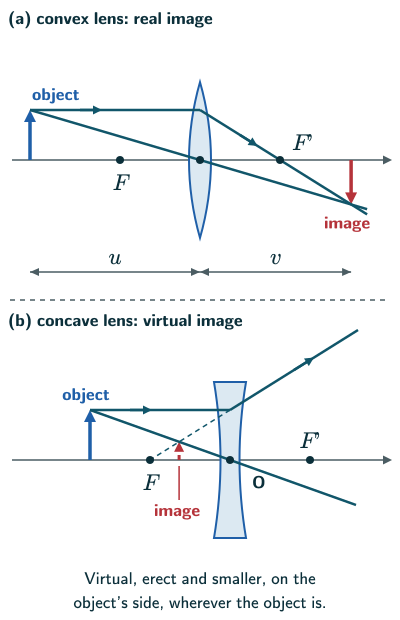
- To locate an image, use two of these rays (NCERT page 235, Figure 9.17): a ray parallel to the axis passes, after refraction, through the second focus F′ of a convex lens, or seems to diverge from the first focus F of a concave lens; a ray through the optical centre goes on undeviated; a ray through the first focus of a convex lens (or aimed at the second focus of a concave lens) emerges parallel to the axis.
- The magnification of a lens is the ratio of image size to object size (NCERT Eq. (9.24), page 236):
Magnification of a lens (NCERT Eq. 9.24)
- For a real object, an erect image is virtual with a positive m, and an inverted image is real with a negative m (NCERT page 236). In general the sign of m tells only erect (+) or inverted (−): with a virtual object, as in Q3 and the extra Q7, a real image is erect. Note the sign: for a mirror m = −v/u, for a lens m = +v/u.
Power of a lens
- The power P of a lens measures how much it converges or diverges light. For a paraxial ray entering parallel to the axis at height h, the small deflection angle satisfies δ ≈ h/f in radians, so power is the deflection per unit ray height, P ≈ δ/h = 1/f (NCERT Section 9.5.3, page 236, Figure 9.18):
Power of a lens (NCERT Eq. 9.25)
- The SI unit is the dioptre (D): 1 D = 1 m−1, with f in metres. Power is positive for a converging lens and negative for a diverging one: a +2.5 D lens is convex with f = +40 cm, and a −4.0 D lens is concave with f = −25 cm (NCERT page 236).
Combination of thin lenses in contact
- For two thin lenses A and B in contact, the image I1 formed by A serves as the object for B. Adding the lens equations for the two (NCERT Eqs. (9.27)–(9.29), page 237) and comparing with a single lens of focal length f gives (NCERT Eqs. (9.30)–(9.31), pages 237–238):
Lenses in contact (NCERT Eq. 9.31)
- In powers this is P = P1 + P2 + P3 + … (NCERT Eq. (9.32), page 238), an algebraic sum: convex lenses count positive and concave lenses negative.
- Because each image is the object for the next lens, the total magnification is the product, m = m1m2m3… (NCERT Eq. (9.33), page 238). Combinations are used in cameras, microscopes and telescopes to get the desired magnification and a sharper image (NCERT page 238).
- NCERT slip: page 238 says “Eq. (9.25) implies” the product rule for magnification; Eq. (9.25) is P = 1/f. The rule follows from the magnification formula, NCERT Eq. (9.24).
Solved examples
Example 1: A single curved surface (NCERT Example 9.5)
A point source in air is 100 cm from a spherical glass surface, convex towards the source (n = 1.5, radius of curvature 20 cm, centre on the glass side). Where is the image?
Answer: u = −100 cm, R = +20 cm, n1 = 1, n2 = 1.5: 1.5/v + 1/100 = 0.5/20, so 1.5/v = 0.015 and v = +100 cm, in the glass, on the far side of the surface (NCERT Example 9.5, page 233).
Example 2: Power, lens maker and water (NCERT Example 9.7)
(i) Find the power of a lens with f = 0.5 m. (ii) A double convex lens has radii 10 cm and 15 cm and focal length 12 cm; find n. (iii) A convex glass lens (n = 1.5) has f = 20 cm in air; find f in water (n = 1.33).
Answer: (i) P = 1/0.5 = +2 D. (ii) With R1 = +10 cm and R2 = −15 cm, 1/12 = (n − 1)(1/10 + 1/15) = (n − 1)/6, so n = 1.5. (iii) In air 1/20 = 0.5 K, where K = 1/R1 − 1/R2; in water 1/f = (1.5/1.33 − 1)K. Dividing, f ≈ 78.2 cm (NCERT Example 9.7, pages 236–237). NCERT slip: part (ii) says it uses “the lens formula of Eq. (9.22)”, but the working uses the lens maker’s formula, NCERT Eq. (9.21).
Example 3: Three lenses (NCERT Example 9.8)
An object is 30 cm in front of a convex lens of focal length 10 cm. A concave lens of focal length 10 cm is 5 cm behind it, and a convex lens of focal length 30 cm is 10 cm beyond that (NCERT Figure 9.20). Find the final image.
Answer: first lens: 1/v1 = 1/10 − 1/30, so v1 = 15 cm. This is 10 cm beyond the second lens, a virtual object: 1/v2 = −1/10 + 1/10 = 0, so v2 = ∞ and the light leaves parallel. The third lens brings parallel light to its focus: v3 = 30 cm to its right (NCERT Example 9.8, pages 238–239).
Example 4: A concave lens (NCERT Exercise 9.9)
An object 3.0 cm tall is 14 cm in front of a concave lens of focal length 21 cm. Describe the image.
Answer: 1/v = 1/f + 1/u = −1/21 − 1/14 = −5/42, so v = −8.4 cm, on the object’s side; m = v/u = 0.6, so the image is virtual, erect and 1.8 cm tall. As the object moves away, the image moves towards the focus but never beyond it, and shrinks (NCERT Exercise 9.9, page 249; answer on page 346). NCERT’s answer on page 346 prints v = 8.4 cm; with Cartesian signs it is −8.4 cm.
Example 5: Two lenses in contact (NCERT Exercise 9.10)
A convex lens of focal length 30 cm is in contact with a concave lens of focal length 20 cm. Find the focal length of the combination. Is it converging or diverging?
Answer: 1/f = 1/30 − 1/20 = −1/60, so f = −60 cm: a diverging lens (NCERT Exercise 9.10, page 250; answer on page 346).
Common mistakes to avoid
Common mistake
Using the mirror sign for a lens’s magnification
For a lens m = v/u; for a mirror m = −v/u (NCERT Eqs. (9.9) and (9.24)).
Common mistake
Forgetting the sign of R<sub>2</sub>
In the lens maker’s formula, a double convex lens has R1 positive and R2 negative, so 1/R1 − 1/R2 adds the two curvatures (NCERT page 234; Example 9.7).
Common mistake
Adding focal lengths of lenses in contact
Add powers, or reciprocals of focal lengths, with their signs: 1/f = 1/f1 + 1/f2 (NCERT Eq. (9.30), page 238).
Common mistake
Expecting a lens to keep its focal length in water
f depends on n21: a glass lens of 20 cm in air has a focal length of about 78 cm in water (NCERT Example 9.7, page 237).
Quick revision summary
- One spherical surface: n2/v − n1/u = (n2 − n1)/R, for small angles, with Cartesian signs.
- Lens maker’s formula 1/f = (n21 − 1)(1/R1 − 1/R2); a concave lens in a lower-index surrounding medium has negative f.
- Thin lens formula 1/v − 1/u = 1/f for every lens and image; magnification m = h′/h = v/u, positive for erect and negative for inverted; the virtual/real association assumes a real object.
- Power P = 1/f in dioptres (f in metres), positive for converging lenses.
- Lenses in contact: 1/f = 1/f1 + 1/f2 + …, P = P1 + P2 + …, m = m1m2m3….
Formula sheet
- n2/v − n1/u = (n2 − n1)/R
- 1/f = (n21 − 1)(1/R1 − 1/R2)
- 1/v − 1/u = 1/f
- m = h′/h = v/u
- P = 1/f
- 1/f = 1/f1 + 1/f2 + 1/f3 + …
- P = P1 + P2 + P3 + …
- m = m1 m2 m3 …
Questions students ask
What is the difference between the lens formula and the lens maker’s formula?
The lens maker’s formula, 1/f = (n21 − 1)(1/R1 − 1/R2), finds a thin lens’s focal length from its refractive index and the radii of its faces, while the lens formula, 1/v − 1/u = 1/f, uses that focal length to find where the image of an object forms. So the first describes the lens and the second what the lens does with an object; both come from applying NCERT Eq. (9.16) to the two faces in turn (NCERT pages 233–235). The lens maker’s formula is named for its use: NCERT says it “is useful to design lenses of desired focal length using surfaces of suitable radii of curvature” (page 234).
Why are the focal length and power of a concave lens negative?
The focal length and power of a concave lens are negative because of the Cartesian sign convention, which records a direction, not a size: distances are measured from the optical centre, positive along the incident light, and a concave lens makes parallel light diverge as if from a focus on the side the light comes from, so f is measured against the light (NCERT pages 222 and 235). The lens maker’s formula agrees, since a concave lens has R1 negative and R2 positive (NCERT page 234), and P = 1/f carries the sign over. So −1.25 D means a diverging lens of f = −80 cm, while a convex lens, with its second focus beyond it, has positive f and P.
What does the focal length of a lens depend on?
The focal length of a thin lens depends on the radii of curvature of its faces and on n21, its refractive index relative to the surrounding medium, not on where the object is (NCERT Eq. (9.21), page 234). So it changes in another medium, as in NCERT Example 9.7, and with colour, since n21 depends on the wavelength (NCERT page 228; index and wavelength). Beyond the NCERT text, with SCHOTT’s N-BK7 indices, a 36.0 cm lens for yellow light (n = 1.517) has 35.1 cm for violet (1.530) and 36.2 cm for red (1.514), the chromatic aberration of NCERT page 245. A mirror’s f = R/2 depends on neither (reasoned).
What is the focal length of two thin lenses separated by a distance?
Two thin lenses of focal lengths f1 and f2, a distance d apart, have an equivalent focal length F, with 1/F = 1/f1 + 1/f2 − d/(f1f2) (NCERT Laboratory Manual, Experiment 12, page 98); for d = 0 it is the rule for lenses in contact. In general F is measured from a principal plane of the combination, rather than from either lens: convex lenses of 45 cm and 24 cm, 9 cm apart, give F = 18 cm, yet parallel light focuses 14.4 cm beyond the second lens (reasoned). NCERT’s answer to Exercise 9.20 (page 347) therefore says the notion “does not seem to be meaningful”, and images are found lens by lens with 1/v − 1/u = 1/f, as in NCERT Example 9.8.
What is the difference between magnification and power of a lens?
The power of a lens, P = 1/f in dioptres, is a property of the lens in a given medium, while its magnification, m = v/u, depends on where the object is placed, so one lens gives many magnifications (NCERT Eqs. (9.24)–(9.25), page 236). A +8 D lens (f = 12.5 cm) gives m = −1/3, a real, inverted image a third the size, for an object 50 cm away, but m = +5, a virtual, erect image, for one 10 cm away. Neither is the magnifying power of a microscope or telescope, which compares angles, not sizes.
How does the focal length of a thick lens differ from that of a thin lens?
A thick lens obeys the thin lens formulas only roughly, because their derivation neglects the thickness (NCERT page 234 takes BI1 = DI1); the NCERT Laboratory Manual asks this as a self-assessment question (Experiment 10, page 84). Applying NCERT Eq. (9.16) at each face of a glass sphere, the extreme thick lens, of radius 1.0 cm and n = 1.5, brings parallel light to a focus 0.5 cm beyond its back surface, 1.5 cm from its centre, while the lens maker’s formula, f = R = 1.0 cm, would put it at the back surface (reasoned). For an ordinary lens whose thickness is small compared with the relevant curvature and optical distance scales, the difference is small, which is why the thin lens formulas work on the optical bench.
Practice questions
Try each question first, then open the answer to check your working.
-
Q1. Double-convex lenses are to be made from glass of refractive index 1.55, with both faces of the same radius. What radius gives a focal length of 20 cm?
Show answerHide answer
1/20 = 0.55 × (2/R), so R = 22 cm (NCERT Exercise 9.7, page 249; answer on page 346).
-
Q2. An optician prescribes a lens of power −2.0 D. What kind of lens is it, and what is its focal length?
Show answerHide answer
A concave (diverging) lens with f = 1/P = −0.50 m = −50 cm (NCERT Eq. (9.25), page 236).
-
Q3. A beam converging to a point P meets a convex lens of focal length 20 cm placed 12 cm before P. Where does it now converge?
Show answerHide answer
P is a virtual object: u = +12 cm. 1/v = 1/20 + 1/12 = 2/15, so v = 7.5 cm to the right of the lens (NCERT Exercise 9.8(a), page 249; answer on page 346).