Experiment: focal length of mirrors and a lens by the parallax method
Beyond NCERT In the JEE Main and NEET syllabus; the Class 12 book has no section for it.
Quick answer
In the focal length of concave mirror and convex lens experiments, each real image is located on an optical bench with a pin, moved until there is no parallax between pin and image. With the object between f and 2f, f = uv/(u + v) from the distances as magnitudes, averaged over the readings; for a convex lens a 1/u–1/v graph is a straight line with intercepts 1/f. A convex mirror’s image is virtual, so a convex lens makes the rays strike it normally: the lens’s image then lies at the mirror’s centre of curvature C, and f = R/2 = PC/2, P being the pole.
What is this experiment?
The principle behind it
For a spherical mirror, 1/v + 1/u = 1/f, and for a thin lens, 1/v − 1/u = 1/f (NCERT Eqs. (9.7) and (9.23)). NCERT stresses that the mirror equation covers every case once the signs are used properly (NCERT Section 9.2.3, page 226):
With the proper use of sign convention, these are, in fact, valid for all the cases of reflection by a spherical mirror (concave or convex) whether the image formed is real or virtual.
NCERT Physics Part II (Class 12), Section 9.2.3, page 226
So measuring the object distance u and the image distance v gives f. On an optical bench the image is found by moving a second pin until there is no parallax between the pin and the image.
The aim is to find the focal lengths of a concave mirror, a convex mirror and a convex lens on an optical bench, locating each image by the parallax method.
The JEE Main 2027 syllabus lists this under Unit 20, Experimental Skills, as item 13: “The focal length of (i) Convex mirror (ii) Concave mirror and (iii) Convex lens, using the parallax method.” The NEET (UG) 2026 syllabus has the same item 13 in its Unit 20. The methods below follow the NCERT Laboratory Manual (Physics, Class 12), Experiments 9, 10 and 11, pages 69–91.
Conventions: bench formulas and graphs use positive distance magnitudes and report |f| for the concave mirror; its Cartesian focal length is negative. The optical model is paraxial, with a thin lens. Error sums below are conservative bounds, not statistical standard deviations, and the assigned distance errors must include reading, index-correction and focusing uncertainty.
Locating an image by removing parallax
- Parallax: look at an image and a pin while moving your eye to the left and right. If they are at different places along the bench, they seem to move relative to each other; if they are at the same place, they move together. Moving the pin until this relative motion stops locates the image: this is the method of parallax (Laboratory Manual, Experiment 9, page 70). If they still separate, the one that shifts with your eye is the farther one; move the image pin towards the image until the two shift together (reasoned from the method of parallax).
- The tip of the image should just touch the tip of the image pin, not overlap it, and the eye should be about 25 cm or more from the image pin (Laboratory Manual, pages 75 and 83–84).
- Index correction: the distance between two uprights on the scale is not exactly the distance between the pin’s tip and the mirror’s pole (or the lens’s optical centre). Measure an index needle that touches both, compare its length with the difference of the upright readings, and add the difference, e = actual − observed, to every distance measured with that pin; the object pin and the image pin each have their own e (Laboratory Manual, pages 69 and 73–74). For a lens, the actual distance to the optical centre is the needle’s length plus half the lens’s thickness (Laboratory Manual, Experiment 10, page 80).
- Set the bench horizontal with a spirit level, and bring the pin tips to the height of the mirror’s pole or the lens’s optical centre (Laboratory Manual, pages 73 and 80).
Concave mirror
- Find a rough focal length first by focusing a distant building or tree onto a wall or paper (Laboratory Manual, Experiment 9, page 73).
- Place the object pin between F and the centre of curvature C. The image is then real, inverted and magnified, beyond C, and easy to locate with the image pin by removing parallax (Laboratory Manual, pages 72–73).
- Record u and v for at least five object positions and apply the index corrections (Laboratory Manual, pages 73–74). With both distances as positive magnitudes, f = uv/(u + v); in Cartesian signs this is the mirror equation, NCERT Eq. (9.7), with u, v and f all negative (Laboratory Manual, page 72).
- Work out f for each pair and then average the values of f; do not put the mean u and mean v into the formula (Laboratory Manual, page 75).
- Conservative first-order maximum-error estimate: from 1/f = 1/u + 1/v, by the rules for combining errors, Δf/f2 = Δu/u2 + Δv/v2 (Laboratory Manual, page 75).
- Sources of error: a bench that is not level, pin tips and pole at different heights, and multiple reflections from a mirror that is not front-coated (Laboratory Manual, page 76).
Convex mirror
- A convex mirror forms a virtual, erect image of a real object, so its focal length cannot be found directly; a convex lens is put between the object and the mirror (Laboratory Manual, Experiment 11, page 86).
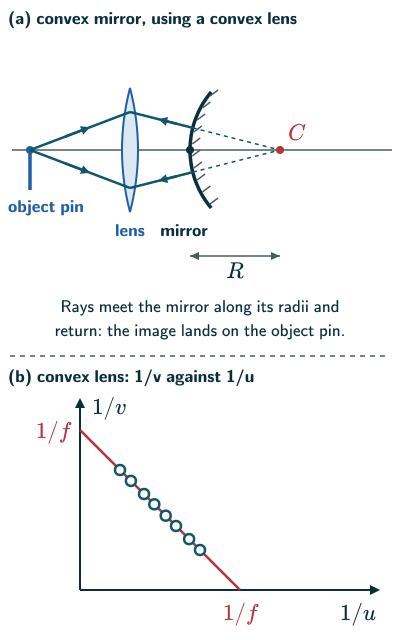
- Method: the convex lens forms a real, inverted image of the object pin at a point C. Place the convex mirror between the lens and C and move it until the reflected light forms an image on the object pin itself. Then the rays strike the mirror normally and retrace their paths, so C is the mirror’s centre of curvature (Laboratory Manual, pages 86–88).
- Remove the mirror and find C with the image pin by removing parallax. The distance from the mirror’s pole P to C is the radius of curvature, so f = R/2 = PC/2 (Laboratory Manual, pages 87–89).
- The lens must suit the mirror: the mirror has to fit between the lens and C, with PC = R, so the lens must form its image more than R beyond itself, within the length of the bench. That is why a lens of very short or very long focal length does not work well (reasoned from the Laboratory Manual’s discussion, page 90).
Convex lens
- Find a rough focal length by focusing a distant object. Place the object pin a little inside 2f from the lens, between f and 2f; the real, inverted image forms beyond 2f on the other side. Locate it with the image pin by removing parallax, and take at least six sets of readings (Laboratory Manual, Experiment 10, pages 79–81).
- In magnitudes, 1/f = 1/v + 1/u, so f = uv/(u + v); this is the thin lens formula, NCERT Eq. (9.23), with u negative (Laboratory Manual, pages 78–79).
- u–v graph: a rectangular hyperbola with asymptotes u = f and v = f (reasoned from 1/u + 1/v = 1/f). It meets the line u = v at u = v = 2f (Laboratory Manual, page 82).
- 1/u–1/v graph: a straight line of negative slope, cutting both axes at 1/f (Laboratory Manual, pages 79 and 83); its slope is −1, so it lies at 45° when both axes have the same scale (reasoned).
- u and v are interchangeable (the object and image are conjugate points), so six readings with the object between f and 2f give twelve plotted points on each graph, but only six independently measured pairs (Laboratory Manual, pages 80 and 82).
Solved examples
Example 1: A concave mirror and its error
For a concave mirror the corrected distances are u = 24.0 cm and v = 40.0 cm, each to ±0.1 cm. Find f and its uncertainty.
Answer: f = uv/(u + v) = 960/64 = 15.0 cm. Δf = f2(Δu/u2 + Δv/v2) = 225 × (0.1/576 + 0.1/1600) ≈ 0.05 cm, so f = 15.00 ± 0.05 cm (reasoned from the Laboratory Manual, pages 72 and 75).
Example 2: Reading the 1/u–1/v graph
The straight line of a convex-lens experiment cuts both axes at 0.050 cm−1. Find the focal length, and where the u–v hyperbola crosses the line u = v.
Answer: 1/f = 0.050 cm−1, so f = 20 cm; the hyperbola crosses u = v at u = v = 2f = 40 cm (Laboratory Manual, pages 82–83).
Example 3: A convex mirror with a lens
With the mirror in place and the image on the object pin, the mirror’s upright reads 70.0 cm. With the mirror removed, the image pin at C reads 90.0 cm, and the index correction is −0.2 cm. Find f.
Answer: the Laboratory Manual writes R′ = c − d from the mirror and image-pin readings (page 89); its size here is 90.0 − 70.0 = 20.0 cm; corrected R = 20.0 − 0.2 = 19.8 cm; f = R/2 = 9.9 cm (Laboratory Manual, Experiment 11, page 89).
Example 4: Why average f, not u and v
Two readings for a concave mirror are (u, v) = (18 cm, 90 cm) and (25 cm, 37.5 cm). Find f properly, and from the mean u and mean v.
Answer: each pair gives f = 1620/108 = 15 cm and 937.5/62.5 = 15 cm, so f = 15 cm. The means, 21.5 cm and 63.75 cm, give 1370.6/85.25 ≈ 16.1 cm, which is wrong: f is not a linear function of u and v (Laboratory Manual, page 75).
Common mistakes to avoid
Common mistake
Averaging u and v before finding f
Find f for each pair of readings and average the values of f (Laboratory Manual, page 75).
Common mistake
Leaving out the index correction
The upright readings are not the pin-to-pole distances; add the index correction, and for a lens include half its thickness (Laboratory Manual, pages 74 and 80).
Common mistake
Trying to catch a convex mirror’s image on the bench
Its image of a real object is virtual; use a convex lens to find its centre of curvature (Laboratory Manual, page 86).
Quick revision summary
- Images are located on an optical bench by removing parallax between the image and a pin.
- Concave mirror and convex lens: with magnitudes, f = uv/(u + v); take the object between f and 2f, average f over the readings, and apply index corrections.
- Convex mirror: a convex lens makes the rays strike the mirror normally; the lens image at C is the centre of curvature, and f = R/2 = PC/2.
- Convex lens graphs: u–v is a hyperbola meeting u = v at 2f; 1/u–1/v is a straight line with intercepts 1/f.
- Error: Δf/f2 = Δu/u2 + Δv/v2.
Formula sheet
- f = uv/(u + v)
- convex mirror: f = R/2 = PC/2
- Δf/f2 = Δu/u2 + Δv/v2
Questions students ask
Is the parallax method in the JEE Main and NEET syllabus, or was it deleted from Class 11?
Yes, the parallax method is in both syllabuses, but only as this optical-bench method: item 13 of Unit 20, Experimental Skills, of the JEE Main syllabus and of NEET (UG) 2026 asks for the focal length of a convex mirror, a concave mirror and a convex lens “using the parallax method”. The parallax method for the distances of planets and stars, taught in older editions (NCERT Class 11 Physics, Chapter 2, Section 2.3.1, 2021–22 reprint), is not in the current Class 11 Chapter 1, Units and Measurement, and neither syllabus names it. The NCERT Class 12 textbook has no section on the optical-bench method either; it is in the NCERT Laboratory Manual (Physics, Class 12), Experiment 9, page 70.
How do you find the focal length of a concave lens on an optical bench?
The focal length of a concave lens can be found with a suitable convex lens, often chosen with a shorter focal length, because a concave lens alone gives only virtual images of real objects (NCERT Laboratory Manual, Experiment 12, pages 92–93). The convex lens forms a real image I1 of the object pin; the concave lens, put between them nearer to I1 than its own focal length, takes I1 as a virtual object and forms a real image I2 farther off, located by removing parallax. With u and v the distances of I1 and I2 from the concave lens, both positive, f = uv/(u − v) (page 93): u = 13.0 cm and v = 39.0 cm give f = −19.5 cm.
Why is the parallax method used to locate the image instead of a screen?
The parallax method locates an image directly in space, so no screen is needed: as NCERT notes, a real image exists where the rays meet even when no screen is there (Points to Ponder 2, page 248), and a pin can be set exactly at that point. The test is sharpest along the line of sight, the direction that matters on the bench, because an image and a pin even slightly apart along it separate when the eye moves sideways (NCERT Laboratory Manual, Experiment 9, page 70). In the convex-mirror method the image falls on the object pin itself, where a screen would block the incoming light, so parallax provides a convenient check without blocking those rays (reasoned from the Lab Manual, pages 86–88).
Does the convex lens used change the measured focal length of a convex mirror?
No, the measured focal length of a convex mirror should not depend on the convex lens: the lens only places its real image at a point C, and when the reflected rays retrace their path C is the mirror’s centre of curvature, so PC = R and f = R/2 belong to the mirror alone (NCERT Laboratory Manual, Experiment 11, pages 86–87). That is why the Lab Manual suggests repeating the experiment with convex lenses of different focal lengths, and asks how a lens of another refractive index would change the result (page 91): any difference is experimental error. The lens’s focal length decides only whether the arrangement fits on the bench.
Can the focal length be found from a graph of uv against u + v?
Yes, a graph of uv (on the y-axis) against u + v is a straight line through the origin whose slope is the focal length, since 1/u + 1/v = 1/f for the magnitudes rearranges to uv = f(u + v); the NCERT Laboratory Manual suggests it for the concave mirror and the convex lens (Experiments 9 and 10, pages 76 and 85). For a lens of focal length 12 cm, the readings (15 cm, 60 cm) and (20 cm, 30 cm) give the points (75 cm, 900 cm) and (50 cm, 600 cm), both on the line of slope 12 cm. The slope uses all the readings at once, so it checks the mean of f worked out pair by pair.
Practice questions
Try each question first, then open the answer to check your working.
-
Q1. For a convex lens the object and image distances are 30 cm and 60 cm. Find the focal length.
Show answerHide answer
f = uv/(u + v) = 1800/90 = 20 cm (Laboratory Manual, Experiment 10, page 79).
-
Q2. How do you know that parallax between an image and a pin has been removed?
Show answerHide answer
When you move your eye from side to side, the pin and the image move together, with no relative shift (Laboratory Manual, page 70).
-
Q3. Why is the object pin placed between F and C in the concave-mirror experiment?
Show answerHide answer
The image is then real, inverted, magnified and beyond C, so it is clear and easy to locate with the image pin (Laboratory Manual, Experiment 9, pages 72–73).