Total internal reflection
NCERT Class 12 Physics Chapter 9 Section 9.4
Quick answer
Total internal reflection happens when light travels from an optically denser medium towards a rarer one at an angle of incidence greater than the critical angle: no light is refracted and the whole ray is reflected back. The critical angle satisfies sin ic = n21, the index of the rarer medium relative to the denser one; for a medium in air, sin ic = 1/n. Totally reflecting prisms and optical fibres, which guide light along a core of higher refractive index than its cladding, both rely on it.
With your textbook
NCERT Physics Part II (Class 12), Chapter 9 “Ray Optics and Optical Instruments”, Section 9.4 “Total Internal Reflection”, pages 229–232.
Open the official NCERT chapter (PDF, 3.4 MB, ncert.nic.in) (opens in a new tab)
Checked against the 2026-27 reprint on .
What is total internal reflection?
Total internal reflection
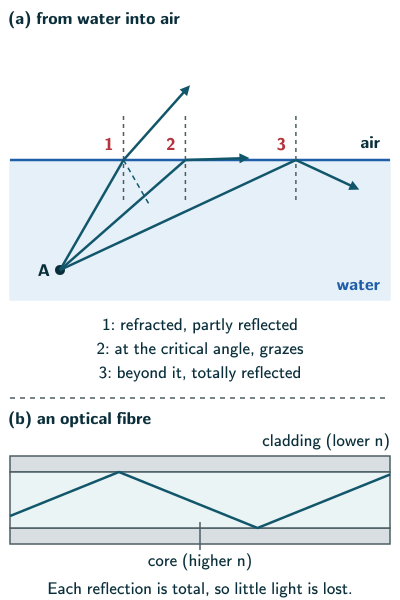
When light passes from an optically denser medium, where it travels more slowly, to a rarer one, it bends away from the normal, by Snell’s law. Beyond a certain angle of incidence, the critical angle, no light is refracted at all, and the whole ray is reflected back into the denser medium (NCERT Section 9.4, pages 229–230):
If the angle of incidence is increased still further (e.g., the ray AO4), refraction is not possible, and the incident ray is totally reflected.
NCERT Physics Part II (Class 12), Section 9.4, page 230
The critical angle ic is the angle of incidence for which the angle of refraction is 90°; it satisfies sin ic = n21, the refractive index of the rarer medium with respect to the denser (NCERT Eq. (9.12), page 230).
In plain words: inside water or glass, a ray that meets the surface nearly head-on gets out; a ray that meets it at a glancing angle, beyond the critical angle, cannot, and the surface acts as a perfect mirror. Prisms in binoculars and the optical fibres that carry internet signals both use this.
Ideal-interface model: both media are transparent and lossless, with n > n and incidence above the critical angle. No propagating refracted ray carries energy across the boundary, but a decaying evanescent field exists on the rarer side. Absorption or a nearby third medium can change this ideal result. Fibre acceptance calculations here use straight, step-index fibres and meridional rays; tight bends can cause leakage.
Critical angle
- Light going from a denser to a rarer medium is partly reflected back, the internal reflection, and partly refracted, with the angle of refraction r larger than the angle of incidence i (NCERT pages 229–230, Figure 9.11).
- As i increases, so does r. At one angle of incidence, the critical angle ic, the refracted ray grazes the surface (r = 90°). For i > ic Snell’s law cannot be satisfied, no refraction is possible, and the ray is totally reflected (NCERT page 230).
- At an ordinary transparent interface below the critical angle, some energy is transmitted; a practical metal mirror instead loses some by absorption. At an ideal total-internal-reflection interface, no propagating energy crosses into the second medium (NCERT page 230).
- Since sin r cannot exceed 1, the largest sin i allowed by Snell’s law is n21 (NCERT Eq. (9.12), page 230):
Critical angle (NCERT Eq. 9.12)
- Equivalently, the refractive index of the denser medium 1 with respect to the rarer medium 2 is n12 = 1/sin ic. For a medium in air, sin ic = 1/n (NCERT page 230).
- NCERT Table 9.1 (page 230) lists water (n = 1.33, ic = 48.75°), crown glass (1.52, 41.14°), dense flint glass (1.62) and diamond (2.42, 24.41°).
- n depends on wavelength (NCERT page 228), so the critical angle does too: in glass n is a little larger for violet light than for red, so the critical angle is a little smaller for violet (beyond the NCERT text).
- NCERT error: in Table 9.1 the refractive index and the critical angle for dense flint glass disagree. With n = 1.62, sin ic = 1/1.62 gives ic ≈ 38.1°, while 37.31° fits n ≈ 1.65, the value NCERT Class 10 Science gives for dense flint glass (Table 9.3, page 149). So the printed 1.62 is the likelier slip. The other three rows are right.
- A laser demonstration (NCERT pages 230–231): shine a laser pointer up through slightly milky water in a beaker so that the beam shows. Aimed steeply at the surface, the beam is partly reflected and partly refracted out; tilted more and more, it reaches an angle where nothing comes out and the whole beam is reflected back into the water. Never look into a laser beam or point it at anyone’s face.
Total internal reflection in nature and its technological applications
- NCERT’s Section 9.4.1 describes two technological uses, prisms and optical fibres (NCERT pages 231–232). Both appear in their own sections below.
- NCERT’s Summary names multiple internal reflections in diamond, totally reflecting prisms and the mirage as examples of total internal reflection (NCERT page 246).
- Diamond has the smallest critical angle in NCERT Table 9.1, 24.41°, so light that enters a cut diamond is easily trapped and totally reflected many times before it leaves, which helps it sparkle (reasoned from NCERT Table 9.1, page 230).
- Mirage (the explanation is beyond the NCERT text): on a hot day the air near the road is hotter and optically rarer than the air above. Light from the sky, travelling down at a glancing angle, bends more and more and is finally turned upward, as if reflected from a pool of water on the road.
Totally reflecting prisms
- Prisms designed to turn light through 90° or 180°, or to invert an image without changing its size, use total internal reflection (NCERT page 231, Figure 9.13).
- In a right-angled isosceles prism, light entering one face at right angles meets the next face at 45°: the long face when turning light through 90°, each short face in turn when turning it through 180° (NCERT page 231, Figure 9.13). So the critical angle must be less than 45°, true for crown and dense flint glass (NCERT Table 9.1).
Optical fibres
- An optical fibre is a thin fibre of high-quality glass or quartz with a core surrounded by a cladding of lower refractive index (NCERT page 231).
- Light sent into one end at a suitable angle undergoes repeated total internal reflections along the fibre and comes out at the other end. Total reflection avoids transmission loss at the ideal interface; real fibres still have absorption, scattering, connection and bending losses. The fibre is designed so that light reflected from one side strikes the other side above the critical angle, and light follows the fibre even when it is bent (NCERT page 231, Figure 9.14).
- Uses (NCERT pages 231–232): sending audio and video signals over long distances; transmitting electrical signals converted to light; a light pipe for looking inside the oesophagus, stomach and intestines; and decorative fibre lamps.
- The main requirement is very low absorption. At suitable low-loss communication wavelengths, high-quality silica fibres can carry more than 95% of the light over 1 km (NCERT page 232).
Solved examples
Example 1: Light from a bulb under water (NCERT Exercise 9.5)
A small bulb lies at the bottom of a tank of water 80 cm deep (n = 1.33). Through what area of the surface can its light come out?
Answer: light escapes only where it meets the surface at less than the critical angle: sin ic = 1/1.33 ≈ 0.75, so ic ≈ 48.8°. The light comes out through a circle of radius r = 0.80 tan ic ≈ 0.91 m, of area πr2 ≈ 2.6 m2 (NCERT Exercise 9.5, page 249; answer on page 346). In general r = h/√(n2 − 1).
Example 2: A light pipe (NCERT Exercise 9.17)
A straight step-index glass fibre in air (n = 1.68) has a covering of refractive index 1.44. For what angles of the incident rays with the axis does total reflection take place inside the pipe? What if there is no covering?
Answer: at the core–covering boundary sin i′c = 1.44/1.68, so i′c ≈ 59°. A ray entering the end face at angle i refracts to r and meets the wall at 90° − r, so it needs r < 31°: sin i < 1.68 sin 31° ≈ 0.87, so 0 ≤ i < about 60° is accepted in the meridional-ray model. The exactly axial ray (i = 0) travels straight without needing a reflection. Without a covering the critical angle is sin−1(1/1.68) ≈ 36.5°; even as i approaches 90° from below, r approaches 36.5° and the ray meets the wall at 53.5°, more than 36.5°, so all entering meridional rays are guided (the axial ray travels straight, and exact grazing incidence does not enter) (NCERT Exercise 9.17, pages 250–251; answer on page 347). NCERT error: NCERT’s answer writes this range as 53.5° < i < 90°; that is the range of the angle at the wall, not of the angle of incidence. The largest entry angle in part (a), 60°, is the acceptance angle; for a fibre in air, sin imax = √(ncore2 − nclad2) ≈ 0.865 (beyond the NCERT text).
Example 3: Critical angle of crown glass
Find the critical angle of crown glass (n = 1.52) in air, and check NCERT Table 9.1.
Answer: sin ic = 1/1.52 ≈ 0.658, so ic ≈ 41.1°, matching NCERT Table 9.1’s 41.14° (NCERT Eq. (9.12) and Table 9.1, page 230).
Example 4: Can a 45° prism use water?
A hollow right-angled prism is filled with water (n = 1.33); neglect the thin parallel glass walls when finding the net water-to-air escape condition. Will it totally reflect light meeting its long face at 45°?
Answer: no: water’s critical angle is 48.75°, more than 45°, so the light is partly refracted out. A totally reflecting prism needs ic < 45°, that is n > √2 ≈ 1.41 (reasoned from NCERT page 231).
Common mistakes to avoid
Common mistake
Expecting total internal reflection from air into glass
It happens only when light goes from the denser medium into the rarer one; going into a denser medium the ray bends towards the normal and always refracts (NCERT pages 229–230).
Common mistake
Writing sin i<sub>c</sub> = n for glass in air
With n the refractive index of the denser medium, sin ic = 1/n; NCERT Eq. (9.12) uses n21, the rarer medium with respect to the denser (NCERT page 230).
Common mistake
Thinking an optical fibre must be straight
Light follows the fibre round bends, as long as it meets the wall above the critical angle (NCERT page 231).
Quick revision summary
- From a denser to a rarer medium, beyond the critical angle the ray is totally reflected and no propagating light carries energy across the ideal lossless interface; an evanescent field remains.
- sin ic = n21 (rarer with respect to denser); for a medium in air, sin ic = 1/n.
- Totally reflecting prisms turn light by 90° or 180° or invert images; they need ic < 45°, true for crown and dense flint glass.
- Optical fibres guide light by repeated total internal reflection in a core of higher refractive index than its cladding, with very low loss.
Formula sheet
- sin ic = n21
- in air: sin ic = 1/n
Questions students ask
Is a rainbow formed by total internal reflection?
No, a rainbow does not involve total internal reflection: the reflection inside each raindrop is partial, and part of the light leaks out through the back of the drop. A ray entering a spherical drop at angle i refracts to r, with sin r = sin i/n, and by the symmetry of the sphere meets the back surface at the same angle r; since sin r can never exceed 1/n = sin ic, it never passes the critical angle (reasoned from NCERT Eqs. (9.10) and (9.12), pages 228 and 230). The rainbow is no longer in the Class 12 chapter: NCERT Science Class 10, Chapter 10 (page 167) explains it by refraction and dispersion, internal reflection, and refraction out of the drop.
Why does an optical fibre need a cladding?
An optical fibre needs a cladding of lower refractive index so that the surface where light is totally reflected is sealed inside the glass, where nothing can touch it. A bare fibre in air would also guide light (Example 2), but wherever it touched a support, another fibre, dust or water, the critical angle there would rise or vanish and light would leak out (reasoned from NCERT Eq. (9.12), page 230). Beyond the NCERT text, that leaking and the wear of bare fibres are why early medical fibres were given a lower-index glass cladding, which led to fibre gastroscopes (The Nobel Prize in Physics 2009, information for the public).
Who invented the optical fibre?
Beyond the NCERT text, no single person invented the optical fibre. Image-carrying bundles of glass fibres were reported in one issue of Nature in January 1954 (Nature 173, 39) by Harold Hopkins and the Indian-born Narinder Singh Kapany in London (Optica obituary, 2020), and by Abraham van Heel in Delft, whose fibres had a transparent cladding (Jeff Hecht, fibre-optic chronology). In 1966 Charles Kao, with George Hockham, worked out that purer glass could carry light over long distances, winning Kao half of the 2009 Nobel Prize in Physics; the first such ultrapure fibre followed in 1970 (NobelPrize.org). Today silica fibres carry more than 95% of the light over 1 km (NCERT page 232).
Are optical fibres in the JEE Main and NEET syllabus?
Yes, optical fibres are in both syllabuses as an application of total internal reflection: Unit 16 of the JEE Main syllabus lists “total internal reflection and its applications”, and Unit 16 of NEET (UG) 2026 “Total internal reflection and its applications.” NCERT covers them with totally reflecting prisms in Section 9.4.1 of Class 12 Physics Part II (pages 231–232), and NCERT Exercise 9.17 (pages 250–251) is a numerical on a light pipe. The acceptance angle and numerical aperture of a fibre are beyond the NCERT text and neither syllabus names them, though both follow from Snell’s law and the critical angle.
Do optical fibres carry visible light or infrared?
Beyond the NCERT text, long-distance communication fibres carry infrared light, not visible light: silica glass is most transparent near 1550 nm, in the infrared, so long links are run there (The Nobel Prize in Physics 2009, information for the public). That fits NCERT’s figure of more than 95% of the light surviving 1 km of silica fibre (page 232). Total internal reflection works at any wavelength so long as the light meets the wall above the critical angle, so the light pipes used to look inside the stomach, and decorative fibre lamps, carry visible light (NCERT pages 231–232).
Practice questions
Try each question first, then open the answer to check your working.
-
Q1. State the two conditions for total internal reflection.
Show answerHide answer
Light must go from the optically denser medium towards the rarer one, and its angle of incidence must exceed the critical angle (NCERT pages 229–230).
-
Q2. The critical angle of a glass in air is 42°. Find its refractive index.
Show answerHide answer
n = 1/sin 42° ≈ 1/0.669 ≈ 1.49 (NCERT page 230).
-
Q3. Why is the reflected light in total internal reflection brighter than in reflection from a mirror?
Show answerHide answer
A practical ordinary mirror loses some energy, whereas ideal TIR reflects all incident energy. The statement assumes transparent lossless media and compares equal incident intensities (NCERT page 230).