Optical instruments: microscopes and telescopes
NCERT Class 12 Physics Chapter 9 Section 9.7
Quick answer
With the eye close to a simple microscope, m = 1 + D/f for an image at the near point and m = D/f at infinity, where D is conventionally 25 cm. A compound microscope in normal adjustment has m = (L/fo)(D/fe), with L the optical tube length; a Keplerian telescope in normal adjustment has m = fo/fe. These are paraxial magnification magnitudes.
With your textbook
NCERT Physics Part II (Class 12), Chapter 9 “Ray Optics and Optical Instruments”, Section 9.7 “Optical Instruments”, pages 240–246.
Open the official NCERT chapter (PDF, 3.4 MB, ncert.nic.in) (opens in a new tab)
Checked against the 2026-27 reprint on .
What are optical instruments?
Optical instruments
Optical instruments use mirrors, lenses and prisms to help the eye. The microscope makes small, near objects look bigger; the telescope makes distant objects look bigger by increasing the angle they subtend at the eye (NCERT Section 9.7, pages 240–246). For the microscope NCERT notes:
Clearly, to achieve a large magnification of a small object (hence the name microscope), the objective and eyepiece should have small focal lengths.
NCERT Physics Part II (Class 12), Section 9.7.1, page 244
A simple microscope with the final image at infinity magnifies by D/f; a compound microscope by (L/fo)(D/fe); a telescope by fo/fe (NCERT Eqs. (9.42), (9.45) and (9.46), pages 242–244).
In plain words: you see an object bigger when it fills a bigger angle in your eye. For the normal eye the near point is taken as 25 cm: an object brought closer cannot be seen sharply, so a magnifying lens lets you bring it closer (an individual’s near point can differ). A microscope does this twice over; a telescope collects light from far away and sends it into your eye at a larger angle.
Conventions and assumptions: formulas here give magnification magnitudes; an inverted final image has negative signed magnification. Use paraxial thin-lens optics, with the eye close to the eyepiece and D the observer’s near point. Telescope formulas here describe a Keplerian telescope with converging objective and eyepiece. L is the optical tube length between the objective’s second focal point and eyepiece’s first focal point, not simply their separation; the L-based near-point microscope formula is approximate.
The microscope
- A simple microscope (a magnifier) is one converging lens of small focal length; a compound microscope uses two lenses, one building on the effect of the other (NCERT Section 9.7.1, pages 240 and 243).
- The image can be viewed at the near point, D ≈ 25 cm, where it is closest and still sharp, or at infinity, which is more comfortable for the relaxed eye. NCERT works out both, then assumes the final image is at infinity for instruments (NCERT pages 240–242).
Simple microscope
- The lens is held one focal length or less from the object, with the eye close behind it; it forms an erect, magnified, virtual image (NCERT pages 240–241, Figure 9.23).
- Image at the near point: with v = −D, the thin lens formula gives the magnification (NCERT Eq. (9.39), page 242):
Simple microscope, image at D (NCERT Eq. 9.39)
- So a magnification of six needs f = 5 cm (NCERT page 242). This m is also the ratio of the angle subtended by the image to the angle the object would subtend at D; the magnifier lets the object be brought closer than D (NCERT page 242).
- Image at infinity: the object is at F. Without the lens the largest clear angle is θo = h/D; with it the image subtends θi = h/f, so the angular magnification is (NCERT Eqs. (9.40)–(9.42), page 242):
Simple microscope, image at infinity (NCERT Eq. 9.42)
- This is one less than at the near point, but the viewing is more comfortable and the difference is usually small. A simple microscope has a limited maximum magnification, about 9 or less, for realistic focal lengths (NCERT page 243); for more, one uses a compound microscope. Strictly, 9 follows from realistic focal lengths in this simple-lens model; it is not a fundamental limit on magnifiers (reasoned).
Compound microscope
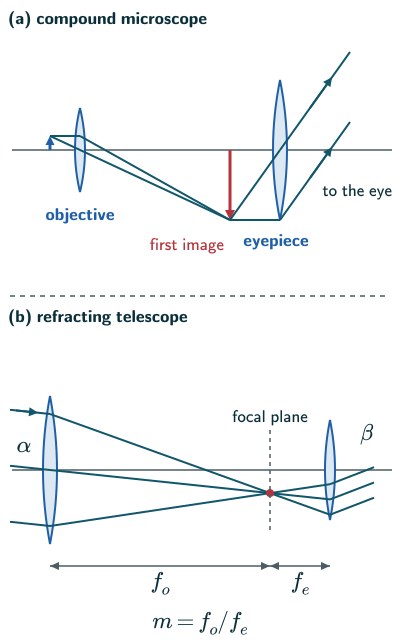
- The objective, the lens nearest the object, forms a real, inverted, magnified image. This lies near the focal plane of the eyepiece, which works like a simple microscope and gives an enlarged, virtual final image. The final image is inverted relative to the object (NCERT page 243, Figure 9.24).
- For the final image at infinity, the objective’s magnification magnitude is mo = L/fo, where the tube length L is the distance between the second focal point of the objective and the first focal point of the eyepiece (NCERT Eq. (9.43), page 243).
- The eyepiece magnifies by me = 1 + D/fe with the final image at D, or D/fe with it at infinity (NCERT Eqs. [9.44(a)]–[9.44(b)], page 244). The magnifications multiply (NCERT Eq. (9.45), page 244):
Compound microscope, image at infinity (NCERT Eq. 9.45)
- For a large magnification both focal lengths should be small; NCERT adds that “in practice, it is difficult to make the focal length much smaller than 1 cm”, and that large lenses are needed to make L large (NCERT page 244); give that in an exam. Beyond the NCERT text: today’s multi-element microscope objectives reach focal lengths of a few millimetres, down to about 2 mm (Wikipedia, “Objective (optics)”). With fo = 1.0 cm, fe = 2.0 cm and L = 20 cm, m = 20 × 12.5 = 250 (NCERT page 244). Modern microscopes use multi-component lenses to reduce aberrations (NCERT page 244).
- With the final image at the near point, the eyepiece factor is 1 + D/fe (NCERT Eq. [9.44(a)], page 244), using L/fo for the objective gives the usual approximation below. At fixed lens separation, the intermediate image shifts when the eyepiece is adjusted for D; use vo/|uo| for an exact paraxial calculation (reasoned):
Compound microscope, image at D (usual approximation)
- In numericals, take the objective’s magnification as vo/|uo| from the lens formula; the lenses are vo + |ue| apart, as in Example 1.
Telescope
- A telescope gives angular magnification of distant objects. Its objective has a long focal length and a much larger aperture than the eyepiece. Light from a distant object forms a real image at the objective’s second focal point, and the eyepiece magnifies this image; the final image is inverted (NCERT Section 9.7.2, pages 244–245, Figure 9.25).
- What matters most in an astronomical telescope is its light-gathering power, which depends on the area of the objective, and its resolving power, the ability to see two objects in nearly the same direction as separate, which also depends on the objective’s diameter. So objectives are made as large as possible (NCERT page 245). A bigger aperture makes the image brighter and sharper, but does not change the magnifying power fo/fe (reasoned from NCERT Eq. (9.46)).
Refracting telescope
- The magnifying power is the ratio of the angle β subtended at the eye by the final image to the angle α the object subtends at the lens or the eye (NCERT Eq. (9.46), page 244):
Telescope in normal adjustment (NCERT Eq. 9.46)
- The tube is then fo + fe long. A terrestrial telescope adds a pair of inverting lenses to make the final image erect (NCERT page 245).
- Final image at the near point (beyond the NCERT text, which does not derive it, though NCERT Exercise 9.27(b) asks for it): the first image sits feD/(fe + D) in front of the eyepiece, so the tube is a little shorter than fo + fe, and
Telescope, final image at D
- For NCERT Exercise 9.13 this gives m = 24 × 1.24 ≈ 29.8, with the lenses about 148.8 cm apart.
- With fo = 100 cm and fe = 1 cm, m = 100, so two stars 1′ apart appear 100′ ≈ 1.67° apart (NCERT page 245).
- The largest lens objective in use is 40 inch (about 1.02 m) across, at the Yerkes Observatory, Wisconsin, USA. Big lenses are heavy, can be supported only at their edges, and are hard to make free of chromatic aberration and distortion (NCERT page 245).
Reflecting telescope (Cassegrain)
- Large modern astronomical telescopes commonly use a concave mirror as the objective. A mirror has no chromatic aberration, weighs much less than a lens of the same optical quality, and can be supported over its whole back (NCERT page 245).
- But the mirror focuses light inside the tube. In the 200-inch (about 5.08 m) Mt. Palomar telescope observers historically sat in a small cage near the prime focus, blocking some light (NCERT pages 245–246).
- The Cassegrain design instead uses a convex secondary mirror to send the light back through a hole in the primary mirror (NCERT page 246, Figure 9.26). It gives a large focal length in a short telescope (NCERT page 246).
- NCERT names the 2.34 m Cassegrain reflector at Kavalur, Tamil Nadu, run by the Indian Institute of Astrophysics, Bangalore, as the largest telescope in India, and the two 10 m Keck telescopes in Hawaii as the largest in the world (NCERT page 246). Both records are now out of date (beyond the NCERT text). The 3.6 m Devasthal Optical Telescope in Nainital district, commissioned in 2016, is described by the Aryabhatta Research Institute of Observational Sciences (ARIES), which runs it, as the largest telescope in India for optical astronomy. At the same site ARIES also runs the larger 4 m International Liquid Mirror Telescope (first light 2022), but its mirror is a spinning pool of mercury that cannot be tilted, so it only surveys a narrow strip of sky straight overhead. The Gran Telescopio Canarias on La Palma, Spain, whose 36 mirror segments act as a single mirror 10.4 m across, is described by GRANTECAN, which runs it, as the largest optical and infrared telescope in the world.
Magnifying power
- For an instrument, magnifying power means angular magnification: the angle subtended at the eye by the final image divided by the angle subtended by the object without the instrument, at the near point for a microscope and at the eye for a distant object seen through a telescope (NCERT pages 242 and 244).
- It is not the same as the size ratio of image to object. A magnifier’s image can be ten times larger than the object yet subtend the same angle at the eye; the gain comes from bringing the object closer than 25 cm. The two numbers agree only when the image is at the near point (NCERT Exercise 9.22 and its answer, pages 251 and 348).
- Summary for the final image at infinity: simple microscope D/f; compound microscope (L/fo)(D/fe); telescope fo/fe (NCERT Eqs. (9.42), (9.45) and (9.46)).
Solved examples
Example 1: A compound microscope (NCERT Exercise 9.11)
A compound microscope has an objective of focal length 2.0 cm and an eyepiece of focal length 6.25 cm, 15 cm apart. Where should the object be for the final image (a) at 25 cm, (b) at infinity? Find the magnifying power in each case.
Answer: (a) For the eyepiece ve = −25 cm, so ue = −5 cm; the first image is 15 − 5 = 10 cm from the objective, so 1/uo = 1/10 − 1/2 and uo = −2.5 cm. m = (10/2.5) × (1 + 25/6.25) = 4 × 5 = 20. (b) Now ue = −6.25 cm, the first image is 8.75 cm from the objective, uo ≈ −2.59 cm, and m = (8.75/2.59) × (25/6.25) ≈ 13.5 (NCERT Exercise 9.11, page 250; answer on page 346).
Example 2: A small telescope (NCERT Exercise 9.13)
A telescope has an objective of focal length 144 cm and an eyepiece of 6.0 cm. In normal adjustment, find its magnifying power and the separation of the lenses.
Answer: m = 144/6.0 = 24; in normal adjustment the lenses are 144 + 6 = 150 cm apart (NCERT Exercise 9.13, page 250; answer on page 346).
Example 3: A giant refractor and the moon (NCERT Exercise 9.14)
An objective of focal length 15 m is used with an eyepiece of 1.0 cm. In normal adjustment, find the theoretical angular magnification, and the diameter of the moon’s image formed by the objective (moon’s diameter 3.48 × 10⁶ m, distance 3.8 × 10⁸ m).
Answer: m = 1500/1.0 = 1500. The moon subtends (3.48 × 10⁶ m)/(3.8 × 108 m) ≈ 9.16 × 10⁻³ rad, so its image in the focal plane is 15 m × 9.16 × 10−3 ≈ 13.7 cm across (NCERT Exercise 9.14, page 250; answer on page 346).
Example 4: Magnification against magnifying power (NCERT Exercise 9.22)
A card of 1 mm squares is viewed at 9 cm through a magnifying glass of focal length 10 cm, held close to the eye (NCERT’s exercise prints 9 cm; see the answer). Find the magnification, the area of each square in the image, and the magnifying power.
Answer: NCERT error: the exercise gives the lens a focal length of 9 cm, which would put the image at infinity; NCERT’s answer (page 348) uses 10 cm, and so does this solution. Then 1/v = 1/10 − 1/9, so v = −90 cm and m = 90/9 = 10: each square appears 10 mm × 10 mm, 1 cm2. The magnifying power is 25/9 ≈ 2.8. They differ because the image, ten times larger, is also ten times farther away (NCERT Exercise 9.22, page 251; answer on page 348).
Common mistakes to avoid
Common mistake
Confusing magnification with magnifying power
Magnifying power is a ratio of angles, not of sizes; for a magnifier they agree only when the image is at the near point (NCERT answer to Exercise 9.22, page 348).
Common mistake
Taking a long focal length for a microscope objective
A microscope needs short focal lengths for both lenses; a telescope needs a long focal length objective and a short focal length eyepiece (NCERT pages 244–245).
Common mistake
Expecting an erect image from an astronomical telescope
The final image of a compound microscope or an astronomical telescope is inverted; a terrestrial telescope adds inverting lenses (NCERT pages 243 and 245).
Quick revision summary
- Simple microscope: m = 1 + D/f with the image at the near point, m = D/f with it at infinity; D is the observer’s near-point distance, conventionally 25 cm.
- Compound microscope: objective mo = L/fo (L the tube length); eyepiece me = D/fe (image at infinity) or 1 + D/fe (image at D); m = mome; the final image is inverted.
- Telescope: m = fo/fe, tube fo + fe, in normal adjustment; m = (fo/fe)(1 + fe/D) with the image at D. A large objective gathers more light and resolves finer detail.
- Reflecting telescopes (such as the Cassegrain) use a concave mirror: no chromatic aberration, lighter, supported from the back.
Formula sheet
- m = 1 + D/f
- m = D/f
- mo = L/fo
- m = (L/fo)(D/fe)
- m ≈ (L/fo)(1 + D/fe)
- m = fo/fe
- m = (fo/fe)(1 + fe/D)
Questions students ask
What is the difference between a compound microscope and an astronomical telescope?
A compound microscope and an astronomical telescope both have an objective and an eyepiece and give an inverted final image, but the microscope enlarges a small, near object placed just beyond its objective’s focus, and the telescope the angle of a distant one (NCERT pages 243–245). The microscope’s objective forms a real image larger than the object, mo = L/fo, which the eyepiece magnifies again; the telescope’s objective forms a tiny real image, and all its gain, fo/fe, is angular (NCERT Eqs. (9.43)–(9.46)). A telescope also needs a wide objective to gather faint light; a microscope’s object can simply be lit.
Why is it called a compound microscope?
A compound microscope is so called because it uses two lenses, the objective and the eyepiece, “one compounding the effect of the other”, as NCERT puts it (page 243): the objective forms a magnified real image, and the eyepiece magnifies that image again, so the total magnification is the product, m = mome (NCERT Eq. (9.45), page 244). For realistic focal lengths a simple microscope gives at most about 9 (NCERT page 243), while compounding reaches hundreds: an objective that magnifies 40 times with an eyepiece that magnifies 10 times gives 400.
Is the magnifying power of a compound microscope positive or negative?
The magnifying power of a compound microscope is negative if its sign is kept, because the final image is inverted relative to the object: the objective forms a real, inverted image, with mo = vo/uo negative (NCERT Eq. (9.24)), and the eyepiece, working as a simple magnifier, gives an erect virtual image of that image, so the inversion remains (NCERT page 243). NCERT’s formulas, such as m = (L/fo)(D/fe), give its size only, so they come out positive. A question asking for the sign wants negative, and the same holds for an astronomical telescope, whose final image is also inverted (NCERT page 244).
What is the magnifying power of a concave lens?
The magnifying power of a concave lens is less than 1, so it cannot be used as a magnifier: for a real object it always forms a virtual, erect image that is smaller than the object and nearer the lens (reasoned from NCERT Eq. (9.23)). For a weak concave lens with |f| > D, a real object can give a virtual image at the near point. In that restricted case, putting its negative focal length into m = 1 + D/f, shows this: a −0.8 D lens (f = −125 cm) gives m = 1 − 25/125 = 0.8 with the image at the near point, the object being about 31 cm away (reasoned from NCERT Eq. (9.39), page 242). Thus a standalone concave lens is not a magnifier for a normal eye viewing a real object. The Keplerian telescope studied here uses a converging eyepiece; a Galilean telescope instead uses a concave eyepiece with the converging light from its objective (beyond NCERT: Museo Galileo’s Model of a Telescope).
What is the difference between magnifying power and resolving power?
Magnifying power is how much an instrument enlarges the angle an object subtends at the eye (fo/fe for a telescope); resolving power is its ability to show two objects in nearly the same direction as separate, which NCERT says depends on the objective’s diameter (page 245). Beyond the NCERT text, Rayleigh’s criterion (Lord Rayleigh, Philosophical Magazine, 1879) gives an ideal diffraction-limit estimate of 1.22λ/a for two incoherent point sources viewed through an unobstructed circular aperture of diameter a: 6.7 × 10 rad for a 10 cm objective in 550 nm light, a diffraction limit given in neither Chapter 9 nor Chapter 10. Past it, a stronger eyepiece only enlarges a blur (reasoned).
Are microscopes and telescopes in the JEE Main and NEET syllabus, and is the human eye deleted?
Yes, both syllabuses list them in Unit 16: “microscope and astronomical telescope (reflecting and refracting) and their magnifying powers” in the JEE Main syllabus, and “Microscope and Astronomical Telescope (reflecting and refracting) and their magnifying powers.” in NEET (UG) 2026, covered by NCERT Section 9.7 (pages 240–246). The human eye has no section in the Class 12 chapter, though its introduction (page 222) still mentions it: NCERT page 240 says it was studied in Class X, and neither syllabus lists it. The near point, about 25 cm, in the microscope’s magnifying-power formulas comes from it (NCERT Science Class 10, Chapter 10, page 162).
Practice questions
Try each question first, then open the answer to check your working.
-
Q1. What focal length of magnifier gives a magnification of 6 with the image at the near point (D = 25 cm)?
Show answerHide answer
1 + 25/f = 6, so f = 5 cm (NCERT Eq. (9.39), page 242).
-
Q2. A telescope has fo = 100 cm and fe = 1 cm. Find its magnifying power and tube length in normal adjustment.
Show answerHide answer
m = 100/1 = 100, and the tube is 101 cm long (NCERT page 245).
-
Q3. Give two reasons why large telescopes use mirrors instead of lenses.
Show answerHide answer
A mirror has no chromatic aberration, and it weighs less and can be supported over its whole back, while a big lens is heavy and can be held only at its rim (NCERT page 245).