Refraction through a prism
NCERT Class 12 Physics Chapter 9 Section 9.6
Quick answer
For a prism in the same medium on both sides, r1 + r2 = A and δ = i + e − A. At minimum deviation the path is symmetric and n21 = sin[(A + Dm)/2]/sin(A/2); for a thin prism at small angles, Dm ≈ (n21 − 1)A.
With your textbook
NCERT Physics Part II (Class 12), Chapter 9 “Ray Optics and Optical Instruments”, Section 9.6 “Refraction through a Prism”, pages 239–240.
Open the official NCERT chapter (PDF, 3.4 MB, ncert.nic.in) (opens in a new tab)
Checked against the 2026-27 reprint on .
What is refraction through a prism?
Refraction through a prism
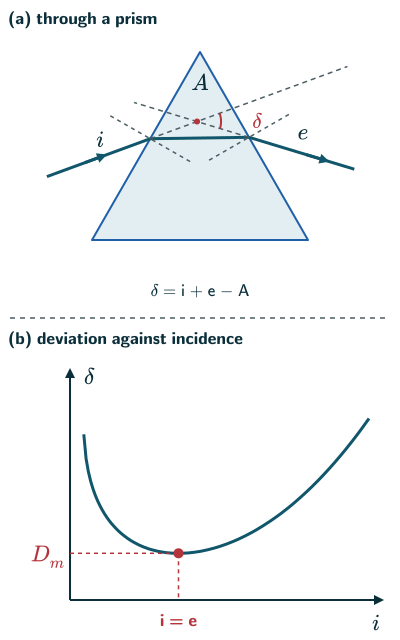
A ray passing through a triangular prism is refracted at two faces and comes out turned through an angle of deviation δ. With A the angle of the prism, i the angle of incidence and e the angle of emergence, δ = i + e − A (NCERT Section 9.6, page 239, Eq. (9.35)):
Thus, the angle of deviation depends on the angle of incidence.
NCERT Physics Part II (Class 12), Section 9.6, page 239
At one angle of incidence the deviation is least, the angle of minimum deviation Dm, and then n21 = sin[(A + Dm)/2]/sin(A/2) (NCERT Eq. (9.38), page 240).
In plain words: a glass prism in air refracts light at two nonparallel faces, giving a net turn towards its thicker base in the usual transmitted-ray arrangement. Turn the prism slowly and the turning first gets smaller, then larger again. The smallest turning is special: the ray then passes through the prism symmetrically, and that angle tells you the refractive index of the glass.
Scope: a transparent isotropic prism of index higher than its surroundings, with the same surrounding medium on both faces, one colour of light, and rays in a plane perpendicular to the prism’s edge. The usual minimum-deviation formulas describe rays transmitted through the chosen pair of faces; total internal reflection limits which incidence angles are possible.
Angle of deviation
- In NCERT Figure 9.21 a ray PQ meets face AB at an angle of incidence i and refracts at r1; inside, it meets face AC at r2 and leaves at the angle of emergence e. The angle between the emergent ray RS and the incident ray PQ is the angle of deviation δ (NCERT page 239). Each refraction follows Snell’s law.
- In the quadrilateral AQNR (N is where the normals at Q and R meet), the angles at Q and R are right angles, so ∠A + ∠QNR = 180°. In triangle QNR, r1 + r2 + ∠QNR = 180°. Comparing the two (NCERT Eq. (9.34), page 239):
Angles inside the prism (NCERT Eq. 9.34)
- The total deviation is the sum of the deviations at the two faces, δ = (i − r1) + (e − r2), so (NCERT Eq. (9.35), page 239):
Angle of deviation (NCERT Eq. 9.35)
Angle of minimum deviation
- A plot of δ against i is a curve with a minimum (NCERT page 239; Figure 9.22, page 240). Apart from the minimum, where i = e, each deviation in the allowed transmitted range (away from grazing endpoints) is reached for two values of i, and so of e. This follows from the symmetry of i and e in NCERT Eq. (9.35): the path of the ray can be traced backwards, giving the same deviation with i and e swapped (NCERT pages 239–240).
- At the minimum deviation Dm, the path is symmetric, i = e and r1 = r2 (NCERT page 240). So the ray inside makes equal angles with the two refracting faces. It runs parallel to the base only when the two faces are equally inclined to the base (AB = AC, as in an equilateral prism); NCERT’s statement that the ray becomes parallel to the base assumes such a prism (reasoned).
- So NCERT Eq. (9.34) gives 2r = A (NCERT Eq. (9.36)) and NCERT Eq. (9.35) gives Dm = 2i − A (NCERT Eq. (9.37), page 240):
At minimum deviation (NCERT Eqs. 9.36–9.37)
Refractive index from the minimum deviation
- Putting these into Snell’s law at the first face, n21 = sin i/sin r (NCERT Eq. (9.38), page 240):
Refractive index of a prism (NCERT Eq. 9.38)
- A and Dm can both be measured, so this gives a way to find the refractive index of the material of the prism (NCERT page 240).
- Dm depends on the medium around the prism through n21: the same prism deviates light much less in water than in air (NCERT Exercise 9.6, page 249).
Thin prism
- For a prism of small angle A, Dm is also small, and the sines can be replaced by the angles in radians: n21 ≈ [(A + Dm)/2]/(A/2), which gives (NCERT page 240):
Thin prism (NCERT page 240)
- So thin prisms do not deviate light much (NCERT page 240). A 6° prism of crown glass (n = 1.52) deviates light by only about 3.1°.
Solved examples
Example 1: Minimum deviation in air and in water (NCERT Exercise 9.6)
A prism of angle 60° gives a minimum deviation of 40° in air. Find its refractive index. What is the minimum deviation in water (n = 1.33)?
Answer: (A + Dm)/2 = 50° and A/2 = 30°, so n = sin 50°/sin 30° = 0.766/0.5 ≈ 1.53. In water the relative index is 1.532/1.33 ≈ 1.152, so sin[(60° + D′m)/2] = 1.152 × 0.5 = 0.576, giving (60° + D′m)/2 ≈ 35.2° and D′m ≈ 10° (NCERT Exercise 9.6, page 249; answer on page 346).
Example 2: Just total reflection at the second face (NCERT Exercise 9.21)
At what limiting incidence angle does a ray through a 60° prism in air (n = 1.524) reach the onset of total internal reflection at the other face?
Answer: at the threshold the refracted ray grazes the second face; strict total reflection requires an angle above critical there. At the threshold, r2 = sin−1(1/1.524) ≈ 41°. Then r1 = 60° − 41° = 19°, and sin i = 1.524 × sin 19° ≈ 0.496, so i ≈ 30° (NCERT Exercise 9.21, page 251; answer on page 348).
Example 3: The prism of the figure
A prism has A = 60° and n = 1.5. Find the angle of minimum deviation and the angle of incidence that gives it.
Answer: sin[(60° + Dm)/2] = 1.5 × sin 30° = 0.75, so (60° + Dm)/2 ≈ 48.6°: i ≈ 48.6° and Dm ≈ 37.2° (NCERT Eqs. (9.37)–(9.38), page 240).
Example 4: A thin prism
A thin prism of angle 4° is made of glass of refractive index 1.5. Find its approximate minimum deviation.
Answer: Dm = (n − 1)A = 0.5 × 4° = 2° (NCERT page 240).
Common mistakes to avoid
Common mistake
Thinking a larger angle of incidence always means a larger deviation
The deviation first falls, reaches Dm at i = e, and then rises again (NCERT Figure 9.22, page 240).
Common mistake
Using A instead of A/2 inside the sine
The formula is n = sin[(A + Dm)/2]/sin(A/2), both angles halved (NCERT Eq. (9.38), page 240).
Common mistake
Using D<sub>m</sub> = (n − 1)A for any prism
It holds only for a thin prism, where the angles are small (NCERT page 240).
Quick revision summary
- Inside a prism r1 + r2 = A, and the deviation is δ = i + e − A.
- δ depends on i: it is least, Dm, when i = e (in an equilateral prism the ray inside then runs parallel to the base); other allowed transmitted deviations below the grazing-limit maximum occur at two angles of incidence.
- At minimum deviation r = A/2 and i = (A + Dm)/2, so n21 = sin[(A + Dm)/2]/sin(A/2).
- A thin prism deviates light by Dm = (n21 − 1)A, a small angle.
Formula sheet
- r1 + r2 = A
- δ = i + e − A
- r = A/2, i = (A + Dm)/2
- n21 = sin[(A + Dm)/2]/sin(A/2)
- Dm ≈ (n21 − 1)A
Questions students ask
What does the angle of deviation of a prism depend on?
The angle of deviation of a prism depends on the angle of incidence i, the prism angle A and the refractive index n21 of the prism relative to its surroundings, which depends in turn on the colour of the light (NCERT pages 228 and 239). For a given i, a larger A or n21 deviates the ray more, and the minimum deviation depends on A and n21 alone (reasoned from NCERT Eqs. (9.34)–(9.38)). So a glass prism deviates violet light more than red, because its index is larger for violet (NCERT Science Class 10, Chapter 10, page 167; index and wavelength).
What is the difference between refraction through a prism and through a glass slab?
In a glass slab the two faces are parallel, so the bending at the second face undoes the bending at the first: the ray leaves parallel to the incident ray, shifted sideways but not deviated (the glass slab). In a prism the faces meet at the angle A, so the two refractions generally give a net turn towards the base, and it leaves deviated by δ = i + e − A (NCERT Eq. (9.35), page 239), as NCERT Science Class 10, Chapter 10 also notes (pages 165–166). And while a slab’s lateral shift grows with its thickness, a prism’s deviation is an angle set by A, n and i, whatever the prism’s size (reasoned).
Does a prism reflect or refract light?
A glass prism both reflects some light at its interfaces and refracts the transmitted part: a ray bends at the face it enters and again at the face it leaves, and comes out deviated towards the base (NCERT Section 9.6, page 239). A prism reflects when the ray meets the second face at more than the critical angle: then no light emerges there and the ray is totally reflected inside, which is how totally reflecting prisms bend light by 90° or by 180° (NCERT page 231). Which happens depends on the angle at which the ray meets that face, so the same prism can do either.
Is the deviation of a thin prism independent of the angle of incidence?
The deviation of a thin prism is nearly independent of the angle of incidence, but only while that angle is small: then the angles at both faces are small enough for sin θ ≈ θ, and the deviation stays close to (n21 − 1)A (reasoned from NCERT Eqs. (9.34)–(9.35), page 239). For an 8° prism with n = 1.55, (n − 1)A = 4.40°, and Snell’s law at both faces gives 4.46° at normal incidence and 4.43° at i = 10°, but 5.09° at 30° and 5.88° at 40°. So the thin prism result of NCERT page 240 is used for rays near normal incidence.
Is dispersion by a prism deleted from Class 12 Physics?
Yes, dispersion of light by a prism is no longer a section of the 2026–27 NCERT Class 12 chapter: Section 9.6 ends with the thin prism (page 240), and dispersion appears only in passing, in the chapter’s introduction (page 222), Summary point 7 (page 247) and Points to Ponder 4, on the coloured images of thick lenses (page 248). Unit 16 of the JEE Main syllabus lists “refraction of light through a prism”, and NEET (UG) 2026 “Refraction of light through a prism.”, without naming dispersion. The splitting of white light by a prism and the rainbow are explained in NCERT Science Class 10, Chapter 10 (pages 166–167).
Practice questions
Try each question first, then open the answer to check your working.
-
Q1. At the angle of minimum deviation, how are i and e related, and what are r1 and r2?
Show answerHide answer
i = e, and r1 = r2 = A/2 (NCERT Eq. (9.36), page 240).
-
Q2. A prism of angle 60° has a minimum deviation of 30°. Find its refractive index.
Show answerHide answer
n = sin 45°/sin 30° = 0.707/0.5 ≈ 1.41 (NCERT Eq. (9.38), page 240).
-
Q3. Find the deviation produced by a thin prism of angle 5° and refractive index 1.6.
Show answerHide answer
Dm = (1.6 − 1) × 5° = 3° (NCERT page 240).