SI units
NCERT Class 11 Physics Chapter 1 Sections 1.1–1.2
Quick answer
SI has seven base units: metre (m), kilogram (kg), second (s), ampere (A), kelvin (K), mole (mol) and candela (cd); derived units include the newton (kg m s). The revision adopted in 2018 took effect on 20 May 2019 and defines SI through seven constants with fixed numerical values. The radian and steradian are dimensionless derived SI units for plane and solid angle.
With your textbook
NCERT Physics Part I (Class 11), Chapter 1 “Units and Measurement”, Sections 1.1–1.2 “Introduction” and “The international system of units”, pages 1–3.
Open the official NCERT chapter (PDF, 1.1 MB, ncert.nic.in) (opens in a new tab)
Checked against the 2026-27 reprint on .
What are SI units?
The International System of Units (SI)
To measure a physical quantity is to compare it with an agreed reference standard, its unit (NCERT Section 1.1, page 1).
- Base units belong to a small set of base quantities. SI has seven: the metre (m), kilogram (kg), second (s), ampere (A), kelvin (K), mole (mol) and candela (cd).
- Derived units are combinations of base units, such as the newton, N = kg m s.
- Two dimensionless derived SI units are used for angles: the radian (rad) for plane angle and the steradian (sr) for solid angle. Both are dimensionless (NCERT Section 1.2, page 2).
The result of a measurement of a physical quantity is expressed by a number (or numerical measure) accompanied by a unit.
NCERT Physics Part I (Class 11), Section 1.1, page 1
In plain words: “5” on its own means nothing; “5 metres” or “5 seconds” does. A handful of base units is enough, because every other quantity, such as speed, force or energy, can be built from a few basic ones.
Systems of units
Base units and the units derived from them together make a system of units (page 1). Three systems were widely used until recently (page 1):
- CGS: centimetre, gram, second;
- FPS (British): foot, pound, second;
- MKS: metre, kilogram, second.
The system accepted internationally today is the Système International d’Unités, SI. NCERT describes its scheme of symbols, units and abbreviations as developed by the International Bureau of Weights and Measures (BIPM) in 1971 and revised by the General Conference on Weights and Measures in November 2018 (pages 1–2). (Strictly, the SI was adopted in 1960; 1971 is the year its seventh base unit, the mole, was added. This point is beyond the NCERT text.) Because SI is a decimal system, conversions within it are simple.
The seven base units
| Base quantity | Unit | Symbol |
|---|---|---|
| Length | metre | m |
| Mass | kilogram | kg |
| Time | second | s |
| Electric current | ampere | A |
| Thermodynamic temperature | kelvin | K |
| Amount of substance | mole | mol |
| Luminous intensity | candela | cd |
The revision agreed in 2018 took effect on 20 May 2019. It defines SI through the fixed numerical values of seven constants; a base-unit definition can use units already defined through other constants (NCERT Table 1.1, page 2; effective date and clarification beyond the NCERT text, from the BIPM SI Brochure):
- the second, by the caesium-133 hyperfine frequency, ΔνCs = 9 192 631 770 Hz;
- the metre, by the speed of light in vacuum, c = 299 792 458 m s;
- the kilogram, by the Planck constant, h = 6.626 070 15 × 10 J s;
- the ampere, by the elementary charge, e = 1.602 176 634 × 10 C;
- the kelvin, by the Boltzmann constant, k = 1.380 649 × 10 J K;
- the mole, by the Avogadro constant NA: one mole contains exactly 6.022 140 76 × 10 specified elementary entities;
- the candela, by the luminous efficacy Kcd of monochromatic radiation of frequency 540 × 10 Hz, fixed at 683 lm W.
NCERT notes that these values need not be remembered; they show how precisely the units are now defined (page 2). Two slips in NCERT Table 1.1: the elementary charge is printed as 1.602176634 × 10, without the minus sign in the power (it is 10 C); and the unit of k is written kg m s k, where the last symbol should be the kelvin, K.
When the mole is used, the entities must be stated: atoms, molecules, ions, electrons or other specified particles (page 3).
Derived units
Every other SI unit is a product of powers of the base units (NCERT Appendix A6, referred to on page 3); the powers are the dimensions of the quantity the unit measures. Several have special names:
| Quantity | Unit | In base units |
|---|---|---|
| Force | newton (N) | kg m s |
| Work, energy | joule (J) | kg m s |
| Power | watt (W) | kg m s |
| Pressure | pascal (Pa) | kg m s |
| Frequency | hertz (Hz) | s |
For example, the newton follows from F = ma, and the joule from work = force × displacement (Example 1).
Prefixes give multiples and sub-multiples (NCERT Appendix A2, referred to on page 3): tera (T, 10), giga (G, 10), mega (M, 10), kilo (k, 10), deci (d, 10), centi (c, 10), milli (m, 10), micro (µ, 10), nano (n, 10), pico (p, 10), femto (f, 10). The power applies to the prefix as well: 1 dm = (10 m) = 10 m.
Plane angle and solid angle
The unit for plane angle is radian with the symbol rad and the unit for the solid angle is steradian with the symbol sr.
NCERT Physics Part I (Class 11), Section 1.2, page 2
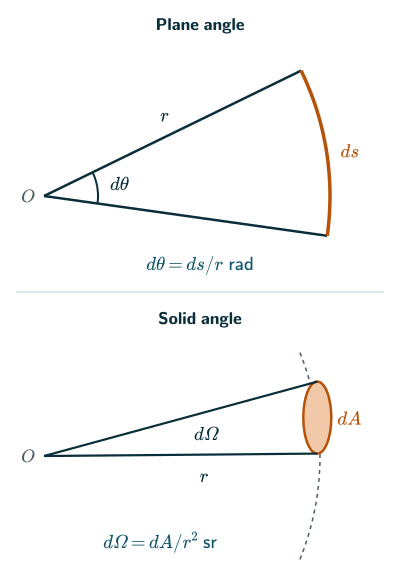
- Plane angle: the ratio of the arc length ds to the radius r of a circle centred at the vertex O, dθ = ds/r radian. A full circle is 2πr/r = 2π rad.
- Solid angle: the ratio of the area dA that the cone cuts out on a sphere centred at its apex O to the square of the sphere’s radius, dΩ = dA/r steradian. A whole sphere is 4πr/r = 4π sr.
Both are ratios of like quantities, so both are dimensionless (page 2). Older books and some exam questions call the radian and steradian supplementary units; since 1995 the SI treats them as dimensionless derived units (beyond the NCERT text).
Units outside SI
Some units outside SI are retained for general use (NCERT Table 1.2, page 3), for example:
- minute (min) = 60 s; hour (h) = 3600 s; day (d) = 86 400 s; year (y) = 365.25 d ≈ 3.156 × 10 s;
- degree (°) = (π/180) rad;
- litre (L) = 1 dm = 10 m; tonne (t) = 10 kg;
- bar = 10 Pa; standard atmosphere (atm) = 101 325 Pa ≈ 1.013 × 10 Pa.
(Two printing slips in NCERT Table 1.2: the litre’s value is printed with a capital I in place of the digit 1, and the carat’s symbol is given as c, which clashes with centi; the usual symbol is ct.)
Solved examples
Example 1: Derived units in base units
Express the newton, joule, watt and pascal in SI base units.
- Newton, from F = ma: kg × m s = kg m s.
- Joule, from work = force × displacement: kg m s × m = kg m s.
- Watt, from power = work/time: kg m s ÷ s = kg m s.
- Pascal, from pressure = force/area: kg m s ÷ m = kg m s.
Answer: N = kg m s, J = kg m s, W = kg m s, Pa = kg m s.
Example 2: An angle in radians
An arc 15 cm long is cut from a circle of radius 30 cm. Find the angle it subtends at the centre.
θ = s/r = 15/30 = 0.5 rad. In degrees, 0.5 × 180/π, about 28.6°.
Answer: 0.5 rad, about 28.6°. The lengths must be in the same unit; the radian has no unit of length left over.
Example 3: A solid angle
A patch of area 0.2 m lies on a sphere of radius 2 m. What solid angle does it subtend at the centre?
Ω = A/r = 0.2/2 = 0.05 sr. The whole sphere is 4π ≈ 12.57 sr, so the patch is about 0.4% of it.
Answer: 0.05 sr.
Example 4: Converting units
Convert (a) 72 km/h to m/s and (b) a density of 1 g/cm to kg/m.
(a) 72 km/h = 72 × 1000 m/3600 s = 20 m/s.
(b) 1 g/cm = 10 kg/10 m = 1000 kg/m.
Answer: 20 m/s and 1000 kg/m.
Example 5: A small angle
A metre stick is seen side-on from 100 m away. What angle does it subtend at the eye?
For a small angle the arc is very nearly the straight length: θ ≈ 1.0/100 = 0.01 rad, about 0.573°.
Answer: about 0.01 rad (0.573°).
Common mistakes to avoid
Common mistake
Writing unit symbols wrongly
Symbols have fixed forms: kg, not Kg or kgs; K, not °K; s, not sec. Units named after people have capital symbols (N, J, W, Pa, Hz), but their names are written in lower case (newton, joule). The litre’s capital L is an allowed exception, so it is not misread as the digit 1. NCERT Appendix A8 (referred to on page 3) gives the full guidelines.
Common mistake
Calling the coulomb or the lumen a base unit
Electric current, not charge, is the base quantity: the coulomb is derived, 1 C = 1 A s. The candela (luminous intensity) is a base unit, but the lumen (luminous flux, 1 lm = 1 cd sr) is derived.
Common mistake
Treating the radian as a unit of length
An angle in radians is a ratio of two lengths, so it is dimensionless. Use the same unit for the arc and the radius.
Common mistake
Calling the litre an SI unit
The litre is accepted for use with SI, but the SI unit of volume is the cubic metre; 1 L = 10 m.
Common mistake
Using a mole without saying of what
One mole always means the same number of specified entities. For example, 1 mol of oxygen molecules contains 2 mol of oxygen atoms, whereas 1 mol of oxygen atoms contains half as many atoms. Both samples have an amount of substance of 1 mol when counted using their stated entities, but their masses differ. Always state what is being counted.
Common mistake
Copying the elementary charge from NCERT Table 1.1
The table drops the minus sign in the power. The elementary charge is 1.602 176 634 × 10 C, a tiny charge.
Quick revision summary
- A measurement is a number times a unit.
- SI has seven base units: m, kg, s, A, K, mol, cd. Derived SI units are built from the base units.
- Since 20 May 2019, SI is defined through seven constants with fixed numerical values: c, h, ΔνCs, e, k, NA and Kcd.
- Plane angle: dθ = ds/r rad; solid angle: dΩ = dA/r sr; both dimensionless. A circle is 2π rad and a sphere 4π sr.
- Derived units: N = kg m s, J = kg m s, W = kg m s, Pa = kg m s.
Formula sheet
- dθ = ds/r (radian)
- dΩ = dA/r (steradian)
- full circle = 2π rad; full sphere = 4π sr
- 1° = (π/180) rad
- N = kg m s; J = kg m s; W = kg m s; Pa = kg m s
Questions students ask
What is the full form of SI, and when was it adopted?
SI is short for Système International d’Unités, French for the International System of Units, the form of the metric system used in science worldwide. It was adopted by the General Conference on Weights and Measures (CGPM) in 1960 and is maintained by the International Bureau of Weights and Measures (BIPM) at Sèvres, near Paris. Its present definitions come from the revision agreed in November 2018 and in force since 20 May 2019, which defines the system through seven constants with fixed numerical values.
What is the difference between fundamental and derived units?
Fundamental units, also called base units, are the units of the base quantities, chosen so that none of them is built from the others: SI has seven, among them the metre, kilogram and second. Derived units are products of powers of the base units, read off from the formula that defines the quantity: density is mass/volume, so its unit is kg m, and acceleration is change in velocity/time, so its unit is m s. Some derived units have special names, such as the newton and the hertz, but each is still a combination of base units.
What are supplementary units in SI?
The supplementary units were the radian (rad), for plane angle, and the steradian (sr), for solid angle, which older books list as a third class beside the base and derived units. One radian is the angle subtended at the centre of a circle by an arc equal in length to the radius, and one steradian is the solid angle subtended at the centre of a sphere by a patch of its surface whose area equals the square of the radius. Since 1995 the SI has counted both as dimensionless derived units; neither is a base unit.
Why is the kilogram, not the gram, the SI base unit of mass?
The kilogram is the SI base unit of mass for historical and practical reasons, and it is the only base unit whose name carries a prefix. The metric system of the 1790s defined the gram, but trade needed a sturdy metal standard of a practical size, so in 1799 a one-kilogram platinum cylinder became the standard of mass. When the metre–kilogram–second system was later chosen, it also made the mechanical units match the practical electrical units with no stray powers of 10: 1 V × 1 A = 1 W = 1 J s = 1 kg m s. Prefixes still go on the gram: 10 kg is a milligram, not a microkilogram.
Is the degree Celsius an SI unit?
Yes, the degree Celsius (°C) is an SI derived unit, though the SI base unit of thermodynamic temperature is the kelvin (K). The two are the same size, so a temperature difference of 1 °C equals 1 K, but their zeros differ: 0 °C is 273.15 K, so T = t + 273.15, with t in °C and T in kelvin (see the kelvin scale). Gas laws such as PV = nRT need the temperature in kelvin.
How are the volt and the ohm written in SI base units?
In SI base units the volt is kg m s A and the ohm is kg m s A. A volt is a joule per coulomb and a coulomb is an ampere second, so 1 V = (1 kg m s)/(1 A s) = 1 kg m s A; an ohm is a volt per ampere, which adds one more A. The same powers make up the dimensional formulae of potential difference and resistance.
Practice questions
Try each question first, then open the answer to check your working.
-
Q1. Name the seven SI base quantities and their units.
Show answerHide answer
Length (metre, m), mass (kilogram, kg), time (second, s), electric current (ampere, A), thermodynamic temperature (kelvin, K), amount of substance (mole, mol) and luminous intensity (candela, cd).
-
Q2. What solid angle does a hemisphere subtend at its centre?
Show answerHide answer
Its curved surface area is 2πr, so Ω = 2πr/r = 2π, about 6.28 sr.
-
Q3. Why are the radian and the steradian dimensionless?
Show answerHide answer
Each is a ratio of like quantities: the radian is arc length divided by radius, and the steradian is area divided by the square of the radius. The units cancel.