Dimensions of physical quantities
NCERT Class 11 Physics Chapter 1 Section 1.4
Quick answer
The dimensions of a physical quantity are the powers to which the base quantities, such as mass [M], length [L] and time [T], are raised to represent it. Force is mass times acceleration, so its dimensions are [M L T]: one in mass, one in length and −2 in time. Dimensions describe the kind of quantity, not its size, so every velocity and speed has dimensions [L T].
With your textbook
NCERT Physics Part I (Class 11), Chapter 1 “Units and Measurement”, Section 1.4 “Dimensions of physical quantities”, page 7.
Open the official NCERT chapter (PDF, 1.1 MB, ncert.nic.in) (opens in a new tab)
Checked against the 2026-27 reprint on .
What are the dimensions of a physical quantity?
Dimensions
Every physical quantity can be built from seven base quantities: length, mass, time, electric current, thermodynamic temperature, luminous intensity and amount of substance. NCERT calls them the seven dimensions of the physical world and writes them in square brackets: [L], [M], [T], [A], [K], [cd] and [mol] (Section 1.4, page 7).
The dimensions of a quantity are the powers to which these base quantities are raised to represent it. Force has dimensions [M L T]: one in mass, one in length and −2 in time.
The dimensions of a physical quantity are the powers (or exponents) to which the base quantities are raised to represent that quantity.
NCERT Physics Part I (Class 11), Section 1.4, page 7
In plain words: dimensions tell you what kind of quantity something is, not how big it is. A speed of 3 m/s and a speed of 300 km/h are different amounts of the same kind of thing, a length divided by a time, so both have dimensions [L T].
The seven base dimensions
| Base quantity | SI unit | Dimension |
|---|---|---|
| Length | m | [L] |
| Mass | kg | [M] |
| Time | s | [T] |
| Electric current | A | [A] |
| Thermodynamic temperature | K | [K] |
| Luminous intensity | cd | [cd] |
| Amount of substance | mol | [mol] |
These are the base quantities of the SI units. Square brackets round a quantity mean “the dimensions of” it: [F] is read as the dimensions of force (NCERT page 7). In mechanics, [L], [M] and [T] are enough.
The SI’s own dimension symbols differ for four of them: I for current, Θ (theta) for temperature, N for amount of substance and J for luminous intensity, and many books follow the SI (beyond the NCERT text). NCERT’s [A], [K], [mol] and [cd] borrow the unit symbols instead. Whatever the letters, temperature is never [T], which is time.
A note on printing: NCERT writes some zero powers with a raised circle, as in [M°] and [T°] on page 7. These are zero powers, M and T, as in its own equation [V] = [M L T] on the same page; they have nothing to do with degrees.
Dimensions of derived quantities
To find the dimensions of any derived quantity:
- Write it in terms of quantities whose dimensions you know, using its definition or a formula.
- Replace each quantity by its dimensions, and drop pure numbers such as ½ or 2π, which have none.
- Collect the powers of M, L and T.
NCERT’s first two examples (page 7): volume = length × breadth × height, so its dimensions are [L] × [L] × [L] = [L], with zero dimension in mass and time. Force = mass × acceleration = mass × length/(time), so its dimensions are [M L T].
Note that in this type of representation, the magnitudes are not considered.
NCERT Physics Part I (Class 11), Section 1.4, page 7
So a change in velocity, an initial velocity, an average velocity, a final velocity and a speed all have the same dimensions, [L T] (page 7).
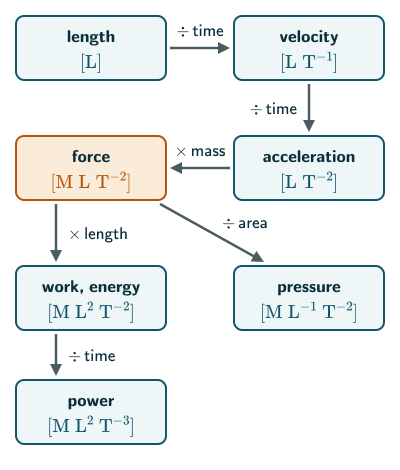
The same steps give the dimensions of the common mechanical quantities; with zero powers left out, these are the quantities’ dimensional formulae. In the table, the middle column gives a relation sufficient to find dimensions. It is not always a general vector equation: use change in velocity over time for average acceleration, constant force for Ft, and force parallel to displacement for Fs. The notation is: m is mass, V volume, v velocity, a acceleration, F force, W work, A area and θ an angle; l, b, h and s are lengths, t is a time, and d is the perpendicular distance from the axis to the line of the force:
| Quantity | From | Dimensions |
|---|---|---|
| Area | l × b | [L] |
| Volume | l × b × h | [L] |
| Density | m/V | [M L] |
| Velocity, speed | s/t | [L T] |
| Acceleration | v/t | [L T] |
| Momentum | mv | [M L T] |
| Force | ma | [M L T] |
| Impulse | Ft | [M L T] |
| Work, energy | Fs | [M L T] |
| Power | W/t | [M L T] |
| Pressure, stress | F/A | [M L T] |
| Frequency | 1/period | [T] |
| Angular velocity | θ/t | [T] |
| Torque | Fd | [M L T] |
As a check, the kinetic energy ½mv has dimensions [M] × [L T] = [M L T], the same as work, as it must since work changes kinetic energy.
Dimensionless quantities
A quantity whose powers of every base quantity are zero is dimensionless. Many are ratios of two like quantities; NCERT gives angle and refractive index as examples (NCERT Section 1.6.1, page 8). Common ones:
- angle = arc length/radius, in radians;
- strain = change in length/original length;
- refractive index = speed of light in vacuum/speed of light in the medium;
- relative density = density of a substance/density of water;
- coefficient of friction = limiting static friction/normal reaction, or kinetic friction/normal reaction in the usual sliding model. Static friction below its limit need not equal the coefficient times the normal reaction.
Pure numbers, such as 2, π and ½, are dimensionless too. A dimensionless quantity can still have a unit: an angle is measured in radians, but the radian is a ratio of two lengths (see plane and solid angle).
Same dimensions, different quantities
Dimensions describe the kind of quantity, but they do not identify it uniquely; this is one of the limits of dimensional analysis. Several different quantities share the same dimensions:
- work, energy and torque: [M L T];
- momentum and impulse: [M L T];
- angular momentum and the Planck constant: [M L T] (Q4 and Q5);
- pressure, stress, Young’s modulus (stress/strain) and energy per unit volume: [M L T];
- spring constant and surface tension: [M T] (Example 4);
- frequency and angular velocity: [T].
Constants can have dimensions as well. The gravitational constant G in the universal law of gravitation is [M L T] (Example 3); a pure number such as 2π has none.
Solved examples
Example 1: Momentum and impulse
Find the dimensions of momentum (p = mv) and of impulse (force × time). What do you notice?
[p] = [M] × [L T] = [M L T]. [Impulse] = [M L T] × [T] = [M L T].
Answer: both are [M L T]. This fits the fact that an impulse equals the change in momentum it produces.
Example 2: Pressure and energy per unit volume
Show that pressure (force/area) and kinetic energy per unit volume (½ρv, where ρ is density) have the same dimensions.
[Pressure] = [M L T]/[L] = [M L T].
[½ρv] = [M L] × [L T] = [M L] × [L T] = [M L T]. The ½ is a pure number and is dropped.
Answer: both are [M L T], and 1 Pa = 1 J m. This establishes dimensional equivalence, not equality of pressure and kinetic-energy density in every situation.
Example 3: The gravitational constant
In F = Gm1m2/r, find the dimensions of G.
Rearranging, G = Fr/(m1m2). So [G] = [M L T] × [L]/[M] = [M L T].
Answer: [M L T]. Its SI unit, N m kg, says the same thing in units.
Example 4: Spring constant and surface tension
A spring constant is force per unit extension (k = F/x), and surface tension is force per unit length (S = F/l). Find the dimensions of each.
[k] = [M L T]/[L] = [M T]. [S] = [M L T]/[L] = [M T].
Answer: both are [M T], although one measures the stiffness of a spring and the other a property of a liquid surface.
Example 5: A quantity with temperature and amount of substance
In the ideal gas equation PV = nRT, n is the amount of substance and T the temperature. Find the dimensions of the gas constant R.
R = PV/(nT). [PV] = [M L T] × [L] = [M L T], an energy. Dividing by [mol] and [K]:
[R] = [M L T K mol].
Answer: [M L T K mol]. Here T is a temperature, so its dimension is [K], not the [T] of time.
Common mistakes to avoid
Common mistake
Confusing units with dimensions
The kilogram, the gram and the tonne are different units, but all have the dimension [M]. A unit says how a quantity is measured; a dimension says what kind of quantity it is.
Common mistake
Giving numbers dimensions
The ½ in ½mv and the 2π in 2πr are pure numbers. They have no dimensions and do not appear in the answer.
Common mistake
Thinking an angle has dimensions because it has a unit
An angle in radians is arc length/radius, a ratio of two lengths. It has a unit, the radian, but no dimensions.
Common mistake
Assuming the same dimensions mean the same quantity
Work and torque are both [M L T], but torque is not energy. Dimensions cannot tell them apart.
Common mistake
Writing temperature as [T]
In dimensions [T] is time. NCERT writes temperature as [K]; other books use Θ.
Common mistake
Losing a power of time
Power is work per unit time: [M L T]/[T] = [M L T], not [M L T].
Quick revision summary
- The dimensions of a quantity are the powers of the base quantities that represent it (NCERT page 7).
- Seven base dimensions: [L], [M], [T], [A], [K], [cd], [mol]. In mechanics, [L], [M] and [T] are enough.
- To find dimensions, write the defining relation, replace each quantity by its dimensions, and drop pure numbers.
- Magnitudes do not matter: every velocity and speed is [L T].
- Ratios of like quantities (angle, strain, refractive index) are dimensionless.
- Different quantities can share dimensions (work and torque), and constants such as G can have dimensions.
Formula sheet
- [velocity] = [L T]; [acceleration] = [L T]
- [force] = [M L T]
- [momentum] = [impulse] = [M L T]
- [work] = [energy] = [torque] = [M L T]
- [power] = [M L T]
- [pressure] = [stress] = [M L T]
- [G] = [M L T]
Questions students ask
Why is electric current, and not charge, a fundamental quantity?
Electric current is an SI base quantity by convention; charge is derived, with dimensions [A T], because a constant current transfers charge q = It. This choice does not mean charge could never serve as a base quantity in another system. Before 2019 the ampere’s definition used the force between ideal parallel current-carrying wires. Since 2019 the ampere has been defined by fixing the elementary charge, e = 1.602 176 634 × 10 C, but current has stayed the base quantity.
Is every unitless quantity dimensionless?
Yes, every quantity without a unit is dimensionless, because a quantity with dimensions changes its number when the units change, so it cannot be stated without a unit. The converse is false: a dimensionless quantity may still carry a unit that names what is measured, such as the radian for an angle or the steradian for a solid angle, while strain, refractive index and relative density have neither unit nor dimensions.
How do you find the dimensions of a derivative or an integral?
A derivative dy/dx has the dimensions of y divided by those of x, because dy and dx are just small changes in y and x; a second derivative dy/dx has [y]/[x]. An integral ∫y dx is a sum of products y dx, so it has the dimensions of y times x. For example, dx/dt is [L]/[T] = [L T], an acceleration, and ∫F dx is [M L T][L] = [M L T], the dimensions of work.
Why is mass a fundamental quantity, and could force be one instead?
Mass is a fundamental quantity of SI by choice, not by necessity: any independent set of quantities from which all the others can be built would serve. If force, length and time were taken as the base quantities, mass would be derived from m = F/a, with dimensions [F L T], and some older engineering systems did work this way, with the kilogram-force or the pound-force as a base unit. In the same way, if force, velocity and time are the base quantities, mass = force × time/velocity has dimensions [F V T].
Are dimensions in physics the same as the three dimensions of space?
No, the dimensions of a physical quantity are the powers of the base quantities that represent it, such as [M L T] for force, while the three dimensions of space are the three independent directions in which a length can be measured. The two ideas meet in geometry: an area, the product of two lengths, has dimensions [L], and a volume [L]. SI has seven base dimensions, though mechanics needs only [M], [L] and [T].
Practice questions
Try each question first, then open the answer to check your working.
-
Q1. Find the dimensions of power.
Show answerHide answer
Power = work/time, so [power] = [M L T]/[T] = [M L T].
-
Q2. Which of these are dimensionless: strain, angle, pressure, refractive index, frequency?
Show answerHide answer
Strain, angle and refractive index are ratios of like quantities, so they are dimensionless. Pressure is [M L T] and frequency is [T].
-
Q3. Show that ρgh (density × acceleration due to gravity × height) has the dimensions of pressure.
Show answerHide answer
[ρgh] = [M L] × [L T] × [L] = [M L T], the dimensions of pressure.