Ideal-gas equation and absolute temperature
NCERT Class 11 Physics Chapter 10 Section 10.4
Quick answer
For a low-density gas, Boyle’s law (PV constant at fixed temperature) and Charles’ law (V/T constant at fixed pressure) combine into the ideal-gas equation PV = μRT, where μ is the number of moles and R = 8.31 J mol−1 K−1. At constant volume the pressure is proportional to the absolute temperature, and extrapolating to zero pressure gives absolute zero, −273.15 °C. The kelvin scale starts there, with T = tC + 273.15.
With your textbook
NCERT Physics Part II (Class 11), Chapter 10 “Thermal Properties of Matter”, Section 10.4 “Ideal-gas equation and absolute temperature”, pages 203–204.
Open the official NCERT chapter (PDF, 2.3 MB, ncert.nic.in) (opens in a new tab)
Checked against the 2026-27 reprint on .
What is the ideal-gas equation?
Ideal-gas equation
For an ideal gas, which approximates a dilute classical gas far from condensation, the pressure P, volume V and absolute temperature T of a sample containing μ moles are related by
where R = 8.31 J mol K is the universal gas constant (NCERT Section 10.4, page 204, Eq. 10.2). T is measured on the kelvin (absolute) scale, T = tC + 273.15.
In plain words: all gases at low density behave in the same simple way. At fixed temperature, compression raises pressure; heating a fixed sample at constant pressure increases its volume, or at constant volume raises its pressure. These facts combine into one equation, which also points to the lowest possible temperature, absolute zero, and so to the kelvin scale.
Boyle’s law and Charles’ law
The state of a fixed quantity of gas is described by its pressure, volume and temperature. Experiments on low-density gases give two laws (NCERT, page 203):
- Boyle’s law (Robert Boyle, 1627–1691): at constant temperature, PV = constant. Halve the volume and the pressure doubles. At constant temperature, Boyle’s law makes a gas’s bulk modulus equal to its pressure, about 10 Pa for air at 1 atm, over 20 000 times smaller than water’s.
- Charles’ law (Jacques Charles, 1747–1823): at constant pressure, V/T = constant, with T the absolute temperature. Raise T by a quarter and the volume rises by a quarter. In general ΔV/V = ΔT/T, so at constant pressure an ideal gas has a coefficient of volume expansion αV = 1/T (NCERT Eq. 10.6, page 206).
Together they give PV/T = constant for a given quantity of gas; the additional experimental fact that this constant is proportional to the number of moles gives the ideal gas law. Written for any quantity of any low-density gas, it is the ideal-gas equation:
Ideal-gas equation
Here μ is the number of moles. For a fixed quantity going from one state to another, P1V1/T1 = P2V2/T2.
Why “low density”? Real gases follow these laws closely when their molecules are far apart. At high densities or low temperatures they deviate, and near liquefaction they stop being gases at all (NCERT, pages 203–204).
The gas thermometer and absolute zero
At constant volume, the ideal-gas equation gives P ∝ T: the pressure of the gas measures its temperature.
Thus, with a constant-volume gas thermometer, temperature is read in terms of pressure.
NCERT Physics Part II (Class 11), Section 10.4, page 204
A graph of pressure against Celsius temperature for a gas at constant volume is a straight line. Extend it to lower temperatures, as if the gas stayed a gas, and it reaches zero pressure at −273.15 °C. Remarkably, every low-density gas, whatever its amount or kind, extrapolates to the same temperature. This temperature is absolute zero, the lowest temperature there can be (NCERT, page 204).
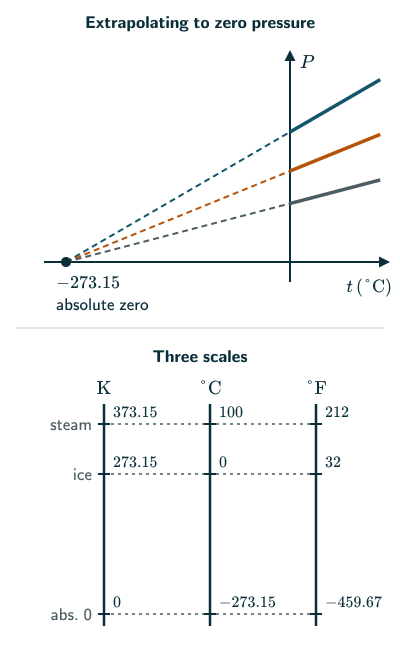
The kelvin scale
Absolute zero is the zero of the kelvin scale (absolute scale), named after Lord Kelvin: 0 K = −273.15 °C (NCERT, page 204).
The size of unit in Kelvin and Celsius temperature scales is the same.
NCERT Physics Part II (Class 11), Section 10.4, page 204
So the two scales differ only by a shift:
Kelvin and Celsius
The ice point is about 273.15 K and the steam point about 373.15 K; on the Fahrenheit scale, absolute zero is −459.67 °F (NCERT Fig. 10.4 prints −459.69 °F; NCERT Eq. 10.1 gives −459.67 °F). NCERT’s Points to Ponder (page 223) adds that the scale is fixed by assigning exactly 273.16 K to the triple point of water, where ice, water and vapour coexist (since 2019 the kelvin has been defined through Boltzmann’s constant, and the triple-point thermodynamic temperature is approximately 273.16 K with measurement uncertainty, rather than an exact defining value); with this choice, water melts and boils at 1 atm very close to, but not exactly at, 0 °C and 100 °C. In every gas-law formula, T must be in kelvin: using °C would make V/T blow up at 0 °C, which has no physical meaning.
Solved examples
Take R = 8.31 J mol K.
Example 1: Squeezing a gas (Boyle’s law)
A gas occupies 2.0 L at 1.0 atm. At the same temperature it is compressed to 0.50 L. Find its new pressure.
P1V1 = P2V2, so P2 = 1.0 × 2.0/0.50 = 4.0 atm.
Answer: 4.0 atm.
Example 2: Heating a gas (Charles’ law)
A gas occupies 3.0 L at 27 °C. At constant pressure it is heated to 127 °C. Find its new volume.
In kelvin, 27 °C ≈ 300 K and 127 °C ≈ 400 K (adding 273). V2 = V1T2/T1 = 3.0 × 400/300 = 4.0 L.
Answer: 4.0 L. (Using °C would give the wrong answer, 3.0 × 127/27 ≈ 14 L.)
Example 3: How many moles in a cubic metre?
How many moles of an ideal gas fill 1.0 m at 1.013 × 10 Pa and 0 °C? What volume does one mole occupy?
μ = PV/(RT) = 1.013 × 10 × 1.0/(8.31 × 273.15), about 44.6 mol. One mole occupies 1.0/44.6 m, about 22.4 L.
Answer: about 44.6 mol; about 22.4 L per mole at 0 °C and 1 atm.
Example 4: Reading a gas thermometer
A constant-volume gas thermometer reads a pressure of 80 kPa in melting ice (273.15 K) and 112 kPa in a hot bath. Find the temperature of the bath.
At constant volume P ∝ T, so T = 273.15 × 112/80, about 382.4 K, that is about 109.3 °C.
Answer: about 382 K (109 °C).
Example 5: Finding absolute zero from data
A gas at constant volume has a pressure of 100 kPa at 0 °C and 136.6 kPa at 100 °C. Where does the straight line through these points reach zero pressure?
The slope is (136.6 − 100)/100 = 0.366 kPa per °C, so the line is P = 100 + 0.366t (P in kPa, t in °C). Setting P = 0 gives t = −100/0.366 ≈ −273.2 °C.
Answer: at about −273 °C, absolute zero.
Common mistakes to avoid
Common mistake
Using degrees Celsius in the gas laws
V/T, P/T and PV = μRT need T in kelvin. Always add 273.15 (273 is fine when the data are whole degrees).
Common mistake
Applying the ideal-gas equation to any gas at any density
It holds well only for gases at low density, far from liquefying.
Common mistake
Confusing moles with molecules
μ in PV = μRT is the number of moles. For N molecules, PV = NkBT, where kB = R/NA = 1.38 × 10 J K is Boltzmann’s constant and NA = 6.02 × 10 mol is Avogadro’s number (met in the kinetic theory chapter).
Common mistake
Mixing units with R
With R = 8.31 J mol K, put P in pascals and V in cubic metres (1 L = 10 m). Litres and atmospheres may also be used with a matching value of R (about 0.0821 L atm mol K), or consistently in ratios such as P1V1/T1 = P2V2/T2.
Common mistake
Converting a temperature difference with 273.15
A change of 1 °C is a change of 1 K; only temperatures themselves need the 273.15.
Quick revision summary
- Boyle’s law: PV = constant at constant temperature. Charles’ law: V/T = constant at constant pressure.
- Ideal-gas equation for low-density gases: PV = μRT, with R = 8.31 J mol K and μ the number of moles.
- At constant volume P ∝ T: a gas thermometer reads temperature through pressure.
- Extrapolated to zero pressure, all gases point to −273.15 °C: absolute zero, 0 K.
- Kelvin and Celsius degrees are the same size: T = tC + 273.15.
- In short: PV = μRT, with T in kelvin.
Formula sheet
- PV = constant (Boyle’s law, T constant)
- V/T = constant (Charles’ law, P constant)
- PV = μRT, R = 8.31 J mol K
- PV/T = PV/T (fixed quantity)
- T = tC + 273.15
Questions students ask
What is the SI unit and dimensional formula of the gas constant R?
The universal gas constant R has the SI unit J mol K and the dimensional formula [M L T K mol], since R = PV/(μT) and PV is an energy (see the table of dimensional formulae). Its value is 8.314 J mol K (8.31 in NCERT), which is about 1.99 cal mol K, so it rounds to R ≈ 2 cal mol K. It is the same for every gas, and it equals Avogadro’s number times Boltzmann’s constant: R = NAkB.
What are some real-life examples of Boyle’s law and Charles’ law?
Everyday examples of Boyle’s law (PV = constant for a fixed quantity of gas at constant temperature) include a syringe, which draws in liquid because pulling the plunger back lowers the pressure inside; the initial pressure reduction during breathing, before significant air enters; and a diver’s air bubbles, which grow as they rise into water at lower pressure. Once gas enters or leaves, the fixed-quantity law alone no longer describes the process. An approximate everyday example of Charles’ law (V/T = constant at constant pressure) is a balloon that shrinks in a refrigerator and swells again in a warm room. In Charles’ law T is the absolute temperature: a balloon cooled from 27 °C (300 K) to 0 °C (273 K) shrinks by only about 9%.
How do you find the density of a gas from the ideal-gas equation?
The density of an ideal gas is ρ = PM/(RT), where M is the molar mass in kg mol, because putting μ = m/M in PV = μRT gives P = (m/V)RT/M. So at fixed pressure a gas becomes less dense as it is heated, and at fixed temperature its density is proportional to its pressure. For example, air (M ≈ 0.029 kg mol) at 1.013 × 10 Pa and 300 K has ρ = 1.013 × 10 × 0.029/(8.31 × 300) ≈ 1.18 kg m; the hotter, less dense air inside a hot-air balloon is what gives it lift.
Can a gas be cooled to absolute zero?
No, a gas, or anything else, cannot be cooled all the way to absolute zero, 0 K (−273.15 °C or −459.67 °F); it can only be approached, and experiments can approach extremely low temperatures. At ordinary pressures gases condense before reaching 0 K (helium boils at about 4.2 K at 1 atm), while dilute trapped gases can instead enter quantum-degenerate regimes, so the straight line of pressure against temperature that points to absolute zero is an extrapolation of how an ideal gas would behave, not a measurement down to it. Absolute zero is the lowest possible temperature, but not one at which all motion stops: quantum physics leaves particles a small zero-point energy even there.
What do the graphs of Boyle’s law look like?
For a fixed quantity of gas at constant temperature, Boyle’s law (PV = constant) gives three standard graphs: P against V is a rectangular hyperbola, P against 1/V is a straight line through the origin, and PV against P (or against V) is a horizontal straight line. On a P–V graph each such curve, an isotherm, lies farther from the axes at a higher temperature, since PV = μRT is then larger. Real gases follow these lines only at low pressure; at high pressure their PV against P graphs curve away from the horizontal.
Practice questions
Try each question first, then open the answer to check your working. Take R = 8.31 J mol K.
-
Q1. The air in a tyre is at an absolute pressure of 300 kPa at 27 °C. After a long drive it warms to 57 °C. Treating the volume as fixed, find the new pressure.
Show answerHide answer
P ∝ T at constant volume: 300 × (57 + 273)/(27 + 273) = 300 × 330/300 = 330 kPa.
-
Q2. How many moles of gas are in a 10 L cylinder at 2.0 × 10 Pa and 300 K?
Show answerHide answer
μ = PV/(RT) = 2.0 × 10 × 0.010/(8.31 × 300), about 8.0 mol.
-
Q3. Why must temperatures be in kelvin, not degrees Celsius, in Charles’ law?
Show answerHide answer
Charles’ law says V is proportional to T, so V/T is constant. Since tC = T − 273.15, V/tC changes with temperature and would blow up at 0 °C, where the volume is not zero.