Measuring temperature
NCERT Class 11 Physics Chapter 10 Section 10.3
Quick answer
A thermometer uses a reproducible property that varies with temperature, such as liquid volume. In NCERT’s elementary two-point calibration, the ice and steam points at standard pressure are treated as 0 °C and 100 °C, or 32 °F and 212 °F, giving tF = 1.8tC + 32. Differences obey ΔtF = 1.8ΔtC, and the scales agree at −40°; modern SI temperature is defined using Boltzmann’s constant.
With your textbook
NCERT Physics Part II (Class 11), Chapter 10 “Thermal Properties of Matter”, Section 10.3 “Measurement of temperature”, page 203.
Open the official NCERT chapter (PDF, 2.3 MB, ncert.nic.in) (opens in a new tab)
Checked against the 2026-27 reprint on .
How is temperature measured?
A measure of temperature is obtained using a thermometer.
NCERT Physics Part II (Class 11), Section 10.3, page 203
Temperature scales
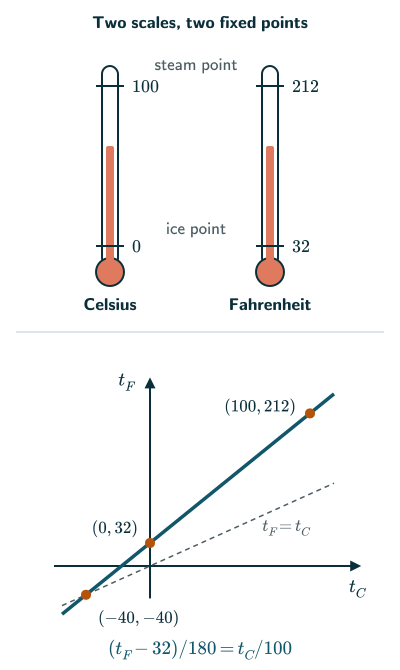
A thermometer uses a reproducible measurable property that varies with temperature, called a thermometric property. In the elementary two-point linear calibration described here, two fixed points set the offset and scale factor (NCERT Summary, page 221): the ice point and the steam point of pure water at standard pressure. On the Celsius scale these are 0 °C and 100 °C; on the Fahrenheit scale, 32 °F and 212 °F. The two scales are related by (NCERT Section 10.3, page 203, Eq. 10.1)
In plain words: to build a thermometer, choose something that changes as a body gets hotter, mark its value at two reproducible reference temperatures under specified conditions, divide the gap into equal steps, and you have a scale. The Celsius and Fahrenheit scales use the same two fixed points but number them differently.
Thermometers and fixed points
Many properties of materials change with temperature, and any of them can be used to build a thermometer. The commonest is the change in volume of a liquid. Liquids hardly change volume under pressure (their bulk modulus is large), so pressure effects are usually small over ordinary operating ranges, though precision thermometry must account for them. Its expansion is small, so a large bulb feeds a narrow tube that turns it into a long movement of the thread: in a liquid-in-glass thermometer, mercury or alcohol expands up the tube, and over a wide range its volume changes linearly with temperature (NCERT, page 203). Other thermometers use the pressure of a gas kept at constant volume (NCERT Section 10.4, page 204) or the electrical resistance of a wire (NCERT Exercise 10.3, page 223); beyond the NCERT text, a thermocouple uses the thermoelectric voltage of a circuit made from different conductors, with the measuring and reference junctions at different temperatures.
To calibrate this simple linear thermometer, use two fixed reference points with reproducible conditions. This is a calibration method, not a requirement that every modern temperature scale be defined by two water phase changes. Water gives two convenient ones:
- the ice point, where pure water freezes, and
- the steam point, where pure water boils,
both at standard atmospheric pressure. The gap between them is then divided into equal degrees: 100 on the Celsius scale and 180 on the Fahrenheit scale (NCERT, page 203). NCERT’s Points to Ponder (page 223) describes the older triple-point-based definition. Since 2019 the kelvin has instead been defined using Boltzmann’s constant; the triple point remains useful for calibration, and on the modern scale water melts and boils at 1 atm very close to, but not exactly at, 0 °C and 100 °C (see the kelvin scale).
Celsius and Fahrenheit
| Fixed point | Celsius | Fahrenheit |
|---|---|---|
| Ice point | 0 °C | 32 °F |
| Steam point | 100 °C | 212 °F |
A graph of tF against tC is a straight line through (0, 32) and (100, 212). Its equation is the conversion formula
Celsius–Fahrenheit conversion
which can also be written tF = 1.8tC + 32, or tC/5 = (tF − 32)/9. The line in the figure (after NCERT Fig. 10.1) has slope 9/5 = 1.8 and intercept 32. Because 100 Celsius degrees span the same range as 180 Fahrenheit degrees, a temperature difference converts as ΔtF = 1.8ΔtC, with no 32.
Any linear scale. The same idea converts between any two linear scales: the fraction of the way from the ice point to the steam point is the same on every scale,
Here X can be a scale reading or the thermometric property itself, such as the length of a mercury thread, a resistance or a gas pressure. For two linear scales X and Y, (X − Xice)/(Xsteam − Xice) = (Y − Yice)/(Ysteam − Yice). This also lets you correct a thermometer whose fixed points are marked wrongly (Example 3, Q7).
Different liquid-in-glass thermometers agree at the fixed points but can disagree slightly in between, because different liquids do not expand in exactly the same way. A gas thermometer, extrapolated to the zero-density limit, avoids this gas-dependent disagreement, which leads to the absolute (kelvin) scale (NCERT Section 10.4, pages 203–204).
Solved examples
Example 1: Body temperature
Normal body temperature is often given as 98.6 °F. Express it in degrees Celsius.
tC = (98.6 − 32) × 100/180 = 66.6/1.8 = 37 °C.
Answer: 37 °C.
Example 2: Where the scales agree
At what temperature do the Celsius and Fahrenheit scales give the same reading?
Put tF = tC = t in tF = 1.8tC + 32: t = 1.8t + 32, so −0.8t = 32 and t = −40.
Answer: −40 °C = −40 °F.
Example 3: An arbitrary scale
A thermometer on a scale X reads 20 at the ice point and 220 at the steam point. What is the Celsius temperature when it reads 120?
(X − 20)/(220 − 20) = tC/100, so tC = (120 − 20) × 100/200 = 50 °C.
Answer: 50 °C.
Example 4: A change in temperature
The temperature of a room rises by 18 °F during the day. What is the rise in Celsius degrees?
A difference converts without the 32: ΔtC = ΔtF/1.8 = 18/1.8 = 10 Celsius degrees.
Answer: 10 Celsius degrees (and also 10 K).
Common mistakes to avoid
Common mistake
Subtracting 32 from a temperature difference
The 32 shifts the zero of the scale. For a change in temperature use ΔtF = 1.8ΔtC only.
Common mistake
Dividing by 100 and 180 the wrong way round
Fahrenheit degrees are smaller: 180 of them span the same range as 100 Celsius degrees, so the same temperature change is a bigger number in Fahrenheit (ΔtF = 1.8ΔtC). Check with the steam point: 100 °C must give 212 °F.
Common mistake
Forgetting “standard pressure” for the fixed points
Water boils at a lower temperature at a lower pressure, for example on a mountain. The fixed points are defined at standard atmospheric pressure.
Common mistake
Thinking all thermometers agree everywhere
Two liquid-in-glass thermometers calibrated at the same fixed points can differ slightly between them, because liquids do not expand in exactly the same way.
Quick revision summary
- A thermometer uses a property that changes with temperature, such as the volume of mercury or alcohol.
- Elementary linear calibration uses two fixed points, such as the ice and steam points of pure water at standard pressure.
- Celsius: 0 °C and 100 °C, 100 divisions. Fahrenheit: 32 °F and 212 °F, 180 divisions.
- Conversion: (tF − 32)/180 = tC/100, or tF = 1.8tC + 32; a difference converts as ΔtF = 1.8ΔtC.
- The two scales agree at −40°.
Formula sheet
- (tF − 32)/180 = tC/100
- tF = 1.8tC + 32
- ΔtF = 1.8ΔtC
- (X − Xice)/(Xsteam − Xice) = tC/100 (any linear scale or thermometric property)
Questions students ask
How many temperature scales are there, and how are they related?
Three temperature scales are in common use, Celsius, Fahrenheit and kelvin (the SI scale), and two more, Réaumur and Rankine, are met occasionally; all are linear, so they are related by tC/100 = (tF − 32)/180 = (T − 273.15)/100 = tR/80, where tR is the Réaumur reading. Each fraction is how far the temperature lies from the ice point towards the steam point. For example, 300 K is 26.85 °C, which is 1.8 × 26.85 + 32 = 80.33 °F. The Rankine scale uses Fahrenheit-sized degrees counted from absolute zero, which is 0 K, −273.15 °C and −459.67 °F.
At what temperature do the Fahrenheit and kelvin scales give the same reading?
The Fahrenheit and kelvin scales give the same reading at about 574.6: 574.6 K is 574.6 °F, which is about 301.4 °C. Putting tF = T = x in tF = 1.8tC + 32, with tC = T − 273.15, gives x = 1.8(x − 273.15) + 32, so 0.8x = 459.67 and x ≈ 574.59. The Celsius and kelvin scales never agree, because they differ by 273.15 at every temperature.
Why is mercury used in thermometers?
Mercury is used in thermometers because it stays liquid over a wide range, from about −39 °C to 357 °C, and expands nearly uniformly over it, so equal steps on the scale mean equal changes in temperature. It is also opaque and shiny, so the thread is easy to read; it does not wet glass, so it leaves no film behind; and it conducts heat well and has a small specific heat, so it quickly takes the temperature of what it touches. Alcohol is used for very low temperatures, since it freezes only near −114 °C, and mercury thermometers are now being replaced in many places because mercury is toxic.
What is the difference between a clinical thermometer and a laboratory thermometer?
A traditional mercury-in-glass clinical thermometer measures body temperature over a short range, about 35 °C to 42 °C, and has a kink (a narrow constriction) above its bulb that stops the mercury falling back, so it keeps its reading after it is taken out of the mouth; it must be shaken down before use. A laboratory thermometer has a much wider range, typically −10 °C to 110 °C, and no kink, so it must be read while its bulb is still in the liquid. These two liquid-in-glass types use expansion. Modern digital and infrared clinical thermometers use different sensing methods and do not have a mercury-retaining kink.
What is the difference between a thermometer and a pyrometer?
A contact thermometer senses temperature after thermal contact with a body. A radiation pyrometer is a non-contact thermometer, often used for high temperatures, such as those of furnaces and molten metal, from a distance by the radiation the hot body gives out. A radiation pyrometer uses the fact that a hotter body radiates more strongly and at shorter wavelengths, the Stefan–Boltzmann and Wien laws, so it never needs to touch the body and is not damaged by its heat. Infrared thermometers that read body temperature from the forehead work in the same way.
Practice questions
Try each question first, then open the answer to check your working.
-
Q1. Convert 25 °C to degrees Fahrenheit.
Show answerHide answer
tF = 1.8 × 25 + 32 = 77 °F.
-
Q2. At what temperature is the Fahrenheit reading twice the Celsius reading?
Show answerHide answer
2tC = 1.8tC + 32, so 0.2tC = 32 and tC = 160 °C, which is 320 °F.
-
Q3. Why does an elementary linear calibration with unknown offset and scale factor need two fixed points?
Show answerHide answer
A linear conversion has two unknowns: its offset and scale factor. Two reference readings determine both. If one of those parameters is already known, one reference can suffice; modern SI temperature is defined through Boltzmann’s constant.