Heat transfer
NCERT Class 11 Physics Chapter 10 Section 10.9
Quick answer
Heat travels by conduction through matter, by convection as a fluid moves, and by radiation as electromagnetic waves that need no medium. In steady conduction through a bar of length L and cross-section A with ends at TC and TD, the heat current is H = KA(TC − TD)/L, where K is the thermal conductivity. A blackbody’s spectrum peaks where λm T = 2.9 × 10⁻³ m K (Wien’s law), and a body radiates power H = AeσT4 (Stefan–Boltzmann law, with e the emissivity and σ = 5.67 × 10⁻⁸ W m−2 K−4).
With your textbook
NCERT Physics Part II (Class 11), Chapter 10 “Thermal Properties of Matter”, Section 10.9 “Heat transfer”, pages 214–219.
Open the official NCERT chapter (PDF, 2.3 MB, ncert.nic.in) (opens in a new tab)
Checked against the 2026-27 reprint on .
What is heat transfer?
Three ways heat travels
Heat flows from one body to another, or from one part of a body to another, because of a temperature difference. It travels in three ways (NCERT Section 10.9, page 214):
- conduction: passed from particle to neighbouring particle, with no bulk movement of matter;
- convection: carried by the actual movement of a fluid;
- radiation: carried by electromagnetic waves, which need no medium.
There are three distinct modes of heat transfer: conduction, convection and radiation
NCERT Physics Part II (Class 11), Section 10.9, page 214
In plain words: hold one end of a steel spoon in a flame and the heat creeps along the metal to your fingers (conduction). Heat a pan of water and the hot water rises while cooler water sinks, stirring itself (convection). Sit near a fire and you feel its warmth at once, across the air and even through a vacuum (radiation).
Conduction
Conduction is the mechanism of transfer of heat between two adjacent parts of a body because of their temperature difference.
NCERT Physics Part II (Class 11), Section 10.9.1, page 214
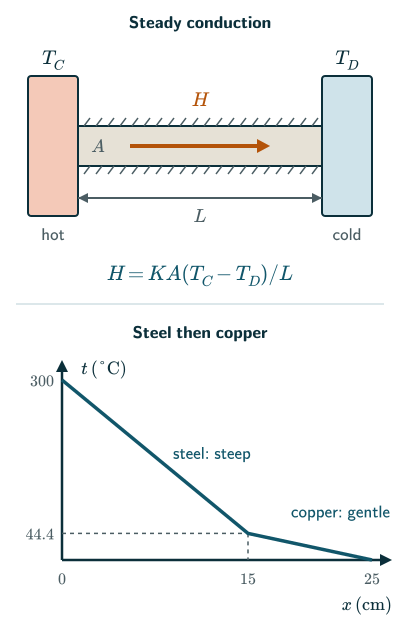
Take a bar of length L and uniform cross-section A. Hold its ends at temperatures TC and TD (with TC > TD), and insulate its sides so no heat leaks out sideways (NCERT Fig. 10.14, pages 214–215). After a while a steady state is reached. With constant thermal conductivity and no internal heat source, the temperature then falls evenly along the bar, and heat flows through it at a constant rate H, the heat current. Experiment shows that H is proportional to the temperature difference and to A, and inversely proportional to L:
Heat current by conduction (NCERT Eq. 10.14)
The constant K is the thermal conductivity of the material, in W m K (the same as J s m K). The larger K, the faster the material conducts heat.
Values. NCERT Table 10.6 (page 215) gives, in W m K:
- metals: silver 406, copper 385, aluminium 205, brass 109, steel 50.2, lead 34.7, mercury 8.3;
- non-metals: ice 1.6, concrete 0.8, glass 0.8, body fat 0.20, insulating brick 0.15, wood 0.12, felt 0.04, glass wool 0.04;
- gases: hydrogen 0.14, air 0.024, argon 0.016.
The table also lists water at 0.8 W m K. That is too high: measured values for water at room temperature are about 0.6 W m K. Its ice value, 1.6, is lower than the representative 2.2 W m K used in the Swiss Institute for Snow and Avalanche Research’s snow model; thermal conductivity depends on temperature and material structure. And where NCERT’s text (page 215) asks you to note the low conductivity of air “in the Table 10.5”, it means Table 10.6.
Using it. NCERT gives these examples (page 215):
- Some cooking pots have a copper-coated base, which spreads the heat evenly.
- Plastic foams insulate well because they hold pockets of air, a poor conductor.
- A concrete roof gets very hot in summer because concrete, though a far poorer conductor than metal, does not conduct poorly enough. A layer of earth or foam on the roof helps.
- In a nuclear reactor, heat must be carried out of the core fast enough to stop it overheating.
Bars in series and thermal resistance. In the steady state the same heat current H passes through every cross-section of a compound bar; otherwise some part would be heating up or cooling down (NCERT, page 216). It helps to write Eq. 10.14 as H = (TC − TD)/R, with R = L/(KA) the thermal resistance of the bar. This idea goes beyond the NCERT text. With negligible thermal contact resistance, bars joined end to end add their resistances, just like resistors in series in an electric circuit. For two bars of the same length and area, with free ends at T1 and T2, NCERT shows (page 216) that
- the junction temperature is T0 = (K1T1 + K2T2)/(K1 + K2);
- the compound bar of length 2L behaves like a single bar of conductivity K′ = 2K1K2/(K1 + K2).
Bars placed side by side between the same two temperatures are in parallel: their heat currents add, so 1/R = 1/R1 + 1/R2, and for equal lengths Keq = (K1A1 + K2A2)/(A1 + A2).
Convection
Convection is a mode of heat transfer by actual motion of matter.
NCERT Physics Part II (Class 11), Section 10.9.2, page 217
Convection is possible only in fluids (liquids and gases), and it moves whole parts of the fluid, which conduction does not (page 217).
Natural convection. When a fluid is heated from below, the hot part expands and becomes less dense. The buoyant force on it, which comes from the pressure increasing with depth, equals the weight of the cooler fluid it displaces, so it is now more than its own weight and the hot fluid rises. Cooler fluid moves in to take its place. That fluid is heated in turn, and the cycle goes on. This buoyancy-driven mechanism requires effective gravity and an unstable density distribution. Surface-tension gradients can drive a different form of convection even in microgravity.
Forced convection. A pump or fan moves the fluid. NCERT’s examples are forced-air home heating, the cooling system of a car engine, and the human body, where the heart pumps blood that carries heat around and helps redistribute heat and regulate temperature (page 217).
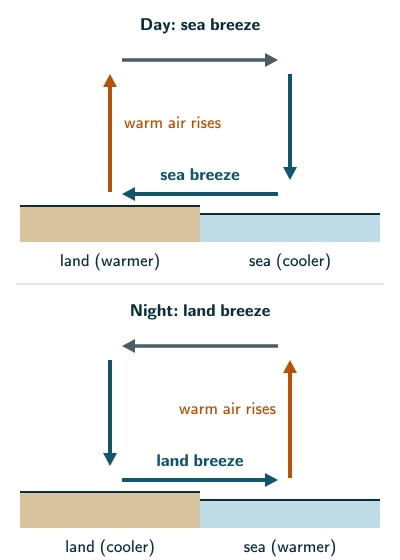
Sea and land breezes. By day the ground heats up faster than the sea. Water has a larger specific heat, and mixing spreads the heat it absorbs through a great volume. Air over the warm land rises, and cooler air from the sea flows in along the ground: a sea breeze. At night the land cools faster, the sea is the warmer of the two, and the cycle reverses (NCERT Fig. 10.17, page 217).
Trade winds. The equator receives more of the Sun’s heat than the poles. On a non-rotating Earth, convection would make air rise at the equator, move towards the poles high up, sink there and flow back along the surface. The Earth’s rotation changes this, and NCERT gives a simple explanation. Air near the equator moves eastward with the ground at about 1670 km/h (NCERT rounds this to 1600 km/h), while near the poles that speed is zero. Poleward-moving air is deflected eastward by Earth’s rotation. The tropical circulation generally descends in the subtropics, roughly 30° latitude; that latitude is not derived from a simple constant-eastward-speed argument. Flowing back along the surface, it reaches ground that moves east faster than it does, lags westward, and arrives from the north-east as the steady trade wind (NCERT, page 217).
Radiation
The third mechanism for heat transfer needs no medium; it is called radiation and the energy so transferred by electromagnetic waves is called radiant energy.
NCERT Physics Part II (Class 11), Section 10.9.3, page 218
Electromagnetic waves travel through a vacuum at the speed of light, 3 × 10 m s. That is how the Sun’s heat reaches the Earth across empty space, and why you feel a fire’s warmth at once. Every body emits radiant energy, solid, liquid or gas. The radiation a body emits because of its temperature, like the glow of red-hot iron or a lamp filament, is thermal radiation (page 218).
Absorbing and emitting. Incident radiation can be reflected, absorbed or transmitted. Visible colour is only a rough guide to absorption of sunlight; it does not determine infrared emissivity. At the same temperature, wavelength and direction, a good absorber is an equally good emitter (Kirchhoff’s law, beyond the NCERT text): a blackbody absorbs all the radiation falling on it and so is also the best emitter. Hence:
- light-coloured clothes often absorb less sunlight; thermal comfort also depends on fabric, ventilation and infrared properties;
- blackened bottoms on cooking utensils, to absorb the most heat from the fire.
The Dewar flask (thermos). It keeps hot things hot and cold things cold by cutting down all three modes (page 218):
- double glass walls, with the space between them evacuated, which cuts conduction and convection;
- silvered walls: the inner wall reflects radiation back into the contents, and the outer wall reflects incoming radiation away;
- a support on an insulator such as cork.
Blackbody radiation
Blackbody thermal radiation has a continuous spectrum, with different amounts of energy at different wavelengths (NCERT Section 10.9.4, page 218). For a perfect emitter, the spectral power per unit emitting area depends only on temperature. Total power still scales with area, while real materials can have wavelength-selective emission (page 219). Explaining them led to quantum physics.
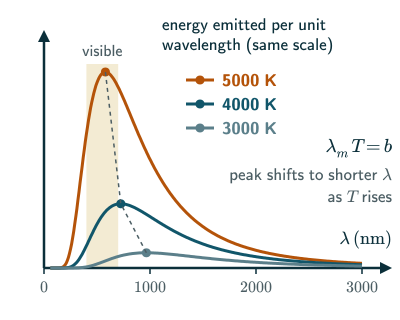
Wien’s displacement law. The wavelength λm at which the energy is greatest gets shorter as the temperature rises:
Wien’s displacement law (NCERT Eq. 10.15)
Here b = 2.9 × 10 m K is Wien’s constant.
This is why iron heated in a flame glows first dull red, then reddish yellow, then white hot. It also lets us estimate the surface temperatures of the Moon, the Sun and the stars (pages 218–219; Example 4).
Stefan–Boltzmann law. A perfect radiator of area A at absolute temperature T emits energy at the rate H = AσT, where σ = 5.67 × 10 W m K is the Stefan–Boltzmann constant (NCERT Eq. 10.16, page 219). Real bodies emit only a fraction e of this, their emissivity; e = 1 for a perfect radiator, and lamp black comes close. For a gray surface surrounded by a large isothermal enclosure at Ts, with the same effective absorptivity and emissivity and negligible intervening absorption, the net exchange is the second line below.
Radiated power (NCERT Eqs. 10.17 and 10.18)
At fixed emitting area and emissivity, doubling absolute temperature multiplies emitted power by 16; the net loss need not increase by that factor. Arctic clothing has a thin shiny metal layer next to the skin to reflect the body’s radiation back (page 219). When the excess T − Ts is much smaller than Ts, the net loss is nearly proportional to it, about 4eσATs3(T − Ts), so radiation alone then follows Newton’s law of cooling (beyond the NCERT text).
Solved examples
Example 1: Junction of a steel and a copper rod (NCERT Example 10.6)
A 15.0 cm steel rod (K = 50.2 W m K) is joined end to end to a 10.0 cm copper rod (K = 385 W m K). The steel rod has twice the cross-section of the copper rod. The free end of the steel is in a furnace at 300 °C, the free end of the copper in an ice box at 0 °C, and the rods are insulated along their sides. Find the junction temperature T in the steady state.
The same heat current flows through both rods: 50.2 × 2A(300 − T)/15 = 385A(T − 0)/10.
So 6.693(300 − T) = 38.5T, which gives T = 2008/45.19.
Answer: about 44.4 °C, as NCERT finds (page 216). Most of the temperature drop is across the steel, which conducts far less well.
Example 2: A compound bar (NCERT Example 10.7)
An iron bar (K1 = 79 W m K) and a brass bar (K2 = 109 W m K), each 0.1 m long with cross-section 0.02 m, are joined end to end. The free ends are held at 373 K (iron) and 273 K (brass). Find the junction temperature, the equivalent conductivity, and the heat current.
Junction: T0 = (79 × 373 + 109 × 273)/
Equivalent conductivity: K′ = 2 × 79 × 109/188, about 91.6 W m K.
Heat current: H = K′A(373 − 273)/(2L) = 91.6 × 0.02 × 100/0.2, about 916 W.
Answer: about 315 K, 91.6 W m K and 916 W, as NCERT finds (pages 216–217). Check with thermal resistances: R1 = 0.1/(79 × 0.02) ≈ 0.0633 K W and R2 ≈ 0.0459 K W, so H = 100/0.1092 ≈ 916 W.
Example 3: Heat through a window
A glass pane 1.0 m in area and 4.0 mm thick has its inner face at 20 °C and its outer face at 15 °C. Taking K = 0.8 W m K for glass (NCERT Table 10.6), find the heat current.
H = KAΔT/L = 0.8 × 1.0 × 5/0.004 = 1000 W.
Answer: 1000 W, that is 3.6 MJ every hour. Thin glass is a poor insulator, which is why double glazing traps a layer of air or gas between two panes.
Example 4: Temperatures from Wien’s law
Using NCERT’s illustrative thermal-emission peaks of 14 µm for a lunar region and 4753 Å for sunlight, estimate blackbody temperatures, with b = 2.9 × 10 m K.
Moon: T = b/λm = 2.9 × 10/(14 × 10), about 207 K.
Sun: T = 2.9 × 10/(4753 × 10), about 6100 K.
Answer: about 207 K and 6100 K for these assumed peaks. The lunar value concerns thermal infrared emission, not reflected visible moonlight, and is not a uniform Moon temperature: lunar surface temperature varies greatly with location and illumination. NCERT quotes 200 K and 6060 K (page 219); both agree with these within the precision of the data, since b and the Moon’s 14 µm have only two significant figures.
Example 5: A lamp filament and a human body
(a) A tungsten filament of surface area 0.3 cm and emissivity 0.4 is at 3000 K. At what rate does it radiate? (b) A person of surface area 1.9 m has skin at 28 °C (301 K) and emissivity 0.97, in a room at 22 °C (295 K). Find the net rate of radiative heat loss.
(a) H = AeσT = 0.3 × 10 × 0.4 × 5.67 × 10 × 3000, about 55 W.
(b) H = eσA(T − Ts4) = 0.97 × 5.67 × 10 × 1.9 × (301 − 295), about 66.4 W.
Answer: (a) about 55 W; NCERT rounds this to 60 W (page 219), one significant figure, like its data 0.3 cm and 0.4. (b) about 66.4 W, as NCERT finds: more than half of the roughly 120 W the body produces at rest (page 219).
Common mistakes to avoid
Common mistake
Using Celsius in the T law
Stefan’s law needs absolute temperatures in kelvin. In conduction only a temperature difference appears, so Celsius or kelvin give the same answer.
Common mistake
Averaging conductivities of bars in series
The heat current is the same through each bar, so add the thermal resistances L/(KA). For equal lengths and areas K′ = 2K1K2/(K1 + K2), not (K1 + K2)/2.
Common mistake
Expecting the same temperature gradient in every part
The heat current is the same, but the temperature falls fastest in the part with the smallest KA (Example 1).
Common mistake
Thinking a good absorber is a poor emitter
An ideal blackbody is a perfect absorber and emitter. For real surfaces, compare absorption and emission at the same temperature, wavelength and direction; visible colour alone does not determine infrared behaviour.
Common mistake
Convection in a solid or in a vacuum
Convection needs a fluid that can move. Only radiation crosses a vacuum.
Quick revision summary
- Heat travels by conduction (no bulk motion), convection (bulk motion of a fluid) and radiation (electromagnetic waves, no medium needed).
- Steady conduction: H = KA(TC − TD)/L; K in W m K; thermal resistance L/(KA) adds in series.
- Convection may be natural (buoyancy, as in sea and land breezes) or forced (a pump or fan).
- Good absorbers are good emitters; a Dewar flask reduces conduction, convection and radiation.
- Wien’s law: λmT = 2.9 × 10 m K. Stefan–Boltzmann law: H = AeσT, and net loss eσA(T − Ts4).
Formula sheet
- H = KA(TC − TD)/L (steady conduction)
- R = L/(KA); R = R + R in series
- K′ = 2KK/(K + K) (two equal bars in series)
- 1/R = 1/R + 1/R (bars in parallel)
- λm T = 2.9 × 10⁻³ m K (Wien)
- H = AeσT4; Hnet = eσA(T4 − Ts4), σ = 5.67 × 10⁻⁸ W m−2 K−4
Questions students ask
What is the difference between conduction, convection and radiation?
Conduction, convection and radiation differ in what carries the heat: in conduction, particles passing energy to their neighbours with no bulk flow; in convection, a fluid that moves; and in radiation, electromagnetic waves that need no medium. So conduction is the main mode in solids, convection happens only in liquids and gases, and radiation is the only one that crosses a vacuum. Radiation propagates at light speed in vacuum, but this does not mean it always delivers the largest heat-transfer rate; that depends on temperatures, areas and material properties. A pan of water on a stove shows all three: heat is conducted through its base and carried round the water by convection, while some reaches the pan as radiation from the flame.
What is the SI unit and dimensional formula of thermal conductivity?
Thermal conductivity K has the SI unit W m K (J s m K) and the dimensional formula [M L T K], from K = HL/(AΔT): a power, [M L T], times a length, divided by an area and a temperature (see the table of dimensional formulae). A large K means a good conductor: silver’s 406 W m K is about 17 000 times air’s 0.024 W m K. The thermal resistance of a bar, L/(KA), has the unit K W.
Why are metals good conductors of heat?
Metals are good conductors of heat mainly because they contain free electrons, which move quickly through the whole metal and carry energy from the hot end to the cold end far faster than vibrating atoms alone can pass it on. In most non-metals, such as glass or wood, heat travels only as vibrations handed on from atom to atom, so their conductivity is hundreds or thousands of times smaller; diamond, with its very stiff lattice, is a rare exception. The same free electrons make metals good conductors of electricity, which is why silver and copper top both lists.
What is Kirchhoff’s law of thermal radiation?
Kirchhoff’s law of thermal radiation says that, at thermal equilibrium and for the same temperature, wavelength and direction, the ratio of a body’s emissive power to its absorptive power is the same for all bodies and equals the emissive power of a perfect blackbody: E/a = Eb. So a good absorber is a good emitter, and the emissivity e of a surface equals its absorptivity at the same temperature and wavelength. A blackbody, with a = 1, is therefore the best possible emitter at every temperature. The law goes beyond the NCERT text but is in the JEE Advanced syllabus.
What is a perfect blackbody, and does one exist?
A perfect blackbody is an ideal body that absorbs all the radiation falling on it, at every wavelength, and so, by Kirchhoff’s law, is also the best possible emitter at every temperature. No real surface is perfect: even lamp black reflects a few per cent of the radiation that falls on it. The closest practical blackbody is a small hole in the wall of a hollow cavity blackened inside (Ferry’s blackbody), because radiation entering the hole is reflected again and again inside and almost none gets out; the Sun and the stars also radiate nearly as blackbodies.
Are Wien’s law and the Stefan–Boltzmann law in the JEE Main 2027 and NEET (UG) 2026 syllabuses?
Wien’s law and the Stefan–Boltzmann law are not named in the JEE Main 2027 or NEET (UG) 2026 syllabuses, whose Unit 7 lists heat transfer only as “conduction, convection, and radiation”, but they are named in the JEE Advanced 2026 syllabus, along with blackbody radiation and Kirchhoff’s law. Since radiation itself is listed for JEE Main and NEET, simple uses of the two laws are still worth knowing; NCERT covers both in Section 10.9.4.
Practice questions
Try each question first, then open the answer to check your working.
-
Q1. Why are light-coloured clothes cooler in summer, and why are cooking pots often blackened underneath?
Show answerHide answer
Many light fabrics reflect more sunlight than comparable dark fabrics, reducing solar heating; colour alone does not specify infrared emissivity. A black surface absorbs radiation well, so a blackened pot takes in more of the fire’s heat.
-
Q2. A concrete roof of area 20 m is 0.15 m thick. Its top surface is at 45 °C and its underside at 30 °C. Using K = 0.8 W m K (NCERT Table 10.6), find the rate at which heat flows into the room.
Show answerHide answer
H = KAΔT/L = 0.8 × 20 × 15/0.15 = 1600 W.
-
Q3. Why does a breeze blow from the sea to the land on a sunny afternoon?
Show answerHide answer
The land heats up faster than the sea, so the air above it warms, becomes less dense and rises. Cooler, denser air from over the sea flows in along the ground to replace it: a sea breeze, driven by natural convection.