Experiment: refractive index of a glass slab with a travelling microscope
Beyond NCERT In the JEE Main and NEET syllabus; the Class 12 book has no section for it.
Quick answer
A mark seen through a glass slab looks raised; viewed along the normal, the refractive index is n = real thickness/apparent thickness. A travelling microscope, moved without changing its focusing, is read on a mark (a1), on the same mark seen through the slab (a2) and on powder on the top face (a3), so n = (a3 − a1)/(a3 − a2). Repeat with the slab turned over, turn the screw one way only to avoid backlash, and keep the microscope vertical.
What is this experiment?
The principle behind it
A mark seen through a glass slab looks raised, because light from it bends away from the normal as it leaves the top face. NCERT states the result for viewing straight down (NCERT Section 9.3, page 229):
For viewing near the normal direction, it can be shown that the apparent depth (h1) is real depth (h2) divided by the refractive index of the medium (water).
NCERT Physics Part II (Class 12), Section 9.3, page 229
For a slab, the real depth is its real thickness and the apparent depth is its apparent thickness, so n = real thickness/apparent thickness. A travelling microscope measures both with three readings.
The aim is to find the refractive index of a glass slab using a travelling microscope: a microscope that slides up and down a vertical scale with a vernier, so that the height at which it is focused can be read to about 0.001 cm.
Both the JEE Main 2027 and the NEET (UG) 2026 syllabuses list this under Unit 20, Experimental Skills, as item 15, “refractive index of a glass slab using a travelling microscope”. The method below follows the NCERT Laboratory Manual (Physics, Class 12), Experiment 14, pages 105–109.
Uncertainty convention: the laboratory calculation below is a conservative maximum-error estimate, not a statistical standard deviation. The two thicknesses share reading a3 and therefore are correlated; adding their separate maximum relative errors can overestimate the bound. Actual focusing and alignment uncertainty can exceed the least count. Keep the microscope’s optical focus fixed and translate it between all three positions.
Real and apparent thickness of the slab
- Place a glass slab on a horizontal surface and look at its bottom face from above: it appears raised, by refraction. The distance from this apparent bottom up to the top face is the apparent thickness (Laboratory Manual, Experiment 14, page 105).
- Viewed along the normal, n = real thickness/apparent thickness (Laboratory Manual, page 105), the same rule as for real and apparent depth in a tank of water (NCERT page 229).
- So a slab of thickness t has apparent thickness t/n, and a mark under it seems raised by t − t/n = t(1 − 1/n) (reasoned from NCERT page 229).
- The rule holds only for near-normal viewing, so the microscope must look straight down at the slab; a tilted microscope is a source of error (Laboratory Manual, page 108).
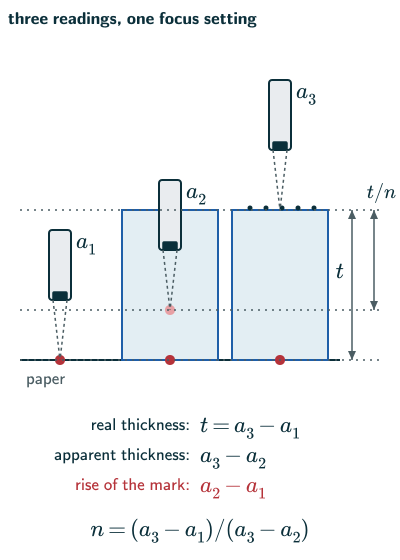
Refractive index from three microscope readings
- Least count. Find it first. In the Laboratory Manual’s example, 20 main-scale divisions are 1 cm and 50 vernier divisions equal 49 main-scale divisions, so the least count is 1/20 − 49/(50 × 20) = 0.001 cm (Laboratory Manual, page 106), worked out as for vernier callipers.
- Reading a1. Put a mark on a sheet of paper on the microscope’s platform, set the microscope vertically above it, focus on the mark and record the main-scale and vernier readings (Laboratory Manual, page 106).
- Reading a2. Place the slab over the mark and raise the microscope, without touching its focusing, until the mark seen through the slab is sharp again (Laboratory Manual, page 106).
- Reading a3. Sprinkle a little lycopodium powder or chalk dust on the top face and raise the microscope until the particles are in focus (Laboratory Manual, page 106).
- Repeat with the slab turned over, and take the mean of the two values of n (Laboratory Manual, pages 106–107).
- Result. Real thickness = a3 − a1; apparent thickness = a3 − a2. So:
Refractive index from the readings
- Laboratory Manual inconsistency: page 107 of the NCERT Laboratory Manual prints n = (a1 − a3)/(a1 − a2). That fits its Fig. E 14.1 (page 105), which labels the top face a1 and the bottom a3, but not its procedure (page 106), which takes a1 on the mark and a3 on the powder. With those readings a1 − a2 is the rise of the mark, and dividing by it gives n/(n − 1), about 3 for glass. Use (a3 − a1)/(a3 − a2).
- Conservative first-order uncertainty bound. With b the real and c the apparent thickness, Δn/n = Δb/b + Δc/c, where each thickness is a difference of two readings. If each reading is assigned a maximum uncertainty of one least count, take Δb = Δc = 2 × least count (Laboratory Manual, page 107; see combination of errors). NCERT Laboratory Manual error: its Eqs. (E 14.2) and (E 14.3) add relative errors; for a difference the absolute errors add, as its final Δn/n = 2Δa/b + 2Δa/c assumes.
- Precautions (Laboratory Manual, page 108): turn the focusing screw in one direction only, to avoid backlash error; do not change the microscope’s focusing after the first reading; keep the slab horizontal; read the vernier with a hand lens.
- Sources of error (Laboratory Manual, page 108): the microscope not normal to the slab; a thick layer of powder that does not mark the true top face.
Solved examples
Example 1: From three readings
The readings are a1 = 4.235 cm, a2 = 4.912 cm and a3 = 6.270 cm, with a least count of 0.001 cm. Find the refractive index and its uncertainty.
Answer: real thickness = 6.270 − 4.235 = 2.035 cm; apparent thickness = 6.270 − 4.912 = 1.358 cm; n = 2.035/1.358 ≈ 1.499. Δn/n = 0.002/2.035 + 0.002/1.358 ≈ 0.0025, so Δn ≈ 0.004 and n = 1.499 ± 0.004 (reasoned from the Laboratory Manual, page 107).
Example 2: The least count
On a travelling microscope, 20 main-scale divisions make 1 cm and 50 vernier divisions match 49 main-scale divisions. Find the least count.
Answer: 1 MSD = 0.05 cm and 1 VSD = (49/50) × 0.05 = 0.049 cm, so the least count is 0.05 − 0.049 = 0.001 cm (Laboratory Manual, page 106).
Example 3: The wrong denominator
With the readings of Example 1, what does the Laboratory Manual’s printed ratio (a1 − a3)/(a1 − a2) give?
Answer: (4.235 − 6.270)/
Example 4: Which mark rises most?
Three slabs of the same size, one hollow and filled with water, one of crown glass and one of flint glass, each have a mark on the bottom. In which does the mark appear to rise most? (nflint > ncrown > nwater.)
Answer: the rise is t(1 − 1/n), which grows with n, so the mark under the flint glass rises most and the one under water least (Laboratory Manual, page 109; reasoned from NCERT page 229).
Common mistakes to avoid
Common mistake
Dividing by the rise of the mark
The apparent thickness is a3 − a2, from the raised image of the mark to the top face; a2 − a1 is how far the mark seems raised (readings as in the Laboratory Manual’s procedure, page 106).
Common mistake
Refocusing between readings
Change the height of the whole microscope, not its focusing; otherwise the readings no longer track the focused points (Laboratory Manual, page 108).
Common mistake
Looking at the slab at an angle
n = real/apparent thickness holds only for near-normal viewing (NCERT page 229; Laboratory Manual, page 108).
Quick revision summary
- A mark under a slab of thickness t seems raised by t(1 − 1/n); viewed along the normal, n = real thickness/apparent thickness.
- Three readings of a travelling microscope: a1 on the mark, a2 on the mark through the slab, a3 on powder on top.
- Real thickness a3 − a1, apparent thickness a3 − a2, so n = (a3 − a1)/(a3 − a2); the Laboratory Manual’s printed (a1 − a3)/(a1 − a2) swaps a1 and a3 relative to its procedure.
- Uncertainty Δn/n = Δb/b + Δc/c, each Δ being two least counts; repeat with the slab inverted and average.
Formula sheet
- n = real thickness/apparent thickness
- n = (a3 − a1)/(a3 − a2)
- rise of the mark = t(1 − 1/n)
- Δn/n = Δb/b + Δc/c
Questions students ask
Is the glass slab experiment with a travelling microscope in NCERT and the JEE and NEET syllabus?
Yes, the refractive index of a glass slab using a travelling microscope is item 15 of Unit 20, Experimental Skills, in both the JEE Main syllabus and NEET (UG) 2026, whose Unit 20 asks for “Familiarity with the basic approach and observations of the experiments and activities”. The NCERT Class 12 textbook has no section on the method: it gives only the theory, that for viewing near the normal the apparent depth is the real depth divided by the refractive index (Class 12 Physics Part II, page 229). The method, readings and precautions are in Experiment 14 of the NCERT Laboratory Manual (Physics, Class 12), pages 105–109.
Why is it called a travelling microscope, and how is it different from a compound microscope?
A travelling microscope is so called because the whole microscope travels along a scale with a vernier, vertically in this experiment, so the reading gives the height at which it is focused: it magnifies the target while measuring its position along the scale. Here it is raised between readings while its focusing is left untouched (NCERT Laboratory Manual, Experiment 14, pages 106 and 108), so each reading follows the height of the point in focus. An ordinary compound microscope is built for a large magnifying power, to show fine detail; the travelling microscope needs only enough magnification to judge a sharp focus.
How do you take a reading on a travelling microscope?
A travelling microscope reading is the main-scale reading plus the vernier reading, MSR + (coinciding vernier division) × least count, as in the NCERT Laboratory Manual’s observation table (page 107). With 20 main-scale divisions to the centimetre, read the main scale at the last 0.05 cm mark below the vernier zero; if that is 6.35 cm and vernier division 27 lines up, the reading is 6.35 + 27 × 0.001 = 6.377 cm for a least count of 0.001 cm, found as for vernier callipers. A constant additive zero offset cancels, because the real and apparent thicknesses are differences of two readings.
Does the refractive index depend on the thickness of the glass slab?
No, the refractive index is a property of the glass (and of the wavelength of light), not of the slab’s thickness: a thicker slab has a larger real and apparent thickness, and the rise of the mark, t(1 − 1/n), grows with t, but the ratio of the two thicknesses stays n. A thicker slab reduces the fractional contribution of the same reading uncertainty, provided focusing quality and other systematic errors remain comparable, because each thickness is a difference of two readings with the same uncertainty of two least counts (NCERT Laboratory Manual, page 107). With a least count of 0.001 cm and n ≈ 1.5, Δn/n = 2 × 0.001 × (1 + n)/t, with t in cm, is about 0.38% for a slab 1.3 cm thick but only about 0.10% for one 5.2 cm thick.
Can the same method find the refractive index of a liquid?
Yes, the NCERT Laboratory Manual suggests using the same method for transparent liquids, held in a thin glass beaker (Experiment 14, page 109). Focus on a mark on the inside of the beaker’s bottom while it is empty (a1), pour in the liquid and translate the whole microscope vertically, without changing its focusing, until the mark is sharp through it (a2), then focus on a little lycopodium powder sprinkled on the surface (a3); n = (a3 − a1)/(a3 − a2) as for the slab. If the liquid stands 4.80 cm deep and the mark appears 3.61 cm below the surface, n = 4.80/3.61 ≈ 1.33, the value for water.
Practice questions
Try each question first, then open the answer to check your working.
-
Q1. A slab 3.0 cm thick appears 2.0 cm thick when viewed from above. Find its refractive index.
Show answerHide answer
n = 3.0/2.0 = 1.5 (Laboratory Manual, page 105).
-
Q2. Will a colourless glass slab be visible when immersed in a transparent liquid of the same refractive index?
Show answerHide answer
No: with the same refractive index there is no refraction or reflection at its surfaces, so light passes as if the slab were not there (Laboratory Manual, page 108, Self assessment 1; reasoned from NCERT Eq. (9.10)). Strictly, a real slab may still show faintly, because the indices match at one wavelength only (dispersion), or through scratches or a slight mismatch (reasoned).
-
Q3. Why is the slab turned over and the readings repeated?
Show answerHide answer
The Laboratory Manual asks you to “Invert the slab and repeat steps 3 to 8” (page 106) and then to take the mean of the two values of n (page 107); it gives no other reason. The second set, for the same slab, reduces random error and can reveal differences between its faces; repetition does not remove common systematic errors (reasoned).