Huygens principle and wavefronts
NCERT Class 12 Physics Chapter 10 Sections 10.1–10.2
Quick answer
Huygens principle constructs a later wavefront as the forward envelope of secondary wavelets from the earlier one. In a homogeneous isotropic medium an outgoing spherical wavefront grows as R = R0 + vτ, with phase speed v = c/n. A wavefront has constant phase, and rays are normal to it in this isotropic model.
With your textbook
NCERT Physics Part II (Class 12), Chapter 10 “Wave Optics”, Sections 10.1–10.2 “Introduction” and “Huygens Principle”, pages 255–258.
Open the official NCERT chapter (PDF, 2.7 MB, ncert.nic.in) (opens in a new tab)
Checked against the 2026-27 reprint on .
What is Huygens principle?
Wavefront and Huygens principle
A wavefront is the surface on which every point of a wave vibrates in the same phase. NCERT puts it this way:
Such a locus of points, which oscillate in phase is called a wavefront; thus a wavefront is defined as a surface of constant phase.
NCERT Physics Part II (Class 12), Section 10.2, page 257
Huygens principle says that each point of a wavefront is a source of secondary wavelets, which spread out in all directions with the speed of the wave. The forward envelope (common tangent) of these wavelets is the wavefront a little later (NCERT Section 10.2, page 257).
In plain words: drop a stone in a still pond and rings spread out. Each ring is a wavefront. Huygens’ trick is to treat every point on a ring as a tiny new source; the little circles from all those points, drawn a moment later, line up along the next ring. Knowing where a wave is now, you can draw where it will be next.
Model: homogeneous, isotropic, non-absorbing media are assumed unless stated otherwise. Here v is the phase speed; rays follow the wavefront normals in this isotropic model. The spherical construction describes an outgoing wave, and intensity-spreading laws assume no absorption. Real finite beams and sources need additional diffraction/coherence conditions.
From rays to waves
- In 1637 Descartes gave a corpuscular (particle) model of light and derived Snell’s law; Newton developed it in his book Opticks. In 1678 Huygens put forward the wave theory (NCERT page 255).
- The two models disagree about refraction. When a ray bends towards the normal, the particle model needs light to go faster in the second medium, and the wave model needs it to go slower. Foucault showed in 1850 that light is slower in water than in air, as the wave model says (NCERT page 255).
- Young’s interference experiment of 1801 firmly established that light is a wave. Its wavelength is very small: about 0.6 μm for yellow light (NCERT page 256).
- Because the wavelength is so small compared with mirrors and lenses, light travels in nearly straight lines. Geometrical optics neglects the wavelength altogether: a ray is the path of energy in the limit of wavelength tending to zero (NCERT page 256).
- Maxwell’s equations showed that light is an electromagnetic wave, which explained how it can travel through a vacuum (NCERT page 256).
- NCERT slips (footnote, page 256): the footnote dates Maxwell’s prediction of electromagnetic waves to “around 1855”, but his paper deriving the wave equation and concluding that light is an electromagnetic wave was read in 1864 and published in 1865 (Maxwell, A Dynamical Theory of the Electromagnetic Field, Philosophical Transactions, 1865). Its “around 1890” for Hertz is also late: his wave experiments began in 1886, with major demonstrations in 1886–1888 (Science Museum, Happy New Year of Light; KIT, 125 Years Discovery of Electromagnetic Waves). NCERT’s own Chapter 8 is not consistent either: 1887 on pages 206 and 212, but 1885 on page 202.
Wavefronts: spherical and plane
- All points on a ripple’s ring are the same distance from the source, so they vibrate in phase: the ring is a wavefront. The speed of the wave is the speed at which the wavefront moves outwards, and the energy travels perpendicular to the wavefront (NCERT page 257).
- A point source sending waves equally in all directions gives spherical wavefronts (NCERT page 257, Figure 10.1(a)).
- Far from the source, a small part of a sphere is nearly flat, so the wave is a plane wave with plane wavefronts (NCERT page 257, Figure 10.1(b)). Light from a distant star reaching the Earth is an example (NCERT Exercise 10.2 and its answer, pages 273 and 350).
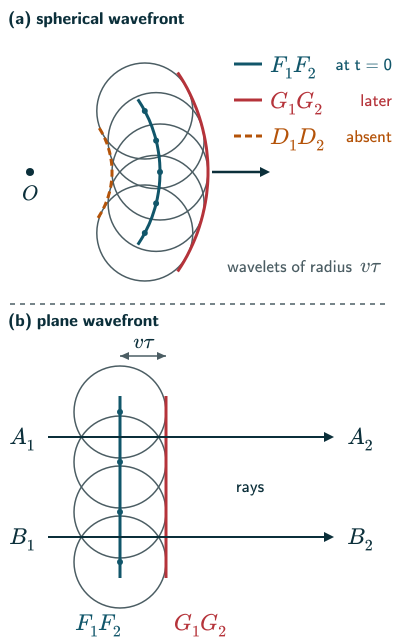
- Rays are normal to the wavefronts. In NCERT Figure 10.3 (page 258), the rays A1A2 and B1B2 cross both the old and the new plane wavefront at right angles. For a spherical wave the rays are the radii from the source (reasoned from NCERT pages 257–258).
- An ideal long, uniformly in-phase line source gives cylindrical wavefronts; a coherently illuminated narrow slit approximates this away from its ends, since the points at a given distance from a line lie on a cylinder around it (beyond the NCERT text).
- Every point of a wavefront has the same phase. Two wavefronts one wavelength apart differ in phase by 2π (reasoned from NCERT Eq. (10.16), page 269).
Secondary wavelets
- The construction. Let F1F2 be part of a spherical wavefront, centre O, at t = 0. Each point of it sends out a wavelet at the wave speed v. To find the wavefront at time τ, draw spheres of radius vτ from every point of F1F2; their common tangent G1G2 is the new wavefront, again a sphere about O (NCERT pages 257–258, Figure 10.2):
Radius of a spherical wavefront after time τ
- The backwave problem. The wavelets also have a backward envelope, D1D2, which would be a wave running back towards the source. No such backward wave is generated merely by propagating this outgoing wave through a homogeneous medium; reflection or scattering at boundaries is a different situation. Huygens assumed that the wavelets are strongest forwards and zero backwards; NCERT calls this ad hoc and not satisfactory, and says the absence of the backwave is justified by a more rigorous wave theory (NCERT page 258).
- A plane wave is built the same way: wavelets of radius vτ from a plane wavefront F1F2 have a plane envelope G1G2, parallel to F1F2 and a distance vτ ahead of it (NCERT page 258, Figure 10.3).
- The wavelets travel at the speed of the wave in that medium. When the speed is the same in every direction, the wavelets are spherical, the rays are perpendicular to the wavefronts, and the time of travel is the same along every ray (NCERT Summary, page 272). NCERT’s box on Huygens (page 259) adds that he explained the double refraction of the crystal calcite. In such a crystal the speed depends on direction, so the wavelets need not be spheres and the rays need not be perpendicular to the wavefronts (beyond the NCERT text).
- Huygens’ construction gives the laws of reflection and refraction (NCERT Section 10.3), and in the form of the Huygens–Fresnel principle it underlies diffraction (NCERT page 256).
Solved examples
Example 1: Shapes of wavefronts (NCERT Exercise 10.2)
What is the shape of the wavefront for (a) light diverging from a point source, (b) light emerging from a convex lens with a point source at its focus, (c) the part of the wavefront from a distant star intercepted by the Earth?
Answer: (a) spherical; (b) plane, because the rays leave the lens parallel and the wavefronts are normal to the rays; (c) plane, because a small area of a very large sphere is nearly flat (NCERT Exercise 10.2, page 273; answer on page 350).
Example 2: A growing spherical wavefront
A point source in air sends out light. At one instant a wavefront has a radius of 1.0 m. Where is it 2.0 ns later, and where would the backwave be?
Answer: The wavelets grow to vτ = (3.0 × 10⁸ m/s) × (2.0 × 10⁻⁹ s) = 0.60 m, so the new wavefront is a sphere of radius 1.0 + 0.60 = 1.6 m about the source. The backward envelope would be a sphere of radius 0.40 m, but no such backwave exists (reasoned from NCERT pages 257–258).
Example 3: Wavelets in glass
In a time of 1.0 ns, how far does a wavefront move in air and in glass of refractive index 1.5?
Answer: In air vτ = 3.0 × 108 × 1.0 × 10−9 = 0.30 m. In glass the speed is c/n = 2.0 × 10⁸ m/s, so the wavelets have radius 0.20 m. That smaller radius in the slower medium is what turns the wavefront at a boundary (NCERT Eqs. (10.4)–(10.5), page 259).
Example 4: Spreading of a spherical wave
A small source radiates 4.0 W of light equally in all directions. Find the intensity on wavefronts 2.0 m and 4.0 m from it.
Answer: The energy flows perpendicular to the wavefronts, so the whole 4.0 W crosses each sphere: I = P/(4πr2). At 2.0 m, I = 4.0/(4π × 4.0) ≈ 0.080 W/m2; at 4.0 m it is a quarter of that, ≈ 0.020 W/m2. From an ideal infinite coherent line source in a non-absorbing medium the power per unit length spreads over cylinders instead, so the intensity falls as 1/r and the amplitude as 1/√r; an ideal unbounded plane wave in a non-absorbing medium does not spread, so its intensity stays the same (reasoned from NCERT page 257; beyond the NCERT text).
Common mistakes to avoid
Common mistake
Taking a wavefront for a ray
A wavefront is a surface of constant phase; a ray is a line normal to it, along which the energy travels (NCERT pages 257–258).
Common mistake
Drawing wavelets with the speed in vacuum
In a medium the wavelets grow at that medium’s speed, c/n, not at c (NCERT Eqs. (10.4)–(10.5), page 259).
Common mistake
Keeping the backward envelope
Only the forward envelope is the new wavefront; the backwave does not exist (NCERT page 258).
Quick revision summary
- A wavefront is a surface of constant phase; the energy travels perpendicular to it, along the rays.
- A point source gives spherical wavefronts; far away, a small part is a plane wavefront; a line source gives cylindrical ones.
- Huygens principle: every point of a wavefront sends out secondary wavelets at the wave speed; their forward envelope is the new wavefront. The backwave does not exist.
- After a time τ, a spherical wavefront of radius R0 has radius R0 + vτ; a plane wavefront moves vτ forward.
- The wave model needs light to be slower in a denser medium, as Foucault found in 1850.
Formula sheet
- R = R0 + vτ
- v = c/n
- I = P/(4πr2)
Questions students ask
What is the difference between a wavefront and a wavelet?
A wavefront is the surface on which every point of a wave vibrates in the same phase, while a secondary wavelet is the wave Huygens pictures spreading from one point of it at the wave speed, a sphere where that speed is the same in every direction; the forward envelope of the wavelets is the next wavefront (NCERT pages 257–258 and 272). A wavefront can be found in a real wave at any instant, but a wavelet is a step in the construction that cannot be picked out of an open beam (reasoned). A narrow slit comes closest, acting as a new source of spreading light (NCERT page 267), as do the pinholes of Young’s experiment.
Why is there no backward wave in Huygens principle?
For an outgoing wave in a homogeneous region, the complete wave solution does not introduce an extra backward wave. In the usual scalar Huygens–Fresnel approximation with locally normal incidence, the obliquity factor is (1 + cos θ)/2: it is 1 forwards and 0 backwards; this factor is not a universal exact formula for every geometry (beyond the NCERT text; Kirchhoff, 1882). Huygens simply assumed the wavelets were zero backwards, which NCERT calls ad hoc and not satisfactory (page 258). Beyond the NCERT text too, David Miller (Optics Letters, 1991) kept a simple wavelet picture with no backwave by using ‘spatiotemporal dipoles’, two opposite sources a moment apart, whose waves cancel backwards.
What could Huygens’ wave theory of light not explain?
Huygens’ wave theory could not explain polarisation: he saw calcite’s two beams act differently in a second crystal as it turned, and wrote that he could not find the cause (beyond the NCERT text; Treatise on Light, Chapter V). His model treated irregular pulses without the periodic-wave framework needed for interference (also beyond the NCERT text; Chapter I), so they gave no interference, which came with Young in 1801 (NCERT page 256). Light seemed to need a medium in empty space until Maxwell’s electromagnetic waves, and the wave theory cannot explain the photoelectric effect.
Which chapter of Class 12 Physics has Huygens principle, and is it in the JEE and NEET syllabus?
Huygens principle is in Chapter 10, Wave Optics, of NCERT Class 12 Physics Part II: Section 10.2 (pages 257–258) states it, and Section 10.3 (pages 258–262) uses it to derive the laws of reflection and refraction. Unit 16 (Optics) of both the JEE Main syllabus and NEET (UG) 2026 opens its wave optics part with the wavefront and Huygens principle, followed, in the JEE Main wording, by the “laws of reflection and refraction using Huygens principle”. It is not a Class 11 topic: NCERT Class 11 Physics, Chapter 14 (Waves), only names Huygens among the early scientists of wave motion.
Practice questions
Try each question first, then open the answer to check your working.
-
Q1. What is the shape of the wavefronts from a point source close by, and from a very distant one?
Show answerHide answer
Spherical close by; very far away a small part of each sphere is nearly flat, so the wavefronts are plane (NCERT page 257).
-
Q2. In which direction does the energy of a wave travel, compared with its wavefront?
Show answerHide answer
Perpendicular to the wavefront, along the rays (NCERT page 257).
-
Q3. Light travels in water of refractive index 1.33. What is the radius of a Huygens wavelet 5.0 ns after it starts?
Show answerHide answer
v = c/n = (3.0 × 10⁸)/1.33 ≈ 2.26 × 10⁸ m/s, so vτ ≈ 2.26 × 108 × 5.0 × 10−9 ≈ 1.13 m (NCERT Eq. (10.5), page 259).