Polarisation of light
NCERT Class 12 Physics Chapter 10 Section 10.7
Quick answer
Linear polarisation fixes the transverse electric-field direction of a plane light wave; circular and elliptical light are also polarised. An ideal linear polaroid transmits half of unpolarised incident light. For linearly polarised input it obeys Malus’ law, I = I0 cos2 θ, with θ between the field and pass axis; real polarisers have losses and leakage.
With your textbook
NCERT Physics Part II (Class 12), Chapter 10 “Wave Optics”, Section 10.7 “Polarisation”, pages 269–271.
Open the official NCERT chapter (PDF, 2.7 MB, ncert.nic.in) (opens in a new tab)
Checked against the 2026-27 reprint on .
What is polarisation?
Polarisation
A transverse wave can vibrate in different directions across its line of travel. If it vibrates in one fixed direction, it is linearly (or plane) polarised; if no transverse direction is statistically preferred and there is no stable relation between orthogonal components over the measurement, it is unpolarised. Light shows polarisation because it is a transverse wave:
Light waves are transverse in nature; i.e., the electric field associated with a propagating light wave is always at right angles to the direction of propagation of the wave.
NCERT Physics Part II (Class 12), Section 10.7, page 270
A polaroid passes only the component of the electric field along its pass axis. Polarised light of intensity I0 meeting a polaroid whose axis is at an angle θ to it comes out with intensity I0 cos2 θ, Malus’ law (NCERT Eq. (10.18), page 270).
In plain words: shake a rope up and down through a vertical fence and the wave gets through; shake it sideways and the fence stops it. A polaroid is a fence for the electric field of light. Careful: its molecules are not the fence’s bars. The field along the molecules is absorbed, so the pass axis is perpendicular to them. Ordinary light shakes in every direction, so a polaroid lets half of it through, and a second polaroid can then let through anything from all of that half to none, depending on how it is turned.
Ideal model: these intensity formulas assume perfect linear polarisers transmitting the pass-axis component without loss and completely blocking the orthogonal one; real sheets have absorption and finite leakage. E is transverse for the plane waves in vacuum or isotropic media considered here. Circular and elliptical light are also polarised: an electric-field direction that changes regularly is not unpolarised. A rotating linear analyser alone cannot distinguish circular from unpolarised light, since both give constant intensity.
Plane-polarised and unpolarised waves
- Move one end of a long horizontal string up and down: a wave travels along +x with displacement y(x, t) = a sin(kx − ωt), where k = 2π/λ (NCERT Eqs. (10.15)–(10.16), page 269, Figure 10.17). This is the travelling wave of Class 11.
- The displacement (along y) is at right angles to the direction of travel, so the wave is transverse. It is called y-polarised; since each point moves on a straight line it is linearly polarised, and since the string stays in the x-y plane it is plane polarised (NCERT pages 269–270).
- Shaking the string in the x-z plane gives a z-polarised wave, z(x, t) = a sin(kx − ωt) (NCERT Eq. (10.17), page 270).
- If the plane of vibration changes randomly in very short intervals, the wave is unpolarised: the displacement changes direction randomly but is always perpendicular to the direction of travel (NCERT page 270).
- Natural light from an ordinary thermal source is often modelled as unpolarised before reflection or scattering: its electric vector takes all possible directions in the transverse plane, rapidly and randomly (NCERT Summary, page 272).
- Only transverse waves can be polarised. Most interference and diffraction effects exist for longitudinal waves such as sound in air too, but polarisation is special to transverse waves like light (NCERT Points to ponder, page 272). See transverse and longitudinal waves.
Polaroids and the pass axis
- A polaroid is a thin plastic-like sheet of long-chain molecules aligned in one direction. The electric field along the molecules is absorbed. Unpolarised light that passes through comes out linearly polarised, with its electric field perpendicular to the molecules; that direction is the pass axis (NCERT page 270).
- One polaroid: light from an ordinary source, such as a sodium lamp, comes out of a polaroid P1 with half its intensity, and turning P1 changes nothing (NCERT page 270). The half is the average of cos2 θ over all the random directions of the incoming field (reasoned).
Unpolarised light through one polaroid
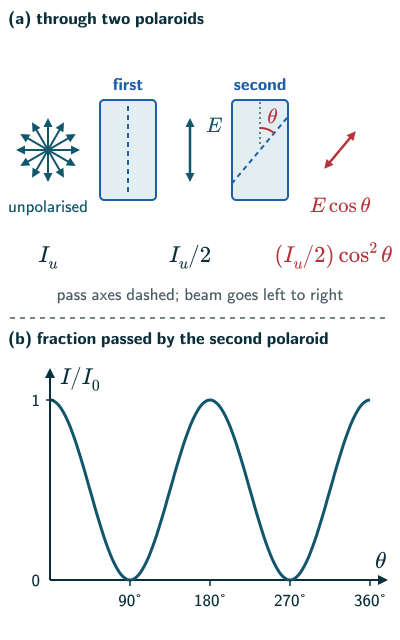
- Two polaroids: put a second, identical polaroid P2 before P1, so the light now meets P2 first. Now turning P1 has a dramatic effect: in one position almost no light gets through both, and turned 90° from there, P1 passes nearly all the light coming from P2 (NCERT page 270, Figure 10.18).
Malus’ law
- Light leaving the first polaroid is polarised along that polaroid’s pass axis. If the pass axes of the two polaroids make an angle θ, only the component E cos θ along the second pass axis gets through. The intensity goes as the square of the field, so (NCERT Eq. (10.18), page 270):
Malus’ law (NCERT Eq. 10.18)
- Here I0 is the intensity of the polarised light after the first polaroid. The second polaroid can therefore control the light from 50% of the original unpolarised intensity down to zero (NCERT page 271).
- Turning the second polaroid through a full circle, 2π, gives two maxima (θ = 0 and π) and two minima (θ = π/2 and 3π/2) (NCERT Summary, page 272).
- NCERT slip (page 270): NCERT places P2 before P1 and says the light is polarised by P2, but then writes that “the component E cos θ (along the pass-axis of P2) will pass through P2”, and that I0 is the intensity “after passing through P1”. With P2 first, the component along the pass axis of P1 passes through P1, and I0 is the intensity after P2. The law itself is unaffected.
Uses of polaroids
- Polaroids are used to control intensity, in sunglasses and windowpanes, and in photographic cameras and 3D movie cameras (NCERT page 271).
- Three polaroids: a polaroid turned between two crossed polaroids lets light through, most of all when it is at 45° to both (NCERT Example 10.2, page 271; see Example 2 below).
- Polaroid sunglasses also cut glare: light reflected from water or a road is partly polarised, horizontally, so a vertical pass axis blocks much of it (beyond the NCERT text).
Solved examples
Example 1: Two polaroids
Unpolarised light of intensity 32 W/m2 falls on two polaroids whose pass axes are at 60°. Find the intensity after each.
Answer: After the first, Iu/2 = 16 W/m2. After the second, by Malus’ law, 16 × cos2 60° = 16 × 1/4 = 4.0 W/m2 (NCERT pages 270–271).
Example 2: A polaroid between crossed polaroids (NCERT Example 10.2)
A polaroid P2 is turned between two crossed polaroids P1 and P3. How does the light coming out depend on the angle?
Answer: Let I0 be the intensity after P1 and θ the angle between the pass axes of P1 and P2. After P2: I0 cos2 θ. P1 and P3 are crossed, so P2 and P3 are at π/2 − θ, and after P3:
I = I0 cos2 θ sin2 θ = (I0/4) sin2 2θ.
It is greatest, I0/4, at θ = π/4, and zero when P2 lines up with either of the others (NCERT Example 10.2, page 271). If unpolarised light of intensity Iu enters, I0 = Iu/2 and the most that gets through is Iu/8 (reasoned).
Example 3: Choosing the angle
At what angle between the pass axes does a second polaroid pass three quarters of the polarised light falling on it?
Answer: cos2 θ = 3/4, so cos θ = √3/2 and θ = 30° (NCERT Eq. (10.18), page 270).
Example 4: One polaroid turned in a polarised beam
Polarised light falls on a polaroid that is turned through a full circle. How many times does the light go dark?
Answer: Twice: cos2 θ is zero at θ = 90° and 270°, with maxima at 0° and 180° (NCERT Summary, page 272).
Common mistakes to avoid
Common mistake
Applying Malus’ law to unpolarised light
Unpolarised light through one polaroid always loses half its intensity, whatever the angle; cos2 θ applies only to light that is already linearly polarised (NCERT pages 270–271).
Common mistake
Using cos θ for intensity
The field component is E cos θ; the intensity, which goes as the square of the field, is I0 cos2 θ (NCERT Eq. (10.18), page 270).
Common mistake
Thinking sound can be polarised
Sound in air is longitudinal, and polarisation is special to transverse waves (NCERT page 272).
Quick revision summary
- Light is transverse, so it can be polarised; sound in air cannot.
- Plane (linearly) polarised: the field vibrates in one direction; unpolarised: the direction changes rapidly and randomly.
- A polaroid passes the field along its pass axis; unpolarised light through one polaroid: I = Iu/2.
- Malus’ law: I = I0 cos2 θ, with θ the angle between the pass axes; two maxima and two minima per turn.
- A polaroid between crossed polaroids passes (I0/4) sin2 2θ, at most I0/4 at 45°.
- Uses: controlling intensity, sunglasses, windowpanes, cameras, 3D films.
Formula sheet
- I = Iu/2 (unpolarised, one polaroid)
- I = I0 cos2 θ
- I = (I0/4) sin2 2θ (polaroid between crossed polaroids)
Questions students ask
How are polarised sunglasses different from ordinary tinted sunglasses?
Polarised sunglasses, which NCERT lists as a use of polaroids (page 271), dim all light like tinted lenses but, beyond the NCERT text, also have a vertical pass axis that blocks much of the glare from water and wet roads, which is partly polarised with its field horizontal. To test a pair, look through one lens at a display known to emit linearly polarised light, such as a suitable LCD, and turn the glasses slowly through half a turn: a linear polarising lens gives a strong brightness variation while a simple isotropic tint does not. Some displays emit circular or otherwise modified polarisation, so a negative screen test is inconclusive. That effect on cockpit displays is one reason the US FAA advises pilots against polarised lenses (brochure “Sunglasses for Pilots”).
What are the types of polarisation of light?
Polarised light is of three types: linear (plane), with the electric field vibrating along one fixed line; circular, with the field’s direction turning round once every period at constant size; and elliptical, with its tip tracing an ellipse (beyond the NCERT text and both syllabuses, which treat only plane polarisation). Two coherent equal-amplitude components at right angles, a quarter of a cycle (90°) out of phase, give circular light; most other combinations give elliptical light. A circular-polarisation stereoscopic system can encode the two eye images with opposite handedness; unlike linear axes, handedness does not change when the viewer rolls their head (reasoned beyond NCERT; page 271 names polaroids in 3D movie cameras).
How can plane-polarised light be produced?
Plane-polarised light can be produced in four main ways: by a polaroid, which absorbs the field along its aligned molecules (NCERT page 270); and, beyond the NCERT text, by reflection at the Brewster angle, by scattering, since sunlight scattered at right angles by air molecules is strongly polarised, and by double refraction in calcite, whose two beams are polarised at right angles (beyond NCERT: Huygens’ Treatise on Light and modern transverse-wave interpretation), as in the Nicol prism of NCERT Class 12 Chemistry Part II (page 175). Scattering and reflection were Sections 10.7.1 and 10.7.2 of NCERT’s 2021–22 reprint, dropped in 2022 (NCERT rationalised-content list, Class XII, page 51).
Why is plane-polarised light used to study optical isomers?
Plane-polarised light is used to study optical isomers because a pure enantiomer pair has the same ordinary physical properties in an achiral environment but rotates plane-polarised light by equal and opposite angles under matching wavelength, temperature, solvent, path length and concentration. They can behave differently in chiral chemical or biological environments; optical rotation is not their only possible difference. The sign convention is clockwise for the dextrorotatory (+) form, anticlockwise for the laevorotatory (−) form (NCERT Class 12 Chemistry Part II, pages 175 and 177). A polarimeter measures the angle: light from a Nicol prism crosses the solution, and an analyser is turned to find the new plane. A 50:50 racemic mixture gives no rotation, as the two cancel (stereoisomerism).
Is Malus’ law in the JEE Main and NEET syllabus?
Malus’ law is not named in either syllabus, but it is the working law of the polarisation topics both list: Unit 16 of the JEE Main syllabus lists “plane-polarized light, Brewster’s law, uses of plane-polarized light and Polaroid”, NEET (UG) 2026 Unit 16 has the same topics, and NCERT Class 12 Physics Part II gives Malus’ law as Eq. (10.18) in Section 10.7 (page 270). Any question on how much light gets through two or more polaroids rests on it, as in NCERT Example 10.2 (page 271). Brewster’s law, also listed, has no section in the 2026–27 book.
Who discovered the polarisation of light?
The polarisation of light was named by the French physicist Étienne-Louis Malus, who found it in reflected light: looking through a doubly refracting crystal at sunlight reflected from the windows of the Luxembourg Palace in Paris, he saw that it was polarised, and reported the discovery in 1808 (beyond NCERT: François Arago, Malus, chapter VIII, including the memoir of 12 December 1808). NCERT’s Malus’ law, Eq. (10.18) on page 270, bears his name. Huygens had described, but not explained, the effect in calcite in his Treatise of 1690, and in 1815 David Brewster, crediting Malus, found the law for the angle of complete polarisation (Philosophical Transactions, volume 105).
Practice questions
Try each question first, then open the answer to check your working.
-
Q1. Polarised light of intensity 10 W/m2 meets a polaroid whose pass axis is at 45° to the light’s field. What comes through?
Show answerHide answer
10 × cos2 45° = 10 × 1/2 = 5.0 W/m2 (NCERT Eq. (10.18), page 270).
-
Q2. Two polaroids are crossed. What fraction of unpolarised light gets through?
Show answerHide answer
None: after the first, the light is polarised along its axis, and the second, at 90°, passes cos2 90° = 0 of it (NCERT pages 270–271).
-
Q3. Why does polarisation show that light waves are transverse?
Show answerHide answer
Only a transverse wave has a direction of vibration across its path that a polaroid can select; a longitudinal wave such as sound in air cannot be polarised (NCERT pages 270 and 272).