Diffraction at a single slit
NCERT Class 12 Physics Chapter 10 Section 10.6
Quick answer
Diffraction is wave spreading at edges and openings. For a uniformly illuminated single slit in the far field, minima obey a sin θ = nλ for nonzero integer n with |nλ/a| ≤ 1. At small angles and a ≫ λ, the central maximum has angular width 2λ/a and linear width 2λD/a, with weaker side maxima.
With your textbook
NCERT Physics Part II (Class 12), Chapter 10 “Wave Optics”, Section 10.6 “Diffraction”, pages 266–268.
Open the official NCERT chapter (PDF, 2.7 MB, ncert.nic.in) (opens in a new tab)
Checked against the 2026-27 reprint on .
What is diffraction?
Diffraction
Diffraction is the spreading of a wave around the edges of an obstacle or through a narrow opening, into the region where a sharp shadow would be. Close to the edge of a shadow there are alternate bright and dark regions, as in interference. All waves show it: sound, light, water waves and matter waves (NCERT Section 10.6, pages 266–267). NCERT notes:
These effects, known as diffraction, can only be properly understood using wave ideas.
NCERT Physics Part II (Class 12), Section 10.6, page 267
A single slit of width a gives a broad central maximum at θ = 0 and zero intensity at θ ≈ nλ/a, n = ±1, ±2, ±3, … (NCERT Section 10.6.1, page 267).
In plain words: light normally goes straight, but squeeze it through a very narrow slit and it fans out. On a screen you then see a wide bright band in the middle with fainter bands on either side. The narrower the slit, the more the light spreads. You rarely notice this in daily life because light’s wavelength is far smaller than ordinary objects.
Scope: scalar Fraunhofer diffraction from a uniformly illuminated slit under normally incident monochromatic light. Without lenses, D must be large compared with a/λ; a lens can form the far-field pattern in its focal plane. Widths 2λ/a and 2λD/a are small-angle approximations. An order exists only if |nλ/a| ≤ 1; if a < λ there is no first minimum, so the usual between-minima central width is unavailable.
The single slit
- Because the wavelength of light is much smaller than most obstacles, diffraction of light is not noticed every day. But it limits how finely the eye, telescopes and microscopes can separate close objects, and it causes the colours seen on a CD (NCERT pages 266–267).
- Even before Young, Newton and others had noticed light spreading out from narrow holes and slits. Sound is heard around a corner for the same reason (NCERT page 267).
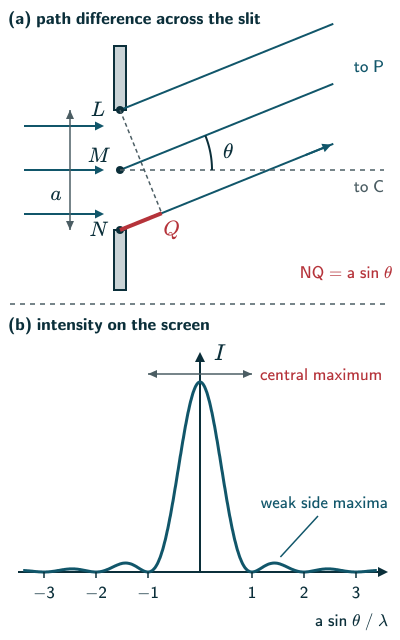
- When the double slit of Young’s experiment is replaced by a single narrow slit lit by monochromatic light, a broad pattern appears: a central bright region, with dark and bright regions on both sides that grow weaker away from the centre (NCERT page 267, Figure 10.15).
- The geometry. A parallel beam falls normally on a slit LN of width a, with midpoint M. The line through M perpendicular to the slit meets the screen at C. For a point P on the screen, the lines from P to L, M and N are nearly parallel and make an angle θ with MC (NCERT page 267, Figure 10.14).
- The idea. Divide the slit into many small parts and add their contributions at P with the right phase differences. Each part is a secondary source, as in Huygens’ principle; because the incoming wavefront is parallel to the slit, they all start in phase (NCERT page 267).
- The two edges L and N differ in path to P by about a sin θ ≈ aθ for small angles (reasoned from NCERT Figure 10.14).
Central maximum at θ = 0, minima at θ = nλ/a (n = ±1, ±2, …)
- Observed pattern (NCERT page 267): a central maximum at θ = 0; minima (zero intensity) at
Minima of a single slit (NCERT page 267)
- Here n = ±1, ±2, ±3, … (never 0: θ = 0 is the central maximum). The secondary maxima lie at about θ ≈ ±(n + 1/2)λ/a, n = 1, 2, 3, …, and grow weaker and weaker as n increases (NCERT page 267).
- Why the first minimum is at λ/a (reasoned; NCERT’s 2026–27 text gives the result without this step): split the slit into an upper and a lower half. Each point in the upper half has a partner a/2 below it. When a sin θ = λ, each pair differs in path by λ/2, so the pairs cancel and the screen is dark. For a sin θ = 2λ, 3λ, …, split the slit into 4, 6, … strips and pair neighbouring strips in the same way.
- At θ = 0 every part of the slit is the same distance away in the parallel-ray picture, so all the contributions add: the centre is the brightest point (reasoned).
- Width of the central maximum. It runs from the first minimum on one side to the first on the other (reasoned from NCERT page 267):
Angular width of the central maximum
- On a screen a distance D away (or in the focal plane of a lens of focal length D), the central maximum is 2λD/a wide, twice the width of each side maximum (reasoned). A narrower slit or a longer wavelength spreads the pattern out.
- For larger angles use a sin θ = nλ for the minima (reasoned; NCERT gives the small-angle form).
Interference and diffraction compared
- NCERT quotes Richard Feynman on how hard it is to separate the two (page 268):
No one has ever been able to define the difference between interference and diffraction satisfactorily.
NCERT Physics Part II (Class 12), Section 10.6, page 268
- Roughly, as the same passage goes on: with only a few sources, such as two, the result is usually called interference; with a large number of them, diffraction (NCERT page 268).
- In the double-slit experiment the pattern on the screen is “a superposition of single-slit diffraction from each slit or hole, and the double-slit interference pattern” (NCERT page 268). Strictly, for identical, uniformly illuminated slits the intensity is the product of the two: the interference fringes are modulated by the single-slit envelope and vanish at its zeros, and their exact peaks can shift slightly (reasoned).
- How they look (reasoned from NCERT pages 264–267):
- Two-slit interference: fringes of equal width λD/d; in the simple picture all bright fringes are equally bright.
- Single-slit diffraction: a central maximum twice as wide as the rest, with side maxima that quickly grow fainter.
- Where the waves come from (reasoned from NCERT pages 265 and 267): interference comes from two separate coherent sources such as S1 and S2; diffraction comes from the many secondary wavelets across one wavefront in a single opening.
- In both, energy is only redistributed: what is missing from a dark fringe appears in a bright one, as conservation of energy requires (NCERT page 268).
Seeing the single slit diffraction pattern
- NCERT’s activity needs two razor blades and a clear glass bulb, preferably with a straight filament. Hold the blades between thumb and forefingers with their edges parallel and a narrow slit between them (NCERT page 268, Figure 10.16).
- Keep the slit parallel to the filament, right in front of the eye (with spectacles if you normally wear them), and adjust the width and the parallelism until the bright and dark bands appear (NCERT page 268). Handle the blades with care; a slit cut in a card does the same job without exposed edges (reasoned).
- The bands other than the central one are coloured, because their positions depend on the wavelength. A red or a blue filter makes them clearer, and with both you can see that the red fringes are wider than the blue ones (NCERT page 268).
- The filament acts as the source slit, and the lens of the eye focuses the pattern on the retina (NCERT page 268).
- NCERT slip (page 268): the text says the filament plays the role of the first slit S “in Fig. 10.15”. NCERT Figure 10.15 shows no slit S; the source S appears in NCERT Figures 10.12(a) and 10.14.
- A double slit cut in aluminium foil, viewed the same way, repeats Young’s experiment. By day, NCERT suggests another bright source that subtends a small angle at the eye: the reflection of the Sun in any shiny convex surface, such as a cycle bell. It warns: do not try direct sunlight, which can damage the eye and will not give fringes anyway, as the Sun subtends an angle of about ½° (NCERT page 268).
Solved examples
Example 1: The central maximum on a screen
Light of wavelength 600 nm falls on a slit 0.20 mm wide. The screen is 2.0 m away. Find the angle of the first minimum and the width of the central maximum.
Answer: θ1 = λ/a = (600 × 10−9)/(0.20 × 10−3) = 3.0 × 10⁻³ rad. The first minima are 2.0 × 3.0 × 10−3 = 6.0 mm either side of the centre, so the central maximum is 12 mm wide (NCERT page 267).
Example 2: A slit as wide as two wavelengths
For what slit width is the first minimum for light of 500 nm at 30°?
Answer: The angle is not small, so use a sin θ = λ: a = 500 nm/sin 30° = 1.0 μm. A slit only two wavelengths wide spreads light very widely (reasoned from NCERT page 267).
Example 3: Red against blue
Compare the widths of the central maxima for red light of 650 nm and blue light of 450 nm through the same slit.
Answer: The width is 2λD/a, proportional to λ, so red’s is 650/450 ≈ 1.44 times blue’s. This is why the red fringes look wider through the razor-blade slit (NCERT page 268).
Example 4: Double slit inside the envelope
Two slits, each 0.10 mm wide, are 0.50 mm apart. How many interference fringe widths fit across the central diffraction maximum?
Answer: The fringe width is λD/d and the central maximum 2λD/a, so the ratio is 2d/a = 2 × 0.50/0.10 = 10 (reasoned from NCERT page 268, where the double-slit pattern combines each slit’s single-slit diffraction with the double-slit interference). Inside it lie 9 bright fringes, orders 0, ±1, …, ±4; the ±5th-order fringes fall on the first diffraction minima and are missing (reasoned).
Common mistakes to avoid
Common mistake
Putting single-slit minima at (n + 1/2)λ/a
For a single slit the minima are at nλ/a (n = ±1, ±2, …) and the side maxima near ±(n + 1/2)λ/a (n = 1, 2, …), the opposite of the double-slit rule (NCERT page 267).
Common mistake
Thinking a wider slit gives a wider pattern
The angular width 2λ/a falls as the slit widens; a slit many wavelengths wide has a narrow angular far-field pattern; ordinary sharp shadows are a geometrical-optics approximation in the appropriate observation geometry (reasoned from NCERT pages 266–267).
Common mistake
Taking the central maximum the same width as the others
The central maximum is twice as wide as each side maximum and much brighter (reasoned from NCERT page 267).
Quick revision summary
- Diffraction is the spreading of waves at edges and openings; for light it is small because λ is small, but it limits the resolution of the eye and of instruments.
- Single slit of width a: central maximum at θ = 0, minima at θ ≈ nλ/a (n = ±1, ±2, …), weaker side maxima near ±(n + 1/2)λ/a (n = 1, 2, …).
- Angular width of the central maximum 2λ/a; on a screen at distance D it is 2λD/a.
- A double-slit pattern is the interference fringes inside the single-slit diffraction envelope; energy is only redistributed.
- Red light gives wider fringes than blue.
Formula sheet
- a sin θ = nλ (nonzero orders)
- θn ≈ nλ/a (small-angle minima)
- angular width = 2λ/a
- linear width = 2λD/a
Questions students ask
What is the difference between diffraction and refraction?
Refraction is the bending of light as it passes obliquely into a slower or faster medium, by an angle set by Snell’s law, while diffraction is the spreading of light round edges and through narrow openings into the geometrical shadow (NCERT pages 259, 266–267). Refraction needs only a boundary; diffraction is strongest where a gap or obstacle is a few wavelengths across, though faint bands fringe any shadow (page 266). They sort colours in opposite orders: glass bends violet more than red (dispersion), but a slit spreads red more than blue, as spreading grows with wavelength (NCERT page 268).
Why is the central maximum of a single slit twice as wide as the other maxima?
The central maximum of a single slit is twice as wide because the minima, at sin θ = nλ/a, are evenly spaced, one λ/a apart in sin θ, except across the centre, where the n = 0 minimum is missing: at θ = 0 every wavelet arrives in phase, so the centre is bright instead of dark (reasoned from NCERT page 267). Each side maximum fills one gap, from nλ/a to (n + 1)λ/a, while the central one runs from −λ/a to +λ/a, two gaps, so it is 2λ/a wide in angle, or 2λD/a on a screen a distance D away, for small angles. It is also far brighter, since at its centre no part of the slit cancels another.
What is the difference between Fresnel and Fraunhofer diffraction?
Fraunhofer diffraction is the pattern seen when the light reaching the opening and the light leaving it for each point of the screen are effectively parallel, with source and screen far off or at lens focal planes; Fresnel diffraction, when the source or screen is near enough for the wavefronts to be curved, as at the edge of a shadow (beyond the NCERT text; reasoned). NCERT’s single slit is the Fraunhofer case: a parallel beam falls on it, and lines to a point on the screen are taken as parallel (page 267). The changeover is near the Fresnel distance a/λ from the slit, which NCERT’s 2021–22 reprint gave; the 2026–27 book and the syllabuses name neither kind.
Why do the secondary maxima of a single slit get fainter and fainter?
The secondary maxima of a single slit get fainter because at each successive one more of the slit’s light cancels: near θ = (n + 1/2)λ/a the slit splits into 2n + 1 equal strips whose neighbours cancel in pairs, leaving one strip, only 1/(2n + 1) of the slit, whose wavelets are themselves spread over half a cycle of phase (reasoned; NCERT page 267 just says they weaken). The standard scalar formula I/I(0) = (sin q/q), q = πa sin θ/λ, with its limit 1 at q = 0 (beyond NCERT; reasoned) puts the first three side maxima at about 4.7%, 1.6% and 0.8% of the central intensity, at 1.43, 2.46 and 3.47 times λ/a, a little inside the simple (n + 1/2) rule. In the ideal scalar Fraunhofer/paraxial sinc-squared model, integrating the intensity gives about 90.3% in the central maximum.
What are some examples of diffraction of light in daily life?
Diffraction of light shows in daily life wherever light passes objects or gaps no wider than a fraction of a millimetre: the colours of a CD, which NCERT puts down to diffraction (page 267), and the bands seen when a bulb’s filament is viewed through a narrow slit between two razor blades (page 268). The coloured rings, or corona, round the Moon seen through thin cloud come from diffraction by water droplets of nearly equal size (beyond the NCERT text; NASA, Astronomy Picture of the Day, 15 June 2015). A distant street lamp seen through a fine net curtain or an umbrella’s cloth breaks into a cross or grid of spots, the threads acting like many slits side by side (reasoned).
What is a diffraction grating, and how is it different from a single slit?
A diffraction grating is a plate with many equally spaced parallel slits or grooves; light from all of them interferes, giving narrow bright lines where neighbouring slits differ in path by whole wavelengths, d sin θ = nλ for normal incidence, with near darkness between, unlike a single slit’s broad central maximum (beyond the NCERT text; reasoned). With 625 lines per millimetre, d = 1.6 μm, so 560 nm yellow-green light has its first-order line at sin θ = 0.35, θ ≈ 20.5°, and other colours go to other angles, making a spectrum. A CD’s closely spaced tracks act as one, hence the colours on NCERT page 267.
Is single-slit diffraction in the JEE Main and NEET syllabus, and is its derivation needed?
Single-slit diffraction is in both syllabuses, which name no derivation: Unit 16 of the JEE Main syllabus and of NEET (UG) 2026 lists “Diffraction due to a single slit, width of central maximum”. NCERT’s 2022 rationalisation kept Section 10.6 with “only qualitative treatment” and dropped its parts on resolving power and the validity of ray optics (NCERT rationalised-content list, Class XII, page 51), so the 2026–27 book states the minima at θ ≈ nλ/a without deriving them (page 267). The width of the central maximum follows from that condition (2λ/a in angle); the half-slit argument is under minima.
Practice questions
Try each question first, then open the answer to check your working.
-
Q1. A slit 0.10 mm wide is lit by light of 500 nm. Find the angular width of the central maximum.
Show answerHide answer
2λ/a = 2 × (500 × 10−9)/(0.10 × 10−3) = 1.0 × 10⁻² rad (NCERT page 267).
-
Q2. What happens to the central maximum if the slit is made narrower?
Show answerHide answer
It becomes wider, since its angular width 2λ/a grows as a shrinks (NCERT page 267).
-
Q3. Why is diffraction of sound easy to notice but diffraction of light is not?
Show answerHide answer
The wavelength of sound is comparable to doors and walls, while that of light is much smaller than ordinary obstacles (NCERT pages 266–267).