Coherent and incoherent addition of waves
NCERT Class 12 Physics Chapter 10 Section 10.4
Quick answer
For equal coherent beams with matching linear polarisation, I = 4I0 cos2(φ/2); initially in-phase sources in one medium give φ = (2π/λ)Δ. Whole-wavelength path differences give maxima and odd half-wavelength differences give minima. Incoherent beams have a zero averaged interference term, so their local intensities add; equal local contributions give I = 2I0.
With your textbook
NCERT Physics Part II (Class 12), Chapter 10 “Wave Optics”, Section 10.4 “Coherent and Incoherent Addition of Waves”, pages 262–265.
Open the official NCERT chapter (PDF, 2.7 MB, ncert.nic.in) (opens in a new tab)
Checked against the 2026-27 reprint on .
What are coherent and incoherent addition?
Coherent and incoherent sources
Two sources are coherent when the phase difference between their waves at a fixed observation point does not change with time. Their displacements add, and for two equal sources the intensity varies from point to point as 4I0 cos2(φ/2): a stable interference pattern. If the phase difference changes rapidly and randomly, the pattern averages out:
When the phase difference between the two vibrating sources changes rapidly with time, we say that the two sources are incoherent and when this happens the intensities just add up.
NCERT Physics Part II (Class 12), Section 10.4, page 265
Interference rests on the principle of superposition: at any point the resultant displacement is the sum of the displacements due to each wave (NCERT Section 10.4, page 262).
In plain words: two waves meeting at a point can help each other (crest on crest) or cancel (crest on trough). If the two sources keep in step, each point always gets the same kind of meeting, so you see fixed bright and dark places. If they drift in and out of step billions of times a second, every point gets a blur of both, and you just see the two brightnesses added.
Conditions for the formulas (reasoned): equal-frequency light in the same medium, overlapping parallel linear polarisations and stable geometry. I0, I1 and I2 are local single-beam intensities; equality at one point does not imply uniform brightness everywhere. The path-only phase formula assumes initially in-phase sources; otherwise add their initial phase offset.
Coherent sources
- Two needles moving up and down in step in a trough of water send out two sets of waves. At any point the phase difference between the two displacements does not change with time, so the sources are coherent (NCERT page 262, Figure 10.8(a)).
- The water surface then shows fixed antinodal lines (largest displacement), where crest meets crest, and nodal lines (no displacement), where crest meets trough (NCERT page 262, Figure 10.8(b)).
- Two separate light sources, such as two sodium lamps, are not coherent: an ordinary source changes its phase abruptly in times of the order of 10−10 s, so two such sources have no fixed phase relation and give no fringes (NCERT page 265, Figure 10.11).
- The interference term matters only if its average over time is not zero, which occurs only if the sources have the same frequency and a stable phase difference (NCERT Summary, page 272). Beyond the NCERT text: the waves must also share a polarisation component, since two orthogonal, coherent, linearly polarised waves cannot interfere (Wikipedia, “Fresnel–Arago laws”).
- Conditions for sustained interference: the two sources must be coherent, with the same frequency and a phase difference that stays constant. A standard way to achieve this is to derive both from one source, as in Young’s experiment (NCERT pages 265 and 272). For good contrast the amplitudes should be nearly equal. NCERT’s analysis on page 263 makes them so by taking the distances to the point to be much larger than the source separation. Narrow sources close together, and monochromatic light, keep the fringes sharp and wide enough to see (beyond the NCERT text).
Path difference and phase difference
- At a point on the perpendicular bisector of S1S2, the paths are equal, so waves that leave in phase arrive in phase (NCERT pages 262–263).
- A path difference of one wavelength delays one wave by one full cycle, a phase difference of 2π. NCERT’s cases: a path difference of 2λ gives 4π, and 2.5λ gives 5π (NCERT pages 263–264). In general (reasoned from these cases):
Phase difference from path difference
- Here Δ is the path difference S1P ~ S2P; NCERT uses ~ for “the difference between” (page 264). Here use a consistent signed difference Δ = S2P − S1P; its sign reverses the phase but not the cosine intensity.
- NCERT slip (page 263): for the point R, the text refers to “Fig. 10.10(b)”. NCERT Figure 10.10 has no part (b); the point R is in NCERT Figure 10.9(b).
Constructive and destructive interference
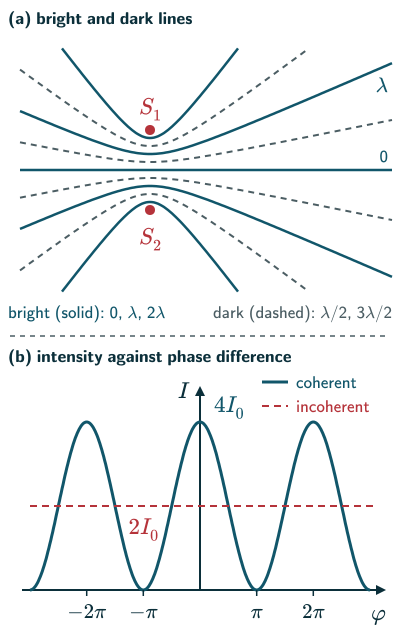
- For sources vibrating in phase, constructive interference (intensity 4I0) occurs where the path difference is a whole number of wavelengths, and destructive interference (zero intensity) where it is an odd number of half wavelengths (NCERT Eqs. (10.9)–(10.10), page 264):
Bright and dark conditions (NCERT Eqs. 10.9 and 10.10)
- Here n = 0, 1, 2, 3, … (NCERT page 264). The points with a given path difference lie on a curve; for 0, ±λ, ±2λ, … these are the bright lines of NCERT Figure 10.10 (page 263). Apart from the zero line, the perpendicular bisector, they are hyperbolas with S1 and S2 as foci, since a hyperbola is the set of points whose distances from two foci differ by a constant (reasoned).
- The general case. With y1 = a cos ωt and y2 = a cos(ωt + φ), the sum is y = 2a cos(φ/2) cos(ωt + φ/2). The non-negative amplitude is |2a cos(φ/2)|, and the intensity, which goes as the square of the amplitude, is (NCERT Eq. (10.11), page 264):
Intensity for two coherent sources (NCERT Eq. 10.11)
- I0 is the intensity from either source alone. I = 4I0 at φ = 0, ±2π, ±4π, … and I = 0 at φ = ±π, ±3π, … (NCERT page 264).
- Energy is not created or destroyed. It is only redistributed: what a dark fringe loses, a bright fringe gains (NCERT page 268). The average of 4I0 cos2(φ/2) over a fringe is 2I0, the same as for two sources without interference (reasoned).
- Unequal sources (beyond the NCERT text): for intensities I1 and I2, I = I1 + I2 + 2√(I1I2) cos φ. The last part is the interference term of NCERT’s Summary (page 272). The maximum is (√I1 + √I2)2 and the minimum (√I1 − √I2)2, so the dark fringes are fully dark only when I1 = I2.
Incoherent sources: intensities add
- If the relative phase samples random values so that its cosine averages to zero during the measurement, the bright and dark places shift rapidly too, and the eye sees only the time average. The average of cos2(φ/2) is 1/2 (reasoned), so (NCERT Eq. (10.12), page 264):
Incoherent sources (NCERT Eq. 10.12)
- There are no interference fringes, and the local intensities simply add. The illumination need not be spatially uniform: I1 and I2 may vary across the screen. This is what happens when two separate lamps light a wall (NCERT pages 264–265).
- For incoherent sources of different intensities, I = I1 + I2 (reasoned from NCERT page 265).
Solved examples
Example 1: Intensity at a path difference of λ/3 (NCERT Exercise 10.5)
In Young’s double-slit experiment with light of wavelength λ, the intensity where the path difference is λ is K units. What is it where the path difference is λ/3?
Answer: A path difference of λ gives φ = 2π, so K = 4I0. For λ/3, φ = 2π/3, and I = 4I0 cos2(π/3) = 4I0 × 1/4 = I0 = K/4 (NCERT Exercise 10.5, page 273; answer on page 350).
Example 2: Path difference to phase difference
Two initially in-phase, equally intense coherent sources send light of wavelength 600 nm to a point where the path difference is 1.5 μm. Is the point bright or dark?
Answer: Δ/λ = 1.5 × 10⁻⁶/(600 × 10−9) = 2.5, so φ = 2π × 2.5 = 5π, an odd multiple of π: the point is dark (NCERT Eq. (10.10), page 264).
Example 3: Coherent against incoherent
Two sources each give intensity I0 at a point where φ = π/2. Find the intensity if they are (a) coherent, (b) incoherent.
Answer: (a) I = 4I0 cos2(π/4) = 4I0 × 1/2 = 2I0. (b) 2I0 as well, because incoherent intensities add. They agree here only because cos2(π/4) happens to equal the average, 1/2; at φ = 0 the coherent value is 4I0 (NCERT Eqs. (10.11)–(10.12), page 264).
Example 4: Unequal sources
Two coherent sources have intensities in the ratio 9 : 1. Find the ratio of the maximum to the minimum intensity in the pattern.
Answer: The amplitudes are in the ratio √9 : √1 = 3 : 1. Imax ∝ (3 + 1)2 = 16 and Imin ∝ (3 − 1)2 = 4, so the ratio is 4 : 1 (beyond the NCERT text; intensity goes as amplitude squared, NCERT page 263).
Common mistakes to avoid
Common mistake
Adding intensities for coherent waves
For coherent waves add the displacements (amplitudes) first and then square; only for incoherent waves do the intensities add (NCERT pages 264–265).
Common mistake
Thinking dark fringes destroy energy
The energy missing from the dark fringes appears in the bright ones; the average stays 2I0 (NCERT page 268).
Common mistake
Expecting fringes from two separate lamps
Ordinary sources change phase every 10−10 s or so, so two of them are incoherent and give no stable interference fringes in ordinary viewing (NCERT page 265).
Quick revision summary
- Coherent sources keep a constant phase difference; light from two separate lamps is incoherent.
- Phase difference φ = (2π/λ) × path difference.
- Path difference nλ: bright, I = 4I0; (n + 1/2)λ: dark, I = 0.
- In general I = 4I0 cos2(φ/2) for two equal coherent sources.
- Incoherent sources: I = 2I0 at a point receiving equal individual intensities; the local intensities simply add.
- Unequal sources: Imax = (√I1 + √I2)2, Imin = (√I1 − √I2)2.
Formula sheet
- φ = (2π/λ)Δ
- I = 4I0 cos2(φ/2)
- I = 2I0 (incoherent)
- I = I1 + I2 + 2√(I1 I2) cos φ
Questions students ask
Is sunlight coherent or incoherent?
Sunlight is incoherent: it is sent out by countless atoms on the Sun, each emitting independently, so light from different parts of the Sun has no fixed phase relation and two such beams give no fringes (reasoned from NCERT page 265). Direct sunlight would not give fringes anyway, NCERT notes, because the Sun subtends about half a degree, too large a source, and looking at it can damage the eye (page 268). Light from one tiny region can still interfere with itself after a pinhole, as S does in Young’s arrangement (NCERT page 265), or from a small bright image of the Sun, such as its reflection in a cycle bell.
What is coherence length, and how is it related to coherence time?
The coherence time of a source is roughly how long its waves keep a steady phase, and the vacuum coherence length is the corresponding distance L ≈ cτ (beyond the NCERT text; reasoned; a characteristic scale, not a sharp cutoff). NCERT gives abrupt phase changes in times of the order of 10 s for an ordinary source (page 265), so its coherence length is of the order of 3 × 10 × 10 m = 3 cm. Two beams split from one such source interfere clearly only if their path difference is well below this, as at the first fringes of Young’s experiment, about a micrometre; a narrower linewidth can give a much longer coherence length.
How are coherent sources produced in practice?
Coherent sources are produced by taking two beams from one source, with sufficiently small differential delay that their phase fluctuations remain correlated (reasoned from NCERT page 265). Division of wavefront uses two parts of one wavefront: Young’s two pinholes lit through one pinhole or, beyond the NCERT text, a Fresnel biprism, two thin prisms joined base to base that bend the two halves of a slit’s light across each other, or Lloyd’s mirror, which overlaps light from a slit with its own grazing reflection (beyond NCERT: division-of-wavefront arrangements). Division of amplitude splits each wave at a partly reflecting surface, as the two faces of a soap film do (thin-film interference, not in the 2026–27 NCERT book).
Can two independent sources, such as two lasers, ever be coherent?
Two free-running lasers can show mutual interference over exposures shorter than their relative phase-drift time: in 1963 Magyar and Mandel overlapped the beams of two separate ruby lasers and recorded interference fringes (the paper establishes the counterexample; exposure time and relative phase stability govern visibility) (beyond the NCERT text; Nature, vol. 198, page 255). The two lasers’ phases wander independently, so the fringes shift about and, over sufficiently long exposures wash out into the sum of their local intensities. Two separate lasers can also be phase-locked electronically or optically to maintain a controlled phase relation (beyond NCERT: NIST, Ye and Hall, Optics Letters, 1999); they are then deliberately coupled. Splitting one source, as in Young’s experiment, is the standard classroom method (NCERT page 265).
Practice questions
Try each question first, then open the answer to check your working.
-
Q1. What phase difference corresponds to a path difference of 3λ/2?
Show answerHide answer
φ = (2π/λ)(3λ/2) = 3π, so the point is dark for equal coherent sources (NCERT Eq. (10.10), page 264).
-
Q2. Two coherent sources each give intensity I0. Find the intensity where φ = 2π/3.
Show answerHide answer
I = 4I0 cos2(π/3) = 4I0 × 1/4 = I0 (NCERT Eq. (10.11), page 264).
-
Q3. Why do two candles never show interference fringes on a wall?
Show answerHide answer
Their light changes phase abruptly and independently, in times of about 10−10 s, so the two are incoherent and their intensities simply add (NCERT pages 264–265).