Young’s double-slit experiment
NCERT Class 12 Physics Chapter 10 Section 10.5
Quick answer
With symmetric coherent illumination, Young’s two slits produce bright fringes at xn = nλD/d and dark fringes at xn = (n + 1/2)λD/d in the small-angle limit x, d ≪ D. Successive bright fringes, or successive dark fringes, have spacing β = λD/d; adjacent bright and dark fringes are half that distance apart. Finite slit width supplies a diffraction envelope.
With your textbook
NCERT Physics Part II (Class 12), Chapter 10 “Wave Optics”, Section 10.5 “Interference of Light Waves and Young’s Experiment”, pages 265–266.
Open the official NCERT chapter (PDF, 2.7 MB, ncert.nic.in) (opens in a new tab)
Checked against the 2026-27 reprint on .
What is Young’s double-slit experiment?
Young’s double-slit experiment
Light from one pinhole S falls on two pinholes S1 and S2 very close together. In the symmetric arrangement, a phase change at S reaches S1 and S2 together, so they behave as two coherent sources and produce steady bright and dark fringes on a screen (NCERT Section 10.5, page 265). Two separate lamps cannot do this:
Thus the light waves coming out from two independent sources of light will not have any fixed phase relationship and would be incoherent, when this happens, as discussed in the previous section, the intensities on the screen will add up.
NCERT Physics Part II (Class 12), Section 10.5, page 265
The bright fringes are at x = nλD/d and are equally spaced, λD/d apart (NCERT Eqs. (10.13)–(10.14), page 266).
In plain words: you need two light sources that stay in step, and two ordinary independent lamps do not maintain that relation over normal viewing times. Young’s trick was to split the light of one source with two tiny holes. The two beams then overlap on a screen; where their paths differ by a whole number of wavelengths you see a bright band, and half-way between, a dark one.
Working assumptions: symmetric illumination makes the two slit fields initially in phase, with matching polarisation and adequate spatial and temporal coherence. The position and spacing formulas use x, d ≪ D and λ in the intervening medium. Finite slit widths give a diffraction envelope, and unequal illumination reduces contrast; the centre is bright only when the total initial and optical phase difference there is zero modulo 2π.
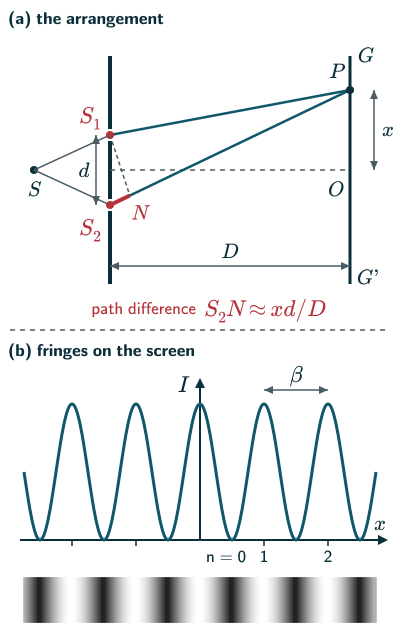
Young’s double-slit arrangement
- Why not two lamps? Light from an ordinary source such as a sodium lamp undergoes abrupt phase changes in times of the order of 10−10 s. Two such sources have no fixed phase relation, so two sodium lamps lighting two pinholes give no fringes: the intensities just add (NCERT page 265, Figure 10.11).
- Young’s way: two pinholes S1 and S2, very close together on an opaque screen, are lit by light spreading from another pinhole S, itself lit by a bright source. Any phase change at S shows up equally at S1 and S2, so they are locked in phase, like the two needles moving together in the water-wave example (NCERT page 265, Figures 10.12(a) and 10.8(a)).
- The spherical waves from S1 and S2 overlap and form fringes on a screen GG′. Here d is the distance S1S2, D the distance from the pinholes to the screen, and x the distance of a point P from the central point O (NCERT page 265, Figure 10.12(b)).
Positions of bright and dark fringes
- Path difference. In NCERT Figure 10.12(b), S2P2 = D2 + (x + d/2)2 and S1P2 = D2 + (x − d/2)2. Subtracting, S2P2 − S1P2 = 2xd. When x and d are small compared with D, S2P + S1P ≈ 2D, so (reasoned; NCERT’s 2026–27 text uses the result without this step):
Path difference at P
- Bright fringes (constructive interference) where the path difference is a whole number of wavelengths, xd/D = nλ, with n = 0, ±1, ±2, … (NCERT Eq. (10.13), page 266):
Bright fringes (NCERT Eq. 10.13)
- Dark fringes (destructive interference) where xd/D = (n + 1/2)λ (NCERT Eq. (10.14), page 266):
Dark fringes (NCERT Eq. 10.14)
- The centre O, where the paths are equal, is bright (n = 0). The first dark fringes are at ±λD/(2d) (reasoned from NCERT Eqs. (10.13)–(10.14)).
- Between them the intensity varies smoothly. With the phase difference φ = 2πxd/(λD) in NCERT Eq. (10.11), I = 4I0 cos2[πxd/(λD)] (reasoned). The pattern on the screen is also shaped by the diffraction of each slit (NCERT page 268).
Bright and dark fringes are equally spaced
- Equations (10.13) and (10.14) show that dark and bright fringes are equally spaced (NCERT page 266): neighbouring bright fringes, and neighbouring dark ones, are the same distance apart, and each dark fringe lies half-way between two bright ones (reasoned). That spacing is the fringe width (reasoned from NCERT Eqs. (10.13)–(10.14)):
Fringe width
- The angular fringe width, the angle between neighbouring bright fringes seen from the slits, is β/D = λ/d (reasoned).
- So the fringes spread out for longer wavelengths, a farther screen or closer slits. For the values of NCERT Figure 10.13 (d = 0.025 mm, D = 5 cm, λ = 5 × 10⁻⁵ cm), β = 1 mm (NCERT page 266; computed in Example 3).
- In a liquid. If the space between the slits and the screen is filled with a liquid of refractive index μ, the wavelength there becomes λ/μ (from NCERT Eqs. (10.4), (10.5) and (10.7), page 259), so the fringes close up to β/μ (reasoned; beyond the NCERT text).
- With white light each colour makes fringes of its own width. They all have their bright centre at O, so the central fringe is white, and the others are coloured and soon blur (reasoned from NCERT page 268; beyond the NCERT text).
- A thin sheet over one slit (beyond the NCERT text). A transparent sheet of thickness t and refractive index μ over S1 adds (μ − 1)t to the optical path from S1. The point of zero path difference, and with it the whole pattern, moves towards S1 by:
Fringe shift
- That is (μ − 1)t/λ fringe widths in this monochromatic small-angle model, with a uniform plate normal to the beam in air; the fringe width itself does not change. A dispersive plate with white light need not shift every colour by the same distance.
Solved examples
Example 1: Finding the wavelength (NCERT Exercise 10.4)
The slits are 0.28 mm apart and the screen is 1.4 m away. The distance from the central bright fringe to the fourth bright fringe is 1.2 cm. Find the wavelength.
Answer: x4 = 4λD/d, so λ = x4d/(4D) = (1.2 × 10−2 × 0.28 × 10−3)/
Example 2: Two wavelengths together (NCERT Exercise 10.6)
Light of wavelengths 650 nm and 520 nm is used in Young’s experiment. Find (a) the distance of the third bright fringe of 650 nm from the centre, (b) the least distance from the centre where bright fringes of both wavelengths coincide.
Answer: NCERT slip (page 273): the exercise gives neither d nor D, so it cannot be solved numerically as printed. The general answers are x3 = 1950 nm × D/d and, for the first noncentral coincidence, x = 2600 nm × D/d (reasoned). In an exam, use the d and D the question gives; for the exercise as printed, an NCERT-based key expects 1.17 mm and 1.56 mm. NCERT’s answers, 1.17 mm and 1.56 mm, match D/d = 600, for example d = 2.0 mm and D = 1.2 m; this solution uses those. (a) x3 = 3λD/d = 3 × 650 × 10−9 × 600 ≈ 1.17 mm. (b) The bright fringes coincide where n1 × 650 = n2 × 520; the smallest whole numbers are 4 and 5 (4 × 650 = 5 × 520 = 2600 nm). So x = 2600 × 10−9 × 600 ≈ 1.56 mm (NCERT Exercise 10.6, page 273; answers on page 350).
Example 3: The fringes of NCERT Figure 10.13
For d = 0.025 mm, D = 5 cm and λ = 5 × 10⁻⁵ cm, find the fringe width.
Answer: β = λD/d = (5 × 10−7 m × 0.05 m)/(2.5 × 10−5 m) = 1.0 × 10⁻³ m = 1 mm (NCERT Eq. (10.13) and Figure 10.13, page 266).
Example 4: Under water
A double-slit apparatus gives fringes 0.60 mm wide in air. What is the fringe width if the whole apparatus is put in water (μ = 4/3)?
Answer: The wavelength in water is λ/μ, so β′ = β/μ = 0.60 × 3/4 = 0.45 mm (reasoned from NCERT Eq. (10.7), page 259; beyond the NCERT text).
Common mistakes to avoid
Common mistake
Using two independent lamps as the two sources
Two lamps are incoherent and give no fringes; Young lit both pinholes from one pinhole S (NCERT page 265).
Common mistake
Putting the first dark fringe at λD/d
The first dark fringe is at λD/(2d), half-way to the first bright fringe; λD/d is the first bright fringe after the central one (NCERT Eqs. (10.13)–(10.14), page 266).
Common mistake
Making the fringes wider by moving the slits apart
β = λD/d: slits farther apart give narrower fringes; a farther screen or a longer wavelength gives wider ones (reasoned from NCERT Eq. (10.13)).
Quick revision summary
- Young lit two pinholes S1 and S2 from one pinhole S, so they were coherent; two separate lamps give no fringes.
- Path difference at a height x on the screen: xd/D, for x and d small compared with D.
- Bright fringes: xn = nλD/d; dark fringes: xn = (n + 1/2)λD/d; the centre is bright.
- Fringe width β = λD/d, the same for bright and dark fringes; angular width λ/d.
- In a liquid of refractive index μ the fringe width becomes β/μ; a thin sheet over one slit shifts the pattern by (μ − 1)tD/d; with white light the central fringe is white.
Formula sheet
- path difference = xd/D
- xn = nλD/d (bright)
- xn = (n + 1/2)λD/d (dark)
- β = λD/d
Questions students ask
How do you find the number of fringes in Young’s double-slit experiment?
The number of fringes in a stretch of screen of width w is about w/β, since neighbouring bright fringes, and dark ones, are one fringe width β = λD/d apart (from NCERT Eqs. (10.13)–(10.14), page 266). For ideal equally illuminated point-like slits, the allowed interference orders in the forward half-space are set by the far-field angular path difference, d sin θ, which can never exceed d: bright fringes need d sin θ = nλ, so n must stay below d/λ (beyond the NCERT text, which uses the small-angle form xd/D). For slits 1.8 μm apart in 480 nm light, d/λ = 3.75, so n runs from −3 to 3, giving 7 bright orders, with 8 dark orders in the ideal angular pattern; a real finite screen and slit envelope may hide some where d sin θ = (n + 1/2)λ.
What happens in Young’s double-slit experiment if one slit is closed?
If one slit is closed, the interference fringes disappear: the screen is lit by the open slit alone, which spreads its light into a broad single-slit diffraction pattern. Across the middle of the screen the intensity becomes roughly even at I0, that of one slit alone: the bright fringes fall from 4I0 to a quarter of that, while the dark fringes, which had zero, get brighter (reasoned from NCERT pages 263–264). Dimming one slit instead, by narrowing it, keeps the fringes but leaves the dark ones not fully dark.
Does the fringe width depend on the slit width or the brightness of the light?
The fringe width β = λD/d depends only on the wavelength, the distance to the screen and the separation of the slits, not on the width of each slit or on how bright the light is (from NCERT Eq. (10.13), page 266). Increasing the incident intensity scales the pattern brightness without changing its nominal spacing. Widening both slits increases the central intensity for fixed illumination but also changes the envelope, so it need not brighten every off-axis fringe. Wider slits do narrow each slit’s own diffraction pattern, so fewer fringes fit inside its central maximum.
How did Young’s experiment prove that light is a wave?
Young’s double-slit experiment demonstrates the wave behaviour of light: at the dark fringes light added to light gives darkness, which wave amplitudes can produce but a simple classical particle-intensity addition model cannot; modern photons also exhibit interference, and NCERT says the experiment of 1801 firmly established that light is a wave (page 256). Young himself recognised that interference gives proof of the wave properties of light (NCERT page 266). The fringes also measure the tiny wavelength of light, λ = βd/D, a fraction of a micrometre for visible light (NCERT page 256).
Is the derivation of fringe width in Young’s experiment in the JEE and NEET syllabus?
The JEE Main 2027 and NEET (UG) 2026 syllabuses name the fringe-width result, not its derivation: Unit 16 of both lists Young’s double-slit experiment and “expression for fringe width”. In NCERT Class 12 Physics Part II it is Section 10.5 of Chapter 10, Wave Optics (pages 265–266), but the 2026–27 book gives only the bright fringes at nλD/d and the dark ones at (n + 1/2)λD/d and says they are equally spaced; it never uses the words “fringe width” and does not show how the path difference xd/D is found. The short derivation is under positions of bright and dark fringes.
Practice questions
Try each question first, then open the answer to check your working.
-
Q1. In Young’s experiment d = 1.0 mm, D = 1.0 m and λ = 500 nm. Find the fringe width.
Show answerHide answer
β = λD/d = (500 × 10−9 × 1.0)/
(1.0 × 10⁻³) = 5.0 × 10⁻⁴ m = 0.50 mm (NCERT Eq. (10.13), page 266). -
Q2. What happens to the fringe width if the slit separation is halved and the screen is moved twice as far away?
Show answerHide answer
β = λD/d becomes λ(2D)/(d/2) = 4λD/d: the fringes become four times as wide (NCERT Eq. (10.13), page 266).
-
Q3. How far from the centre is the second dark fringe, in terms of β?
Show answerHide answer
x = (1 + 1/2)λD/d = 1.5β (NCERT Eq. (10.14), page 266).