Refraction and reflection by Huygens principle
NCERT Class 12 Physics Chapter 10 Section 10.3
Quick answer
When a plane wavefront meets a surface at an angle, the wavelet from the end that arrives first grows at the second medium’s speed while the other end is still travelling, so sin i/sin r = v1/v2, which with n = c/v gives Snell’s law n1 sin i = n2 sin r. Light bending towards the normal is therefore slower in the second medium; its wavelength changes as λ1/λ2 = v1/v2, but its frequency does not. In reflection the wavelet grows at the same speed, the two triangles are congruent, and i = r.
With your textbook
NCERT Physics Part II (Class 12), Chapter 10 “Wave Optics”, Section 10.3 “Refraction and Reflection of Plane Waves using Huygens Principle”, pages 258–262.
Open the official NCERT chapter (PDF, 2.7 MB, ncert.nic.in) (opens in a new tab)
Checked against the 2026-27 reprint on .
What do Huygens wavelets say about refraction and reflection?
Refraction and reflection by Huygens principle
Huygens’ construction gives the laws of refraction and reflection. When a plane wavefront meets a surface at an angle, one end reaches it first and starts its secondary wavelet there, while the other end is still travelling. In refraction the wavelet grows at the speed of the second medium, so the new wavefront is turned: sin i/sin r = v1/v2, which is Snell’s law. In reflection the wavelet grows at the same speed, so the angle of reflection equals the angle of incidence (NCERT Section 10.3, pages 258–261). Applied to prisms, lenses and mirrors, it gives a general rule:
From the above discussion it follows that the total time taken from a point on the object to the corresponding point on the image is the same measured along any ray.
NCERT Physics Part II (Class 12), Section 10.3, page 261
In plain words: think of a line of marchers walking at a slant from a road onto sand. The marchers who reach the sand first slow down while the rest are still on the road, so the whole line swings round. Light’s wavefronts do the same at the surface of glass, and that turning is refraction.
Assumptions: linear, homogeneous, isotropic media and stationary interfaces, with v the phase speed at the stated frequency. Use n sin i = n sin r at normal incidence rather than the undefined 0/0 sine ratio. Spherical focusing wavefronts and equal-path imaging assume paraxial/aberration-free optics; ordinary spherical lenses and mirrors have aberrations outside that approximation.
Refraction of a plane wave
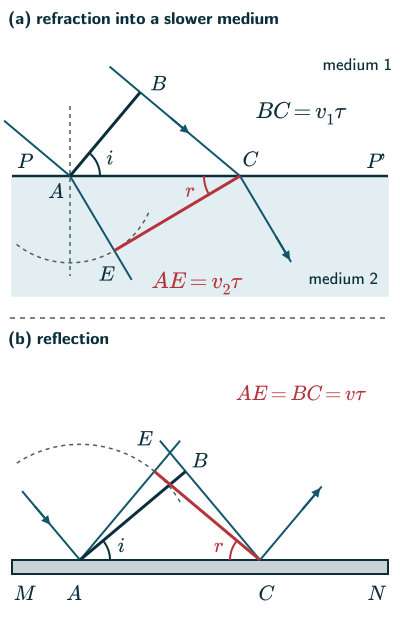
- Let a plane wavefront AB meet the surface PP′ between medium 1 (speed v1) and medium 2 (speed v2) at an angle i. Let τ be the time the end B takes to reach the surface at C, so BC = v1τ (NCERT page 258, Figure 10.4).
- In that time the wavelet from A grows in medium 2 to a sphere of radius AE = v2τ. The tangent plane from C to this sphere, CE, is the refracted wavefront (NCERT page 259).
- In the right-angled triangles ABC and AEC, with the hypotenuse AC common (NCERT Eqs. (10.1)–(10.2), page 259):
Angles from the construction (NCERT Eqs. 10.1 and 10.2)
- The angle between the incident wavefront and the surface equals the angle of incidence between the ray and the normal, because the ray is perpendicular to the wavefront and the normal is perpendicular to the surface; the same holds for r (reasoned from NCERT page 258).
Snell’s law from Huygens principle
- Dividing the two equations (NCERT Eq. (10.3), page 259):
Snell’s law from wave speeds (NCERT Eq. 10.3)
- If the ray bends towards the normal (r < i), then v2 < v1: light is slower in the medium it bends into. The corpuscular model predicted the opposite, and experiment showed the wave theory is right (NCERT page 259).
- With the refractive indices n1 = c/v1 and n2 = c/v2, this becomes Snell’s law (NCERT Eqs. (10.4)–(10.6), page 259):
Snell’s law (NCERT Eq. 10.6)
- Wavelength changes, frequency does not. If BC is one wavelength λ1, then AE is one wavelength λ2, because a crest from A reaches E in the same time as a crest from B reaches C. So λ1/λ2 = v1/v2 (NCERT Eq. (10.7), page 259). Going into a denser medium the speed and the wavelength both fall, but the frequency ν = v/λ stays the same (NCERT page 260; see wavelength and frequency).
Wavelength in two media (from NCERT Eq. 10.7)
-
Taking medium 1 as a vacuum (or air) and medium 2 of refractive index n, the wavelength becomes λ0/n, while the frequency, and so the colour, stays the same (reasoned from NCERT Eqs. (10.4)–(10.7); the point about colour is beyond the NCERT text).
-
Why the frequency stays the same: reflection and refraction come from atoms driven by the light. They oscillate at the frequency of the incoming light and send out light of that frequency (NCERT Example 10.1, page 262).
-
Slower does not mean weaker. A lower phase speed does not by itself mean energy loss: at a stationary transparent interface the frequency and photon energy hν stay unchanged. Classical intensity depends on field amplitude and the medium’s impedance; reflection can still reduce transmitted power (NCERT Example 10.1, page 262).
Refraction at a rarer medium
- If medium 2 is rarer (v2 > v1), the wavelet from A grows farther than BC, so the refracted wavefront CE makes a larger angle with the surface than AB does, and r > i: the ray bends away from the normal. Snell’s law n1 sin i = n2 sin r still holds (NCERT page 260, Figure 10.5).
- The angle of refraction reaches 90° at the critical angle ic (NCERT Eq. (10.8), page 260):
Critical angle (NCERT Eq. 10.8)
- For i > ic there is no propagating refracted ray carrying normal power across the ideal interface; an evanescent field remains, and the light undergoes total internal reflection (NCERT page 260). In wave terms, sin ic = v1/v2 (reasoned from NCERT Eqs. (10.3) and (10.8)).
Reflection of a plane wave by a plane surface
- Now let the plane wavefront AB meet a reflecting surface MN at an angle i. While B travels to C, BC = vτ, the wavelet from A grows to a sphere of radius vτ in the same medium. The tangent plane CE from C is the reflected wavefront, and AE = BC = vτ (NCERT pages 260–261, Figure 10.6).
- The right-angled triangles BAC and ECA share the hypotenuse AC and have BC = AE, so they are congruent. Their angles at A and C, which are i and r, are equal: the law of reflection (NCERT page 261).
Prisms, lenses and mirrors
- Thin prism: light is slower in glass, so the part of a plane wavefront that crosses the thickest glass is delayed most, and the wavefront comes out tilted (NCERT page 261, Figure 10.7(a)).
- Convex lens: the central part of a plane wavefront crosses the thickest part of the lens and is delayed most. The emerging wavefront has a depression at the centre, becomes spherical, and converges to the focus F (NCERT page 261, Figure 10.7(b)).
- Concave mirror: a plane wave is reflected as a spherical wave converging to the focus F (NCERT page 261, Figure 10.7(c)). Concave lenses and convex mirrors can be understood in the same way.
- Equal paths in the ideal imaging model: the ray through the centre of a convex lens has the shorter path but goes slower in glass, so it takes the same time as a ray near the edge. For ideal aberration-free imaging in this model, the optical path from an object point to its image is the same along the imaging rays (NCERT page 261).
Solved examples
Example 1: Light entering water (NCERT Exercise 10.1)
Light of wavelength 589 nm in air falls on water (n = 1.33). Find the wavelength, frequency and speed of (a) the reflected and (b) the refracted light.
Answer: (a) The reflected light is unchanged: λ = 589 nm, ν = c/λ = (3.00 × 10⁸)/(589 × 10−9) ≈ 5.09 × 10¹⁴ Hz, speed 3.00 × 10⁸ m/s. (b) The refracted light has the same frequency, 5.09 × 10¹⁴ Hz. Its speed is c/n ≈ 2.26 × 10⁸ m/s and its wavelength is λ/n = 589/1.33 ≈ 443 nm (NCERT Exercise 10.1, page 273; answer on page 350).
NCERT slip: NCERT’s answer gives 444 nm, because it divides the rounded values 2.26 × 10⁸ and 5.09 × 10¹⁴. Unrounded, λ/n is 443 nm.
Example 2: Speed in glass and colour (NCERT Exercise 10.3)
(a) The refractive index of glass is 1.5. Find the speed of light in it. (b) Is this speed the same for all colours? Which is slower in a glass prism, red or violet?
Answer: (a) v = c/n = (3.0 × 10⁸)/1.5 = 2.0 × 10⁸ m/s. (b) No. The refractive index depends on the wavelength. For ordinary glass in its visible normal-dispersion range, violet is deviated more than red by a prism, so n is larger for violet, and violet travels slower (NCERT Exercise 10.3, page 273; answer on page 350).
Example 3: Frequency, energy and intensity (NCERT Example 10.1)
(a) Why do reflected and refracted light have the same frequency as the incident light? (b) Does the drop in speed in a denser medium mean less energy? (c) What fixes the intensity in the photon picture?
Answer: (a) The atoms of the medium act as oscillators driven by the light; they oscillate at its frequency and emit light of that frequency. (b) No: unchanged frequency means unchanged photon energy hν. Intensity depends on amplitude and the medium’s electromagnetic properties, and some incident power can be reflected. (c) For a given frequency, the number of photons crossing unit area in unit time (NCERT Example 10.1, page 262).
Example 4: Delaying half a wavefront
A glass plate 2.0 mm thick (n = 1.5) is placed normally across half of a plane wavefront; use the nondispersive approximation. By how much does that half fall behind, in time and in distance?
Answer: Crossing the glass takes nd/c instead of d/c, so the delay is (n − 1)d/c = 0.5 × (2.0 × 10−3)/(3.0 × 108) ≈ 3.3 × 10⁻¹² s. Light in air covers c × 3.3 × 10⁻¹² s = (n − 1)d = 1.0 mm in that time, so the delayed half of the wavefront lags 1.0 mm behind the other half. A thin prism does the same with a thickness that grows across the beam, so it tilts the wavefront (reasoned from NCERT page 261).
Common mistakes to avoid
Common mistake
Thinking the frequency changes in a new medium
The speed and the wavelength change in the same ratio; the frequency stays that of the source (NCERT page 260).
Common mistake
Expecting light to speed up when it bends towards the normal
That was the corpuscular prediction. The wave theory, confirmed by experiment, says it slows down (NCERT pages 255 and 259).
Common mistake
Measuring i from the ray in one place and from the wavefront in another
The angle between the wavefront and the surface equals the angle between the ray and the normal; use one picture consistently (reasoned from NCERT page 258).
Quick revision summary
- In refraction the wavelet from the first point grows at the second medium’s speed: sin i/sin r = v1/v2, which with n = c/v gives n1 sin i = n2 sin r.
- Bending towards the normal means slower light in the second medium, as the wave theory predicts.
- λ1/λ2 = v1/v2: speed and wavelength change, the frequency does not.
- Into a rarer medium r > i; sin ic = n2/n1, and beyond ic there is total internal reflection.
- In reflection AE = BC, the triangles are congruent, and i = r.
- For ideal aberration-free imaging, the imaging rays have equal optical paths (and equal travel times in the nondispersive model).
Formula sheet
- sin i/sin r = v1/v2
- n = c/v
- n1 sin i = n2 sin r
- λ1/λ2 = v1/v2
- sin ic = n2/n1
Questions students ask
Why does light slow down in glass?
Light slows down in glass because it drives the atoms of the glass, which NCERT treats as oscillators, into forced oscillation at the light’s own frequency (NCERT Example 10.1, page 262). Beyond the NCERT text, the electrons in those atoms send out waves of their own, which together lag behind the incoming wave; the incoming wave and these waves add up to one wave of the same frequency whose crests advance more slowly, at c/n, so the slowing belongs to the combined wave, not to light stopping and starting at each atom (Feynman Lectures on Physics, Vol. I, Chapter 31). That lower speed in glass is what bends the ray towards the normal in Huygens’ construction (NCERT page 259).
What is optical path length, and how is it different from the actual path?
The optical path length, a term beyond the NCERT text (NCERT Chapters 9 and 10 and both syllabuses never use it), is the refractive index times the actual distance, nL: the phase-equivalent vacuum distance. In a nondispersive medium this is also c times the transit time, since L/v = nL/c; a pulse in a dispersive medium instead travels at its group velocity (from NCERT Eq. (10.5), page 259). So 3.5 mm of glass with n = 1.52 is an optical path of about 5.3 mm, 1.8 mm more than the same thickness of air. Interference depends on differences of optical path, not of actual path, which is why a thin sheet over one slit in Young’s experiment shifts the fringes.
How is Fermat’s principle related to Huygens principle and Snell’s law?
Fermat’s principle says that a geometrical-optics ray follows a stationary optical path; in the nondispersive model this is stationary travel time, not necessarily the shortest time; for light crossing from one medium into another it gives the same Snell’s law, sin i/sin r = v1/v2, as Huygens’ construction (beyond the NCERT text; Feynman Lectures on Physics, Vol. I, Chapter 26, especially §26–5). The two agree because each Huygens wavefront is a surface that light from the source reaches in equal times, and NCERT’s remark that the time from an object point to its image is the same along every ray (page 261) is the same idea. Neither the JEE Main nor the NEET (UG) 2026 syllabus names Fermat’s principle.
How did Huygens explain double refraction in calcite?
Huygens explained double refraction in calcite (Iceland spar) by giving each point of a wavefront two secondary wavelets inside the crystal: an ordinary spherical one, whose envelope gives a beam that obeys Snell’s law, and a spheroidal one, spreading a little faster in some directions than in others, whose envelope gives the second, ‘irregular’ beam (beyond the NCERT text; Huygens, Treatise on Light, 1690, Chapter V, public domain). Two envelopes mean two refracted beams, so an object seen through the crystal looks double. NCERT’s box on Huygens (page 259) notes that he explained it.
Practice questions
Try each question first, then open the answer to check your working.
-
Q1. Light goes from air into glass (n = 1.5). Its wavelength in air is 600 nm. Find its wavelength and frequency in the glass.
Show answerHide answer
λ = 600/1.5 = 400 nm; the frequency is unchanged, c/λair = (3.0 × 10⁸)/(600 × 10−9) = 5.0 × 10¹⁴ Hz (NCERT Eq. (10.7), page 259).
-
Q2. A plane wave in medium 1 (speed 3.0 × 10⁸ m/s) meets medium 2 (speed 2.0 × 10⁸ m/s) at i = 30°. Find r.
Show answerHide answer
sin r = (v2/v1) sin i = (2.0/3.0) × 0.5 ≈ 0.333, so r ≈ 19.5° (NCERT Eq. (10.3), page 259).
-
Q3. Why are the incident and reflected wavefronts at equal angles to a mirror?
Show answerHide answer
While one end of the wavefront travels BC = vτ to the mirror, the wavelet from the other end grows to AE = vτ in the same medium. The right triangles BAC and ECA share AC and have BC = AE, so they are congruent and i = r (NCERT page 261).