Brewster’s law
Beyond NCERT In the JEE Main and NEET syllabus; the Class 12 book has no section for it.
Quick answer
For unpolarised light at a lossless isotropic dielectric interface, Brewster’s law is tan iB = μ, with μ the relative refractive index. The reflected light is then linearly polarised perpendicular to the incidence plane, while iB + r = 90°; for glass of index 1.5 in air, iB is about 56.3°. Purely in-plane polarised incident light instead has zero reflected intensity at that angle.
What is Brewster’s law?
Brewster’s law
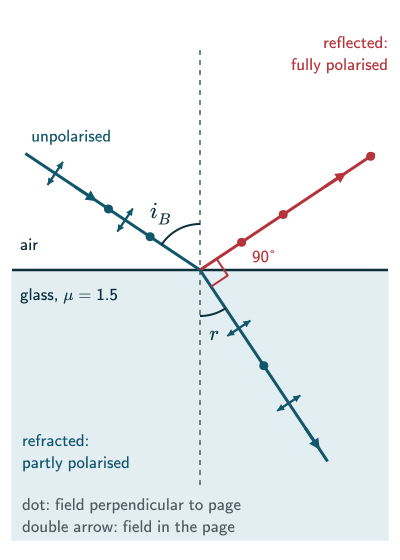
When unpolarised light falls on the surface of a transparent medium such as glass or water, the reflected light is partly polarised. At one angle of incidence, the Brewster angle iB, it is completely plane-polarised, with its electric field perpendicular to the plane of incidence. Brewster’s law gives that angle: tan iB = μ, the refractive index of the second medium relative to the first. At the Brewster angle the reflected and refracted rays are at right angles.
Brewster’s law is not in the 2026–27 NCERT textbook, but the JEE Main 2027 and NEET (UG) 2026 syllabuses both list it in Unit 16, with plane-polarised light and polaroids. It builds on NCERT Section 10.7, Polarisation (pages 269–271), which covers polaroids and Malus’ law, and starts from NCERT’s description of natural light:
Natural light, e.g., from the sun is unpolarised. This means the electric vector takes all possible directions in the transverse plane, rapidly and randomly, during a measurement.
NCERT Physics Part II (Class 12), Chapter 10, Wave Optics, page 272
In plain words: the glare from a lake or a wet road is light reflected at a slant. At one particular slant the reflected light’s electric field vibrates only side to side, parallel to the surface. That angle depends only on the refractive index, through tan iB = μ, and it is the angle at which the reflected and refracted rays make a right angle.
Scope: a smooth boundary between two isotropic, transparent, non-magnetic, effectively lossless media with different refractive indices. Statements that reflection produces complete or partial polarisation assume initially unpolarised light. If the incident light is purely in-plane polarised at iB, the reflected intensity is zero, not a nonzero fully polarised beam. Index-matched media have no ordinary interface reflection. Real absorption, coatings, roughness and wavelength spread can prevent perfect extinction.
Reflected light fully plane-polarised at the Brewster angle
- Unpolarised light has its electric field in all directions across the ray (NCERT Summary, page 272). Any such field can be split into two parts: one in the plane of incidence (the plane holding the incident ray and the normal), and one perpendicular to it, along the surface (reasoned).
- On reflection the in-plane part is reflected less than the perpendicular part, so reflected light is usually partly polarised. At the Brewster angle the in-plane part is not reflected at all: the reflected light is completely plane-polarised, with its field perpendicular to the plane of incidence (beyond the NCERT text).
- At the Brewster angle, the refracted light carries all the incident in-plane power and a fraction of the perpendicular power, so it is only partly polarised (beyond the NCERT text).
- Why (beyond the NCERT text): the light entering the glass sets the electrons in it oscillating along the refracted wave’s field, and these accelerated charges send out the reflected light. An oscillating charge sends out no light along its own line of oscillation. At the Brewster angle the reflected ray is perpendicular to the refracted ray, so it lies along the in-plane oscillation, and that part cannot appear in the reflected light.
Brewster angle: tan i_B = μ
- At the Brewster angle the reflected and refracted rays are at right angles, so iB + r = 90° and sin r = cos iB. Snell’s law, sin iB = μ sin r, then gives sin iB = μ cos iB (reasoned):
Brewster’s law
- μ is the refractive index of the second medium relative to the first. For glass of μ = 1.5 in air, iB = tan−1 1.5 ≈ 56.3°; for water (1.33), about 53.1° (reasoned).
- NCERT’s answer section still gives answer 10.8 as tan−1(1.5) ≈ 56.3°, but the 2026–27 book has only six Chapter 10 exercises, so there is no question for it (NCERT answers, page 350).
- Since μ depends on the wavelength, so does the Brewster angle, slightly (beyond the NCERT text).
- The Brewster angle is also called the polarising angle, ip. From index μ1 into index μ2, tan iB = μ2/μ1: from water into glass, tan−1(1.5/1.33) ≈ 48.4°. For incidence from air into a denser material, μ = 1/sin ic, where ic is for the reverse material-to-air interface; then tan iB = 1/sin ic (reasoned).
- Inside the glass, going towards air, the Brewster angle is tan−1(1/μ) ≈ 33.7° for μ = 1.5. This is less than the critical angle, sin−1(1/1.5) ≈ 41.8°. Here tan iB = 1/μ = sin ic, and tan x > sin x for any acute angle, so the Brewster angle is always the smaller (reasoned).
Reflected and refracted rays at right angles
- At the Brewster angle the angle of refraction is r = 90° − iB, and the reflected ray makes 90° with the refracted ray (reasoned from Snell’s law above).
- The reverse holds too: if the reflected and refracted rays are at right angles, the light is meeting the surface at the Brewster angle, and the reflected light is fully polarised.
- Uses (beyond the NCERT text): glare from water, wet roads and other horizontal surfaces is partly polarised at most angles, and strongly so near the Brewster angle, with its field mostly horizontal. Polaroid sunglasses, with a vertical pass axis, and camera polaroid filters block much of it. NCERT (page 271) names polaroids in sunglasses and cameras, but not this reason.
- A pile of glass plates at the Brewster angle uses this. The in-plane part passes every surface without reflection, because inside each plate it meets the far face at 90° − iB, the glass-to-air Brewster angle. For ordinary glass of index 1.5 in air, each surface reflects about 15% of the perpendicular power at this angle. After many plates, the light that gets through is nearly plane-polarised in the plane of incidence (reasoned).
Solved examples
Example 1: Glass
Find the Brewster angle for glass of refractive index 1.5 in air, and the angle of refraction at that angle.
Answer: iB = tan−1 1.5 ≈ 56.3°, and r = 90° − 56.3° = 33.7°. Check with Snell’s law: sin 56.3°/sin 33.7° ≈ 0.832/0.555 ≈ 1.5 (reasoned; NCERT’s answer 10.8 on page 350 gives the same 56.3°).
Example 2: Glare from a lake
At what angle of incidence is sunlight reflected from water (μ = 1.33) completely polarised? How high is the Sun above the horizon then?
Answer: iB = tan−1 1.33 ≈ 53.1° from the vertical, so the Sun is 90° − 53.1° ≈ 36.9° above the horizon (reasoned).
Example 3: From the Brewster angle to μ
Initially unpolarised light incident from air on a transparent slab has a completely polarised reflection when the angle of incidence is 60°. Find the refractive index and the critical angle of the slab.
Answer: μ = tan 60° = √3 ≈ 1.73. The critical angle is sin−1(1/1.73) ≈ 35.3° (reasoned; critical angle from NCERT Eq. (9.12), page 230).
Example 4: Inside the glass
Light inside glass (μ = 1.5) meets the glass–air surface. Find the Brewster angle and compare it with the critical angle.
Answer: Going from glass to air the relative index is 1/1.5, so iB = tan−1(1/1.5) ≈ 33.7°, while the critical angle is sin−1(1/1.5) ≈ 41.8°. For initially unpolarised light, at 33.7° the reflected light inside is fully polarised; beyond 41.8° all the light is reflected (reasoned).
Common mistakes to avoid
Common mistake
Writing sin instead of tan
Brewster’s law is tan iB = μ; the critical angle uses sin ic = 1/μ (reasoned).
Common mistake
Expecting the refracted light to be fully polarised too
Only the reflected light is fully polarised at the Brewster angle; the refracted light is partly polarised (beyond the NCERT text).
Common mistake
Taking the polarisation in the plane of incidence
The reflected light’s field is perpendicular to the plane of incidence, that is, parallel to the reflecting surface (beyond the NCERT text).
Quick revision summary
- At the Brewster angle, light reflected from a transparent surface is completely plane-polarised, with its field perpendicular to the plane of incidence; the refracted light is partly polarised.
- Brewster’s law: tan iB = μ; about 56.3° for glass of μ = 1.5 and 53.1° for water.
- At iB the reflected and refracted rays are at right angles: iB + r = 90°.
- From glass to air the Brewster angle, tan−1(1/μ), is smaller than the critical angle.
- Polaroid sunglasses cut glare because reflected light is mostly polarised parallel to the surface.
Formula sheet
- tan iB = μ
- iB + r = 90°
Questions students ask
What is the difference between Brewster’s law and Malus’ law?
Brewster’s law (beyond the NCERT text) says when reflection polarises light: at the angle of incidence iB with tan iB = μ, reflected light is fully plane-polarised; Malus’ law says how much plane-polarised light a polaroid then passes, I0 cos2 θ (NCERT Eq. (10.18), page 270). So Brewster’s law is about producing polarised light and depends on the refractive index, while Malus’ law is about analysing it and depends only on an angle. The angles differ in kind too: iB is measured from the normal to the surface, θ between two directions across the beam, the field and the pass axis.
Is Brewster’s law in the JEE Main and NEET syllabus if it is not in NCERT?
Yes, Brewster’s law is in both syllabuses: Unit 16 of the JEE Main syllabus lists “plane-polarized light, Brewster’s law, uses of plane-polarized light and Polaroid”, and NEET (UG) 2026 Unit 16 has “Polarization, plane-polarized light: Brewster’s law”. The 2026–27 NCERT Class 12 Physics Part II lacks it because NCERT’s 2022 rationalisation dropped Section 10.7.2, Polarisation by Reflection, with Section 10.7.1 (scattering) and Exercises 10.7–10.21 (NCERT rationalised-content list, Class XII, page 51). NCERT Exemplar Problems for Class XII Physics still asks about polarisation by reflection (Chapter 10, questions 10.1 and 10.16), and this page covers what the dropped section did.
Is light reflected from a surface always polarised?
For initially unpolarised light at an ordinary lossless dielectric interface, complete linear polarisation by reflection occurs at the Brewster angle; at other angles glass or water reflects partly polarised light, and at normal incidence it is not polarised at all, as both components then meet the surface alike (beyond the NCERT text). For glass of μ = 1.5 at 30°, the Fresnel equations give about 5.8% of the light polarised along the surface reflected but only 2.5% of the light polarised in the plane of incidence, and at grazing incidence both near 100%, so the polarisation fades again. Ordinary absorbing metal mirrors generally have no exact zero of the in-plane reflectance, so they do not give complete polarisation by reflection of initially unpolarised light. Their reflectance and phase shifts depend on material, wavelength and angle.
What is the Brewster angle used for?
The Brewster angle is used where light must cross glass without reflection loss or be polarised by reflection: the end windows of many gas lasers, such as helium–neon lasers, are set at it, so light polarised in the plane of incidence crosses them with no reflection loss while the other polarisation keeps losing light, and the beam comes out plane-polarised (beyond the NCERT text; Thorlabs, Optics Selection Guide: Brewster Windows). It also gives the refractive index of a transparent material from reflected light alone: find the angle of incidence at which a turning polaroid can make the reflection vanish; then μ = tan iB.
Practice questions
Try each question first, then open the answer to check your working.
-
Q1. Find the Brewster angle for a glass of refractive index 1.6.
Show answerHide answer
iB = tan−1 1.6 ≈ 58.0° (Brewster’s law; beyond the NCERT text).
-
Q2. In which direction does the electric field of light reflected at the Brewster angle vibrate?
Show answerHide answer
Perpendicular to the plane of incidence, parallel to the reflecting surface (beyond the NCERT text).
-
Q3. Light falls on a liquid at 53°, and the reflected and refracted rays are at right angles. Find the refractive index of the liquid.
Show answerHide answer
The rays at right angles mean 53° is the Brewster angle, so μ = tan 53° ≈ 1.33 (Brewster’s law; beyond the NCERT text).