Electron emission and work function
NCERT Class 12 Physics Chapter 11 Sections 11.1–11.2
Quick answer
Electron emission releases electrons from a metal surface: heat or absorbed light can supply escape energy, while a strong electric field can thin the surface barrier enough for tunnelling. The work function measures the energy from the Fermi level to vacuum (beyond the NCERT text; Wikipedia, “Photoelectric effect”); 1 eV = 1.602 × 10⁻¹⁹ J to four significant figures, the energy gained by an electron through a 1 V accelerating potential difference.
With your textbook
NCERT Physics Part II (Class 12), Chapter 11 “Dual Nature of Radiation and Matter”, Sections 11.1–11.2 “Introduction” and “Electron Emission”, pages 274–276.
Open the official NCERT chapter (PDF, 1.8 MB, ncert.nic.in) (opens in a new tab)
Checked against the 2026-27 reprint on .
What is electron emission?
Electron emission and work function
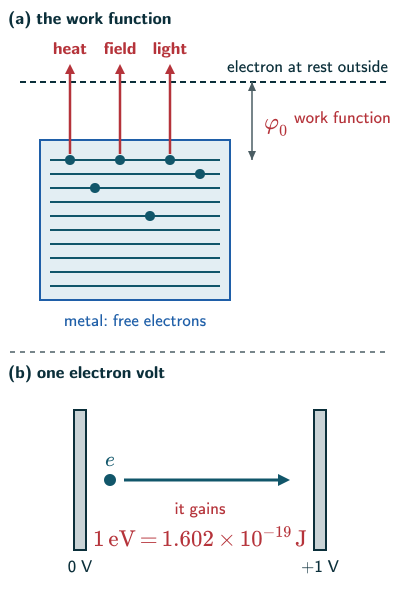
Metals have free electrons, but these cannot normally escape out of the metal surface: if an electron attempts to come out, the metal surface acquires a positive charge and pulls the electron back, so it is held inside by the attractive forces of the ions (NCERT page 275). Strictly, the positive charge is induced by the departing electron itself, so this surface barrier is there even when the bulk metal is neutral or grounded; removing charge from an isolated metal adds a further electrostatic barrier (reasoned from NCERT page 275). To escape, an electron must be given a certain minimum energy:
This minimum energy required by an electron to escape from the metal surface is called the work function of the metal.
NCERT Physics Part II (Class 12), Section 11.2, page 275
The work function φ0 is usually given in electron volts (eV). The energy can be supplied by heating the metal (thermionic emission), by a very strong electric field that pulls electrons out (field emission) or by light of suitable frequency (photoelectric emission) (NCERT Section 11.2, pages 275–276); for how field emission really works, see below.
In plain words: the free electrons in a metal are like marbles in a bowl. They roll about freely inside, but each needs a minimum push to get over the rim. That push is the work function, and heat or light can supply escape energy, while a strong electric field changes the barrier so that tunnelling becomes possible.
Units and scope: e denotes the positive magnitude of the electron’s charge. Beyond the NCERT text: since the 2019 revision of the SI, 1 eV is exactly 1.602176634 × 10⁻¹⁹ J (Wikipedia, “Electronvolt”); the 1.602 × 10⁻¹⁹ J used below is rounded. The energy gained is eV for an electron accelerated through a potential rise V, while ½mv2 assumes v ≪ c (reasoned). Field emission is tunnelling, not simply adding φ0 as classical kinetic energy (Wikipedia, “Field electron emission”).
Cathode rays and the electron
- Around the end of the 19th century, studies of electric discharge through gases at low pressure, about 0.001 mm of mercury, showed a fluorescent glow on the glass opposite the cathode, caused by rays coming from the cathode. J. J. Thomson, using electric and magnetic fields at right angles, was the first to measure the speed and the specific charge e/m of these cathode-ray particles (NCERT pages 274–275).
- They travelled at about 0.1 to 0.2 times the speed of light, and e/m is now taken as 1.76 × 10¹¹ C/kg, the same whatever the cathode metal or the gas. Particles emitted by metals under ultraviolet light or when heated have the same e/m (NCERT page 275). Thomson called these particles “corpuscles”; the name electron, proposed by G. Johnstone Stoney in 1891, was soon adopted for them (beyond the NCERT text; Thomson’s 1906 Nobel lecture and the American Institute of Physics, From Thomson’s Corpuscles to the Electron).
- NCERT slip (page 275): NCERT says Thomson, in 1897, “named these particles as electrons”; 1897 is the year he discovered them, but the name was Stoney’s.
- In 1913 Millikan’s oil-drop experiment showed that the charge on an oil drop is always a whole multiple of an elementary charge e, now taken as 1.602 × 10⁻¹⁹ C: charge is quantised. From e and e/m, the electron’s mass follows (NCERT page 275).
Work function
- Metals have free electrons that carry the current (see drift of electrons), but these are held inside the surface by the attraction of the positive ions (NCERT page 275).
- The work function φ0 is the minimum energy an electron needs to escape from the metal surface. It depends on the metal and on the nature of its surface (NCERT page 275).
- The free electrons do not all have the same energy, so different electrons need different extra energy to come out: those with higher energy need less. The work function is the least energy required by an electron to come out of the metal (NCERT Points to ponder 2–3, page 288). Beyond the NCERT text: this least energy is measured from the Fermi level inside the metal to an electron at rest in the vacuum just outside (Wikipedia, “Work function”); at a finite temperature a few electrons in the thermal tail already have part of it (reasoned).
The electron volt
- One electron volt is the energy an electron gains when it is accelerated through a potential difference of 1 volt (NCERT page 275):
Electron volt (NCERT page 275)
- The unit is common in atomic and nuclear physics, where energies in joules are awkward numbers (NCERT page 275).
- An electron accelerated through V volts gains eV joules, that is V electron volts: the eV is a unit of energy, not of potential (reasoned).
Thermionic, field and photoelectric emission
- Thermionic emission: heating the metal gives the free electrons enough thermal energy to come out (NCERT page 275).
- Field emission: a very strong electric field, of the order of 108 V m−1, pulls electrons out of the metal, as in a spark plug (NCERT page 276). Strictly, the field does not hand the electron the work function: it makes the surface barrier so thin that electrons tunnel through it, a quantum effect (beyond the NCERT text; Wikipedia, “Field electron emission”).
- Photoelectric emission: light of suitable frequency falling on the metal surface ejects electrons, called photoelectrons (NCERT page 276). This is the subject of the rest of the chapter.
Solved examples
Example 1: Work function in joules
The work function of caesium is 2.14 eV (NCERT Example 11.2). Express it in joules.
Answer: φ0 = 2.14 × 1.602 × 10−19 J ≈ 3.43 × 10⁻¹⁹ J (NCERT page 275).
Example 2: An electron accelerated through 100 V
An electron starts from rest and is accelerated through 100 V. Find its kinetic energy in eV and in joules, and its speed.
Answer: It gains 100 eV = 100 × 1.602 × 10−19 ≈ 1.60 × 10⁻¹⁷ J. With ½mv2 = 1.60 × 10⁻¹⁷ J and m = 9.11 × 10⁻³¹ kg, v2 = 2K/m ≈ 3.5 × 10¹³ m2/s2, so v ≈ 5.9 × 10⁶ m/s (NCERT page 275).
Example 3: The electron’s mass
Find the mass of the electron from e = 1.602 × 10⁻¹⁹ C and e/m = 1.76 × 10¹¹ C/kg.
Answer: m = e/(e/m) = (1.602 × 10⁻¹⁹)/
Example 4: Fast cathode rays
Cathode-ray electrons travel at up to about 0.2 times the speed of light. Estimate their kinetic energy in eV.
Answer: v = 0.2 × 3.0 × 108 = 6.0 × 10⁷ m/s, so ½mv2 = ½ × 9.11 × 10−31 × (6.0 × 107)2 ≈ 1.6 × 10⁻¹⁵ J ≈ 1.0 × 10⁴ eV, about 10 keV (NCERT page 275; at this speed the non-relativistic formula is about 3% low, beyond the NCERT text).
Common mistakes to avoid
Common mistake
Treating the electron volt as a unit of potential
The eV is a unit of energy, 1.602 × 10⁻¹⁹ J; the volt is the unit of potential (NCERT page 275).
Common mistake
Thinking free electrons can leave a metal freely
They are free inside but cannot normally escape: an electron leaving the surface would charge it positively and be pulled back, so it needs at least the work function to leave (NCERT page 275). Strictly, grounding the metal does not remove this surface barrier (reasoned).
Common mistake
Taking the work function as a fixed number for an element
It depends on the nature of the surface as well as on the metal (NCERT page 275).
Quick revision summary
- The work function φ0 is the least energy an electron needs to escape from a metal surface; it depends on the metal and its surface.
- 1 eV = 1.602 × 10⁻¹⁹ J, the energy an electron gains through 1 V.
- Emission by heating (thermionic), by a strong field of about 108 V/m (field), or by light (photoelectric).
- Thomson measured the speed and e/m of cathode-ray particles in 1897; e/m is now taken as 1.76 × 10¹¹ C/kg. Millikan (1913) showed that charge comes in whole multiples of e, now taken as 1.602 × 10⁻¹⁹ C.
Formula sheet
- 1 eV = 1.602 × 10⁻¹⁹ J
- energy gained = e × V
- m = e/(e/m)
Questions students ask
What are the unit and dimensional formula of work function?
The work function is an energy, so its SI unit is the joule and its dimensional formula is [M L T], the same as that of kinetic energy (NCERT page 288). It is usually quoted in electron volts because metals’ values come to a few eV, awkward numbers in joules: 2.42 eV for lithium is 3.88 × 10 J, and 4.8 eV for copper is 7.7 × 10 J (values from NCERT Class 11 Chemistry, Table 2.2). The physics book writes it φ0, the chemistry book W0; for how the electron volt differs from the volt, see electrostatic potential.
What is the difference between work function and ionisation energy?
The work function is the least energy needed to take an electron out through the surface of a solid metal, while the ionisation energy is the least energy needed to remove an electron from a single free atom, as in a gas. For the same element the work function is much smaller: potassium’s is 2.25 eV and copper’s 4.8 eV (NCERT Class 11 Chemistry, Table 2.2), against 4.34 eV and 7.73 eV to ionise their free atoms (beyond the NCERT text; NIST Atomic Spectra Database). In the metal the outer electrons have already left their own atoms to move freely, so they need only enough energy to get out through the surface (reasoned from NCERT page 275).
Does the work function of a metal depend on the frequency or intensity of light?
In the ordinary weak-illumination model with unchanged surface and temperature, no: it is a property of the metal and of the nature of its surface (NCERT page 275), so changing frequency or intensity does not directly change it. Intense illumination can heat or alter the surface, outside this model. A higher frequency only leaves more energy beyond φ0 for the photoelectron’s kinetic energy, and a more intense above-threshold beam gives a larger emission rate when the quantum yield is unchanged (NCERT pages 281–282). Metals differ in how firmly they hold their free electrons: the alkali metals, with low work functions such as about 2.3 eV for sodium, respond even to visible light, while copper, at 4.8 eV, needs ultraviolet light (NCERT Class 11 Chemistry, Table 2.2; NCERT pages 277 and 280).
What is the difference between thermionic emission and field emission?
Thermionic emission frees electrons by heating a metal until some have enough thermal energy to get over the surface barrier, while field emission pulls electrons out with a very strong electric field, of the order of 10 V m (NCERT pages 275–276). Cold field emission can work at room temperature, the electrons tunnelling through the thinned barrier instead of going over it, so it is also called cold emission (beyond the NCERT text; Wikipedia, “Field electron emission”). A heated tungsten filament in a thermionic electron microscope is a thermionic source, while sharp field-emission tips give the bright electron beams of high-resolution electron microscopes (Wikipedia, “Field electron emission” and “X-ray tube”; reasoned).
Why does thermionic emission need such a high temperature?
Thermionic emission needs a very hot metal because thermal energies are of the order of kT, far smaller than a work function of a few electron volts: at 20 °C (293 K), kT ≈ 0.025 eV, and even at 2500 K it is only about 0.22 eV (beyond the NCERT text; k = 8.617 × 10 eV K, NIST). So only the rare free electrons far out in the spread of energies (NCERT Points to ponder 2–3, page 288) can get over the barrier, and their number climbs very steeply as the metal gets hotter. A kT of a full 1 eV would need a temperature of about 11 600 K.
Practice questions
Try each question first, then open the answer to check your working.
-
Q1. Convert 4.2 eV into joules.
Show answerHide answer
4.2 × 1.602 × 10−19 ≈ 6.7 × 10⁻¹⁹ J (NCERT page 275).
-
Q2. Name the three ways of giving electrons enough energy to leave a metal.
Show answerHide answer
Heating the metal (thermionic emission), applying a very strong electric field (field emission), and shining light of suitable frequency on it (photoelectric emission) (NCERT pages 275–276).
-
Q3. An electron gains 50 eV of kinetic energy. Through what potential difference was it accelerated?
Show answerHide answer
50 V, since an electron gains 1 eV for every volt (NCERT page 275).