Wave nature of matter: de Broglie wavelength
NCERT Class 12 Physics Chapter 11 Section 11.8
Quick answer
The de Broglie wavelength is λ = h/p, where p is momentum; λ = h/p ≈ h/mv (v ≪ c). For a nonrelativistic particle accelerated from rest through a potential difference of magnitude V, λ = h/√(2mqV), where q is the charge magnitude; for electrons, λ ≈ 1.227/√V nm (electron).
With your textbook
NCERT Physics Part II (Class 12), Chapter 11 “Dual Nature of Radiation and Matter”, Section 11.8 “Wave Nature of Matter”, pages 284–286.
Open the official NCERT chapter (PDF, 1.8 MB, ncert.nic.in) (opens in a new tab)
Checked against the 2026-27 reprint on .
What is the wave nature of matter?
Wave nature of matter
Light behaves as a wave in interference, diffraction and polarisation, and as a stream of particles, photons, in the photoelectric effect. In 1924 de Broglie proposed that moving particles of matter should also show wave-like properties under suitable conditions. His reasoning, in NCERT’s words:
If radiation shows dual aspects, so should matter.
NCERT Physics Part II (Class 12), Section 11.8, page 285
A particle of momentum p has a de Broglie wavelength λ = h/p, approximately h/mv at nonrelativistic speeds (NCERT Eq. (11.5), page 285). The wavelength is a wave property and the momentum a particle property; Planck’s constant links them.
In plain words: if light, a wave, can act like particles, perhaps particles can act like waves. De Broglie’s formula says the wavelength of a moving thing is Planck’s constant divided by its momentum. Planck’s constant is so tiny that ordinary objects have wavelengths far too small ever to notice; electron wavelengths are easy to observe, and carefully prepared atoms and molecules show interference too.
Model limits: λ = h/p uses momentum magnitude. The forms with p = mv, K = p/(2m) and 1.227/√V nm assume nonrelativistic motion; acceleration formulas assume a particle initially at rest and positive gained energy |q|V. At high energy use p = √[K(K + 2mc)]/c. A wave packet has a spread of momenta and wavelengths; matter-wave behaviour is not limited to charged or subatomic objects.
Dual nature of radiation
- Light shows its wave nature in interference, diffraction and polarisation, and its particle nature in the photoelectric effect and the Compton effect, which involve transfers of energy and momentum (NCERT pages 284–285).
- Which description suits an experiment depends on the experiment. In seeing an object, the focusing of light by the eye lens is described by the wave picture, while its absorption by the rods and cones of the retina needs the photon picture (NCERT page 285).
De Broglie relation λ = h/p
- De Broglie reasoned that nature is symmetrical: matter and energy should have symmetrical character, so if radiation has a dual nature, so should matter (NCERT page 285).
- The wavelength of the matter wave of a particle of mass m and speed v is (NCERT Eq. (11.5), page 285):
De Broglie relation (NCERT Eq. 11.5)
- For a material particle this was a hypothesis, to be tested by experiment (NCERT page 285). C. J. Davisson and L. H. Germer verified the wave nature of electrons experimentally in 1927 (NCERT Chapter 12, page 301): electrons scattered from a nickel crystal gave a diffraction pattern (beyond the NCERT text; Davisson and Germer, The Scattering of Electrons by a Single Crystal of Nickel, Nature, 1927). De Broglie received the 1929 Nobel Prize for the discovery of the wave nature of electrons (NCERT page 285).
- In terms of energy (beyond the NCERT text): with kinetic energy K = p2/2m, λ = h/√(2mK). For an electron accelerated from rest through V volts, K = eV (see the electron volt), which gives λ ≈ 1.227/√V nm.
Electron through V volts (beyond the NCERT text)
- The de Broglie wavelength does not depend on the charge or the nature of the particle, only on its momentum (NCERT Summary point 9, page 287).
- The wavelength λ = h/p is measurable. The phase velocity is not the particle or signal speed: for a free relativistic particle, using total energy, it is E/p = c/v and can exceed c without carrying information faster than light. A narrow free-particle wave packet has group velocity dE/dp equal to the particle velocity (NCERT Points to ponder 6, page 288; the explicit phase/group-velocity relations are an extension).
De Broglie wavelength of a photon
- The relation is satisfied by a photon too. A photon has momentum p = hν/c, so (NCERT Eqs. (11.6)–(11.7), page 285):
Photon (NCERT Eq. 11.7)
- So the de Broglie wavelength of a photon equals the wavelength of the electromagnetic radiation it belongs to (NCERT page 285; NCERT Exercise 11.11, page 289).
Why everyday objects show no wave nature
- λ is smaller for a heavier or faster particle. For a ball of mass 0.12 kg at 20 m/s, p = 2.40 kg m/s and λ = 6.63 × 10⁻³⁴/2.40 ≈ 2.76 × 10⁻³⁴ m, far too small to measure (NCERT pages 285–286).
- The tiny wavelength and environmental decoherence make interference of ordinary moving macroscopic objects inaccessible in everyday conditions. In the sub-atomic world, the wave character is significant and measurable (NCERT page 286).
- NCERT emphasises subatomic particles such as electrons and protons, whose momenta can give wavelengths comparable with atomic spacings. Its word “only” is too restrictive: interference has also been observed with atoms and molecules, including C in 1999 (Arndt and colleagues, Nature, beyond NCERT) (NCERT Summary point 9, page 287).
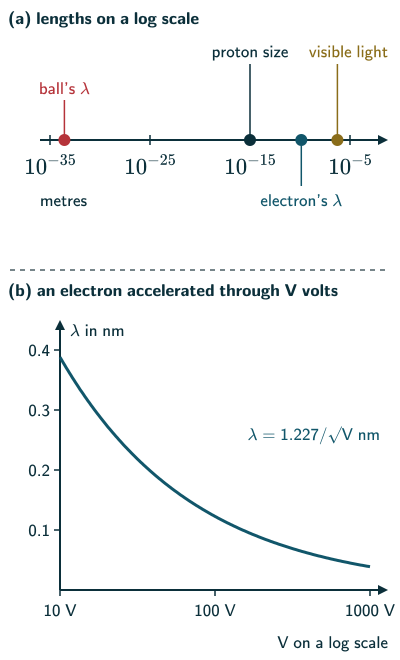
Comparing de Broglie wavelengths
- A particle of charge magnitude q accelerated from rest through an accelerating voltage magnitude V (beyond the NCERT text): it gains K = qV, so λ = h/√(2mqV). The charge enters only through the energy gained; λ still depends only on p.
Charge q through V volts (beyond the NCERT text)
- Through the same V, a proton has λ ≈ 0.0286/√V nm, and an alpha particle (charge 2e, mass about 4 proton masses) λ ≈ 0.010/√V nm, so the proton’s is about √8 ≈ 2.8 times the alpha’s. At the same kinetic energy, λ ∝ 1/√m, so the proton’s is about 2 times the alpha’s. At the same momentum, every particle has the same λ.
- Thermal neutrons (beyond the NCERT text): a nonrelativistic, nondegenerate free-particle gas at temperature T has an average kinetic energy of (3/2)kBT, so h/√(3mkBT) is the wavelength associated with the rms momentum, not the mean wavelength of the distribution or the statistical-mechanics thermal wavelength h/√(2πmkBT). For neutrons at 300 K the rms-momentum wavelength is about 0.145 nm, comparable to the spacing of atoms in a crystal.
Wavelength at rms momentum of a classical gas (beyond NCERT)
- A photon of energy E and a nonrelativistic electron of kinetic energy E: the photon has λ = hc/E (from NCERT Eq. (11.7), page 285) and the electron λ = h/√(2mE). At 100 eV these are 12.4 nm and 0.123 nm, about 100 times apart.
Solved examples
Example 1: An electron and a ball (NCERT Example 11.3)
Find the de Broglie wavelength of (a) an electron moving at 5.4 × 10⁶ m/s, (b) a ball of mass 150 g at 30.0 m/s.
Answer: (a) p = 9.11 × 10−31 × 5.4 × 106 ≈ 4.92 × 10⁻²⁴ kg m/s, so λ = h/p ≈ 0.135 nm, comparable with X-ray wavelengths. (b) p = 0.150 × 30.0 = 4.50 kg m/s, so λ ≈ 1.47 × 10⁻³⁴ m, about 10−19 times the size of a proton (NCERT Example 11.3, page 286).
Example 2: A bullet, a ball and a dust particle (NCERT Exercise 11.10)
Find the de Broglie wavelengths of (a) a 0.040 kg bullet at 1.0 km/s, (b) a 0.060 kg ball at 1.0 m/s, (c) a dust particle of 1.0 × 10⁻⁹ kg drifting at 2.2 m/s.
Answer: λ = h/mv: (a) 6.63 × 10⁻³⁴/40 ≈ 1.7 × 10⁻³⁵ m; (b) 6.63 × 10⁻³⁴/0.060 ≈ 1.1 × 10⁻³² m; (c) 6.63 × 10⁻³⁴/(2.2 × 10−9) ≈ 3.0 × 10⁻²⁵ m (NCERT Exercise 11.10, page 289).
NCERT slip: NCERT’s answer to part (c) (page 351) prints 3.0 × 10⁻²³ m; h/mv gives 3.0 × 10⁻²⁵ m.
Example 3: An electron through 100 V
An electron is accelerated from rest through 100 V. Find its de Broglie wavelength.
Answer: λ ≈ 1.227/√100 nm = 0.123 nm, about the spacing of atoms in a crystal (beyond the NCERT text; λ = h/p from NCERT Eq. (11.5), page 285).
Example 4: Same speed, different masses
A proton and an electron move at the same speed. Which has the longer de Broglie wavelength, and by how much?
Answer: λ = h/mv, so at the same speed the lighter electron has the longer wavelength, by the mass ratio, about 1836 times (reasoned from NCERT Eq. (11.5), page 285; the proton–electron mass ratio is beyond the NCERT text).
Common mistakes to avoid
Common mistake
Thinking only charged particles have matter waves
The de Broglie wavelength depends only on the momentum, not on the charge or the kind of particle (NCERT page 287). Charge matters only through the energy a potential difference gives, K = qV (beyond the NCERT text).
Common mistake
Using λ = hc/E for an electron
λ = hc/E holds only for a photon. For a material particle, p = √(2mK), so λ = h/√(2mK). At 100 eV, hc/E gives 12.4 nm instead of 0.123 nm (NCERT Eqs. (11.5) and (11.7), page 285; λ = h/√(2mK) is beyond the NCERT text).
Common mistake
Expecting a heavier particle at the same speed to have a longer wavelength
λ = h/mv: more mass or more speed means a shorter wavelength (NCERT page 285).
Quick revision summary
- Radiation has a dual nature; which picture to use depends on the experiment.
- De Broglie (1924): matter has waves too, λ = h/p, with p ≈ mv at low speeds.
- For a photon, p = hν/c gives λ = c/ν, the wavelength of the radiation itself.
- A ball’s wavelength is about 10−34 m, unmeasurable; an electron’s at a few million m/s is about 0.1 nm, like the spacing of atoms in a crystal.
- For an electron through V volts, λ ≈ 1.227/√V nm (beyond the NCERT text).
- A charge q through V volts: λ = h/√(2mqV); the rms-momentum wavelength in a classical gas: λrms = h/√(3mkBT) (both beyond the NCERT text).
Formula sheet
- λ = h/p ≈ h/mv (v ≪ c)
- λ = c/ν (photon)
- λ = h/√(2mK)
- λ = h/√(2mqV)
- λ ≈ 1.227/√V nm (electron)
- λrms = h/√(3m kB T)
Questions students ask
Can the de Broglie relation be derived?
The de Broglie relation cannot be derived for matter from earlier physics: NCERT calls λ = h/p for a material particle a hypothesis whose validity can be tested only by experiment (page 285). What books present as its derivation is an argument, not a proof: for light, the photon’s momentum hν/c already links a momentum to a wavelength, and de Broglie, reasoning that nature is symmetrical, proposed that the same link holds for electrons and every other particle (NCERT page 285). Experiments on electrons later confirmed it (NCERT Chapter 12, page 301).
Is the Davisson–Germer experiment in the JEE Main and NEET syllabus?
No, the Davisson–Germer experiment is not named anywhere in the JEE Main or the NEET (UG) 2026 syllabus: for matter waves, Unit 17 lists only “Matter waves: wave nature of particle, de-Broglie relation” (JEE Main) and “wave nature of particle, de Broglie relation” (NEET), and the 2026–27 NCERT Chapter 11 no longer describes it. NCERT now gives it one sentence, in Chapter 12: Davisson and Germer verified the wave nature of electrons in 1927 (page 301). Beyond the NCERT text, they scattered 54 eV electrons from a nickel crystal and found a diffraction peak giving a wavelength of 0.165 nm, against 0.167 nm from λ = h/p (Davisson and Germer, The Scattering of Electrons by a Single Crystal of Nickel, Nature, 1927).
What is the difference between matter waves and electromagnetic waves?
Matter waves are the de Broglie waves of any moving particle, such as an electron, a proton or a neutron, with λ = h/p (NCERT page 285), while electromagnetic waves are oscillating electric and magnetic fields radiated by accelerated charges. An electromagnetic wave travels at c in vacuum at every wavelength, but a matter wave’s group velocity equals the particle’s velocity, below c and changing as the particle speeds up (NCERT Points to ponder 6, page 288; the explicit phase/group-velocity relations are an extension). In elementary quantum mechanics the matter wave is a probability amplitude, not an ordinary mechanical displacement or an electromagnetic wave (what it means).
What is the unit of de Broglie wavelength, and what units must the mass and speed be in?
The de Broglie wavelength is a length, with SI unit the metre and dimensional formula [L] (NCERT page 288), and it comes out in metres only if h is in J s, the mass in kg and the speed in m s, since J s ÷ (kg m s) = m. The commonest slip is leaving the mass in grams, which NCERT avoids by writing 150 g as 0.150 kg (Example 11.3, page 286): a 3.5 g bead at 0.60 m s has λ = 6.63 × 10/(0.0035 × 0.60) ≈ 3.2 × 10 m, and putting in 3.5 instead of 0.0035 gives an answer 1000 times too small. Masses in atomic mass units need the same care: 1 u ≈ 1.66 × 10 kg.
What is the significance of the de Broglie relation?
The de Broglie relation matters because it ties a wave property, the wavelength λ, to a particle property, the momentum p, through Planck’s constant, writing the dual nature of matter into one equation (NCERT page 285). It explained Bohr’s quantised orbits as standing electron waves, and Schrödinger built wave mechanics on it (NCERT page 285). Because fast electrons have far shorter wavelengths than light, suitable transmission electron microscopes can resolve subnanometre structure; ordinary visible-light microscopy has a diffraction scale of a few hundred nanometres, while specialised super-resolution methods can go below it (beyond NCERT; actual performance depends on instrument and specimen).
Practice questions
Try each question first, then open the answer to check your working.
-
Q1. Find the de Broglie wavelength of an electron moving at 1.0 × 10⁶ m/s.
Show answerHide answer
λ = h/mv = (6.63 × 10⁻³⁴)/
(9.11 × 10−31 × 1.0 × 106) ≈ 7.3 × 10⁻¹⁰ m = 0.73 nm (NCERT Eq. (11.5), page 285). -
Q2. Why don’t we notice the wave nature of a moving car?
Show answerHide answer
Its momentum is so large that λ = h/p is far smaller than anything measurable (NCERT page 286).
-
Q3. Show that the de Broglie wavelength of a photon equals the wavelength of its radiation. (NCERT Exercise 11.11)
Show answerHide answer
p = hν/c, so λ = h/p = c/ν, which is the wavelength of the radiation (NCERT Eqs. (11.6)–(11.7), page 285).