Photoelectric effect: Hertz, Hallwachs and Lenard
NCERT Class 12 Physics Chapter 11 Section 11.3
Quick answer
The photoelectric effect is the emission of electrons when a surface absorbs light of sufficient frequency. In the ordinary one-photon regime, the metal has a threshold frequency and emission is prompt after absorption; photocurrent counts collected electrons, n = I/e per second, and need not count every emitted electron.
With your textbook
NCERT Physics Part II (Class 12), Chapter 11 “Dual Nature of Radiation and Matter”, Section 11.3 “Photoelectric Effect”, pages 276–277.
Open the official NCERT chapter (PDF, 1.8 MB, ncert.nic.in) (opens in a new tab)
Checked against the 2026-27 reprint on .
What is the photoelectric effect?
Photoelectric effect
The photoelectric effect is the emission of electrons from a metal surface when light of suitable frequency falls on it. The emitted electrons are called photoelectrons (NCERT Sections 11.2–11.3, pages 276–277). Hertz found it in 1887, and NCERT describes what was happening:
Light shining on the metal surface somehow facilitated the escape of free, charged particles which we now know as electrons.
NCERT Physics Part II (Class 12), Section 11.3, page 276
Below a certain threshold frequency, which depends on the metal, no electrons come out at all (NCERT page 277).
In plain words: shine ultraviolet light on a zinc plate and it starts losing electrons. Some electrons near the surface take enough energy from the light to break free. The surprise was that the colour (frequency) of the light, not its brightness, decides whether this happens at all.
Regime: the standard one-photon photoelectric model at ordinary intensity, with a fixed clean surface and negligible heating, space charge, contact-potential offsets and background current. Multiphoton/strong-field emission can occur outside this regime. “Instantaneous” means no classical energy-accumulation delay, not literally zero interaction time or zero random waiting time for the next photon. Photon absorption does not guarantee electron escape.
Hertz’s observations
- Heinrich Hertz discovered photoelectric emission in 1887, during his experiments on electromagnetic waves (NCERT page 276; see sources of electromagnetic waves).
- He was producing waves with a spark discharge. Ultraviolet illumination of the receiving spark gap facilitated the detector discharge; covering the receiver with UV-blocking glass suppressed this help. NCERT calls the illuminated metal an emitter plate, but it should not be confused with the radio-wave transmitter (NCERT page 276; Institute of Physics, Stories from Physics: Hertz’s Photoelectric Effect).
- The light helped free charged particles, now known to be electrons, to escape. Some electrons near the surface absorb enough energy from the light to overcome the attraction of the positive ions, and escape into the space around (NCERT page 276).
Hallwachs’ and Lenard’s observations
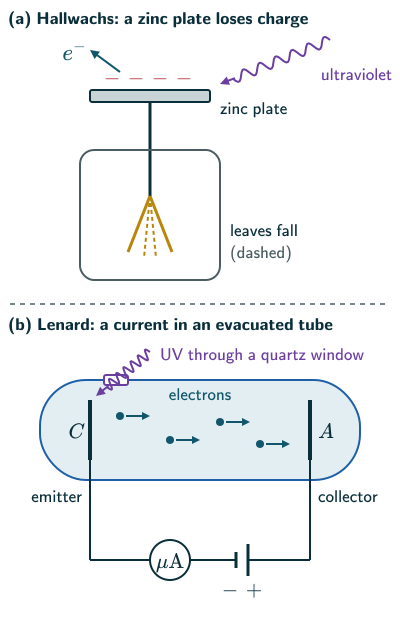
- Lenard put two metal plates in an evacuated glass tube. When ultraviolet light fell on the emitter plate C, a current flowed in the circuit; when the light was stopped, the current stopped too. Electrons ejected from C were attracted to the positive collector A (NCERT page 276; Figure 11.1, page 277).
- Hallwachs, in 1888, connected a negatively charged zinc plate to an electroscope. Under ultraviolet light the plate lost its charge; an uncharged plate became positively charged; and a positively charged plate became more positive. So the light was making negatively charged particles leave the zinc (NCERT page 276).
- With ordinary laboratory UV and electron energies of a few eV, a positive isolated plate can gain charge this way only while its potential is low, typically a few volts. The ejected electrons have only a few electron volts of energy, so a plate charged strongly enough to spread the leaves, to hundreds of volts, pulls them all back and keeps its charge (reasoned).
- After the electron was discovered in 1897, it became clear that these particles are electrons (NCERT page 276).
- They also found that no electrons at all were emitted if the frequency of the light was below a certain minimum, the threshold frequency, which depends on the material of the emitter (NCERT page 277).
- Metals such as zinc, cadmium and magnesium respond only to ultraviolet light, of short wavelength. Alkali metals such as lithium, sodium, potassium, caesium and rubidium respond even to visible light. All of these are photosensitive substances (NCERT page 277).
- NCERT gives the period of Hallwachs’ and Lenard’s work as 1886–1902, with Hertz’s discovery in 1887 and Hallwachs’ zinc-plate study in 1888 (NCERT page 276). The chronology should not be read as dating all of these different observations to one year.
Solved examples
Example 1: Hallwachs’ three plates
A zinc plate on an electroscope is lit by ultraviolet light. What happens if the plate starts (a) negatively charged, (b) uncharged, (c) positively charged, and what does this show?
Answer: (a) It loses its charge and the leaves fall. (b) It becomes positively charged. (c) It becomes more positive if it is only weakly charged (NCERT page 276); a strongly charged plate pulls the ejected electrons back and keeps its charge (reasoned). In each case where charge changes, negative charge leaves the plate: the light ejects negatively charged particles, electrons (NCERT page 276).
Example 2: Counting the electrons
In Lenard’s tube a steady saturation photocurrent of 1.6 μA flows, with every emitted electron collected. How many electrons leave the emitter each second?
Answer: n = I/e = (1.6 × 10⁻⁶)/(1.6 × 10−19) = 1.0 × 10¹³ electrons per second (reasoned; e from NCERT page 275).
Example 3: Frequencies of ultraviolet and visible light
Find the frequencies of ultraviolet light of wavelength 250 nm and red light of 700 nm. Which might eject electrons from zinc?
Answer: ν = c/λ: (3.0 × 10⁸)/(250 × 10−9) = 1.2 × 10¹⁵ Hz, and (3.0 × 10⁸)/(700 × 10−9) ≈ 4.3 × 10¹⁴ Hz. Zinc responds only to ultraviolet light (NCERT page 277), so only the 250 nm light might eject electrons from it.
Example 4: A charge that leaks away
An electroscope’s zinc plate carries −3.2 × 10⁻¹¹ C. How many electrons must the light remove to discharge it completely?
Answer: N = |q|/e = (3.2 × 10⁻¹¹)/(1.6 × 10−19) = 2.0 × 10⁸ electrons (reasoned; e from NCERT page 275).
Common mistakes to avoid
Common mistake
Thinking any bright light will eject electrons
Below the threshold frequency no electrons come out, however strong the light (NCERT page 277).
Common mistake
Expecting every metal to respond to visible light
Zinc, cadmium and magnesium need ultraviolet light; only metals such as the alkali metals respond to visible light (NCERT page 277).
Common mistake
Saying the plate gains positive charge because light adds it
The plate becomes positive because it loses electrons, not because light brings positive charge (NCERT page 276).
Quick revision summary
- Photoelectric effect: light of suitable frequency ejects electrons, called photoelectrons, from a metal surface.
- Hertz (1887): ultraviolet illumination of the receiving spark gap facilitated discharge.
- Hallwachs (1888): ultraviolet light discharges a negative zinc plate and makes a neutral one positive, so negative particles leave.
- Lenard: light on the emitter of an evacuated tube causes a current that stops when the light stops.
- No emission below the threshold frequency, which depends on the metal; zinc needs ultraviolet, alkali metals respond to visible light.
Formula sheet
- n = I/e (electrons per second)
- ν = c/λ
Questions students ask
What is the difference between the photoelectric effect and the Compton effect?
In a one-photon photoelectric event that ejects an electron, the photon is absorbed completely. In Compton scattering from an initially stationary free electron (or approximately from a loosely bound one), an X-ray or gamma-ray photon transfers some energy and emerges with a longer wavelength at a nonzero scattering angle; forward scattering has no shift (beyond the NCERT text; Arthur Compton, Physical Review, 1923). The Compton effect also shows that a photon carries momentum. NCERT now names it only in passing, as further evidence for the photon (page 283), and neither the JEE Main nor the NEET (UG) 2026 syllabus lists it.
What is the difference between the photoelectric effect and the photovoltaic effect?
In the photoelectric effect light ejects electrons out of a material, usually a metal, while in the photovoltaic effect light gives energy to electrons inside a semiconductor, creating electron–hole pairs that the junction helps separate; illumination supplies the energy for an external current when the circuit is closed, as in a solar cell (beyond the NCERT text; US Department of Energy, Solar Photovoltaic Cell Basics). For crystalline silicon, the absorption threshold is set approximately by its band gap, about 1.1 eV (NCERT page 332, 2025–26 reprint); this differs from the work function of a metal, usually a few eV. So red light of 670 nm, 1.85 eV a photon, ejects none from copper (NCERT page 280) but drives a silicon solar cell.
What is the difference between a photon and a photoelectron?
A photon is a quantum of light, with energy hν, no charge and speed c in vacuum, while a photoelectron is an ordinary electron, of charge −e and mass 9.11 × 10 kg, that light has knocked out of a metal (NCERT pages 276–277, 283 and 286). The prefix only says how it was freed: photoelectrons have the same e/m as the electrons of cathode rays (NCERT page 275). The photon is absorbed and disappears, and the photoelectron carries off at most what is left of its energy after paying the work function.
What did Lenard find about the photoelectric effect that Hertz did not?
Lenard found what ultraviolet light releases from a metal and how it behaves, which Hertz did not: Hertz, in 1887, saw only that the light made the sparks across his detector stronger (NCERT page 276). Working in a vacuum and bending the emitted particles with a magnet, Lenard found the same charge-to-mass ratio as for cathode rays (1899), and in 1902 that their greatest speed did not depend on the light’s intensity (beyond the NCERT text; Lenard’s Nobel lecture, 1906). A continuous wave cannot explain that second result; Einstein’s light quanta did, in 1905 (NCERT page 282).
Is the photoelectric effect in the JEE Main and NEET syllabus?
Yes, the photoelectric effect is in both: Unit 17 of the JEE Main syllabus lists “Dual nature of radiation, Photoelectric effect, Hertz and Lenard’s observations, Einstein’s photoelectric equation, particle nature of light”, and NEET (UG) 2026 Unit 17 has “Photoelectric effect. Hertz and Lenard’s observations; Einstein’s photoelectric equation: particle nature of light.” Both also list it in chemistry, Unit 2 (Atomic Structure). In NCERT it is in Chapter 11 of Class 12 Physics Part II (Sections 11.3–11.7) and in Class 11 Chemistry, Section 2.3.2.
What are the applications of the photoelectric effect?
The photoelectric effect is used wherever light must be turned into free electrons in a vacuum: photomultiplier tubes detect very faint light by multiplying each photoelectron many times along a chain of electrodes, and the image intensifiers of night-vision devices turn a dim scene into electrons and then into a brighter image on a phosphor screen (beyond the NCERT text; Hamamatsu, Photomultiplier Tubes: Basics and Applications). Photoelectron spectroscopy measures the energies of photoelectrons to find how firmly electrons are bound in a material. In space, photoemission from sunlight contributes positive charging of a spacecraft; its net potential also depends on surrounding plasma and other currents, as ultraviolet light charged Hallwachs’ zinc plate (NCERT page 276).
Practice questions
Try each question first, then open the answer to check your working.
-
Q1. Who discovered the photoelectric effect, and in what experiment?
Show answerHide answer
Heinrich Hertz, in 1887, while producing electromagnetic waves with a spark discharge: ultraviolet illumination helped sparks cross the receiving gap (NCERT page 276).
-
Q2. Name two metals that emit photoelectrons in visible light and two that need ultraviolet light.
Show answerHide answer
Visible light: for example sodium and potassium (also lithium, caesium, rubidium). Ultraviolet only: for example zinc and cadmium (also magnesium) (NCERT page 277).
-
Q3. What is the threshold frequency?
Show answerHide answer
The minimum frequency of light below which no electrons are emitted from a given metal, however intense the light; it depends on the material (NCERT page 277).