Einstein’s photoelectric equation
NCERT Class 12 Physics Chapter 11 Section 11.6
Quick answer
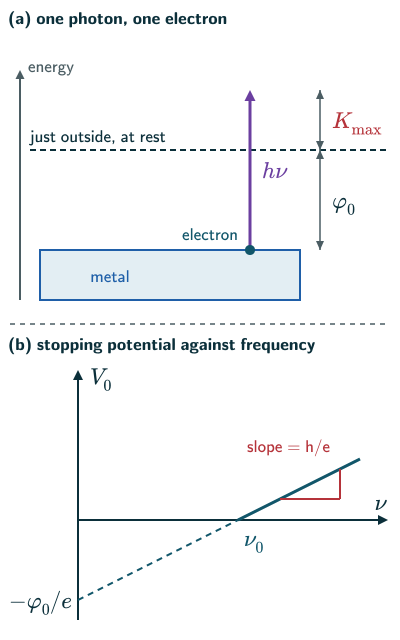
Einstein’s one-photon equation is Kmax = hν − φ0: a photon supplies energy hν, the work function φ0 is needed to escape, and the remainder is the maximum electron kinetic energy. For a fixed surface in the ordinary one-photon regime, ν0 = φ0/h and Kmax = eV0; intensity changes the emission rate, while frequency sets Kmax.
With your textbook
NCERT Physics Part II (Class 12), Chapter 11 “Dual Nature of Radiation and Matter”, Section 11.6 “Einstein’s Photoelectric Equation: Energy Quantum of Radiation”, pages 281–283.
Open the official NCERT chapter (PDF, 1.8 MB, ncert.nic.in) (opens in a new tab)
Checked against the 2026-27 reprint on .
What is Einstein’s photoelectric equation?
Einstein’s photoelectric equation
In 1905 Einstein proposed that light energy comes in discrete packets, quanta, each of energy hν, where h is Planck’s constant and ν the frequency. In NCERT’s words:
Radiation energy is built up of discrete units – the so called quanta of energy of radiation.
NCERT Physics Part II (Class 12), Section 11.6, page 281
An electron absorbs one whole quantum. It spends at least the work function φ0 to escape, so the fastest photoelectrons leave with Kmax = hν − φ0, Einstein’s photoelectric equation (NCERT Eq. (11.2), page 281).
In plain words: light pays electrons in fixed coins, one coin each, and each coin is worth hν. An electron must pay an exit fee, the work function, and keeps the change as kinetic energy. Brighter light means more coins, so more electrons, but not bigger coins; only a higher frequency makes each coin worth more.
Regime: the standard one-photon photoelectric model at ordinary intensity, with a fixed clean surface and negligible heating, space charge, contact-potential offsets and background current (reasoned). “Instantaneous” means no classical energy-accumulation delay, not literally zero interaction time or zero random waiting time for the next photon (reasoned). Beyond the NCERT text: not every photon produces an emitted electron; the chance depends on the photon energy (Wikipedia, “Photoelectric effect”). Electron speeds from ½mv2 are nonrelativistic. The linear stopping-potential relation applies above threshold; extending it below threshold does not describe emitted electrons with negative kinetic energy (reasoned).
Energy quantum hν
- In Einstein’s picture, emission does not come from energy absorbed continuously. Each quantum of radiant energy has energy hν, and in the photoelectric effect an electron absorbs one quantum (NCERT page 281).
- The intensity of light of a given frequency is set by the number of quanta (photons) arriving per unit area per second; the energy of each quantum depends only on the frequency (NCERT pages 281–282).
- Planck’s constant is about 6.626 × 10⁻³⁴ J s (NCERT page 283). In electron volts, E = hν gives about 2.5 eV for light of 6 × 10¹⁴ Hz (reasoned; see Example 1).
Energy of one quantum
K_max = hν − φ
- If the quantum’s energy exceeds the work function, the electron is emitted, and the most loosely bound electrons leave with the maximum kinetic energy (NCERT Eq. (11.2), page 281):
Einstein’s photoelectric equation (NCERT Eq. 11.2)
- More tightly bound electrons come out with less than Kmax (NCERT page 281).
- Kmax depends linearly on ν and not at all on the intensity, because the effect comes from one quantum absorbed by one electron. More intense light gives more quanta, so more electrons and a larger current, but each still gets hν (NCERT page 282).
- The basic process is the absorption of a light quantum by an electron, a single event, so photoelectric emission is instantaneous however dim the light (NCERT page 282); NCERT puts the delay at about 10−9 s or less (page 280). Strictly, “instantaneous” means prompt on that timescale, not a zero-duration process (reasoned).
Threshold frequency ν = φ/h
- Since Kmax cannot be negative, photoelectric emission is possible only if hν > φ0, that is ν > ν0 (NCERT Eq. (11.3), page 282); at the threshold itself, hν = φ0 and Kmax = 0 (reasoned):
Threshold frequency (NCERT Eq. 11.3)
- The larger the work function, the higher the threshold frequency. Below ν0 no electrons come out, however intense the light or however long it shines (NCERT page 282).
- In terms of ν0, Kmax = h(ν − ν0) (NCERT Summary point 7, page 287).
- In terms of wavelength, emission needs λ < λ0, where λ0 is the threshold wavelength (reasoned from NCERT Eq. (11.3) and c = νλ):
Threshold wavelength
- For caesium, λ0 = (3 × 10⁸)/(5.16 × 1014) ≈ 581 nm (see Example 2): violet light ejects electrons from it, red light does not (reasoned).
Stopping potential against frequency: slope h/e
- With Kmax = eV0 (the energy an electron loses against a retarding potential V0), the equation becomes eV0 = hν − φ0, so (NCERT Eq. (11.4), page 282):
Stopping potential (NCERT Eq. 11.4)
- This holds for ν ≥ ν0. The graph of V0 against ν is a straight line of slope h/e, the same for every material; it meets the frequency axis at ν0 (NCERT Figure 11.5, page 279; Eq. (11.4), pages 282–283). Produced backwards, it would meet the V0 axis at −φ0/e. Plotted as Kmax against ν instead, the line has slope h and meets the Kmax axis at −φ0 (both reasoned).
- Millikan’s test. From 1906 to 1916 Millikan did experiments aimed at disproving the equation. He measured the slope of the line for sodium and, with the known e, found h close to 6.626 × 10⁻³⁴ J s, the value found in an entirely different context. In 1916 he had proved the equation instead of disproving it (NCERT page 283).
- Einstein received the 1921 Nobel Prize for his contribution to theoretical physics and the photoelectric effect; Millikan received the 1923 prize, partly for his work on the photoelectric effect (NCERT page 283).
Solved examples
Example 1: Caesium in visible light (NCERT Exercise 11.2)
The work function of caesium is 2.14 eV. Light of frequency 6 × 10¹⁴ Hz falls on it. Find (a) the maximum kinetic energy of the photoelectrons, (b) the stopping potential, (c) their maximum speed.
Answer: hν = 6.63 × 10−34 × 6 × 1014 ≈ 3.98 × 10⁻¹⁹ J (2.48 eV with 1 eV = 1.602 × 10⁻¹⁹ J), and φ0 = 2.14 eV ≈ 3.43 × 10⁻¹⁹ J. (a) Kmax ≈ 0.55 × 10⁻¹⁹ J, which is 0.34 eV. (b) V0 ≈ 0.34 V. (c) vmax = √(2Kmax/m) ≈ 3.5 × 10⁵ m/s, about 347 km/s (NCERT Exercise 11.2, page 289).
Rounding: NCERT’s answer on page 351 gives 0.54 × 10⁻¹⁹ J and 344 km/s. It rounds Kmax to 0.34 eV and then to 0.54 × 10⁻¹⁹ J before taking the square root; unrounded, the speed is about 347 km/s.
Example 2: Threshold and wavelength (NCERT Example 11.2)
For caesium (φ0 = 2.14 eV), find (a) the threshold frequency, (b) the wavelength of light for which the stopping potential is 0.60 V.
Answer: (a) ν0 = φ0/h = (2.14 × 1.6 × 10−19)/
Example 3: Planck’s constant from a slope (NCERT Exercise 11.5)
The slope of the cut-off voltage against frequency is 4.12 × 10⁻¹⁵ V s. Find Planck’s constant.
Answer: The slope is h/e, so h = 4.12 × 10−15 × 1.6 × 10−19 ≈ 6.59 × 10⁻³⁴ J s (NCERT Eq. (11.4), page 282; Exercise 11.5, page 289; answer on page 351).
Example 4: Predicting the cut-off voltage (NCERT Exercise 11.6)
The threshold frequency of a metal is 3.3 × 10¹⁴ Hz. Light of 8.2 × 10¹⁴ Hz falls on it. Find the cut-off voltage.
Answer: V0 = h(ν − ν0)/e = (6.63 × 10−34 × 4.9 × 1014)/
Common mistakes to avoid
Common mistake
Thinking intense light raises K_max
Kmax = hν − φ0 has no intensity in it; intensity sets only the number of electrons (NCERT page 282).
Common mistake
Mixing joules and electron volts
Convert hν and φ0 to the same unit before subtracting: 1 eV = 1.602 × 10 J (NCERT page 275), often rounded to 1.6 × 10 J, as in NCERT Example 11.2 (page 284). Round only at the end.
Common mistake
Expecting the slope of V against ν to depend on the metal
The slope is h/e for every metal; only the intercept, set by φ0, changes (NCERT page 283).
Quick revision summary
- Light energy comes in quanta of E = hν; one electron absorbs one quantum.
- Kmax = hν − φ0: linear in frequency, independent of intensity.
- Threshold frequency ν0 = φ0/h; no emission below it; Kmax = h(ν − ν0).
- With Kmax = eV0: V0 = (h/e)ν − φ0/e, a straight line of slope h/e for every metal.
- Millikan’s measurements (1906–1916) confirmed the equation and gave h ≈ 6.6 × 10⁻³⁴ J s.
Formula sheet
- E = hν
- Kmax = hν − φ0
- ν0 = φ0/h
- λ0 = hc/φ0
- Kmax = eV0
- V0 = (h/e)ν − φ0/e
Questions students ask
Can Einstein’s photoelectric equation be derived, or is it just conservation of energy?
Einstein’s photoelectric equation is the law of conservation of energy applied to one quantum of light absorbed by one electron (NCERT Summary point 7, page 287), so its ‘derivation’ is a single energy balance, hν = φ0 + Kmax. It gives the maximum kinetic energy because the work function is the least energy needed to escape: an electron that needs more than φ0 keeps less (NCERT page 281). The real step was Einstein’s hypothesis that light energy comes in whole quanta of hν, each absorbed by one electron (NCERT page 281); measuring Kmax by the stopping potential then turns the same balance into NCERT Eq. (11.4).
What is the difference between threshold frequency and work function?
The work function φ0 is an energy, the least an electron needs to escape from the metal, while the threshold frequency ν0 is the frequency of light whose photons carry exactly that energy, so φ0 = hν0 (NCERT Eq. (11.3), page 282). Both describe the same property of the metal surface: dividing a work function in eV by h ≈ 4.14 × 10 eV s gives the threshold frequency, so a metal of work function 3.6 eV has ν0 ≈ 8.7 × 10 Hz, in the ultraviolet. The work function is measured in joules or electron volts, [M L T], and the threshold frequency in hertz, [T] (NCERT page 288).
Are threshold frequency and cut-off frequency the same thing?
Yes, in the photoelectric effect the threshold frequency and the cut-off frequency are the same: NCERT first calls ν0 the minimum cut-off frequency, at which the stopping potential falls to zero, then names it the threshold frequency (pages 279–280). Below it no photoelectrons come out, however intense the light. For X-rays the cut-off is instead the highest frequency a tube gives, νmax = eV/h (beyond the NCERT text; energy conservation for an electron stopped in an X-ray target), as in NCERT Exercise 11.1.
If the frequency of light is doubled, does the maximum kinetic energy of photoelectrons double?
For an initial frequency already above threshold, doubling the frequency more than doubles the maximum kinetic energy, because the work function is taken off only once: Kmax = hν − φ0 becomes 2hν − φ0 = 2Kmax + φ0 (from NCERT Eq. (11.2), page 281). For example, photons of 3.2 eV on a metal of work function 2.4 eV give Kmax = 0.8 eV, but photons of 6.4 eV give 4.0 eV, five times as much, and the maximum speed rises √5 ≈ 2.2 times. Kmax and the stopping potential rise in a straight line with ν but are not proportional to it, because the line starts at the threshold ν0, not at zero.
How do you find the threshold frequency without knowing the work function?
Without the work function, the threshold frequency comes from the stopping potential: if h is known, one V0 at one frequency gives ν0 = ν − eV0/h (from NCERT Eq. (11.4), page 282). If h is not known either, measure V0 at two frequencies: the line through the two points has slope h/e and cuts the frequency axis at ν0 (NCERT Figure 11.5, page 279). For 0.45 V at 6.5 × 10 Hz and 1.70 V at 9.5 × 10 Hz, the slope is 1.25 V/(3.0 × 10 Hz) ≈ 4.17 × 10 V s, so 0.45 V of the line spans 1.08 × 10 Hz and ν0 ≈ 6.5 × 10 − 1.08 × 10 ≈ 5.4 × 10 Hz.
Why is there no time lag in the photoelectric effect?
There is no classical energy-accumulation lag: a successful single-photon absorption can supply the escape energy at once, so, as NCERT puts it, “Low intensity does not mean delay in emission” (page 282). Strictly, real absorption and transport take finite times, and a weak beam can leave a long random wait before an individual photon is absorbed (reasoned). Dim light only brings fewer photons each second, so fewer electrons and a smaller current, without reducing the maximum energy of each emitted electron: even a beam of 1.0 × 10 W of 470 nm light delivers about 2.4 × 10 photons every second. Experiment finds emission within about 10 s or less (NCERT page 280).
Practice questions
Try each question first, then open the answer to check your working.
-
Q1. Will a metal of work function 4.2 eV emit photoelectrons in light of wavelength 330 nm? (NCERT Exercise 11.7)
Show answerHide answer
hc/λ = (6.63 × 10−34 × 3 × 108)/
(330 × 10−9) ≈ 6.0 × 10⁻¹⁹ J ≈ 3.8 eV, less than 4.2 eV, so no (NCERT Exercise 11.7, page 289; answer on page 351). -
Q2. A metal has a work function of 2.0 eV. Find its threshold frequency.
Show answerHide answer
ν0 = (2.0 × 1.6 × 10−19)/
(6.63 × 10⁻³⁴) ≈ 4.8 × 10¹⁴ Hz (NCERT Eq. (11.3), page 282). -
Q3. Light of energy 5.0 eV falls on a metal of work function 3.0 eV. Find Kmax and the stopping potential.
Show answerHide answer
Kmax = 5.0 − 3.0 = 2.0 eV, so V0 = 2.0 V (NCERT Eqs. (11.2) and (11.4), pages 281–282).