The photon: particle nature of light
NCERT Class 12 Physics Chapter 11 Section 11.7
Quick answer
A photon is a quantum of light with energy E = hν = hc/λ and momentum magnitude p = h/λ in vacuum. Photons of the same frequency have equal energy and momentum magnitude, but their momentum directions can differ; a monochromatic beam of optical power P carries N = P/E photons per second.
With your textbook
NCERT Physics Part II (Class 12), Chapter 11 “Dual Nature of Radiation and Matter”, Section 11.7 “Particle Nature of Light: The Photon”, pages 283–284.
Open the official NCERT chapter (PDF, 1.8 MB, ncert.nic.in) (opens in a new tab)
Checked against the 2026-27 reprint on .
What is a photon?
Photon
The photoelectric effect showed that light, when it interacts with matter, behaves as if it were made of packets of energy hν. Einstein found that such a light quantum also carries momentum hν/c, and NCERT draws the conclusion:
A definite value of energy as well as momentum is a strong sign that the light quantum can be associated with a particle.
NCERT Physics Part II (Class 12), Section 11.7, page 283
This particle was later named the photon. Each photon has energy E = hν = hc/λ and momentum p = hν/c = h/λ, and travels at speed c in vacuum (NCERT page 283).
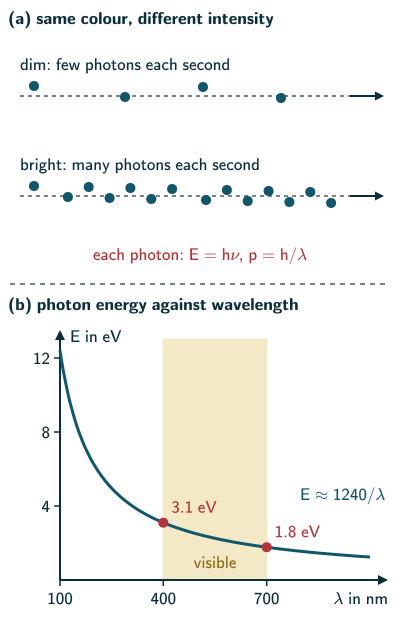
In plain words: in a beam of light of one colour, the energy arrives in tiny equal parcels, photons. The colour fixes how much energy each parcel carries; the brightness fixes how many parcels arrive each second. A photon also gives a small push, its momentum, to whatever absorbs it.
Scope and units: E = hc/λ, p = E/c and speed c here refer to vacuum, with λ the vacuum wavelength. Momentum is a vector: equal frequency fixes its magnitude, while propagation direction fixes its direction. P is optical power in the stated monochromatic beam, not the electrical input power of a lamp; N denotes a photon rate in s. Radiation-force formulas assume full interception and ideal normal absorption/reflection.
Energy and momentum of a photon
- Energy: E = hν. Since c = νλ, also E = hc/λ (NCERT page 283):
Photon energy
- Momentum: p = hν/c = h/λ (NCERT page 283):
Photon momentum
- So E = pc for a photon (reasoned from NCERT page 283). The standard theory assigns photons zero rest mass; experimental tests set upper bounds rather than proving exact zero. The Particle Data Group lists a solar-wind-based limit of 1 × 10⁻¹⁸ eV/c2, about 2 × 10−54 kg (beyond the NCERT text; Particle Data Group, 2025 photon listing, based on the 2024 review and 2025 update).
- A handy number: hc ≈ 1240 eV nm, so E in eV ≈ 1240/λ in nm: about 3.1 eV for violet light of 400 nm and 1.8 eV for red light of 700 nm (computed from h = 6.626 × 10⁻³⁴ J s; beyond the NCERT text).
- The particle-like behaviour of light was confirmed further by A. H. Compton’s experiment on the scattering of X-rays by electrons (NCERT page 283).
- NCERT slip (page 283): NCERT dates Compton’s experiment to 1924. Compton published it in 1923, and received the 1927 Nobel Prize for it (Compton, Physical Review 21 (1923), and the Nobel Prize’s 1927 award record).
Properties of photons
NCERT sums up the photon picture of electromagnetic radiation (NCERT page 283):
- (i) In its interaction with matter, radiation behaves as if it is made of particles, photons.
- (ii) Each photon has energy E = hν, momentum p = hν/c, and speed c.
- (iii) All photons of a given frequency or wavelength have the same energy and momentum magnitude, whatever the intensity. Brighter light means only more photons per second crossing a given area. Photon energy is independent of intensity.
- (iv) Photons are electrically neutral and are not deflected by electric or magnetic fields.
- (v) In a photon–particle collision, total energy and momentum are conserved, but the number of photons need not be: a photon may be absorbed, or a new one created.
- Number of photons: a source of power P sending out photons of energy E emits N = P/E photons per second (NCERT Example 11.1, page 284).
Photons per second (NCERT Example 11.1)
- Photon flux and radiation force (beyond the NCERT text): a beam of intensity I (power per unit area) brings I/hν photons per unit area per second. Each photon carries momentum h/λ, so a beam of power P falling normally on a surface that absorbs it pushes with a force F = P/c. An ideal stationary perfectly reflecting mirror at normal incidence reverses each photon’s momentum, so the force doubles to 2P/c. Divided by the area, these give the radiation pressure, I/c or 2I/c.
Solved examples
Example 1: Photons from a laser (NCERT Example 11.1)
A laser gives light of frequency 6.0 × 10¹⁴ Hz with a power of 2.0 × 10⁻³ W. Find the energy of a photon and the number of photons emitted per second.
Answer: E = hν = 6.63 × 10−34 × 6.0 × 1014 ≈ 3.98 × 10⁻¹⁹ J. N = P/E = (2.0 × 10⁻³)/
Example 2: A helium-neon laser (NCERT Exercise 11.4)
A helium-neon laser gives light of 632.8 nm with a power of 9.42 mW. Find (a) the energy and momentum of each photon, (b) the number of photons per second, (c) how fast a hydrogen atom must move to have the same momentum as a photon.
Answer: (a) E = hc/λ = (6.63 × 10−34 × 3 × 108)/
Example 3: The shortest X-ray wavelength (NCERT Exercise 11.1)
Find the maximum frequency and minimum wavelength of X-rays produced by 30 kV electrons.
Answer: The highest-energy photon takes all of an electron’s energy, eV = hνmax. So νmax = (1.6 × 10−19 × 30 × 103)/
Example 4: Red and violet photons
Compare the energies of photons of red light (700 nm) and violet light (400 nm), in eV.
Answer: E ≈ 1240/λ: red ≈ 1.8 eV, violet ≈ 3.1 eV. A violet photon carries about 1.75 times the energy of a red one (reasoned from NCERT page 283).
Common mistakes to avoid
Common mistake
Thinking brighter light has more energetic photons
Brightness changes the number of photons per second; each photon’s energy hν depends only on the frequency (NCERT page 283).
Common mistake
Expecting the number of photons to be conserved
Energy and momentum are conserved in a collision, but photons can be absorbed or created (NCERT page 283).
Common mistake
Using E = mc with a photon’s ‘mass’
Use E = hν and p = h/λ; a photon has no rest mass, and E = pc (beyond the NCERT text).
Quick revision summary
- A photon has energy E = hν = hc/λ, momentum p = hν/c = h/λ, and speed c.
- Same frequency means the same photon energy and momentum magnitude, whatever the intensity; intensity sets the number of photons per second.
- Photons are neutral, so electric and magnetic fields do not deflect them.
- In collisions energy and momentum are conserved, but photons may be absorbed or created.
- Photons per second from a source of power P: N = P/E; E in eV ≈ 1240/λ in nm.
Formula sheet
- E = hν = hc/λ
- p = h/λ
- N = P/E
Questions students ask
If a photon has no mass, how can it have momentum?
A photon has momentum without mass because momentum is not always mv: in Einstein’s relativity a particle of energy E and rest mass m has E = pc + mc, so a photon, with m = 0, has p = E/c = hν/c = h/λ, the momentum NCERT gives (page 283; the relativity is beyond the NCERT text). mv is the slow-speed form for bodies with mass, and since anything with a rest mass would need infinite energy to reach c, a particle that always moves at c can have none.
Is a photon the same as a quantum of energy?
A photon is not quite the same as a quantum of energy: ‘quantum’ describes a discrete excitation or exchange for a specified system or mode, not a universal smallest energy. For a radiation mode of frequency ν the energy step is hν, as Planck defined it (NCERT Class 11 Chemistry, Section 2.3.2, page 41), while ‘photon’ names the particle of light that carries one quantum, hν. The light quantum is treated as a particle because it has a definite momentum, hν/c, as well as a definite energy, which NCERT calls a strong sign of a particle (page 283); the name photon came later.
What are the SI units and dimensional formulae of a photon’s energy and momentum?
A photon’s energy is measured in joules, with dimensional formula [M L T] (as for the work function, NCERT page 288), and its momentum in kg m s, with [M L T], as for the momentum mv of any body. Photon energies are usually quoted in electron volts, 1 eV = 1.602 × 10 J (NCERT page 275), and p = h/λ gives the momentum in J s m, which is the same unit as kg m s; particle physicists also write momenta in eV/c (beyond the NCERT text; Particle Data Group tables). A green photon of 530 nm has E ≈ 3.75 × 10 J, or 2.34 eV, and p ≈ 1.25 × 10 kg m s.
How many photons per second reach a small area at some distance from a lamp?
A small lamp radiating power P equally in all directions as photons of energy hν sends out N = P/hν photons each second (NCERT Example 11.1, page 284), and at a distance r they are spread over a sphere of area 4πr, so N/4πr cross each unit area per second, falling as 1/r (reasoned; beyond the NCERT text). For example, a lamp radiating 1.5 W of red light of 640 nm emits about 4.8 × 10 photons per second; at 7.0 m that is about 7.8 × 10 per square metre per second, so a pupil of 20 mm facing the lamp still takes in about 1.6 × 10 photons each second. In this fixed-frame, non-absorbing flat-space model, each photon keeps its energy hν as it travels; only the number per unit area falls.
How are photons produced?
Photons are produced whenever matter gives up energy as electromagnetic radiation: an atom emits a photon in a radiative transition to a lower atomic energy level, with hν ≈ Ei − Ef when atomic recoil is neglected, and fast electrons striking a metal target give out X-ray photons (NCERT Chapter 8, page 211). In the wave picture the same radiation comes from accelerated charges (NCERT Chapter 8, page 205). Each photon’s energy is fixed by the energy given up in the event that makes it, not by how bright the source is (NCERT page 283).
Practice questions
Try each question first, then open the answer to check your working.
-
Q1. Find the momentum of a photon of wavelength 500 nm.
Show answerHide answer
p = h/λ = (6.63 × 10⁻³⁴)/(500 × 10−9) ≈ 1.33 × 10⁻²⁷ kg m/s (NCERT page 283).
-
Q2. Find the energy in eV of a photon of frequency 3.0 × 10¹⁵ Hz.
Show answerHide answer
E = hν = 6.63 × 10−34 × 3.0 × 1015 ≈ 1.99 × 10⁻¹⁸ J ≈ 12.4 eV (NCERT page 283).
-
Q3. A beam of photons passes between the poles of a magnet. Is it deflected?
Show answerHide answer
No: photons are electrically neutral, so magnetic and electric fields do not deflect them (NCERT page 283).