Alpha-particle scattering and Rutherford’s nuclear model
NCERT Class 12 Physics Chapter 12 Sections 12.1–12.2
Quick answer
Rutherford’s nuclear model concentrates an atom’s positive charge and most of its mass in a tiny nucleus. Rare large deflections of alpha particles reveal this compact centre, while most particles pass through with small deflections; for a head-on approach to a fixed heavy nucleus, d = 2Ze/(4πεK) gives the closest approach in the elastic Coulomb model.
With your textbook
NCERT Physics Part II (Class 12), Chapter 12 “Atoms”, Sections 12.1–12.2 “Introduction” and “Alpha-particle Scattering and Rutherford’s Nuclear Model of Atom”, pages 290–296.
Open the official NCERT chapter (PDF, 2.1 MB, ncert.nic.in) (opens in a new tab)
Checked against the 2026-27 reprint on .
What is Rutherford’s nuclear model?
Rutherford’s nuclear model
In Rutherford’s nuclear model of the atom, the entire positive charge and most of the mass of the atom are concentrated in a tiny nucleus, and the electrons move in orbits around it, some distance away, as the planets orbit the sun (NCERT page 293). The model came from the scattering of alpha particles by a thin gold foil. Its predictions agreed with the measurements, and in NCERT’s words:
This is why Rutherford is credited with the discovery of the nucleus.
NCERT Physics Part II (Class 12), Section 12.2, page 293
The nucleus is about 10−15 m to 10−14 m across, while an atom is about 10−10 m across, so most of an atom is empty space (NCERT page 293).
In plain words: fire tiny, fast, positive particles at a very thin sheet of gold. Almost all go straight through, but a very few bounce back. Something small, heavy and positive must sit at the centre of each atom, and the rest of the atom must be almost empty. That small, heavy centre is the nucleus.
The Geiger–Marsden experiment
- At Rutherford’s suggestion, H. Geiger and E. Marsden directed a beam of 5.5 MeV alpha particles from a radioactive source, bismuth-214, at a thin gold foil (NCERT pages 291–292). This is the textbook’s idealised source specification. Bismuth-214 decays predominantly by beta emission to polonium-214, whose subsequent alpha emission supplies the familiar roughly 7.7 MeV alphas; the direct alpha branch of bismuth-214 is only about 0.02% (Wikipedia, “Decay chain”).
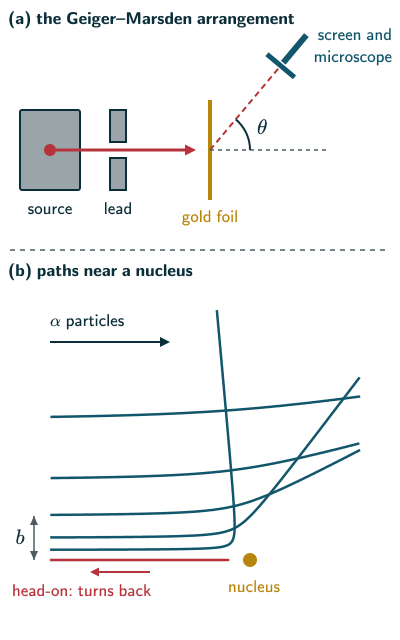
- Lead bricks collimated the alpha particles into a narrow beam, which fell on a gold foil 2.1 × 10⁻⁷ m thick. A rotatable detector, a zinc sulphide screen with a microscope, showed a brief flash (a scintillation) for each scattered alpha particle, so the number scattered could be counted at each angle of scattering θ. The whole apparatus was in a vacuum chamber (NCERT page 292, NCERT Figures 12.1 and 12.2).
- Textbook summary of results (NCERT page 292; apparatus-specific counts): most alpha particles passed straight through the foil. Only about 0.14% were scattered by more than 1°, and about 1 in 8000 by more than 90°.
- Rutherford’s argument: to turn an alpha particle back needs a large repulsive force. That force could arise if most of the mass and all the positive charge of the atom were packed tightly at its centre: an alpha particle could then come very close to the positive charge without entering it, and be deflected strongly. The scattering this nuclear model predicts agreed with Geiger and Marsden’s counts (NCERT pages 292–293, NCERT Figure 12.3).
- Why most pass through: the atom, about 10−10 m across, is 10 000 to 100 000 times larger than its nucleus, so it is mostly empty space. The electrons, being so light, hardly affect the alpha particles (NCERT page 293).
- The model it replaced: in J. J. Thomson’s model, the positive charge is spread uniformly through the atom, with the electrons embedded in it like seeds in a watermelon, the plum pudding model (NCERT page 290). Charge spread so thinly cannot exert the large force needed to turn an alpha particle back (reasoned).
- NCERT slip (page 290): NCERT says Thomson proposed his model in 1898. In 1897 Thomson suggested that atoms are made of his corpuscles (electrons), but he first described this model, with the electrons inside a sphere of uniform positive charge, in 1904 (J. J. Thomson, On the Structure of the Atom, Philosophical Magazine, 1904, as given in Wikipedia, “Plum pudding model”).
- Dates and names: NCERT places the experiment around 1911 (page 291). The experiments ran from 1906 to 1913: the result that about 1 in 8000 alpha particles bounce back, from a platinum reflector, was published in 1909; Rutherford explained it in 1911; and the experiment with a rotating microscope, as NCERT describes it, which tested his formula, was reported in 1913 (Rutherford, The Scattering of α and β Particles by Matter and the Structure of the Atom, 1911; Geiger and Marsden, The Laws of Deflexion of α Particles through Large Angles, 1913; as given in Wikipedia, “Rutherford scattering experiments”). NCERT also spells the first names of Rutherford and Marsden “Ernst”; both were Ernest.
Alpha-particle trajectory
- An alpha particle is a helium nucleus, with charge 2e; a gold nucleus has charge Ze, with Z = 79. At a distance r apart they repel each other with the Coulomb force, along the line joining them (NCERT Eq. (12.1), page 294):
Force on the alpha particle (NCERT Eq. 12.1)
- NCERT’s simplifications (page 293): the gold foil is so thin that an alpha particle can be assumed to suffer not more than one scattering, so the path past a single nucleus is enough; the gold nucleus is about 50 times heavier than an alpha particle, so it can be taken to stay at rest; and the path then follows from Newton’s second law with this force. Strictly, the many tiny deflections by other nuclei and the energy lost in the foil are also neglected (reasoned).
- Domain of the formulas: nonrelativistic elastic Coulomb scattering outside the nucleus, with a fixed heavy target, positive projectile charge and initial kinetic energy K measured far away. Nuclear forces, electron screening at large distances, radiation and energy loss in the foil are neglected.
- The path depends on the impact parameter b: the perpendicular distance of the alpha particle’s initial velocity line from the centre of the nucleus (NCERT page 294, NCERT Figure 12.4).
- A small b gives a large deflection. In a head-on collision (b = 0) the alpha particle rebounds, θ ≈ π; for a large b it goes on nearly undeviated, θ ≈ 0 (NCERT page 294).
- Only a small fraction of the alpha particles rebound, so only a few collide nearly head-on: the mass and positive charge of the atom must sit in a small volume. So Rutherford scattering gives an upper limit to the size of the nucleus (NCERT page 294).
- Impact parameter and angle (beyond the NCERT text): for a head-on distance of closest approach d (next section), a particle with impact parameter b is scattered through θ, where:
Impact parameter (beyond the NCERT text)
- Count against angle (beyond the NCERT text): Rutherford’s analysis predicts that a small detector subtending a fixed solid angle (same area, distance and orientation to the scattered ray) at angle θ counts a number proportional to 1/sin4(θ/2). At fixed incident flux and number of target nuclei per unit area, the count grows as Z2 and falls as 1/K2; for the same material in the single-scattering regime it also grows with foil thickness. Geiger and Marsden tested these dependences in 1913 (Rutherford, The Scattering of α and β Particles by Matter and the Structure of the Atom, 1911; Geiger and Marsden, The Laws of Deflexion of α Particles through Large Angles, 1913; as given in Wikipedia, “Rutherford scattering experiments”). This steep fall with angle is the solid curve that fits the data in NCERT Figure 12.3 (page 293).
Distance of closest approach
- In a head-on collision the alpha particle slows down, stops for an instant at a distance d from the centre of the nucleus, and turns back. The total mechanical energy is conserved, so its initial kinetic energy K has all become electric potential energy at the stopping point (NCERT Example 12.2, page 295):
Energy at the stopping point (NCERT Example 12.2)
Distance of closest approach (NCERT Example 12.2)
- So d is proportional to Z/K: a more energetic alpha particle, or a nucleus of smaller charge, lets it come closer (reasoned).
- For a positively charged projectile of charge q in the same fixed-target, head-on approximation, the same energy balance gives d = qZe/(4πε0K). At the same K, a proton gets to half the distance an alpha particle does (reasoned).
- NCERT takes 7.7 MeV as the highest energy of natural alpha particles and finds d ≈ 3.84 × 10⁻¹⁶Z m, which for gold is about 30 fm, where 1 fm = 10−15 m (NCERT page 295; see Example 2).
- NCERT slip (page 295): 7.7 MeV, about the energy of polonium-214’s alpha particles, is not the highest found in nature. Polonium-212, in the natural thorium series, emits alpha particles of about 8.8 MeV: its decay energy is 8.954 MeV (Wikipedia, “Decay chain”), and the alpha particle carries 208/212 of it, about 8.79 MeV (reasoned).
- What d tells us: the alpha particle turns back without touching the nucleus, so the nucleus is smaller than d: d is an upper limit on the radius of the nucleus. NCERT gives the radius of the gold nucleus as 6 fm, well inside 30 fm (NCERT page 295).
- NCERT calls this “not in very good agreement” with the actual radius of gold, 6 fm, and gives the reason itself: d is much larger than the sum of the radii of the gold nucleus and the alpha particle, so the alpha particle turns back without touching. An upper limit of 30 fm is not wrong, only loose (NCERT page 295).
Electron orbits
- Ignoring radiation, Rutherford’s mechanical model allows bound orbits around the nucleus. The following force, radius and instantaneous energy relations assume a circular orbit; electromagnetic radiation makes that classical orbit unstable. In a hydrogen atom, the electrostatic attraction between the electron and the nucleus provides the centripetal force (NCERT Eq. (12.2), page 295):
Force balance in hydrogen (NCERT Eq. 12.2)
- This links the orbit radius and the electron’s speed (NCERT Eq. (12.3), page 296):
Orbit radius (NCERT Eq. 12.3)
- The kinetic energy is K = ½mv2 = e2/(8πε0r) and the potential energy is U = −e2/(4πε0r), so the total energy is (NCERT Eq. (12.4), page 296):
Total energy (NCERT Eq. 12.4)
- The total energy is negative, which means the electron is bound to the nucleus. If E were positive, the electron would not follow a closed orbit (NCERT page 296).
- Comparing the three: K = −E and U = 2E. The kinetic energy equals the energy needed to free the electron, and the potential energy is twice the total energy (reasoned from NCERT Eq. (12.4), page 296).
- Two difficulties (NCERT Summary point 4, page 303): an orbiting electron is accelerating, so it should radiate energy and spiral into the nucleus, which would make atoms unstable; and the model cannot explain the line spectra of atoms. NCERT takes these up in Section 12.4 with Bohr’s model.
Solved examples
Example 1: The atom as a solar system (NCERT Example 12.1)
The nucleus (radius about 10−15 m) is like the sun, and the electron orbits it at a radius of about 10−10 m. If the solar system had the same proportions, would the earth be closer to the sun or farther than it is? The radius of the earth’s orbit is about 1.5 × 10¹¹ m and the radius of the sun about 7 × 10⁸ m.
Answer: In the atom, the orbit is (10−10 m)/(10−15 m) = 105 times the radius of the nucleus. The same ratio would put the earth at 105 × 7 × 108 m = 7 × 10¹³ m, more than 100 times (about 470 times) its actual distance, so the earth would be much farther away. An atom is far emptier than the solar system (NCERT Example 12.1, page 294).
Example 2: Closest approach of a 7.7 MeV alpha particle (NCERT Example 12.2)
How close does a 7.7 MeV alpha particle get to a gold nucleus (Z = 79) in a head-on approach before it stops for an instant and turns back?
Answer: K = 7.7 MeV ≈ 1.2 × 10⁻¹² J. With 1/4πε0 = 9.0 × 10⁹ N m2 C−2 and e = 1.6 × 10⁻¹⁹ C:
d = 2Ze2/(4πε0K) = 2 × 9.0 × 109 × (1.6 × 10−19)2 × Z/(1.2 × 10−12)
So d ≈ 3.84 × 10⁻¹⁶Z m, and for gold d ≈ 3.0 × 10⁻¹⁴ m = 30 fm (NCERT Example 12.2, page 295).
Example 3: The electron’s orbit in hydrogen (NCERT Example 12.3)
It takes 13.6 eV to separate a hydrogen atom into a proton and an electron. Find the radius of the electron’s orbit and its speed.
Answer: The total energy is E = −13.6 eV = −13.6 × 1.6 × 10−19 J ≈ −2.18 × 10⁻¹⁸ J. From NCERT Eq. (12.4), r = e2/(8πε0|E|):
r = (9 × 109 × (1.6 × 10−19)2)/
From NCERT Eq. (12.3), with m = 9.1 × 10⁻³¹ kg, v = e/√(4πε0mr) ≈ 2.2 × 10⁶ m/s (NCERT Example 12.3, page 296).
Rounding: NCERT prints the energy as −2.2 × 10⁻¹⁸ J but uses the unrounded value; with −2.2 × 10⁻¹⁸ J the radius comes out as 5.2 × 10⁻¹¹ m.
Example 4: A target of solid hydrogen (NCERT Exercise 12.2)
The experiment is repeated with a thin sheet of solid hydrogen in place of the gold foil (hydrogen is a solid below 14 K). What results do you expect?
Answer: A hydrogen nucleus is a single proton, 1.67 × 10⁻²⁷ kg, lighter than an alpha particle, 6.64 × 10⁻²⁷ kg. A heavier particle striking a lighter one at rest cannot bounce back, even head-on (see collisions in one dimension), much as a football hitting a tennis ball does not, so there would be no large-angle scattering (NCERT Exercise 12.2, page 305; answer on page 351); give that in an exam. In fact, in a single elastic collision the alpha particle cannot be deflected by more than about 15°, since sin θmax = mp/mα ≈ 0.25 (reasoned from the conservation of momentum and energy; beyond the NCERT text).
Common mistakes to avoid
Common mistake
Taking the distance of closest approach as the radius of the nucleus
The alpha particle turns back before it touches the nucleus, so d is only an upper limit: 30 fm for a 7.7 MeV alpha particle on gold, against a radius of about 6 fm (NCERT page 295).
Common mistake
Giving the alpha particle a charge of e
An alpha particle is a helium nucleus with charge 2e, so the force and the energy carry (2e)(Ze) (NCERT pages 293–294).
Common mistake
Writing the electron’s potential energy as −e/(8πεr)
That is the total energy. The potential energy is −e/(4πεr), twice as large in size, and the kinetic energy is +e/(8πεr) (NCERT page 296).
Quick revision summary
- In the Geiger–Marsden experiment most alpha particles passed straight through a thin gold foil; about 0.14% were scattered by more than 1° and about 1 in 8000 by more than 90° (NCERT page 292). These counts belong to that apparatus; the 1909 result of 1 in 8000 used a platinum reflector.
- Rutherford’s nuclear model: all the positive charge and most of the mass sit in a nucleus 10−15 m to 10−14 m across; the atom, about 10−10 m, is mostly empty space.
- The alpha particle feels F = (1/4πε)(2e)(Ze)/r; a smaller impact parameter gives a larger deflection, and a head-on alpha particle turns back.
- Closest approach: d = 2Ze/(4πεK), about 30 fm for a 7.7 MeV alpha particle on gold; an upper limit on the size of the nucleus.
- Hydrogen in Rutherford’s model: r = e/(4πεmv) and E = −e/(8πεr), negative because the electron is bound; K = −E and U = 2E.
Formula sheet
- F = (1/4πε)(2e)(Ze)/r
- d = 2Ze/(4πεK)
- b = (d/2) cot(θ/2)
- r = e/(4πεmv)
- K = e/(8πεr), U = −e/(4πεr)
- E = −e/(8πεr)
Questions students ask
What is the difference between impact parameter and distance of closest approach?
The impact parameter b is fixed before the collision: it is the perpendicular distance of the alpha particle’s initial line of motion from the centre of the nucleus, and for a given energy it sets the angle of scattering (NCERT page 294). The distance of closest approach is the least distance from the centre that the particle reaches; in a head-on collision b = 0, and the particle turns straight back after stopping at d = 2Ze/(4πε0K) (NCERT Example 12.2, page 295). For b > 0 it never gets that close: conserving energy and angular momentum gives a closest approach of (d/2)[1 + 1/sin(θ/2)], or 1.5d for a deflection of 60° (reasoned; beyond the NCERT text).
Are the distance of closest approach and impact parameter in the JEE Main and NEET syllabus?
Yes, the distance of closest approach and the impact parameter are examinable in JEE Main and NEET (UG) 2026, though neither syllabus names them: both list the “Alpha-particle scattering experiment” and Rutherford’s model of the atom in Unit 18, Atoms and Nuclei, and NCERT Class 12 Physics Part II (2026–27) teaches that experiment through them, the impact parameter in Section 12.2.1 (page 294) and the distance of closest approach in Example 12.2 (page 295). Neither has been deleted. The formula linking the impact parameter to the angle of scattering, b = (d/2) cot(θ/2), is beyond the NCERT text, so treat it as an extra for JEE.
Why is Rutherford’s model of the atom called the planetary model?
Rutherford’s model is called the planetary model because in it the electrons revolve round a tiny, massive nucleus just as the planets revolve round the sun: NCERT calls it “Rutherford’s planetary model of atom (also called the nuclear model of the atom)” (page 291). The likeness goes further, since in both an attractive inverse-square force supplies the centripetal force, the Coulomb attraction in the atom and gravity in the solar system (NCERT pages 295 and 297). The other name, nuclear model, points to what the experiment actually found, the nucleus, which is why Rutherford is credited with its discovery (NCERT page 293).
Why did Rutherford’s model of the atom fail?
Rutherford’s model failed because, by classical physics, its atom should collapse, and it could not explain line spectra: the two difficulties NCERT lists (Summary point 4, page 303). An orbiting electron is always accelerating, so by electromagnetic theory it should radiate energy and spiral into the nucleus, giving a continuous spectrum instead of lines (NCERT page 297). NCERT Class 11 Chemistry puts the fall at only 10 s (page 36); integrating the nonrelativistic Larmor power for an initially circular orbit of Bohr radius gives a formal collapse time about 1.6 × 10 s (beyond the NCERT text; classical-model calculation, invalid at the final small radii), as the chemistry page explains.
Practice questions
Try each question first, then open the answer to check your working.
-
Q1. NCERT gives the alpha particles in the Geiger–Marsden experiment 5.5 MeV. How close could a 5.5 MeV alpha particle get to a gold nucleus (Z = 79)?
Show answerHide answer
K = 5.5 × 106 × 1.6 × 10−19 J ≈ 8.8 × 10⁻¹³ J. Then d = 2Ze/(4πεK), with 2Ze × 9.0 × 109 ≈ 3.64 × 10⁻²⁶ J m, so d ≈ 4.1 × 10⁻¹⁴ m, about 41 fm (NCERT Example 12.2, page 295).
-
Q2. The ground-state energy of the hydrogen atom is −13.6 eV. What are the kinetic and potential energies of the electron in this state? (NCERT Exercise 12.4)
Show answerHide answer
K = −E = 13.6 eV and U = 2E = −27.2 eV (reasoned from NCERT Eq. (12.4), page 296; NCERT Exercise 12.4, page 305; answer on page 351).
-
Q3. Why did most alpha particles pass through the gold foil without being deflected?
Show answerHide answer
The atom is mostly empty space: its nucleus is 10 000 to 100 000 times smaller than the atom, and the light electrons hardly affect an alpha particle (NCERT page 293).