De Broglie’s explanation of Bohr’s second postulate
NCERT Class 12 Physics Chapter 12 Section 12.6
Quick answer
In de Broglie’s historical circular-orbit picture, the electron wave must match its phase after one circuit, so 2πrn = nλ. Using nonrelativistic λ = h/(m vn) gives m vn rn = nh/2π, Bohr’s angular-momentum rule; modern quantum mechanics replaces the sharp orbit with a three-dimensional orbital.
With your textbook
NCERT Physics Part II (Class 12), Chapter 12 “Atoms”, Section 12.6 “De Broglie’s Explanation of Bohr’s Second Postulate of Quantisation”, pages 301–302.
Open the official NCERT chapter (PDF, 2.1 MB, ncert.nic.in) (opens in a new tab)
Checked against the 2026-27 reprint on .
What is de Broglie’s explanation of Bohr’s second postulate?
De Broglie’s explanation of Bohr’s second postulate
Bohr’s second postulate, that the electron’s angular momentum can only be L = nh/2π, is perhaps the most puzzling of his postulates: why only these values? Louis de Broglie explained it in 1923, ten years after Bohr’s model (NCERT page 301). He treated the electron in its orbit as a wave, and a physically consistent wave must match its phase after one full circuit. In NCERT’s words:
The quantised electron orbits and energy states are due to the wave nature of the electron and only resonant standing waves can persist.
NCERT Physics Part II (Class 12), Section 12.6, page 302
Fitting n de Broglie wavelengths into the circumference, 2πrn = nλ, with λ = h/mvn, gives exactly Bohr’s condition mvnrn = nh/2π (NCERT Eq. (12.12), pages 301–302).
Scope: this is the historical circular-orbit explanation, with nonrelativistic momentum p ≈ mv. Periodic phase matching recovers Bohr’s rule but is not the modern three-dimensional solution for a hydrogen orbital.
In plain words: picture the electron’s wave running round and round its orbit. If a whole number of waves fits the loop, each lap lands exactly on the last one and the wave builds up. If not, the laps fall out of step and cancel. So only certain orbits survive, and they are exactly Bohr’s orbits.
Standing electron waves on an orbit
- In Chapter 11 we met de Broglie’s hypothesis that material particles such as electrons also have a wave nature. C. J. Davisson and L. H. Germer later verified the wave nature of electrons experimentally, in 1927 (NCERT page 301).
- Standing waves on a string: when a string fixed at both ends is plucked, many wavelengths are excited, but only those with nodes at the ends survive and form standing waves. That happens when the distance down the string and back is a whole number of wavelengths; other waves interfere with themselves after reflection and quickly die out (NCERT page 301).
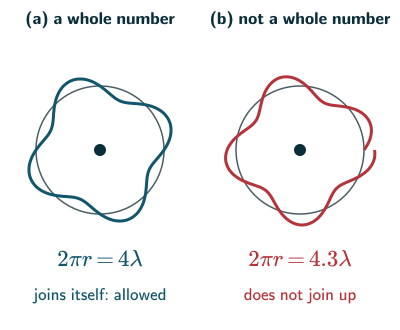
- On an orbit: de Broglie argued that the electron in a circular orbit must be seen as a particle wave, which can also form a standing wave under resonant conditions (NCERT page 301). For an orbit, the distance round is the circumference 2πrn.
- Dates: NCERT gives 1923 here and 1924 for de Broglie’s hypothesis in Chapter 11 (NCERT page 285). Both fit: he set out the idea, including this explanation of Bohr’s condition, in short notes in 1923, and in full in his 1924 thesis (de Broglie, 1923 notes catalogued by CERN; Fondation Louis de Broglie, 1924 thesis centenary).
Circumference as a whole number of wavelengths
- A standing wave on the nth orbit needs a whole number of wavelengths round the circumference (NCERT Eq. (12.12), page 302):
Standing-wave condition (NCERT Eq. 12.12)
- NCERT Figure 12.8 shows the case n = 4: four de Broglie wavelengths fit round the orbit (NCERT pages 301–302).
- The de Broglie wavelength is λ = h/p. If the electron’s speed is much less than the speed of light, p = mvn, so λ = h/mvn (NCERT page 302). Then 2πrn = nh/mvn, that is:
Bohr’s condition recovered (NCERT page 302)
- This is Bohr’s quantisation condition for angular momentum, NCERT Eq. (12.5). So the de Broglie hypothesis explains Bohr’s second postulate: the whole number n of wavelengths round the orbit is the principal quantum number (NCERT page 302; NCERT Summary point 6(b), page 303, names n the principal quantum number).
- NCERT slip (page 302): NCERT calls Bohr’s condition “Eq. (12.15)” and says its use for orbits and energy levels was in “Section 12.5”. The condition is NCERT Eq. (12.5), and the orbits and energy levels were worked out in Section 12.4.
- The wavelength in each orbit (reasoned from NCERT Eqs. (12.7) and (12.12)): λn = 2πrn/n, and since rn = n2a0, λn = 2πna0. The wavelength grows in proportion to n. For a hydrogenic ion with nuclear charge +Ze (NCERT page 302), rn = n2a0/Z, so λn = 2πna0/Z (beyond the NCERT text).
Limitations of the Bohr model
- Bohr’s model correctly predicts the gross features of hydrogenic atoms, in particular the frequencies of the radiation they emit or absorb (NCERT page 302). NCERT calls an atom with a nucleus of charge +Ze and a single electron, such as singly ionised helium or doubly ionised lithium, a hydrogenic atom (NCERT page 302).
- (i) One electron only. The model cannot be extended even to two-electron atoms such as helium. Each electron interacts with the other electrons as well as with the nucleus, and the model leaves out the electrical forces between electrons (NCERT page 302). In an atom these forces are comparable with the pull of the nucleus, unlike the weak pulls between planets (NCERT Points to ponder 4, page 304).
- (ii) Intensities. The model gives the frequencies of hydrogen’s lines but not their relative intensities: why some visible lines are weak and others strong (NCERT page 302).
- The sharp orbits of Bohr’s model clash with the uncertainty principle. In quantum mechanics, which replaced the model, Bohr’s orbits become regions where the electron is likely to be found, and a state is characterised by four quantum numbers, (n, l, m, s) in NCERT’s notation, but for a pure Coulomb potential, as in the hydrogen atom, the energy depends only on n (NCERT Points to ponder 3 and 5, page 304). Strictly, the fourth number is the spin quantum number ms, which can be +½ or −½ (NCERT Class 11 Chemistry, Unit 2, page 56). Beyond the NCERT text: spin and small relativistic corrections, the fine structure, lift some of hydrogen’s degeneracy (Wikipedia, “Fine structure”).
- Still useful: with just three postulates the model accounts for almost all the general features of the hydrogen spectrum, using many ideas from classical physics (NCERT Points to ponder 7, pages 304–305).
- In the model, the frequency of revolution is not the frequency of the light emitted, which is the difference of two energies divided by h. For transitions between very large quantum numbers, n to n − 1, the two coincide, as classical physics expects (NCERT Points to ponder 6, page 304); strictly, their relative difference tends to zero (reasoned; see Example 4).
Solved examples
Example 1: The electron’s wavelength in the ground state
Find the de Broglie wavelength of the electron in the n = 1 orbit of hydrogen in two ways.
Answer: From the orbit: λ1 = 2πr1 = 2π × 5.3 × 10−11 m ≈ 3.3 × 10⁻¹⁰ m. From the speed: λ = h/mv = (6.63 × 10⁻³⁴)/
Example 2: The third orbit
How long is the de Broglie wavelength in the n = 3 orbit, and how many wavelengths fit round it?
Answer: r3 = 9a0, so λ3 = 2π × 9a0/3 = 6πa0 ≈ 6π × 5.3 × 10−11 m ≈ 1.0 × 10⁻⁹ m, three times λ1; exactly 3 wavelengths fit round the orbit (reasoned from NCERT Eqs. (12.7) and (12.12)).
Example 3: From the standing wave to Bohr’s rule
Show that 2πr = nλ leads to Bohr’s quantisation of angular momentum.
Answer: With λ = h/mv, 2πr = nh/mv. Multiply both sides by mv/2π: mvr = nh/2π. The left side is the angular momentum L of the electron in a circular orbit, so L = nh/2π, Bohr’s second postulate (NCERT page 302).
Example 4: When classical and quantum frequencies agree
For a hydrogen atom going from n = 100 to n = 99, compare the frequency of the light emitted with the electron’s frequency of revolution in those orbits.
Answer: The light: ΔE = 13.6 × (1/992 − 1/1002) eV ≈ 2.76 × 10⁻⁵ eV, so ν = ΔE/h ≈ 6.68 × 10⁹ Hz (with h = 6.626 × 10⁻³⁴ J s and 1 eV = 1.602 × 10⁻¹⁹ J). The revolution frequency is 1/T1 ≈ 6.58 × 10¹⁵ Hz for n = 1 (T1 = 1.52 × 10⁻¹⁶ s, NCERT’s answer to Exercise 12.6, page 351) and falls as 1/n3, giving about 6.58 × 10⁹ Hz for n = 100 and 6.78 × 10⁹ Hz for n = 99. The light’s frequency lies between them: NCERT Points to ponder 6 says the two coincide for large n (page 304); strictly, their relative difference tends to zero (reasoned; numbers beyond the NCERT text).
Common mistakes to avoid
Common mistake
Using the string rule nλ/2 for an orbit
An orbit has no fixed ends: the wave must join itself after one full lap, so the circumference holds a whole number of wavelengths, 2πr = nλ (NCERT page 302).
Common mistake
Thinking the wavelength is the same in every orbit
λ = 2πr/n grows with n, because the radius grows as n: the third orbit holds three wavelengths, each three times as long as in the first (reasoned from NCERT Eqs. (12.7) and (12.12)).
Common mistake
Applying Bohr’s model to helium
The model works only for hydrogenic, one-electron atoms; it leaves out the forces between electrons (NCERT page 302).
Quick revision summary
- De Broglie (1923): the orbiting electron is a wave, and only standing waves that fit the orbit can persist.
- Standing-wave condition: 2πrn = nλ, with λ = h/mvn.
- Together these give mvnrn = nh/2π, Bohr’s second postulate; n counts the wavelengths round the orbit.
- The wavelength in the nth orbit is λn = 2πna0, growing with n.
- Bohr’s model fails for atoms with two or more electrons and cannot explain line intensities; quantum mechanics replaced it.
Formula sheet
- 2πrn = nλ
- λ = h/(m vn)
- m vn rn = nh/2π
- λn = 2πn a0
Questions students ask
Is the electron in a hydrogen atom really a standing wave on a circular orbit?
No, the electron in a hydrogen atom is not a wave running round a sharp circular orbit: that was de Broglie’s 1923 picture, which explained why only Bohr’s orbits are allowed, but any sharp orbit clashes with the uncertainty principle (NCERT Points to ponder 3, page 304). What survives is its central idea, that the quantised states come from the electron’s wave nature and only resonant standing waves can persist (NCERT page 302). In quantum mechanics the stationary states are three-dimensional wavefunctions with time-independent probability density round the nucleus, the orbitals of Class 11 Chemistry, not waves on a circle.
Is the Bohr model correct, and why is it still taught?
The Bohr model is not strictly correct: NCERT notes that even for the simplest hydrogenic atoms it does not give the true picture, which is quantum mechanical (Points to ponder 7, page 304), and it gives the ground state of hydrogen an angular momentum of h/2π, where modern quantum mechanics gives zero orbital angular momentum, l = 0 (the electron still has spin; beyond the NCERT text; Wikipedia, “Bohr model”). It is still taught because, with just three postulates, it gets hydrogen’s energy levels, ionisation energy and line frequencies right (NCERT pages 300 and 302; Points to ponder 7, pages 304–305), and its results for one-electron atoms, radii growing as n and energies as −1/n, are the ones JEE and NEET numericals use.
Are the limitations of Bohr’s model in the JEE Main and NEET syllabus?
Yes, the limitations of Bohr’s model are named in the Chemistry syllabus of both exams: Unit 2 (Atomic Structure) of the JEE Main and the NEET (UG) 2026 syllabus lists “limitations of Bohr’s model” right after the derivation of the radii and energies. Physics Unit 18 names only the “Bohr model, energy levels, hydrogen spectrum”, but NCERT Class 12 Physics Part II gives two limitations on page 302, and NCERT Class 11 Chemistry adds others, such as the fine structure of the lines and the Zeeman and Stark effects (Section 2.4.2, page 49). Learn both lists: the chemistry page sets out its list.
Why can the electron’s momentum in a Bohr orbit be taken as mv?
The electron’s momentum in a Bohr orbit can be taken as mv because the electron moves much more slowly than light, the condition NCERT states before writing λ = h/mvn (page 302). Beyond the NCERT text, its speed in the first orbit of hydrogen is about c/137 (the fine-structure constant, about 1/137, from NIST, CODATA 2022), so relativity changes the momentum by only about 0.003%, and less in the outer orbits. In a one-electron ion the first-orbit speed is Z times larger, so for uranium, Z = 92, it would be about two-thirds of c, and mv would no longer be good enough.
Practice questions
Try each question first, then open the answer to check your working.
-
Q1. Find the de Broglie wavelength of the electron in the n = 2 orbit of hydrogen.
Show answerHide answer
λ2 = 2πr2/2 = 2π × 4a0/2 = 4πa0 ≈ 4π × 5.3 × 10−11 m ≈ 6.7 × 10⁻¹⁰ m (reasoned from NCERT Eqs. (12.7) and (12.12)).
-
Q2. How many de Broglie wavelengths fit round the n = 5 orbit?
Show answerHide answer
Five: 2πr5 = 5λ (NCERT Eq. (12.12), page 302).
-
Q3. Why can’t Bohr’s model be used for the helium atom?
Show answerHide answer
Helium has two electrons, and each feels the other’s electrical force as well as the nucleus’s; Bohr’s model includes only the force between the nucleus and one electron (NCERT page 302).