The line spectra of the hydrogen atom
NCERT Class 12 Physics Chapter 12 Section 12.5
Quick answer
In the basic one-photon model, a downward hydrogen transition emits a photon with hν = Ei − Ef. The Rydberg relation 1/λ = R(1/nf2 − 1/ni2) groups the lines into Lyman (ultraviolet), Balmer (visible and near ultraviolet) and Paschen (infrared) series; absorption depends on the available lower states and allowed transitions.
With your textbook
NCERT Physics Part II (Class 12), Chapter 12 “Atoms”, Section 12.5 “The Line Spectra of the Hydrogen Atom”, pages 300–301.
Open the official NCERT chapter (PDF, 2.1 MB, ncert.nic.in) (opens in a new tab)
Checked against the 2026-27 reprint on .
What are the line spectra of the hydrogen atom?
Line spectra of hydrogen
In Bohr’s model, a hydrogen atom that goes from a higher energy state, with quantum number ni, to a lower one, nf, gives out the energy difference as one photon of frequency νif, with hνif = Eni − Enf (NCERT Eq. (12.11), pages 300–301). Only certain energy levels exist, so only certain frequencies appear: the spectrum is a set of lines. Explaining these lines was the triumph of the model; in NCERT’s words:
The explanation of the hydrogen atom spectrum provided by Bohr’s model was a brilliant achievement, which greatly stimulated progress towards the modern quantum theory.
NCERT Physics Part II (Class 12), Section 12.5, page 301
Absorption is the same jump upwards: the atom takes in a photon whose energy exactly matches the gap (NCERT page 301).
Scope: the basic one-photon Bohr transition model, neglecting nuclear recoil, fine structure and line broadening. Quantum selection rules and state populations determine which lines are present and their strengths. Wavelength formulas use vacuum wavelengths; rounded quoted visible wavelengths are adequate at the precision used here.
In plain words: the electron in hydrogen can only stand on certain steps of an energy staircase. Each time it jumps down a step it throws out one packet of light whose energy is the height of that jump. Different jumps give different colours, so the light comes out as a few sharp lines.
Photon emitted in a transition: hν = Ei − Ef
- By Bohr’s third postulate, a jump from a higher state ni to a lower state nf (nf < ni) emits a photon carrying the energy difference (NCERT Eq. (12.11), pages 300–301):
Frequency of the emitted photon (NCERT Eq. 12.11)
- Since ni and nf are whole numbers, light is radiated only at certain discrete frequencies. These spectral lines are the emission lines (NCERT page 301).
- With En = −13.6 eV/n2 (NCERT Eq. (12.10), page 299), the photon energy is (reasoned):
Photon energy for hydrogen (reasoned from NCERT Eqs. 12.10–12.11)
- As a wavelength. Beyond the NCERT Physics text: dividing by hc gives the Rydberg formula, which NCERT Class 11 Chemistry gives with 109 677 cm−1 for hydrogen (Unit 2, page 45). With an infinitely heavy nucleus, R∞ = me4/(8ε02h3c). For hydrogen, replacing m by the electron–proton reduced mass gives R_H ≈ 1.09678 × 10⁷ m−1; both round to R ≈ 1.097 × 10⁷ m−1 at the precision of these examples. For nf = 2 this is Balmer’s formula of 1885 (NCERT page 291).
Rydberg formula (beyond the NCERT text)
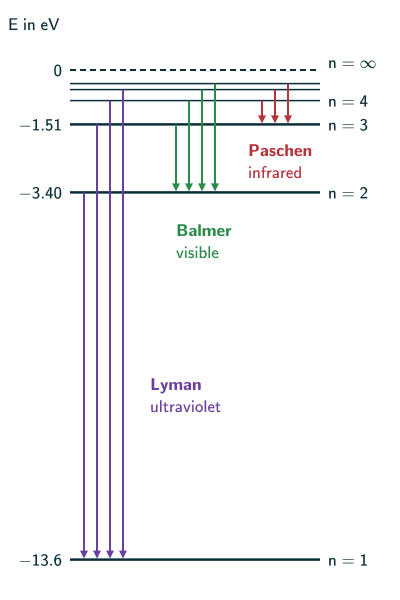
- Spectral series: the lines that end on the same level form a series. NCERT Figure 12.5 (page 297) names the Lyman, Balmer and Paschen series and marks the wavelengths below except 486, 434 and 410 nm. Beyond the NCERT Physics text: the final levels and the regions are from NCERT Class 11 Chemistry’s table of the series (Unit 2, Table 2.3, page 45), and those three wavelengths from the Rydberg formula.
- nf = 1, the Lyman series, in the ultraviolet: from 122 nm down to 91 nm.
- nf = 2, the Balmer series, spanning visible and near-ultraviolet wavelengths: its first four prominent lines, 656, 486, 434 and 410 nm, are visible; the rest crowd down to 365 nm.
- nf = 3, the Paschen series, in the infrared: from 1875 nm down to 820 nm. The Brackett (nf = 4) and Pfund (nf = 5) series lie further into the infrared.
- NCERT slip (page 297): NCERT Figure 12.5 misspells the visible series as Balmar. It is the Balmer series, as NCERT page 291 spells the name.
- In each series the longest wavelength comes from the smallest jump (ni = nf + 1), and the shortest, the series limit, from ni → ∞ (beyond the NCERT text).
- In the simplified single-photon cascade model, without re-excitation, an atom descending from level n emits at most n − 1 photons. An ensemble with all relevant downward transitions accessible has up to n(n − 1)/2 level-pair transitions between n and the ground state; this is the usual exam line count, before selection rules and unresolved or coincident frequencies (beyond the NCERT text).
- Hydrogen-like ions (beyond the NCERT text): for an ion with one electron and nuclear charge +Ze, such as He+ (Z = 2), every level and photon energy is Z2 times hydrogen’s, so each wavelength is divided by Z2. The 4 → 2 line of He+ has the wavelength of hydrogen’s 2 → 1 line, 122 nm.
- Bohr received the Nobel Prize in Physics in 1922 (NCERT page 301).
Absorption as an upward transition
- For a bound-to-bound transition an atom can absorb a photon whose energy matches the level gap within its line width, provided the lower state is populated and the transition is allowed (NCERT page 301). The atom absorbs radiation of the same frequencies that it emits (NCERT Summary point 6(c), page 303):
Absorption (NCERT Summary point 6(c))
- So if light with a continuous range of frequencies passes through a rarefied gas, and the background outshines the gas’s own emission into the sightline, the absorbed frequencies show up as dark absorption lines in the continuous spectrum (NCERT page 301).
- At room temperature most hydrogen atoms are in the ground state (NCERT page 300), so cool hydrogen absorbs mainly the lines that start from n = 1, the Lyman lines in the ultraviolet (reasoned).
- A photon of 13.6 eV or more can free the electron from the ground state: above 0 eV the energies form a continuum, so it need not match exactly, and the extra appears as the electron’s kinetic energy (reasoned from NCERT page 300).
- An atom can also be excited by collisions, for example with electrons (NCERT page 300). Unlike a photon, an electron can hand over only part of its energy, so a 12.5 eV electron can lift a hydrogen atom from n = 1 to n = 2 or n = 3, but not to n = 4, which needs 12.75 eV (reasoned; see Example 2).
Solved examples
Example 1: Absorbing a photon to reach n = 4 (NCERT Exercise 12.5)
A hydrogen atom in the ground state absorbs a photon that takes it to the n = 4 level. Find the wavelength and frequency of the photon.
Answer: hν = 13.6 × (1 − 1/16) = 12.75 eV = 12.75 × 1.6 × 10−19 J ≈ 2.04 × 10⁻¹⁸ J. With hc ≈ 1240 eV nm, λ ≈ 1240/12.75 ≈ 97 nm = 9.7 × 10⁻⁸ m, in the ultraviolet, and ν = c/λ ≈ 3.1 × 10¹⁵ Hz (NCERT Exercise 12.5, page 305; answer on page 351).
Example 2: A 12.5 eV electron beam (NCERT Exercise 12.8)
Hydrogen gas at room temperature is bombarded by a beam of 12.5 eV electrons. Which wavelengths are emitted?
Answer: Assume initially ground-state atomic hydrogen and at most one exciting collision before each radiative cascade. The atoms start in n = 1. Reaching n = 3 needs 12.09 eV and n = 4 needs 12.75 eV, so the electrons can raise atoms up to n = 3 only. Coming back down gives three lines (Rydberg formula, R = 1.097 × 10⁷ m−1):
- 3 → 1: 1/λ = R(1 − 1/9), so λ ≈ 103 nm (Lyman)
- 2 → 1: 1/λ = R(1 − 1/4), so λ ≈ 122 nm (Lyman)
- 3 → 2: 1/λ = R(1/4 − 1/9), so λ ≈ 656 nm (Balmer)
These match NCERT’s answer (NCERT Exercise 12.8, page 305; answer on page 351).
Example 3: The red line from the energy levels
Find the wavelength of the photon emitted when the electron of hydrogen falls from n = 3 to n = 2.
Answer: hν = E3 − E2 = −1.51 − (−3.40) = 1.89 eV. With hc ≈ 1240 eV nm, λ ≈ 1240/1.89 ≈ 656 nm, the red line of hydrogen (reasoned from NCERT Eq. (12.11) and page 300).
Example 4: Series limits
Find the shortest wavelengths of the Lyman and Balmer series.
Answer: For ni → ∞, 1/λ = R/nf2. Lyman: λ = 1/R ≈ 91.2 nm. Balmer: λ = 4/R ≈ 365 nm. NCERT Figure 12.5 (page 297) marks both limits; the formula is beyond the NCERT text.
Common mistakes to avoid
Common mistake
Expecting any photon above 10.2 eV to be absorbed
Below 13.6 eV, a ground-state atom absorbs only photons that match a gap exactly: 10.2 eV, 12.09 eV, 12.75 eV and so on; an 11 eV photon cannot drive a resonant one-photon bound-state excitation of ground-state hydrogen (other scattering processes are outside this model) (NCERT page 301).
Common mistake
Swapping the levels in 1/n
The photon energy is 13.6(1/nf2 − 1/ni2) eV, with the lower level nf first, so that the energy is positive (reasoned from NCERT Eqs. (12.10)–(12.11)).
Common mistake
Thinking one atom gives the whole spectrum at once
Each jump gives one photon of one frequency; the full set of lines comes from many atoms making different jumps (reasoned from NCERT page 301).
Quick revision summary
- A jump from ni down to nf emits one photon with hν = Ei − Ef; whole-number levels give discrete lines.
- For hydrogen, hν = 13.6(1/nf2 − 1/ni2) eV, or 1/λ = R(1/nf2 − 1/ni2) with R ≈ 1.097 × 10⁷ m−1 (the 1/λ form is beyond the NCERT Physics text).
- Series (final levels and regions beyond the NCERT Physics text; NCERT Class 11 Chemistry, Table 2.3): Lyman to n = 1 (ultraviolet), Balmer to n = 2 (visible and near ultraviolet), Paschen to n = 3 (infrared).
- Absorption is the upward jump, Ei + hν = Ef; the atom absorbs the frequencies it can emit, and cool hydrogen absorbs the Lyman lines.
- Electron collisions can excite atoms by giving up part of their energy; photons must match a gap exactly, unless they ionise.
Formula sheet
- hν = Ei − Ef
- En = −13.6/n2 eV
- hν = 13.6 (1/nf2 − 1/ni2) eV
- 1/λ = R(1/nf2 − 1/ni2)
- R ≈ 1.097 × 10⁷ m−1
- Ei + hν = Ef
Questions students ask
How do you find the number of spectral lines emitted by hydrogen atoms in the nth level?
In the usual level-pair counting model, the maximum number of possible transitions for an ensemble initially at level n and cascading to the ground state is n(n − 1)/2, the number of different pairs of levels, since every downward jump between two levels gives one line; if the atoms fall no lower than level n1, it is (n − n1)(n − n1 + 1)/2 (reasoned; beyond the NCERT text). For a gas of atoms excited to n = 7 that is 7 × 6/2 = 21 lines: 6 Lyman lines ending on n = 1, 5 Balmer lines ending on n = 2 and 10 more ending on levels 3 to 6. A single atom makes one jump at a time, so it gives at most n − 1 of them (worked example).
Why does the Rydberg constant have two values?
The Rydberg constant seems to have two values because it is quoted in two units: NCERT Class 11 Chemistry gives it as 109 677 cm (page 45), a wavenumber that gives 1/λ for a line, and as RH = 2.18 × 10 J (page 47), the same constant multiplied by hc to make it an energy, 13.6 eV (how they match). There is also a small real difference: 109 677 cm is hydrogen’s own value, about 0.05% below the R = 1.09737 × 10 m of an infinitely heavy nucleus, because the proton is only about 1836 times as heavy as the electron (beyond the NCERT text; NIST, CODATA 2022).
What is the difference between the Balmer formula and the Rydberg formula?
Balmer’s formula of 1885 was an empirical fit to one group of hydrogen’s lines (NCERT page 291), the series NCERT Figure 12.5 marks from 656 to 365 nm, while the Rydberg formula, 1/λ = R(1/nf2 − 1/ni2), covers every series of hydrogen, with Balmer’s formula as its case nf = 2 (beyond the NCERT text). Balmer wrote his as λ = Bn/(n − 4), with B = 4/R, and the Rydberg form extends the relation to the other series. Both were found by fitting measured wavelengths; Bohr’s model of 1913 was the first to explain them (NCERT pages 298 and 301).
Are the Lyman, Balmer and Paschen series in the JEE Main and NEET syllabus?
Yes, the spectral series of hydrogen are examinable in JEE Main and NEET (UG) 2026, although neither syllabus names them: both list the “hydrogen spectrum” in Physics Unit 18, Atoms and Nuclei, and the spectrum of the hydrogen atom in Chemistry Unit 2, Atomic Structure. NCERT Class 12 Physics Part II (2026–27) has no section on the series and names the Lyman, Balmer and Paschen series only in its Figure 12.5 (page 297). NCERT Class 11 Chemistry still teaches all five series and the Rydberg formula (page 45), as does the chemistry page on the line spectrum of hydrogen.
Practice questions
Try each question first, then open the answer to check your working.
-
Q1. Find the wavelength of the first line of the Lyman series, from n = 2 to n = 1.
Show answerHide answer
hν = 13.6 × (1 − 1/4) = 10.2 eV, so λ ≈ 1240/10.2 ≈ 122 nm, in the ultraviolet (reasoned from NCERT Eqs. (12.10)–(12.11)).
-
Q2. Find the energy and wavelength of the photon emitted when hydrogen goes from n = 4 to n = 2.
Show answerHide answer
hν = 13.6 × (1/4 − 1/16) = 2.55 eV, so λ ≈ 1240/2.55 ≈ 486 nm, the blue-green Balmer line (reasoned from NCERT Eqs. (12.10)–(12.11)).
-
Q3. Hydrogen atoms are excited to n = 4. How many different lines can the gas emit as they return to the ground state?
Show answerHide answer
n(n − 1)/2 = 4 × 3/2 = 6 lines: 4→3, 4→2, 4→1, 3→2, 3→1 and 2→1 (beyond the NCERT text).