Bohr model of the hydrogen atom
NCERT Class 12 Physics Chapter 12 Section 12.4
Quick answer
The Bohr model of the hydrogen atom keeps Rutherford’s nucleus but lets the electron move only in certain stationary orbits, those with angular momentum L = nh/2π, in which it does not radiate; it emits a photon of energy hν = Ei − Ef only when it jumps to a lower orbit. For hydrogen this gives orbit radii n2 a0, with a0 ≈ 5.3 × 10⁻¹¹ m, and energies −13.6/n2 eV, so the ionisation energy is 13.6 eV. Bohr added these postulates because, classically, an orbiting electron should radiate, spiral into the nucleus and give a continuous spectrum.
With your textbook
NCERT Physics Part II (Class 12), Chapter 12 “Atoms”, Section 12.4 “Bohr Model of the Hydrogen Atom”, pages 297–300.
Open the official NCERT chapter (PDF, 2.1 MB, ncert.nic.in) (opens in a new tab)
Checked against the 2026-27 reprint on .
What is the Bohr model of the hydrogen atom?
Bohr model
Rutherford’s nuclear model could not explain why atoms are stable or why they give out line spectra. In 1913 Niels Bohr kept the nucleus and the orbiting electron, but added ideas from the new quantum hypothesis (NCERT page 298). In NCERT’s words:
Bohr combined classical and early quantum concepts and gave his theory in the form of three postulates.
NCERT Physics Part II (Class 12), Section 12.4, page 298
The electron moves only in certain stationary orbits without radiating; in these its angular momentum is L = nh/2π; and it emits a photon of energy hν = Ei − Ef only when it jumps to a lower orbit (absorbing a photon lifts it to a higher one). For hydrogen this gives orbits of radius rn ∝ n2 and energies En = −13.6 eV/n2 (NCERT Eqs. (12.5)–(12.10), pages 299–300).
Model limits: use positive integers n = 1, 2, … for bound circular Bohr orbits, a fixed nucleus and nonrelativistic motion. For hydrogen-like ions this requires Zα/n ≪ 1, with α ≈ 1/137. Modern quantum mechanics has orbitals, not sharp trajectories; the formulas here describe the Bohr approximation.
In plain words: Bohr said the electron is allowed only on certain “rungs”, each with a fixed energy, and while it stays on a rung it does not lose energy. It gives out light only when it drops to a lower rung, and the light carries away exactly the energy difference.
Why an orbiting electron should spiral in
- A planet is held by gravity; an electron in an atom is held by the Coulomb force. An object moving in a circle is always accelerating towards the centre (NCERT page 297).
- By classical electromagnetic theory, an accelerating charge radiates electromagnetic waves. So the orbiting electron should keep losing energy, spiral inwards and fall into the nucleus: such an atom could not be stable (NCERT page 297; NCERT Figure 12.6, page 298).
- The waves would have the frequency of the electron’s revolution. As it spirals in, that frequency changes continuously, so the atom would give out a continuous spectrum, not the line spectrum actually observed (NCERT page 297).
- So Rutherford’s model tells only part of the story: classical ideas alone cannot explain the structure of the atom (NCERT page 297). For the electron of hydrogen, classical theory would put the initial frequency of the light at about 6.6 × 10¹⁵ Hz (NCERT Example 12.4, page 298; see Example 1).
- NCERT slip (page 298): Example 12.4 prints the electron’s speed as 2.2 × 10⁻⁶ m/s. Example 12.3 found 2.2 × 10⁶ m/s, which is the value the frequency calculation actually uses.
Bohr’s three postulates
- (i) Stationary states. An electron in an atom can revolve in certain stable orbits without emitting radiant energy, contrary to electromagnetic theory. Each atom has definite stable states, the stationary states, each with a definite total energy (NCERT pages 298–299).
- (ii) Quantised angular momentum. The electron revolves only in those orbits for which its angular momentum is a positive-integer multiple of h/2π, where h is Planck’s constant (NCERT Eq. (12.5), page 299):
Bohr’s quantisation condition (NCERT Eq. 12.5)
- (iii) Transitions. An electron may jump from one non-radiating orbit to another of lower energy. A photon is then emitted with energy equal to the difference between the initial and final energies (NCERT Eq. (12.6), page 299). This brings in the quantum ideas of Planck and Einstein: the energy of the photon is hν.
Bohr’s frequency condition (NCERT Eq. 12.6)
- Bohr had worked in Rutherford’s laboratory for several months in 1912 and was convinced of the nuclear model; in 1913 he concluded that electromagnetic theory, so successful on the large scale, could not be applied to processes inside the atom (NCERT page 298).
Radius and energy of the orbits
- Start from the force balance of Rutherford’s model, mv2/r = e2/(4πε0r2), and add the quantisation condition mvr = nh/2π. Solving the two together gives the radius of the nth orbit (NCERT Eq. (12.7), page 299):
Radius of the nth orbit (NCERT Eq. 12.7)
- So rn = n2a0, where the smallest radius, a0 ≈ 5.3 × 10⁻¹¹ m, is the Bohr radius (NCERT pages 296 and 300; the value is from NCERT Example 12.3). The orbits for n = 2 and 3 are 4 and 9 times as large.
- Putting rn into v = nh/(2πmr), which comes from NCERT Eq. (12.5), gives the speed: vn = e2/(2ε0nh) ≈ (2.18 × 10⁶ m/s)/n, so the electron moves more slowly in the outer orbits (reasoned from NCERT Eqs. (12.5) and (12.7); NCERT Exercise 12.6).
- Putting rn into the total energy E = −e2/(8πε0r) of NCERT Eq. (12.4) gives the energy of the nth state (NCERT Eqs. (12.8)–(12.10), page 299):
Energy of the nth state (NCERT Eq. 12.8)
In joules (NCERT Eq. 12.9)
In electron volts (NCERT Eq. 12.10)
- The energy is negative because the electron is bound to the nucleus: energy must be supplied to remove it to a great distance (NCERT page 299).
- The kinetic energy is K = −E and the potential energy is U = 2E (reasoned from the expressions for K and U on NCERT page 296). In the ground state K = 13.6 eV and U = −27.2 eV, NCERT’s answer to Exercise 12.4 (page 351).
- Hydrogen-like ions (beyond the NCERT text): NCERT calls a nucleus of charge +Ze with a single electron, such as He+ or Li2+, a hydrogenic atom (NCERT page 302). Replacing e2 by Ze2 in the force and the potential energy gives rn = n2a0/Z, vn ∝ Z/n and En = −13.6 Z2/n2 eV.
Energy levels
- The energy is lowest (most negative) for the orbit closest to the nucleus, n = 1; for n = 2, 3, … it is progressively higher (NCERT page 300).
- The lowest state, the ground state, has E1 = −13.6 eV, with the electron in the orbit of the Bohr radius. So it takes 13.6 eV to free the electron from the ground state: the ionisation energy of hydrogen, in excellent agreement with experiment (NCERT page 300).
- At room temperature most hydrogen atoms are in the ground state. Collisions, for example with electrons, can raise an atom to an excited state (NCERT page 300).
- E2 = −3.40 eV, so the first excited state needs E2 − E1 = 10.2 eV; E3 = −1.51 eV, so the second excited state needs 12.09 eV (NCERT page 300). From an excited state the electron can fall back, emitting a photon.
- The higher the state, the less energy is needed to free the electron from it (NCERT page 300).
- The energy level diagram labels the states by the principal quantum number n. The limit n → ∞ approaches E = 0: the ionisation threshold, with the separated electron and nucleus at rest relative to each other. It is not a final bound orbit. Above 0 eV the electron is free and can have any energy, a continuum (NCERT page 300, NCERT Figure 12.7).
- The levels crowd closer and closer together as n increases (NCERT page 300).
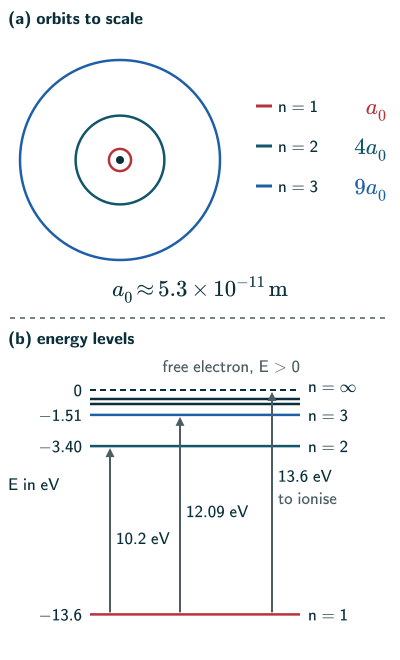
Solved examples
Example 1: The classical frequency (NCERT Example 12.4)
By classical electromagnetic theory, what is the initial frequency of the light emitted by the electron going round the proton in a hydrogen atom?
Answer: From NCERT Example 12.3, v = 2.2 × 10⁶ m/s and r = 5.3 × 10⁻¹¹ m. The frequency of revolution is
ν = v/(2πr) = (2.2 × 10⁶)/
and classically the light has this frequency (NCERT Example 12.4, page 298).
Example 2: Speeds and periods (NCERT Exercise 12.6)
Using the Bohr model, find the speed of the electron in the n = 1, 2 and 3 levels of hydrogen, and its orbital period in each.
Answer: With e = 1.6 × 10⁻¹⁹ C, ε0 = 8.85 × 10⁻¹² C2 N−1 m−2 and h = 6.63 × 10⁻³⁴ J s, vn = e2/(2ε0nh) gives v1 ≈ 2.18 × 10⁶ m/s, v2 ≈ 1.09 × 10⁶ m/s, v3 ≈ 7.27 × 10⁵ m/s. With rn = n2a0, a0 = 5.29 × 10⁻¹¹ m, the period T = 2πr/v grows as n3: T1 ≈ 1.52 × 10⁻¹⁶ s, T2 ≈ 1.22 × 10⁻¹⁵ s, T3 ≈ 4.11 × 10⁻¹⁵ s, NCERT’s answers on page 351 (NCERT Exercise 12.6, page 305).
Example 3: The next two orbits (NCERT Exercise 12.7)
The radius of the innermost orbit of hydrogen is 5.3 × 10⁻¹¹ m. What are the radii of the n = 2 and n = 3 orbits?
Answer: rn = n2r1, so r2 = 4 × 5.3 × 10−11 = 2.12 × 10⁻¹⁰ m and r3 = 9 × 5.3 × 10−11 = 4.77 × 10⁻¹⁰ m (NCERT Eq. (12.7), page 299; NCERT Exercise 12.7, page 305).
Example 4: The earth as a Bohr atom (NCERT Exercise 12.9)
Treating the earth’s orbit by Bohr’s rule, find the quantum number of the earth (mass 6.0 × 1024 kg, orbit radius 1.5 × 10¹¹ m, speed 3 × 10⁴ m/s).
Answer: n = 2πmvr/h = (2π × 6.0 × 1024 × 3 × 104 × 1.5 × 1011)/
Common mistakes to avoid
Common mistake
Thinking the electron radiates while it orbits
In a stationary orbit the electron does not radiate; it emits a photon only when it jumps to a lower orbit (NCERT pages 298–299).
Common mistake
Making the radius grow as n
The radius grows as n: r = 4a and r = 9a, not 2a and 3a (NCERT Eq. (12.7), page 299).
Common mistake
Forgetting the minus sign in the energy
E = −13.6/n eV is negative; a higher level has a smaller magnitude but a higher energy, and n = ∞ is 0 eV (NCERT page 300).
Quick revision summary
- Classically, an orbiting electron radiates, spirals into the nucleus and gives a continuous spectrum; real atoms are stable and give line spectra.
- Bohr’s postulates: stationary orbits without radiation; L = nh/2π; a photon hν = Ei − Ef on a jump down.
- Radius rn = na0 with a0 ≈ 5.3 × 10⁻¹¹ m; speed vn ∝ 1/n.
- Energy En = −13.6/n eV: ground state −13.6 eV, ionisation energy 13.6 eV; E2 = −3.40 eV, E3 = −1.51 eV.
- Excitation from n = 1 needs 10.2 eV to reach n = 2 and 12.09 eV to reach n = 3; levels crowd together towards 0 eV.
Formula sheet
- L = mvr = nh/2π
- hν = Ei − Ef
- rn = n2 h2 ε0/(π m e2) = n2 a0
- vn = e2/(2 ε0 n h)
- En = −m e4/(8 n2 ε02 h2) = −13.6/n2 eV
Questions students ask
Why is the energy of the electron in a Bohr orbit negative?
The energy of the electron in a Bohr orbit is negative because zero energy is taken to be the electron at rest infinitely far from the nucleus, and a bound electron has less energy than that: its potential energy is negative and twice the size of its kinetic energy, so K = −E and U = 2E (reasoned from NCERT page 296; zero at n = ∞, page 300). The size of the negative energy is the energy needed to free the electron from that orbit (NCERT page 299). In the n = 3 orbit of hydrogen, for example, E3 = −1.51 eV, made up of K = +1.51 eV and U = −3.02 eV, so 1.51 eV removes the electron.
How many energy levels does a hydrogen atom have?
A hydrogen atom has infinitely many bound energy levels, n = 1, 2, 3, …, with energies −13.6/n eV that crowd closer and closer together as they approach 0 eV at n = ∞ (NCERT page 300). By n = 20 a level is only 0.034 eV below zero, while the first gap, from n = 1 to n = 2, is 10.2 eV. Above 0 eV the electron is free and can have any energy, a continuum rather than separate levels (NCERT page 300, footnote).
What do n, Z and k stand for in the formula for the radius of the nth Bohr orbit?
In the radius of the nth orbit written as rn = nh/(4πkmZe), a form beyond the NCERT text, n is the principal quantum number (1, 2, 3, …), Z is the atomic number of the one-electron atom or ion (1 for hydrogen, 2 for He+), k = 1/(4πε0) ≈ 9 × 10 N m C is the Coulomb constant, and m is the electron mass while e is the positive magnitude of its charge. NCERT gives the hydrogen case, Z = 1, with 4πε0 in place of 1/k (NCERT Eq. (12.7), page 299); a nucleus of charge +Ze divides the radius by Z. So rn = na0/Z: the n = 3 orbit of He+ has a radius of (9 × 5.3 × 10 m)/2 ≈ 2.4 × 10 m.
Is the derivation of the Bohr radius and energy in the JEE Main and NEET syllabus?
Yes, the derivation of the radius and energy of the Bohr orbits is named in both syllabuses, but under Chemistry: Unit 2 (Atomic Structure) of the JEE Main and the NEET (UG) 2026 syllabus lists the “derivation of the relations for the energy of the electron and radii of the different orbits”, while Physics Unit 18 lists only “Bohr model, energy levels, hydrogen spectrum”. NCERT Class 12 Physics Part II states the results, Eqs. (12.7)–(12.10) on page 299, without every step of the algebra, so learn the full derivation, including ions of charge +Ze, from the chemistry page.
Why are Bohr’s orbits called stationary states?
Bohr’s orbits are called stationary states because the atom’s energy stays fixed while the electron is in one of them: there the electron emits no radiation, contrary to classical electromagnetic theory, so each state has a definite total energy (NCERT pages 298–299). ‘Stationary’ does not mean that the electron is at rest, for in the first orbit of hydrogen it moves at more than 10 m/s (NCERT page 296). De Broglie later pictured each state as a standing wave round the orbit, a useful periodic-wave picture. In modern stationary states the probability density is time independent; this does not require every wavefunction to be a real, motionless standing wave.
Why was Bohr’s model accepted, although it broke the rules of classical physics?
Bohr’s model was accepted because its numbers agreed with experiment: it predicted the ionisation energy of hydrogen, 13.6 eV, in excellent agreement with the measured value (NCERT page 300), and it gave the frequencies of the light that hydrogen emits and absorbs (NCERT page 302). It even gave the Rydberg constant of the empirical line formulas from m, e, h, ε0 and c alone, about 1.097 × 10 m or 109 737 cm, close to the hydrogen value 109 677 cm. Accounting for proton recoil replaces m by the reduced mass μ = mM/(m + M), lowering the Rydberg constant by about 0.05% (beyond the NCERT text; NCERT Class 11 Chemistry, page 45). In 1922 Bohr received the Nobel Prize in Physics (NCERT page 301).
Practice questions
Try each question first, then open the answer to check your working.
-
Q1. Find the energy of the hydrogen atom in the n = 4 state, and the energy needed to ionise it from there.
Show answerHide answer
E4 = −13.6/16 = −0.85 eV, so 0.85 eV frees the electron (NCERT Eq. (12.10), page 299).
-
Q2. By what factor does the radius of the orbit change when the electron goes from n = 1 to n = 3?
Show answerHide answer
r ∝ n, so it grows 9 times (NCERT Eq. (12.7), page 299).
-
Q3. What is the ground-state energy of singly ionised helium, He+ (Z = 2)?
Show answerHide answer
E1 = −13.6 × Z/1 = −13.6 × 4 = −54.4 eV (beyond the NCERT text).