Coulomb’s law
NCERT Class 12 Physics Chapter 1 Section 1.5
Quick answer
Coulomb’s law says that the force between two point charges is proportional to the product of their magnitudes and inversely proportional to the square of the distance between them, and acts along the line joining them: F = (1/4πε)|qq|/r. In vacuum 1/4πε ≈ 9 × 10 N m C, with ε = 8.854 × 10 C N m. Like charges repel and unlike charges attract, and the forces on the two charges are equal and opposite, F = −F.
With your textbook
NCERT Physics Part I (Class 12), Chapter 1 “Electric Charges and Fields”, Section 1.5 “Coulomb’s Law”, pages 6–11.
Open the official NCERT chapter (PDF, 4.0 MB, ncert.nic.in) (opens in a new tab)
Checked against the 2026-27 reprint on .
What is Coulomb’s law?
Coulomb’s law
Coulomb’s law is a quantitative statement about the force between two point charges.
NCERT Physics Part I (Class 12), Section 1.5, page 6
Point charges are charged bodies whose sizes are much smaller than the distance between them. Coulomb found that the force between two point charges varies inversely as the square of the distance between them, is directly proportional to the product of the magnitudes of the charges, and acts along the line joining them (NCERT pages 6–7):
In plain words: double either charge and the force doubles; double the distance and the force drops to a quarter. The force pushes like charges apart and pulls unlike charges together, always along the straight line joining them, and each charge feels the same size of force.
Force between two point charges
For point charges q1 and q2 a distance r apart in vacuum, the magnitude of the force is (NCERT Eqs. (1.1) and (1.2), pages 7–8):
Coulomb’s law (NCERT Eq. 1.2)
How Coulomb did it (NCERT page 7): he measured the forces with a torsion balance. The charges on his metal spheres were unknown, so he made known fractions of them: touching a charged sphere with an identical uncharged one splits the charge equally by symmetry, giving q/2, then q/4 and so on. He varied the distance for a fixed pair of charges, then varied the charges at a fixed distance, and arrived at the law. It has been established from the macroscopic scale down to distances of about 10−10 m.
Choosing a unit of charge. In NCERT Eq. (1.1), k could be any positive number, and its value fixes the size of the unit (page 7). This explains a possible choice of electrical units, not the modern SI definition: today the ampere is defined by fixing the elementary charge, and 1 C = 1 A s (beyond the NCERT text: the SI since 2019; Wikipedia, “Ampere”). With k ≈ 9 × 10⁹ N m2 C−2, two charges of 1 C each, 1 m apart in vacuum, repel with a force of 9 × 10⁹ N: one coulomb is far too big a unit for electrostatics, which uses µC and mC instead (NCERT pages 7–8).
Permittivity of free space
The constant is written k = 1/4πε0 for later convenience, where ε0 is the permittivity of free space (NCERT page 8):
Permittivity of free space
in C2 N−1 m−2 (NCERT page 8).
With this value, 1/4πε0 = 8.99 × 10⁹ N m2 C−2, the value NCERT uses in Example 1.3 (8.987 × 10⁹, page 10). NCERT rounds it to about 9 × 10⁹ (page 7), the value to use unless a problem gives another. The dimensions of ε0 follow from its unit, with C = A s and N = kg m s−2: [M−1 L−3 T4 A2].
The law above is for charges in vacuum. When matter lies between the charges, its own charged constituents complicate the picture; NCERT takes this up in the next chapter (page 9). Beyond the NCERT text: for fixed point charges in an infinite, homogeneous, linear isotropic dielectric of relative permittivity K, the force at the same distance is F/K, K times weaker than in vacuum. In this macroscopic model the medium weakens the field between the charges by the factor K (Wikipedia, “Relative permittivity”), so its permittivity ε = Kε0 takes the place of ε0. NCERT itself brings in K = ε/ε0 only for capacitors, in Section 2.13 (page 70). For air K is very close to 1, so air is treated as vacuum.
Coulomb’s law in vector form
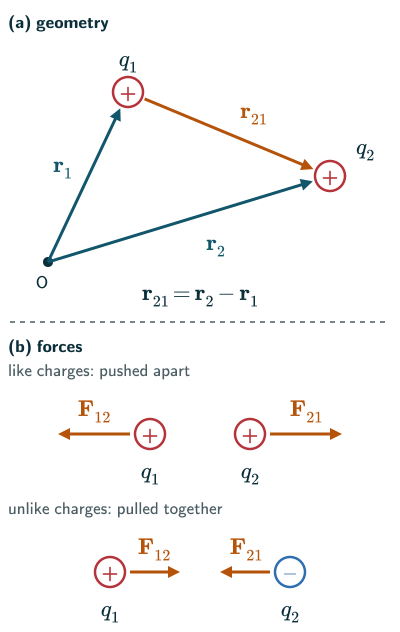
Force is a vector, so NCERT writes the law with position vectors r1 and r2 of the two charges (pages 8–9):
- r21 = r2 − r1 points from charge 1 to charge 2, and r̂21 = r21/r21 is the unit vector along it.
- F21 is the force on q2 due to q1.
Coulomb’s law in vector form (NCERT Eq. 1.3)
- The charges go in with their signs. If q1 and q2 have the same sign, F21 is along r̂21, away from q1: repulsion. If their signs differ, F21 is along −r̂21, towards q1: attraction. One equation covers both cases (page 8).
- Swapping 1 and 2 gives the force on q1: F12 = −F21. Coulomb’s law agrees with Newton’s third law (page 9).
Comparison with the gravitational force
Both laws fall off as 1/r2, but the electric force is enormously stronger. NCERT Example 1.3 (pages 9–10) compares them (worked below as Example 1):
- For an electron and a proton, Fe/FG = e2/(4πε0Gmpme), about 2.3 × 1039. NCERT prints 2.4 × 1039, but the masses NCERT gives, with e = 1.6 × 10⁻¹⁹ C and G = 6.67 × 10⁻¹¹ N m2 kg−2, give 2.3 × 1039.
- For two protons, the ratio is about 1.2 × 1036. NCERT prints 1.3 × 1036; the same values give 1.2 × 1036.
- NCERT slip (page 9): both printed ratios, 2.4 × 1039 and 1.3 × 1036, come out a little high; NCERT’s own data give 2.3 × 1039 and 1.2 × 1036 (see Example 1). In an exam, work with the constants given; an NCERT-based key may print 2.4 × 1039 and 1.3 × 1036.
- Gravity always attracts; the electric force between two protons repels. Inside a nucleus, about 10−15 m apart, two protons repel with Fe ~ 230 N, while their gravitational attraction is only FG ~ 1.9 × 10⁻³⁴ N (page 9).
For the gravitational side, see the universal law of gravitation.
Solved examples
Example 1: Electric against gravitational force (NCERT Example 1.3)
(a) Find the ratio of the electric to the gravitational force (i) for an electron and a proton, (ii) for two protons. (b) Find the accelerations of an electron and a proton due to their mutual electric attraction 1 Å = 10−10 m apart. Take mp = 1.67 × 10⁻²⁷ kg, me = 9.11 × 10⁻³¹ kg, e = 1.6 × 10⁻¹⁹ C, G = 6.67 × 10⁻¹¹ N m2 kg−2.
Answer: (a) The distance cancels, because both forces go as 1/r2.
(i) Electron and proton:
With k = 9 × 10⁹ N m2 C−2 and e2 = 2.56 × 10−38 C2, the top is ke2 = 2.30 × 10⁻²⁸ N m2. For the bottom, Gmp = 6.67 × 10−11 × 1.67 × 10−27 = 1.11 × 10−37, and multiplying by me = 9.11 × 10⁻³¹ kg gives Gmpme = 1.01 × 10−67 N m2. So
(ii) Two protons: replace me by mp, which gives about 1.2 × 1036.
(NCERT prints 2.4 × 1039 and 1.3 × 1036, page 9; recomputed with these constants the ratios are 2.3 × 1039 and 1.2 × 1036.)
(b) The force has the same size on both particles:
With 1/4πε0 = 8.987 × 10⁹ N m2 C−2, e = 1.6 × 10⁻¹⁹ C and r = 10−10 m:
So ae = F/me = (2.3 × 10⁻⁸ N)/(9.11 × 10−31 kg) = 2.5 × 10²² m s−2, and ap = F/mp = 1.4 × 10¹⁹ m s−2: gravity is negligible beside these (NCERT page 10).
Example 2: Halving the charges and the distance (NCERT Example 1.4)
Charged metal spheres A and B, 10 cm apart, repel with a force F. Identical uncharged spheres C and D touch A and B, and are removed; then B is brought to 5.0 cm from A. What is the new force?
Answer: touching splits each charge equally, so A and B now carry q/2 and q′/2. The new force is
The force is unchanged: each charge was halved, but the distance was halved too, and the 1/r2 factor quadruples the force (NCERT pages 10–11).
Example 3: Two charges in vacuum
Charges of +2 µC and −3 µC are 30 cm apart in vacuum. Find the force between them.
Answer: here |q1q2| = 2 × 10−6 × 3 × 10−6 = 6 × 10⁻¹² C2 and r2 = (0.30 m)2 = 0.09 m2. Then k|q1q2| = 9 × 109 × 6 × 10−12 = 5.4 × 10⁻² N m2, so
The charges have opposite signs, so the force is attractive: each charge is pulled towards the other with 0.60 N (NCERT Eq. (1.2), page 8).
Example 4: Using the vector form
A charge q1 = +1.0 µC is at the origin and q2 = +2.0 µC is at the point (3 m, 4 m). Find the force F21 on q2 and the force F12 on q1.
Answer: r21 = r2 − r1 = (3î + 4ĵ) m, so r21 = 5 m and r̂21 = 0.6î + 0.8ĵ. With kq1q2 = 9 × 109 × 2.0 × 10−12 = 1.8 × 10⁻² N m2, the magnitude is
Both charges are positive, so F21 is along r̂21: F21 = (4.32î + 5.76ĵ) × 10−4 N, pushing q2 away from the origin. By the third law, F12 = −F21 (NCERT Eq. (1.3), pages 8–9).
Common mistakes to avoid
Common mistake
Dropping the square on r
The force falls as 1/r: doubling the distance cuts the force to a quarter, not a half (NCERT page 7).
Common mistake
Mixing up F and F
NCERT’s F is the force on q due to q, along r̂ from charge 1 to charge 2 for like charges. The two forces are equal and opposite (NCERT pages 8–9).
Common mistake
Applying the law to large, close bodies
Coulomb’s law is for point charges: bodies much smaller than the distance between them. For big spheres close together the charges are not at single points (NCERT page 6).
Quick revision summary
- Coulomb’s law: the force between two point charges is proportional to the product of their magnitudes, inversely proportional to the square of the distance, and acts along the line joining them.
- F = (1/4πε)|qq|/r, with 1/4πε ≈ 9 × 10 N m C and ε = 8.854 × 10 C N m (in vacuum).
- Vector form: F = (1/4πε)(qq/r) r̂, with the signs of the charges; F = −F, as Newton’s third law requires.
- Coulomb found the law with a torsion balance, halving charges by touching identical spheres.
- The electric force between an electron and a proton is about 10 times their gravitational attraction.
Formula sheet
- F = (1/4πε) |qq|/r
- 1/4πε ≈ 9 × 10 N m C
- ε = 8.854 × 10 C N m
- F = (1/4πε)(qq/r) r̂, r = r − r
- F = −F
Questions students ask
What are the limitations of Coulomb’s law?
Coulomb’s law, F = k|q1q2|/r, is a law for point charges at rest in vacuum: charged bodies much smaller than their separation (NCERT pages 6–7 and 9). It also holds for two non-overlapping spherically symmetric charge distributions whose charge profiles remain fixed, with r measured between centres, since outside such a sphere the field is as if all its charge were at the centre (NCERT page 40; see field of a shell). But two charged metal bodies brought close push each other’s free charges around, so the formula no longer gives the force. In an ordinary linear dielectric filling the space, the macroscopic force is reduced by its relative permittivity, and moving charges also exert magnetic forces, the subject of NCERT Chapter 4.
Why does Coulomb’s law follow an inverse square law?
Coulomb’s law is an inverse square law because that is what experiment shows: Coulomb measured the force at different separations with a torsion balance and found that it varied as 1/r (NCERT pages 6–7). A picture makes it natural: field lines from a point charge spread evenly over spheres of area 4πr, so their density, like the field, falls as 1/r (see density of field lines). Gauss’s law rests on this exact power (NCERT page 31); beyond the NCERT text, Williams, Faller and Hill found in 1971 that the power of r differs from 2 by at most a few parts in 10 (Physical Review Letters, volume 26).
Why is there a 4π in Coulomb’s law?
The 4π in Coulomb’s law comes from writing the constant as k = 1/4πε0, which NCERT does “for later convenience” (NCERT page 8). Since 4πr is the area of a sphere, this choice makes the flux of a point charge through a sphere around it (q/4πε0r) × 4πr = q/ε0, with no 4π left (NCERT pages 29–30; see Gauss’s law). So the 4π is moved into Coulomb’s law to keep Gauss’s law, and the fields worked out from it, simpler; the value of the constant is unchanged, 1/4πε0 ≈ 9 × 10 N m C.
What are the unit and dimensional formula of k in Coulomb’s law?
The constant k = 1/4πε0 in Coulomb’s law has the SI unit N m C and the dimensional formula [M L T A]: rearranging the law gives k = Fr/(q1q2), with force [M L T], r [L] and charge [A T] (see dimensional formulae). In vacuum k ≈ 9 × 10 N m C (NCERT page 7). The permittivity ε0 has the reciprocal unit, C N m, and the reciprocal dimensions.
Why is the force between two charges weaker in a medium than in vacuum?
The force between two charges is weaker in a medium because the medium is polarised: each charge’s field slightly separates, or lines up, the charges in nearby molecules, so each charge is surrounded by induced charge of the opposite sign that partly cancels its field (NCERT Chapter 2, Section 2.10, pages 65–67; see polarisation). Beyond the NCERT text, for a homogeneous linear isotropic dielectric filling all the space around the charges the force falls to F/K, where K = ε/ε0 > 1 is the dielectric constant, the factor by which, NCERT shows, a dielectric cuts the field in a capacitor (page 70).
Practice questions
Try each question first, then open the answer to check your working.
-
Q1. The distance between two point charges is tripled. By what factor does the force change?
Show answerHide answer
It becomes 1/9 of its value, because F ∝ 1/r (NCERT page 7).
-
Q2. Two equal charges 1 m apart in vacuum repel with a force of 9 N. Find each charge.
Show answerHide answer
q = Fr/k = 9 × 1/(9 × 109) = 10−9 C, so |q| ≈ 3.2 × 10⁻⁵ C, about 32 µC. Both charges may be positive or both negative; the given repulsion does not determine their common sign (NCERT Eq. (1.2), page 8).
-
Q3. In the vector form of Coulomb’s law, what does a negative product qq tell you about the direction of F?
Show answerHide answer
That F points along −r̂, towards q: the force is attractive (NCERT page 8).