Dielectrics and polarisation
NCERT Class 12 Physics Chapter 2 Section 2.10
Quick answer
A dielectric has almost no free charge carriers, but its bound charges can shift or molecular dipoles can align. Polarisation P is dipole moment per unit volume; for a linear isotropic dielectric, P = εχE, with E the total field inside. In the wide-slab model with fixed external free charges, bound surface charges oppose and reduce the applied field.
With your textbook
NCERT Physics Part I (Class 12), Chapter 2 “Electrostatic Potential and Capacitance”, Section 2.10 “Dielectrics and Polarisation”, pages 65–67.
Open the official NCERT chapter (PDF, 3.9 MB, ncert.nic.in) (opens in a new tab)
Checked against the 2026-27 reprint on .
What is a dielectric?
Dielectrics and polarisation
A dielectric is an insulator, such as glass, plastic or mica (NCERT Chapter 1, page 3, and Exercise 2.9, page 80). NCERT defines it by what it lacks:
Dielectrics are non-conducting substances. In contrast to conductors, they have no (or negligible number of) charge carriers.
NCERT Physics Part I (Class 12), Section 2.10, page 65
In an external field the molecules of a dielectric become, or line up as, tiny dipoles. The dielectric is then polarised: its faces carry charges whose field opposes the external field and reduces it inside, without cancelling it (pages 65–67).
In plain words: a metal has free electrons that can run to its surface and cancel a field inside it completely. A dielectric has none to spare. Its charges can only shift a little within each molecule, or the molecules can turn. Each molecule becomes a small dipole, and together they weaken the field inside the material.
Conductor and dielectric in a field
- Conductor: the free charge carriers move until the field of the induced charges cancels the external field inside. In the static situation the net field in the conductor is zero (NCERT page 65; see free charges in conductors).
- Dielectric: charges cannot move freely. Instead the external field induces dipole moments by stretching or re-orienting the molecules. The combined effect of all the molecular dipoles is a net charge on the surfaces of the dielectric, whose field opposes the external field (page 65).
- Unlike in a conductor, this opposing field does not cancel the external field; it only reduces it. How much depends on the nature of the dielectric (page 65).
Polar and non-polar molecules
- Non-polar molecule: the centres of positive and negative charge coincide, so it has no permanent (intrinsic) dipole moment. Oxygen (O2) and hydrogen (H2) are examples: their symmetry gives them no dipole moment (NCERT page 65).
- Polar molecule: the two centres are separated even with no external field, so it has a permanent dipole moment. NCERT’s examples are HCl and water (H2O) (page 65; see dipoles in molecules).
- A note on NCERT’s wording: NCERT calls HCl “an ionic molecule” (page 65). HCl is better described as a polar covalent molecule: hydrogen and chlorine share a pair of electrons, pulled towards the more electronegative chlorine, as in HF (NCERT Chemistry Part I (Class 11), Section 4.3.6, pages 110–111; see polarity of bonds). Its bond is only partly ionic, unlike an ionic compound such as NaCl. It is polar, as NCERT says.
Polarisation and electric susceptibility
- Non-polar dielectric in a field: the positive and negative charges of each molecule are pushed in opposite directions. They stop when the external force is balanced by the restoring force of the molecule’s internal fields. Each molecule now has an induced dipole moment, and the dielectric is polarised (NCERT page 66).
- Linear isotropic dielectrics: NCERT takes only the simple case in which the induced dipole moment is along the field and proportional to its strength. Materials for which this holds are called linear isotropic dielectrics (page 66).
- Polar dielectric in a field: with no field, thermal agitation points the permanent dipoles in random directions, so the total dipole moment is zero. A field makes them tend to line up with it, giving a net dipole moment along the field. How far they line up depends on two opposing effects: the dipole’s potential energy in the field, which tends to align it, and thermal energy, which disrupts the alignment. Induced dipoles may add to this, but for polar molecules alignment is generally the larger effect (page 66).
Either way, polar or non-polar, the dielectric gains a net dipole moment along the field. NCERT names this quantity:
The dipole moment per unit volume is called polarisation and is denoted by P.
NCERT Physics Part I (Class 12), Section 2.10, page 66
For a linear isotropic dielectric, E is the total macroscopic field inside the material, not the field E0 of the external sources alone (NCERT Eq. (2.37), page 66):
Polarisation of a linear isotropic dielectric (NCERT Eq. 2.37)
- χe, the electric susceptibility, is a constant characteristic of the dielectric. It can be related to the molecular properties of the substance, which NCERT does not pursue (page 66).
- Units: polarisation is a dipole moment per unit volume, C m ÷ m3 = C m−2 (NCERT table, page 78). ε0 is in C2 N−1 m−2 and E in N C−1, so ε0E is in C m−2, the unit of P. So χe is a pure number.
Bound charges on a polarised slab
Field reduction below assumes fixed source charge. If a slab fills a capacitor held at fixed voltage, extra free charge flows from the battery and the field remains V/d.
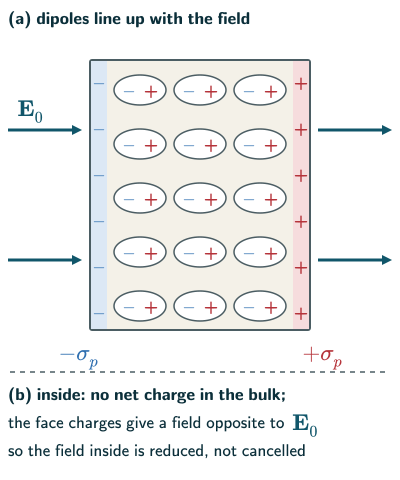
NCERT takes a wide rectangular dielectric slab, neglecting edge effects, in a uniform external field E0 parallel to two of its faces. The field polarises it uniformly (NCERT pages 66–67).
- Every small volume element Δv has a dipole moment PΔv along the field. Δv is macroscopically small but holds a very large number of molecular dipoles (page 67).
- Inside, Δv has a dipole moment but no net charge, because the positive end of one dipole sits next to the negative end of its neighbour (page 67).
- At the two faces normal to the field there is a net charge: the positive ends are left unneutralised at the right face and the negative ends at the left face. The slab acts like two charged surfaces with densities +σp and −σp (page 67).
- The field of these surface charges opposes E0, so, with the external free-charge sources fixed, the total field in this slab is smaller than with no dielectric present (page 67).
- The charge ±σp comes from bound charges in the dielectric, not free charges (page 67). NCERT builds on this slab to show that a dielectric raises a capacitor’s capacitance (Section 2.13, pages 69–70; see capacitance with a dielectric).
- Exam note (beyond the NCERT text): combined with NCERT Section 2.13, σp = P (Example 3 below) gives the dielectric constant as K = 1 + χe.
Solved examples
Example 1: Which molecules are polar?
Which of these have a permanent dipole moment: O2, H2O, H2, HCl and CO2?
Answer: H2O and HCl are polar (NCERT page 65). O2 and H2 are non-polar because of their symmetry (page 65). CO2 also has zero dipole moment (NCERT Section 1.10.2, page 25). In a field, the non-polar ones still develop induced dipole moments (page 66).
Example 2: Polarisation from the susceptibility
The field inside a linear isotropic dielectric with χe = 2.0 is 1.0 × 10⁵ V/m. Find the polarisation.
Answer: P = ε0χeE. Here ε0 × 2.0 = 1.771 × 10⁻¹¹ C2 N−1 m−2, and multiplying by 1.0 × 10⁵ V/m gives P ≈ 1.8 × 10⁻⁶ C m−2, along the field (NCERT Eq. (2.37), page 66).
Example 3: Bound charge on a slab (beyond the NCERT text)
A slab of face area A and thickness d is uniformly polarised, with P normal to two of its faces. Show that σp = P. Then find the bound charge on each face if P = 1.8 × 10⁻⁶ C m−2 and A = 4.0 cm2.
Answer: the slab’s total dipole moment is P × (volume) = PAd. Seen as two face charges ±σpA a distance d apart (NCERT page 67), its dipole moment is σpA × d. Equating the two gives σp = P. The bound charge on each face is σpA = 1.8 × 10−6 × 4.0 × 10−4 ≈ 7.2 × 10⁻¹⁰ C: positive on the face that P points towards, negative on the other.
Example 4: A metal slab and a glass slab
A metal slab and a glass slab are placed in the same uniform field. Compare the field inside each.
Answer: inside the metal the field is zero: free electrons move until the induced field cancels the external one. Inside the glass the field is reduced but not zero: its charges cannot move freely, and the field of the bound surface charges only weakens the external field (NCERT page 65).
Common mistakes to avoid
Common mistake
Thinking a dielectric cancels the field inside
That happens only in a conductor. In a dielectric the opposing field of the bound charges reduces the external field but does not cancel it (NCERT page 65).
Common mistake
Thinking only polar molecules can be polarised
A non-polar molecule has no permanent dipole moment, but a field separates its charges and gives it an induced dipole moment (NCERT page 66).
Common mistake
Treating the surface charges of a dielectric as free charges
The charges ±σp on a polarised dielectric are bound charges: the unneutralised ends of molecular dipoles (NCERT page 67).
Quick revision summary
- Dielectrics are non-conductors with no (or negligibly few) charge carriers; a field stretches or turns their molecules into dipoles.
- Non-polar molecules (O, H) get induced dipoles; polar molecules (HO, HCl) have permanent dipoles that line up against thermal agitation.
- Polarisation P is the dipole moment per unit volume, in C m; for a linear isotropic dielectric P = εχE, with χ the electric susceptibility.
- A polarised slab carries bound charges ±σp on the faces normal to the field and none in the bulk; for uniform P, σp = P.
- The bound charges’ field opposes the external field, so the field inside a dielectric is reduced, not cancelled.
Formula sheet
- P = dipole moment per unit volume, in C m
- P = εχE (linear isotropic dielectric)
- χ: a pure number, fixed by the dielectric
- slab, P normal to two faces: σp = P
- field inside a dielectric: reduced, not zero
Questions students ask
What is the difference between a dielectric and an insulator?
A dielectric and an insulator are the same kind of material, a non-conductor with no or very few free charge carriers (NCERT page 65); the two names stress different behaviour. ‘Insulator’ is the word for a material that does not let charge flow, so that charge put on it stays where it is (NCERT Chapter 1, page 3), while ‘dielectric’ is used when we look at how it is polarised in an electric field and weakens the field inside it, as between the plates of a capacitor (NCERT pages 65–67). NCERT itself writes “the insulator (dielectric)” when it says what a capacitance depends on (page 68), and glass, plastic, paper and mica are both.
Why does water have such a high dielectric constant?
Water has a high dielectric constant mainly because its molecules are polar: each has a permanent dipole moment, 1.85 D, that a field can turn into line, besides the small induced dipole every molecule gets (NCERT pages 65–66; NCERT Chemistry Part I (Class 11), Table 4.5, page 112). NCERT Chemistry gives water’s value as about 80 (Unit 6, page 189); beyond the NCERT text, it is 78.5 at 25 °C, against only 2.23 for carbon tetrachloride, whose molecules have zero dipole moment (Table 4.5) and give only the induced effect (US National Bureau of Standards, Circular 514, 1951).
Are dielectrics and electric polarisation in the JEE Main and NEET syllabus?
Yes, dielectrics and electric polarisation are in both syllabuses: the JEE Main syllabus lists “Conductors and insulators, dielectrics and electric polarization, capacitors and capacitance” in Unit 11, Electrostatics, and the NEET (UG) 2026 syllabus lists “Dielectrics and electric polarization” in its own Unit 11. In NCERT Class 12 Physics Part I the topic is Section 2.10 (pages 65–67), and it leads to the effect of a dielectric on capacitance in Section 2.13 (pages 69–71). Neither syllabus names the electric susceptibility, but NCERT defines it through P = ε0χeE (NCERT Eq. (2.37), page 66).
Practice questions
Try each question first, then open the answer to check your working.
-
Q1. Why do O2 and H2 molecules have no permanent dipole moment?
Show answerHide answer
Because of their symmetry, the centres of positive and negative charge coincide (NCERT page 65).
-
Q2. The field inside a linear isotropic dielectric with χe = 4.0 is 2.0 × 10⁴ V/m. Find the polarisation.
Show answerHide answer
P = ε0χeE = 8.854 × 10−12 × 4.0 × 2.0 × 104 ≈ 7.1 × 10⁻⁷ C m−2 (NCERT Eq. (2.37), page 66).
-
Q3. What is the total charge on a polarised dielectric slab that was neutral to begin with?
Show answerHide answer
Zero. The bulk has no net charge, and the face charges +σp and −σp are equal and opposite (NCERT page 67).