Potential energy of a system of charges
NCERT Class 12 Physics Chapter 2 Section 2.7
Quick answer
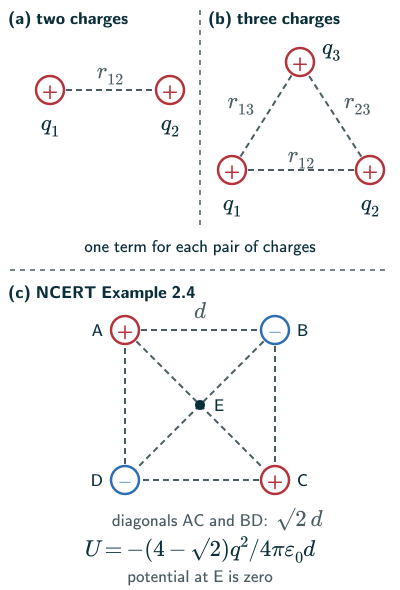
The potential energy of a system of charges is the work done in bringing them from infinity to their positions; for two charges it is U = qq/(4πεr). It is positive for like charges and negative for unlike charges, and for more charges there is one such term for each pair. Because the electrostatic force is conservative, U depends only on the final arrangement, not on the order in which the charges were brought in.
With your textbook
NCERT Physics Part I (Class 12), Chapter 2 “Electrostatic Potential and Capacitance”, Section 2.7 “Potential Energy of a System of Charges”, pages 55–58.
Open the official NCERT chapter (PDF, 3.9 MB, ncert.nic.in) (opens in a new tab)
Checked against the 2026-27 reprint on .
What is the potential energy of a system of charges?
Here assembly is quasistatic, so external work equals the change in potential energy. The formulas give mutual interaction energy, excluding the divergent self-energies of ideal point charges.
Potential energy of a system of charges
The potential energy of a system of charges is the work done by an external agency in bringing the charges from infinity, where they are far apart, to their positions. For two charges a distance r12 apart it is (NCERT Eq. (2.22), page 56):
Since electrostatic force is conservative, this work gets stored in the form of potential energy of the system.
NCERT Physics Part I (Class 12), Section 2.7, page 56
In plain words: assembling charges costs work if they repel and releases energy if they attract. That energy belongs to the arrangement as a whole, not to any one charge, and it depends only on where the charges end up, not on the order in which you placed them.
Two point charges
Build the system one charge at a time (NCERT pages 55–56):
- Bringing q1 from infinity to its place takes no work: there is no field yet to work against.
- q1 now produces a potential q1/(4πε0r) around it. Bringing q2 in takes q2 times that potential at its final place, which gives NCERT’s Eq. (2.22) above.
- Bringing q2 first and q1 second gives the same U. More generally U is the same whatever way the charges are brought in, because the work done by the electrostatic force does not depend on the path (page 56).
Sign of U (NCERT’s Eq. (2.22) holds for either sign, page 56):
- Like charges (q1q2 > 0): they repel, so positive work is needed to push them together: U > 0.
- Unlike charges (q1q2 < 0): they attract, so positive work is needed to pull them apart to infinity, and negative work to bring them in: U < 0.
Three or more charges
For three charges, add the work done at each step (NCERT Eqs. (2.23)–(2.26), page 56):
- Bring q1: no work.
- Bring q2: work q1q2/(4πε0r12).
- Bring q3 into the potential of q1 and q2: work (q1q3/r13 + q2q3/r23)/(4πε0).
Three charges (NCERT Eq. 2.26)
Here k = 1/4πε0, and U12, U13, U23 are the energies of the three pairs. Again the result does not depend on how the system is assembled: the potential energy is a property of the present arrangement, not of the way it was reached (pages 56–57). The pattern continues: for any number of point charges, U has one term kqiqj/rij for each pair (reasoned from NCERT’s Eq. (2.26)), so four charges give six terms.
Solved examples
Example 1: Four charges on a square (NCERT Example 2.4)
Charges +q, −q, +q, −q sit at the corners A, B, C, D of a square of side d. (a) Find the work needed to assemble them. (b) How much extra work is needed to bring a charge q0 to the centre E?
Answer: (a) count the pairs. The four sides join unlike charges a distance d apart, each giving −kq2/d. The two diagonals join like charges a distance √2 d apart, each giving +kq2/(√2 d). So
NCERT builds it charge by charge, A then B, C, D, and gets the same total; any order gives the same energy (pages 57–58). (b) None: at E the potentials of the charges at A and C cancel those at B and D, so the potential at E is zero and q0V = 0 (page 58).
Example 2: Energy of a pair
Charges of +2.0 µC and −3.0 µC are 30 cm apart. Find their potential energy, and the work needed to separate them completely.
Answer: kq1q2 = 9 × 10⁹ × (−6.0 × 10⁻¹²) = −5.4 × 10⁻² J m, so
To pull them apart to infinity, where U = 0, an external agency must supply +0.18 J (NCERT Eq. (2.22), page 56).
Example 3: Three equal charges
Three charges of 1.0 µC each sit at the corners of an equilateral triangle of side 10 cm. Find the potential energy of the system.
Answer: three equal pairs, each a distance 0.10 m apart:
with kq2 = 9 × 109 × 10−12 = 9.0 × 10⁻³ J m and a = 0.10 m:
(NCERT Eq. (2.26), page 56.)
Example 4: Pushing two charges closer
Two charges of +1.0 µC each are moved slowly from 20 cm apart to 10 cm apart. How much work is needed?
Answer: kq1q2 = 9 × 109 × 10−12 = 9.0 × 10⁻³ J m. The energy rises from 9.0 × 10⁻³/0.20 = 0.045 J to 9.0 × 10⁻³/0.10 = 0.090 J, so the work needed is the difference, 0.045 J (NCERT Eq. (2.22), page 56).
Common mistakes to avoid
Common mistake
Counting each pair twice
Each pair of charges gives one term; three charges have three pairs, four charges six (NCERT Eq. (2.26), page 56).
Common mistake
Dropping the signs of the charges
U for unlike charges is negative: it takes work to pull them apart (NCERT page 56).
Common mistake
Thinking the order of assembly matters
The potential energy depends only on the final arrangement, not on the order or paths used to build it (NCERT pages 56–57).
Quick revision summary
- Potential energy of a system: the work done by an external agency in bringing the charges from infinity to their places.
- Two charges: U = qq/(4πεr); positive for like charges, negative for unlike charges.
- Three charges: U = U + U + U, each pair giving U = kqq/r; in general one term for each pair.
- U depends only on the final arrangement, not on how it was assembled.
- NCERT Example 2.4: +q, −q, +q, −q on a square of side d have U = −(4 − √2)q/(4πεd).
Formula sheet
- U = qq/(4πεr)
- U = U + U + U, U = kqq/r
- n charges: one term per pair, n(n − 1)/2 terms
- like charges: U > 0; unlike charges: U < 0
- work to separate to infinity = −U
Questions students ask
How does the potential energy of two charges vary with distance?
The potential energy of two point charges varies as 1/r, U = q1q2/4πε0r (NCERT page 56): halving the distance doubles it, and it tends to zero as the charges move far apart, more slowly than the force between them, which falls as 1/r. Plotted against r, it is a positive curve for like charges, climbing steeply as they approach, and a negative curve for unlike charges, plunging as they approach, both levelling off towards zero at large r.
How is the potential energy of two charges related to the Coulomb force between them?
The Coulomb force between two charges is minus the rate of change of their potential energy with distance, F = −dU/dr, the link between a conservative force and its potential energy in NCERT Class 11 Physics, Chapter 5, page 78 (see force from potential energy): with U = kq1q2/r it gives F = kq1q2/r, Coulomb’s law, with F positive, a repulsion, for like charges. The force is a vector, in newtons, while the energy is a scalar, in joules: for 5.0 µC and 8.0 µC charges 0.60 m apart, with k = 9 × 10 N m C, U = 0.60 J and F = 1.0 N.
Is the potential energy of three or more charges in the JEE Main and NEET syllabus?
The potential energy of three or more charges needs nothing beyond what the JEE Main syllabus and the NEET (UG) 2026 syllabus name, though both name only two point charges: Unit 11, Electrostatics, of each lists “electrical potential energy of a system of two point charges and of electric dipole in an electrostatic field” (JEE Main wording). The energy of three charges is one two-charge term for each pair, the third charge being brought in against the potential of the first two (NCERT Eqs. (2.25)–(2.26), page 56). NCERT Class 12 Physics Part I, Section 2.7, works three charges and, in NCERT Example 2.4 (pages 57–58), four charges on a square, so practise them too.
Practice questions
Try each question first, then open the answer to check your working.
-
Q1. How many terms does the potential energy of five point charges have?
Show answerHide answer
One per pair: 5 × 4/2 = 10 (reasoned from NCERT Eq. (2.26), page 56).
-
Q2. Two electrons are 1.0 × 10⁻¹⁰ m apart. Find their potential energy in eV.
Show answerHide answer
U = ke2/r = 9 × 109 × 2.56 × 10−38/10−10 = 2.3 × 10⁻¹⁸ J ≈ 14 eV, positive since they repel (NCERT Eq. (2.22), page 56).
-
Q3. Is the potential energy of a proton and an electron positive or negative?
Show answerHide answer
Negative: the charges are unlike (NCERT page 56).