Potential energy in an external field
NCERT Class 12 Physics Chapter 2 Section 2.8
Quick answer
A charge q at a point where an external field has potential V(r) has potential energy U = qV(r); for two charges, add their mutual energy, U = qV(r) + qV(r) + qq/(4πεr). A dipole in a uniform field has U(θ) = −pE cos θ = −p·E, taken as zero at θ = 90°. Its energy is lowest when the dipole points along the field and highest when it points against it.
With your textbook
NCERT Physics Part I (Class 12), Chapter 2 “Electrostatic Potential and Capacitance”, Section 2.8 “Potential Energy in an External Field”, pages 58–61.
Open the official NCERT chapter (PDF, 3.9 MB, ncert.nic.in) (opens in a new tab)
Checked against the 2026-27 reprint on .
What is potential energy in an external field?
Potential energy in an external field
Here the field is given, produced by sources outside the charges we study, and we ask for the energy of those charges in it. NCERT marks the difference from the energy of a system of charges:
The main difference is that we are now concerned with the potential energy of a charge (or charges) in an external field.
NCERT Physics Part I (Class 12), Section 2.8, page 58
A charge q at a point where the external potential is V(r) has potential energy qV(r) (NCERT Eq. (2.27), page 59).
In plain words: the sources of the field are fixed somewhere and we don’t need to know what they are; all we need is the potential they produce. Put a charge into it and its energy is charge times potential. Put in two charges and add one more term for their energy with each other.
Potential energy of a single charge
- The external field E and potential V come from sources outside the charge; they may be unknown, and only E or V is given. The charge q is assumed not to disturb those sources: true if q is small, or if the sources are held fixed (NCERT page 58).
- With V = 0 at infinity when that reference is finite, V at P is the quasistatic external work per unit positive charge from infinity to P, so bringing q there takes qV, stored as potential energy (NCERT Section 2.8.1, pages 58–59):
Potential energy of a charge in an external field (NCERT Eq. 2.27)
For an ideal uniform field, use a finite zero of potential instead; ΔU = qΔV is unchanged. Here V(r) is the potential of the external sources only, not of q itself, which is not defined at q’s own position (NCERT Points to Ponder 5–6, page 78).
- Electron volt: an electron accelerated through a potential difference of 1 V gains 1.6 × 10⁻¹⁹ J, the energy unit 1 eV. Multiples: 1 keV = 103 eV = 1.6 × 10⁻¹⁶ J, 1 MeV = 106 eV, 1 GeV = 109 eV, 1 TeV = 1012 eV. These units are common in atomic, nuclear and particle physics (page 59).
Potential energy of a system of two charges in an external field
Bring q1 to r1: work q1V(r1). Then bring q2 to r2: now work is done against the external field, q2V(r2), and against the field of q1, q1q2/(4πε0r12) (NCERT Section 2.8.2, Eq. (2.28), page 59). Adding (NCERT Eq. (2.29)):
Two charges in an external field (NCERT Eq. 2.29)
Here V1 = V(r1) and V2 = V(r2). The first two terms are the charges’ energies in the external field; the last is their mutual energy, the potential energy of the pair on its own (NCERT Eq. (2.22), page 56).
Potential energy of a dipole in an external field
A rigid permanent dipole with fixed charges +q and −q and fixed separation in a uniform field feels no net force but a torque τ = p × E, which tends to turn it unless p is parallel or antiparallel to E (NCERT Eq. (2.30), page 60; see torque on a dipole).
- An external torque that just balances it, turning the dipole slowly from θ0 to θ1, does work W = pE(cos θ0 − cos θ1), stored as potential energy (NCERT Eq. (2.31), page 60).
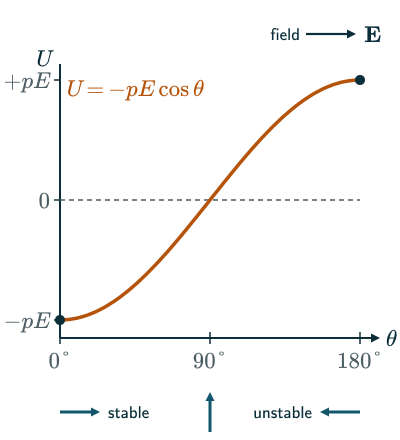
- Choosing U = 0 at θ0 = π/2 gives (NCERT Eq. (2.32), page 60):
Potential energy of a dipole (NCERT Eq. 2.32)
- Why π/2? NCERT also gets the energy from Eq. (2.29), treating the dipole as two charges: U′(θ) = −pE cos θ − q2/(4πε0 × 2a). The extra term, the energy of the two charges with each other, is a constant for a given dipole and can be dropped. At θ = π/2 the works done against the external field in bringing in +q and −q cancel, which is why that angle is the natural zero (NCERT Eqs. (2.33)–(2.34), page 61).
- U is lowest, −pE, when p is along E: an energy minimum, so a small twist brings a restoring torque that swings the dipole back towards this direction: this alignment is stable. It is highest, +pE, when p is against E: an energy maximum, so a small twist grows and this alignment is unstable (reasoned from NCERT Eq. (2.32)).
Solved examples
Example 1: A pair, then the same pair in a field (NCERT Example 2.5)
Charges of 7 µC and −2 µC sit at (−9 cm, 0, 0) and (9 cm, 0, 0). (a) Find their potential energy with no external field. (b) How much work separates them to infinity? (c) Find the energy if they are placed in an external field E = A/r2, with A = 9 × 10⁵ N C−1 m2.
Answer: (a) they are 0.18 m apart, and kq1q2 = 9 × 10⁹ × (−14 × 10−12) = −0.126 J m, so
(b) W = 0 − (−0.7) = 0.7 J (NCERT pages 59–60). (c) The mutual energy stays −0.7 J. NCERT gives the field only as E = A/r2. Read as a field pointing out from the origin, like a point charge’s, it has potential V = A/r, zero at infinity (reasoned from NCERT Eq. (2.8), page 48); this is the A/(0.09 m) NCERT uses. Both charges are 0.09 m from the origin, so each is at V = 9 × 10⁵/0.09 = 107 V, and the charges add q1V + q2V = 70 J − 20 J = 50 J. Total: 50 − 0.7 = 49.3 J (NCERT page 60).
Example 2: Heat from turning dipoles (NCERT Example 2.6)
A molecule has a permanent dipole moment of 10−29 C m. A mole of the substance, fully polarised, sits in a field of 106 V m−1, and the field’s direction is suddenly turned through 60°. Estimate the heat released as the dipoles realign.
Answer: total moment p = 6 × 1023 × 10−29 = 6 × 10⁻⁶ C m, so pE = 6 J. Aligned with the field, U = −pE cos 0° = −6 J. Just after the field turns, the dipoles are at 60° to it: U = −6 cos 60° = −3 J. As they realign, U falls back to −6 J, releasing 3 J as heat (NCERT page 61).
NCERT calls −6 J the initial and −3 J the final energy, writes the change as −3 J − (−6 J) = 3 J, and then calls it a loss. The 3 J is right, but that change is a rise, made when the field turns. The loss is the later fall from −3 J to −6 J as the dipoles realign: they swing about the new field, and damping turns this energy into heat (NCERT Points to Ponder 4, page 78).
Example 3: A dipole at three angles
A dipole of moment 2.0 × 10⁻⁸ C m is in a uniform field of 5.0 × 10⁴ V/m. Find its energy along the field, at 90°, and against the field, and the work needed to turn it from along to against the field.
Answer: pE = 2.0 × 10−8 × 5.0 × 104 = 1.0 × 10⁻³ J. So U = −1.0 × 10⁻³ J, 0 and +1.0 × 10⁻³ J. Turning it from 0° to 180° takes pE(cos 0° − cos 180°) = 2pE = 2.0 × 10⁻³ J (NCERT Eqs. (2.31)–(2.32), page 60).
Example 4: A proton’s energy
A proton is at a point where the external potential is 2.0 kV. Find its potential energy in joules and in eV.
Answer: U = qV = 1.6 × 10−19 × 2.0 × 103 = 3.2 × 10⁻¹⁶ J, which is 2.0 keV (NCERT Eq. (2.27), page 59).
Common mistakes to avoid
Common mistake
Forgetting the mutual energy of two charges
In an external field, two charges have qV for each and also qq/(4πεr) for each other (NCERT Eq. (2.29), page 59).
Common mistake
Taking the dipole’s lowest energy at 90°
U = −pE cos θ is zero at 90° and lowest, −pE, at 0°, where p is along E (NCERT Eq. (2.32), page 60).
Common mistake
Mixing up U = qV and U = qq/4πεr
qV is the energy of a charge in a given external potential; qq/(4πεr) is the energy two charges have with each other (NCERT pages 56 and 58–59).
Quick revision summary
- In an external field the sources are outside the charges studied; a charge q at potential V(r) has potential energy U = qV(r).
- 1 eV = 1.6 × 10 J; keV, MeV, GeV and TeV are 10, 10, 10 and 10 eV.
- Two charges: U = qV(r) + qV(r) + qq/(4πεr).
- Dipole: U(θ) = −pE cos θ = −p·E, zero at θ = 90°; external work to turn it from θ to θ is pE(cos θ − cos θ).
- The dipole’s energy is lowest along the field (stable) and highest against it (unstable).
Formula sheet
- U = qV(r)
- U = qV(r) + qV(r) + qq/(4πεr)
- U(θ) = −pE cos θ = −p·E
- W = pE(cos θ − cos θ)
- 1 eV = 1.6 × 10 J
Questions students ask
Why is the potential energy of a dipole negative?
The potential energy of a dipole in a uniform field, U = −pE cos θ, is negative for angles below 90° only because NCERT takes its zero at θ = 90° (NCERT page 60): a negative value means the dipole has less energy than when it lies across the field, so work must be done on it to turn it back to 90°. Only changes in U matter, so another zero changes nothing physical: with the zero at θ = 0 the energy would be pE(1 − cos θ), never negative, and the work to turn the dipole between any two angles, pE(cos θ0 − cos θ1), would be the same (NCERT Eq. (2.31), page 60). Between 90° and 180° the energy is positive.
How are the torque on a dipole and its potential energy related?
The torque on a dipole in a uniform field is minus the rate of change of its potential energy with angle, τ = −dU/dθ: with U = −pE cos θ this gives τ = −pE sin θ, a torque of size pE sin θ that turns the dipole towards E (beyond the NCERT text, reasoned from NCERT Eqs. (2.31)–(2.32), page 60; see torque on a dipole). So the torque is zero at 0° and 180°, where U is lowest and highest, and largest, pE, at 90°, where U is zero but changing fastest. That is why a dipole at 90° is not in equilibrium even though its energy there is zero.
Does U = −p·E hold for a dipole in a non-uniform field?
For a point dipole, U = −p·E holds in a non-uniform field too, with E taken at the dipole’s position, and for a real dipole it is close when the dipole is small compared with the distance over which the field changes (beyond the NCERT text, reasoned from NCERT Eq. (2.29), page 59; NCERT treats a uniform field, pages 60–61). The energy then depends on position as well as angle, and the dipole is pushed towards lower energy: lined up with the field, it is drawn towards stronger field (see the force on a dipole). In a uniform field U depends on the angle alone, so there is no net force.
Practice questions
Try each question first, then open the answer to check your working.
-
Q1. What is the potential energy of an electron at a point where the potential is 100 V?
Show answerHide answer
U = qV = −1.6 × 10−19 × 100 = −1.6 × 10⁻¹⁷ J, or −100 eV (NCERT Eq. (2.27), page 59).
-
Q2. At what angle to the field is the potential energy of a dipole zero?
Show answerHide answer
At 90° (NCERT Eq. (2.32), page 60).
-
Q3. How many joules is 1 GeV?
Show answerHide answer
1.6 × 10⁻¹⁰ J (NCERT page 59).