Potential due to an electric dipole
NCERT Class 12 Physics Chapter 2 Section 2.4
Quick answer
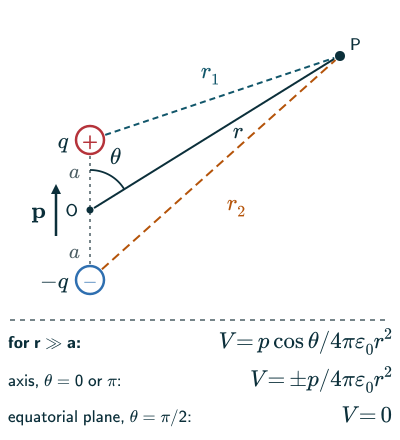
Far from a dipole (r ≫ a), its potential is V = p cos θ/(4πεr), found by adding the potentials of +q and −q, where θ is the angle between r and the dipole moment p. On the axis it is ±p/(4πεr), and on the equatorial plane it is zero. The dipole potential depends on direction as well as distance and falls as 1/r, faster than the 1/r potential of a single charge.
With your textbook
NCERT Physics Part I (Class 12), Chapter 2 “Electrostatic Potential and Capacitance”, Section 2.4 “Potential due to an Electric Dipole”, pages 49–51.
Open the official NCERT chapter (PDF, 3.9 MB, ncert.nic.in) (opens in a new tab)
Checked against the 2026-27 reprint on .
What is the potential of an electric dipole?
Potential due to an electric dipole
For a dipole of moment p at the origin, the potential at a point at distance r and angle θ from p, far from the dipole (r ≫ a), is (NCERT Eqs. (2.14)–(2.15), pages 50–51):
It is found by adding the potentials of the two charges, because potential obeys superposition:
Since potential is related to the work done by the field, electrostatic potential also follows the superposition principle.
NCERT Physics Part I (Class 12), Section 2.4, page 50
In plain words: far from a dipole, the positive and negative charges almost cancel each other’s potential. What is left depends on which side you are on: positive on the side of +q, negative on the side of −q, and exactly zero on the plane halfway between them.
Potential on the axis and on the equatorial plane
A dipole is a charge q and a charge −q a small distance 2a apart, with dipole moment of size p = q × 2a pointing from −q to q (NCERT page 49). With the origin at the centre, the potential at P, a distance r1 from q and r2 from −q, is the sum of the two point-charge potentials (NCERT Eq. (2.9), page 50):
- Geometry: r12 = r2 + a2 − 2ar cos θ and r22 = r2 + a2 + 2ar cos θ (NCERT Eq. (2.10)).
- Far away, r ≫ a: keep terms only to first order in a/r. The binomial theorem then gives 1/r1 ≈ (1/r)(1 + (a/r) cos θ) and 1/r2 ≈ (1/r)(1 − (a/r) cos θ) (NCERT Eqs. (2.11)–(2.13)).
- Subtracting, 1/r1 − 1/r2 ≈ 2a cos θ/r2, and with p = 2qa this gives the result above. Since p cos θ = p·r̂, NCERT writes it as p·r̂/(4πε0r2) (Eqs. (2.14)–(2.15), pages 50–51).
Dipole potential, r ≫ a (NCERT Eqs. 2.14–2.16)
- On the axis, θ = 0 (the side of +q) gives +p/(4πε0r2), and θ = π (the side of −q) gives the same with a minus sign (NCERT Eq. (2.16), page 51).
- On the equatorial plane, θ = π/2, the potential is zero (page 51).
- The formula is approximate, valid when r is large compared with the dipole; for a point dipole at the origin it is exact at r > 0 (page 51).
Potential falls as 1/r
NCERT contrasts the dipole with a single charge (page 51):
- The dipole potential depends not only on r but also on the angle between r and p. It is axially symmetric about p: turning r round p, keeping its length and θ fixed, carries P round a circle on a cone about p, and every point of that circle has the same potential as P.
- At large distances it falls off as 1/r2, not as 1/r like the potential of a single charge. (The dipole’s field falls as 1/r3, one power faster again: NCERT Section 1.10, page 25.)
- NCERT’s text refers to “Fig. 2.5” for graphs of 1/r2 and 1/r against r; those graphs are in Figure 2.4 (page 49), Figure 2.5 being the dipole diagram (page 50).
Solved examples
Example 1: On the axis and off it
A small dipole has p = 4.0 × 10⁻⁹ C m. Find the potential 20 cm from its centre (a) on its axis, on the side of +q, (b) at 60° to the axis, (c) on its equatorial plane.
Answer: with k = 9 × 10⁹ N m2 C−2, kp/r2 = 9 × 109 × 4.0 × 10−9/0.04 = 900 V. So (a) 900 V, (b) 900 × cos 60° = 450 V, (c) 0 (NCERT Eqs. (2.15)–(2.16), page 51).
Example 2: How good is the far-field formula?
Charges of ±2.0 nC are 2.0 cm apart. Find the potential on the axis, 10 cm from the centre on the side of +q, exactly and with the far-field formula.
Answer: exactly, P is 9 cm from +q and 11 cm from −q, and kq = 18 V m, so
With p = 2.0 × 10−9 × 0.020 = 4.0 × 10⁻¹¹ C m, the formula gives kp/r2 = 9 × 109 × 4.0 × 10−11/0.01 = 36 V, about 1% low, because r/a = 10 is not very large (NCERT Eqs. (2.9) and (2.16)).
In general, on the axis beyond +q (r > a), V = kq/(r − a) − kq/(r + a), which simplifies exactly to
This tends to kp/r2 when r ≫ a (reasoned from NCERT Eq. (2.9)).
Example 3: No work along the equator
How much work is needed to carry a charge from infinity to a point on the equatorial plane of a small dipole?
Answer: none. The potential on the equatorial plane is zero, the same as at infinity, so W = q(0 − 0) = 0 (NCERT page 51).
Example 4: Doubling the distance
The potential at a point on the axis of a small dipole is 80 V. What is it at twice the distance along the same line?
Answer: V ∝ 1/r2, so it falls to 80/4 = 20 V. For a single charge it would only halve (NCERT page 51).
Common mistakes to avoid
Common mistake
Using 1/r for the dipole potential
The dipole’s potential falls as 1/r; it is its field that falls as 1/r (NCERT page 51).
Common mistake
Taking zero potential to mean zero field
On the equatorial plane V = 0, but the field there is not zero: it points opposite to p (NCERT Section 1.10, page 24).
Common mistake
Measuring θ from the wrong direction
θ is the angle between r and p, which points from −q to +q; points on the side of +q have cos θ > 0 and positive potential (NCERT page 50).
Quick revision summary
- Potential obeys superposition, so a dipole’s potential is the sum of those of +q and −q.
- For r ≫ a: V = p cos θ/(4πεr) = p·r̂/(4πεr); exact for a point dipole.
- Far from a finite dipole, on the axis V = ±p/(4πεr); on the equatorial plane V = 0.
- The dipole potential depends on the angle as well as r, is symmetric about p, and falls as 1/r (a single charge’s falls as 1/r).
- Doubling the distance divides the dipole potential by 4.
Formula sheet
- V = (q/4πε)(1/r − 1/r)
- V = p cos θ/(4πεr), r ≫ a
- far-field axis: V = ±p/(4πεr)
- equatorial plane: V = 0
- dipole V ∝ 1/r, point charge V ∝ 1/r
Questions students ask
Is the potential due to a dipole the same as the potential energy of a dipole?
No, the potential due to a dipole and the potential energy of a dipole are different quantities: V = p cos θ/4πε0r is the far-field potential the dipole itself produces at a point a distance r away, in volts, with θ the angle between p and the line to that point (NCERT pages 50–51), while U = −pE cos θ is the energy of a dipole placed in a uniform external field E, in joules, with θ the angle between p and E (NCERT page 60; see potential energy of a dipole). The two meet when a charge q is placed near a dipole: its energy in the dipole’s field is qV.
How do you get a dipole’s electric field from its potential?
A dipole’s field follows from its potential because the field’s component in any direction is minus the rate at which V changes per metre in that direction (reasoned from NCERT page 55). Far along the positive axis V ≈ kp/r, with k = 1/4πε0, so −dV/dr = 2kp/r along p, the axial field NCERT finds from Coulomb’s law (NCERT Chapter 1, page 24). Beyond the NCERT text, the same rule taken along the radius and across it at any angle θ, far from the dipole, gives back the field (kp/r)√(1 + 3 cos θ) that the dipole’s field page finds from Coulomb’s law.
What is a short dipole, and when can its potential formula be used?
A short dipole is one whose length 2a is small compared with the distance r to the point; V = p cos θ/4πε0r is then a good approximation, and it is exact for a point dipole, the limit in which 2a shrinks to zero while p stays fixed (NCERT page 51; NCERT Chapter 1, page 25). On the positive axis beyond +q (r > a), the exact potential is kp/(r − a), with k = 1/4πε0, so the short-dipole value kp/r is low by a/r of the exact value: 4% at r = 5a, 0.25% at r = 20a (reasoned from NCERT Eq. (2.9), page 50). Far away only the product p = q × 2a matters, so ±2 nC charges 1 cm apart and ±1 nC charges 2 cm apart give the same distant potential.
Practice questions
Try each question first, then open the answer to check your working.
-
Q1. At what angle to the dipole moment is the potential of a small dipole zero?
Show answerHide answer
At θ = 90°, on the equatorial plane (NCERT page 51).
-
Q2. On the axis of a small dipole, how does the potential on the −q side compare with the potential on the +q side at the same distance?
Show answerHide answer
Same size, opposite sign: V = −p/(4πεr) against +p/(4πεr) (NCERT Eq. (2.16), page 51).
-
Q3. By what factor does the potential of a small dipole fall when the distance is tripled?
Show answerHide answer
By 9, since V ∝ 1/r (NCERT page 51).