Energy stored in a capacitor
NCERT Class 12 Physics Chapter 2 Section 2.15
Quick answer
A linear capacitor of fixed capacitance stores U = Q/(2C) = ½CV = ½QV, equal to the reversible work of charging. The electric energy density in vacuum is u = ½εE. When an isolated charged capacitor shares charge with an identical uncharged one and settles to equilibrium, half the initial stored energy becomes heat and radiation.
With your textbook
NCERT Physics Part I (Class 12), Chapter 2 “Electrostatic Potential and Capacitance”, Section 2.15 “Energy Stored in a Capacitor”, pages 73–76.
Open the official NCERT chapter (PDF, 3.9 MB, ncert.nic.in) (opens in a new tab)
Checked against the 2026-27 reprint on .
How does a capacitor store energy?
Energy stored in a capacitor
Charging a capacitor means moving charge from one conductor to the other against the field between them. That takes work, W = Q2/2C = ½CV2 = ½QV (NCERT Eq. (2.69), page 74), and the work is not lost:
Since electrostatic force is conservative, this work is stored in the form of potential energy of the system.
NCERT Physics Part I (Class 12), Section 2.15, page 74
When the capacitor discharges, this energy is released (page 74).
In plain words: the first bit of charge is easy to move, because the capacitor is still uncharged. Each later bit has to be pushed against the charge already there, so it costs more. The voltage rises steadily from 0 to V as the charge goes in, so on average each coulomb costs V/2, and the total is ½QV.
Energy as work done in charging
These formulas assume fixed geometry and a linear dielectric, so capacitance is constant. The integral gives reversible charging work stored in the capacitor; a real charging source may supply additional energy dissipated in the circuit.
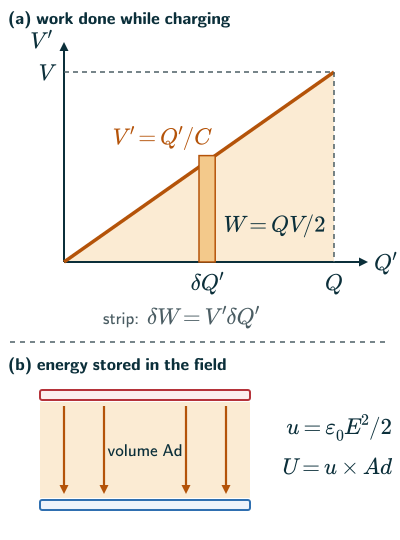
- Start with two uncharged conductors and move positive charge from conductor 2 to conductor 1 bit by bit until conductor 1 has Q; by conservation of charge conductor 2 then has −Q. External work is needed at every stage, since conductor 1 is always at the higher potential (NCERT pages 73–74).
- At an intermediate stage, with charges Q′ and −Q′, the potential difference is V′ = Q′/C. Moving a further small charge δQ′ takes work (NCERT Eq. (2.68), page 74):
- Adding up these steps from 0 to Q (integrating) gives W = Q2/2C. Using Q = CV, the result can be written three ways (NCERT Eq. (2.69), page 74):
Energy stored in a capacitor (NCERT Eq. 2.69)
- Because the electrostatic force is conservative, the stored energy does not depend on how the charge was built up (page 74).
- On a graph of V′ against Q′ the line is straight, so the work is the area of the triangle under it: ½ × Q × V (reasoned from NCERT Eq. (2.68)).
Energy density of the electric field
NCERT shows that the energy can be thought of as stored in the field between the plates, using a parallel plate capacitor with plates of area A, a distance d apart (NCERT page 74):
- The energy is ½Q2/C. With Q = Aσ and C = ε0A/d, this is (Aσ)2/2 × d/(ε0A) (NCERT Eq. (2.70), page 74).
- With E = σ/ε0 (NCERT Eq. (2.71)), the energy becomes U = ½ε0E2 × Ad (NCERT Eq. (2.72), page 74).
- Ad is the volume between the plates, the field-filled region in the ideal model that neglects fringing. So the energy per unit volume, the energy density, is (NCERT Eq. (2.73), page 75):
Energy density of an electric field (NCERT Eq. 2.73)
- NCERT derived this for a parallel plate capacitor, but it is very general: in vacuum it holds for the electrostatic field of any arrangement of charges (page 75).
- With a linear isotropic dielectric of constant K filling the gap, C = ε0KA/d and σ = ε0KE, and the same steps give u = ½ε0KE2 (reasoned from NCERT Eqs. (2.49)–(2.51) and (2.69)). For vacuum, K = 1.
Solved examples
Example 1: Charge, energy, then sharing (NCERT Example 2.10)
(a) A 900 pF capacitor is charged by a 100 V battery. How much energy does it store? (b) It is disconnected and joined to another uncharged 900 pF capacitor. What is the energy of the system now?
Answer: (a) Q = CV = 900 × 10−12 × 100 = 9 × 10⁻⁸ C, and U = ½QV = ½ × 9 × 10−8 × 100 = 4.5 × 10⁻⁶ J.
(b) The two capacitors end at the same potential difference V′. Each carries Q′ = CV′, and charge conservation gives Q′ = Q/2, so V′ = V/2. The total energy is 2 × ½Q′V′ = QV/4 = 2.25 × 10⁻⁶ J, half of the original. The rest was lost as heat and electromagnetic radiation while charge flowed between them (NCERT pages 75–76).
Example 2: Energy in a small capacitor (NCERT Exercise 2.10)
A 12 pF capacitor is connected to a 50 V battery. How much electrostatic energy is stored in it?
Answer: U = ½CV2 = ½ × 12 × 10−12 × 502 = 1.5 × 10⁻⁸ J (NCERT Eq. (2.69), page 74).
Example 3: Energy lost in sharing (NCERT Exercise 2.11)
A 600 pF capacitor is charged by a 200 V supply, disconnected, and connected to another uncharged 600 pF capacitor. How much energy is lost?
Answer: at first U = ½ × 600 × 10−12 × 2002 = 1.2 × 10⁻⁵ J. Afterwards each capacitor is at 100 V, so the total is 2 × ½ × 600 × 10−12 × 1002 = 6 × 10⁻⁶ J. The energy lost is 6 × 10⁻⁶ J, half the original, as in NCERT Example 2.10 (pages 75–76).
Example 4: Energy density between the plates
The vacuum field between the large plates of a capacitor, neglecting fringing, is 2.0 × 10⁵ V/m. Find the energy density, and the energy stored between plates of area 0.010 m2 that are 1.0 mm apart.
Answer: u = ½ε0E2 = ½ × 8.854 × 10−12 × (2.0 × 105)2 ≈ 0.18 J m−3. The volume is 0.010 × 1.0 × 10−3 = 1.0 × 10⁻⁵ m3, so U ≈ 1.8 × 10⁻⁶ J (NCERT Eqs. (2.72)–(2.73), pages 74–75).
Common mistakes to avoid
Common mistake
Writing the energy as QV
The voltage rises from 0 to V while the charge goes in, so the energy is ½QV, not QV (NCERT Eq. (2.69), page 74).
Common mistake
Expecting the stored energy to stay the same when capacitors share charge
Charge is conserved, but the stored energy is not: part of it turns into heat and electromagnetic radiation during the transient current (NCERT page 76).
Common mistake
Picking the wrong form of the energy formula
With Q fixed use Q/(2C); with V fixed use ½CV. For example, with Q fixed, doubling C halves the energy. With a dielectric slid in, U falls to U/K if the battery was removed first, but rises to KU if the battery stays connected, since V is fixed and C becomes KC (reasoned from NCERT Eqs. (2.54) and (2.69)).
Quick revision summary
- Charging takes work because each bit of charge is moved against the charge already there: δW = V′δQ′ = (Q′/C)δQ′.
- The stored energy is U = Q/(2C) = ½CV = ½QV, the triangle under the V′–Q′ line; it does not depend on how the charge was built up.
- The energy can be seen as stored in the field, with energy density u = ½εE in vacuum for any field; in a dielectric it is ½εKE.
- Joining a charged capacitor to an identical uncharged one keeps the charge but halves the energy; the rest goes as heat and electromagnetic radiation.
- In general the energy lost on joining is CC(V − V)/[2(C + C)].
Formula sheet
- U = Q/(2C) = ½CV = ½QV
- δW = V′δQ′ = (Q′/C)δQ′
- u = ½εE
- parallel plates: U = ½εE × Ad
- loss on joining: CC(V − V)/[2(C + C)]
Questions students ask
Is the energy of a charged capacitor stored in its charges or in its electric field?
The energy of a charged capacitor can be described either way, because in electrostatics the two give the same total: NCERT finds it as the potential energy of the separated charges, Q/2C, and then shows that this equals ½ε0E for each unit volume of the field between the plates (NCERT pages 74–75). No measurement on static charges can tell the two pictures apart. The field picture is the one that keeps working when fields change: electromagnetic waves carry energy from one place to another through empty space, as light carries it from the Sun to the Earth (reasoned from NCERT Chapter 8, page 207).
What are the SI unit and dimensional formula of energy density, and why is it the same as pressure?
The energy density of an electric field, u = ½ε0E, is measured in J m and has the dimensional formula [M L T], energy [M L T] per volume [L] (NCERT page 75; see dimensional formulae). Since 1 J m = 1 N m, this is also the unit of pressure, and the match has a meaning: beyond the NCERT text, the field pulls outward on each square metre of a charged conductor’s surface with a force σ/2ε0, exactly ½ε0E for the field E = σ/ε0 just outside (reasoned from NCERT page 63). This pull draws a capacitor’s plates together.
Why does the energy of an isolated charged capacitor increase when its plates are pulled apart?
The energy of an isolated charged capacitor rises when its plates are pulled apart because work must be done against their attraction, and that work is stored: Q stays fixed, so U = Q/2C grows as C = ε0A/d falls (reasoned from NCERT pages 69 and 74). The field σ/ε0 between the plates, and so the energy density, does not change; the extra energy is the same field filling a larger volume. For plates of area 0.025 m carrying ±1.0 × 10 C, pulling them 2.0 mm further apart takes about 4.5 × 10 J. With a battery connected, V stays fixed instead and U = ½CV falls.
Is energy stored in a capacitor deleted from NCERT or the JEE and NEET syllabus?
No, energy stored in a capacitor has not been deleted: it is NCERT Class 12 Physics Part I, Section 2.15 (pages 73–76 of the 2026–27 reprint), with NCERT Example 2.10 on sharing charge between two capacitors. The JEE Main syllabus ends Unit 11, Electrostatics, with “energy stored in a capacitor”, and the NEET (UG) 2026 syllabus ends its Unit 11 with “Energy stored in a capacitor.” The energy density ½ε0E is part of the same NCERT section (page 75), though neither syllabus names it.
What is the difference between the energy stored in a capacitor and in an inductor?
A capacitor stores energy in the electric field between its plates, ½CV, while an inductor stores energy in the magnetic field of its current, ½LI (NCERT Chapter 6, Eq. (6.17), page 169). NCERT compares the two in its Example 6.9: per unit volume the energy is ½ε0E in an electric field and B/2μ0 in a magnetic field, both proportional to the square of the field and valid in vacuum wherever such a field exists (NCERT Chapter 6, pages 169–170). An isolated charged capacitor keeps its energy as long as its charge stays, whereas an inductor holds energy only while the current flows.
Practice questions
Try each question first, then open the answer to check your working.
-
Q1. A 4.0 µF capacitor holds 200 µC. Find the energy stored.
Show answerHide answer
U = Q/(2C) = (200 × 10−6)2/(2 × 4.0 × 10−6) = 5.0 × 10⁻³ J (NCERT Eq. (2.69), page 74).
-
Q2. By what factor does the energy change if the potential difference is doubled while the capacitance stays fixed?
Show answerHide answer
It becomes four times as large, since U = ½CV (NCERT Eq. (2.69), page 74).
-
Q3. Where, according to NCERT, can the energy of a charged capacitor be thought to reside?
Show answerHide answer
In the electric field between the plates, with energy density ½ε0E2 (NCERT pages 74–75).