Electric current
NCERT Class 12 Physics Chapter 3 Sections 3.1–3.2
Quick answer
Electric current is the rate at which net charge flows across an area: for a steady current I = q/t, where q = q − q is the net charge carried forward. For a current that changes, the current at an instant is I(t) = lim ΔQ/Δt = dQ/dt. The SI unit is the ampere, 1 A = 1 C s, about 6.24 × 10 electrons a second.
With your textbook
NCERT Physics Part I (Class 12), Chapter 3 “Current Electricity”, Sections 3.1–3.2 “Introduction” and “Electric Current”, pages 81–82.
Open the official NCERT chapter (PDF, 2.2 MB, ncert.nic.in) (opens in a new tab)
Checked against the 2026-27 reprint on .
What is electric current?
Electric current
In electrostatics the macroscopic charge distribution is at rest; microscopic thermal motion can continue. Once they move, there is a current:
Charges in motion constitute an electric current.
NCERT Physics Part I (Class 12), Section 3.1, page 81
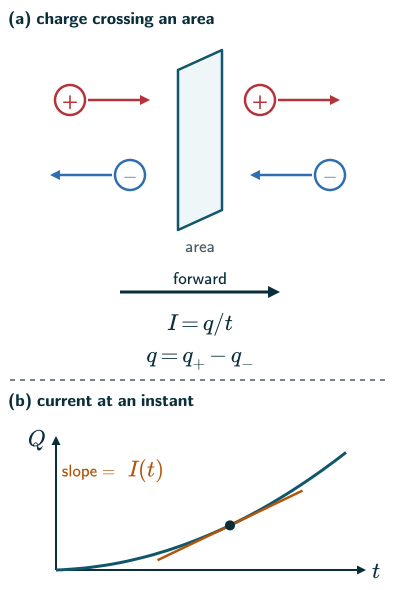
The current across an area is the net charge that crosses it per unit time: I = q/t for a steady current (NCERT Eq. (3.1), page 82). Its SI unit is the ampere (A), one coulomb per second.
In plain words: stand at one cross-section of a wire and count the charge going past. If 1 coulomb goes by every second, the current is 1 ampere. What matters is the net flow: charge going one way counts, charge going the other way counts against it.
Current as the rate of flow of charge
- Lightning is a brief flow of charge within clouds, between clouds or between cloud and earth, but it is not steady. A torch or a cell-driven clock has charge flowing steadily, like water in a river; this chapter deals with steady currents (NCERT page 81).
- Take a small area held normal to the flow. In a time t, let q+ be the net amount of positive charge (forward minus backward) that crosses it in the forward direction, and q− the net amount of negative charge that crosses forward, each measured using the magnitude of its species’ charge, with forward crossings minus backward crossings. Thus either net amount can be negative. The net charge carried forward is q = q+ − q−, which is proportional to t for a steady current (NCERT pages 81–82).
- So negative charge moving backward adds to the forward current, just as positive charge moving forward does (reasoned from q = q+ − q−).
Steady current (NCERT Eq. 3.1)
- If I comes out negative, the current is in the backward direction (page 82).
- Current is a scalar. It is drawn with an arrow, but currents do not obey the law of vector addition; the vector is the current density j (NCERT Points to Ponder 1, page 104).
- Changing currents: if ΔQ is the net charge that crosses a cross-section between t and t + Δt, the current at time t is the limit of ΔQ/Δt as Δt tends to zero (NCERT Eq. (3.2), page 82):
Current at an instant (NCERT Eq. 3.2)
- That is, I = dQ/dt, the slope of the graph of charge passed against time (reasoned from NCERT Eq. (3.2)).
- The other way round, the charge that passes in a time interval is the area under the graph of I against t; for a steady current it is just It (reasoned from NCERT Eq. (3.2)).
Unit: the ampere
- The SI unit of current is the ampere: 1 A = 1 C s−1 (NCERT page 82).
- Sizes: domestic appliances draw currents of the order of an ampere; an average lightning stroke carries tens of thousands of amperes; the currents in our nerves are microamperes (page 82).
- How the ampere is defined: NCERT says the ampere is defined through the magnetic effects of currents (page 82), and NCERT Section 4.8 (page 124) gives that 1946 definition. The revised SI was adopted in November 2018 and took effect on 20 May 2019 (NIST SP 330) (NCERT Physics Part I (Class 11), page 1), and the ampere is now defined by fixing the elementary charge at exactly e = 1.602 176 634 × 10−19 C (NCERT Class 11 Table 1.1, page 2, where the minus sign of the power is misprinted; see SI base units).
- So 1 A is a flow of 1/e ≈ 6.24 × 10¹⁸ elementary charges a second (reasoned from that definition and the quantisation of charge).
Solved examples
Example 1: Current from charge and time
A steady 2.0 C of charge passes a cross-section of a wire in 4.0 s. Find the current.
Answer: I = q/t = 2.0/4.0 = 0.50 A (NCERT Eq. (3.1), page 82).
Example 2: Electrons per second
How many electrons pass a cross-section each second in a wire carrying 1.0 A?
Answer: each electron carries 1.6 × 10⁻¹⁹ C, so the number per second is n = I/e = 1.0/(1.6 × 10−19) ≈ 6.25 × 10¹⁸ (NCERT Eq. (3.1), page 82, with q = ne). With the exact e it is 6.24 × 10¹⁸.
Example 3: Ions moving both ways
In an electrolyte, 3.0 C of positive ions cross an area in the forward direction in 2.0 s, while 1.0 C of negative ions cross it backward. Find the current.
Answer: the net amount of positive charge carried forward is q+ = 3.0 C. The negative ions carry 1.0 C backward, so the net amount of negative charge carried forward is q− = −1.0 C. So q = q+ − q− = 3.0 − (−1.0) = 4.0 C, and I = 4.0/2.0 = 2.0 A, forward (NCERT Eq. (3.1), pages 81–82). Both kinds of ion add to the current.
Example 4: A current that changes
The charge that has passed a cross-section is Q = 2t2 coulomb, with t in seconds. Find the current at t = 3.0 s.
Answer: I = dQ/dt = 4t, so at 3.0 s, I = 12 A (NCERT Eq. (3.2), page 82). The average current over the first 3.0 s is only 18/3.0 = 6.0 A.
Common mistakes to avoid
Common mistake
Taking the electron flow as the current direction
Current is reckoned by the net charge carried forward, q = q − q, so electrons moving one way make a current the other way (NCERT Eq. (3.1), page 82).
Common mistake
Using I = q/t for a changing current
For a changing current, q/t gives only the average; the current at an instant is the limit of ΔQ/Δt (NCERT Eq. (3.2), page 82).
Common mistake
Thinking the magnetic definition is still the SI one
Since the 2018 revision the ampere is fixed by the exact value of e (NCERT Class 11 Table 1.1, page 2). The 1946 statement in NCERT Section 4.8 (page 124), a force of 2 × 10 N per metre between wires 1 m apart, still holds very closely, but it is now a measured result, not the definition.
Quick revision summary
- Charges in motion make an electric current; this chapter deals with steady currents.
- The net charge carried forward across an area is q = q − q, and the steady current is I = q/t.
- For a changing current, I(t) = lim ΔQ/Δt = dQ/dt, the slope of the Q–t graph.
- The SI unit is the ampere, 1 A = 1 C s; it is now defined by fixing e = 1.602 176 634 × 10 C.
- Currents range from microamperes in nerves to about an ampere in appliances and tens of thousands of amperes in lightning.
Formula sheet
- I = q/t (steady current)
- q = q − q
- I(t) = lim ΔQ/Δt = dQ/dt
- 1 A = 1 C s
- electrons per second: n = I/e
Questions students ask
Is electric current a scalar or a vector?
Electric current is a scalar, even though it is drawn with an arrow: currents add as signed numbers, not by the law of vector addition (NCERT Points to Ponder 1, page 104). If 3.0 A and 4.0 A flow into a junction along wires at right angles, 7.0 A flows out of it, not the 5.0 A a vector sum would give, and bending or turning the wires changes nothing (reasoned from NCERT Points to Ponder 6, page 105). The arrow gives the positive conventional-current direction, opposite to a net electron drift; the vector is the current density j, and for uniform j over a flat area the current is the scalar product I = j·ΔS; in general one integrates j·dS over the surface (see current density).
Why is electric current, and not charge, an SI base quantity?
Electric current is an SI base quantity by choice, not because it is more basic than charge: beyond the NCERT text, Giorgi showed in 1901 that one electrical unit added to the metre, kilogram and second gives a coherent system, and in 1954 electric current was made a base quantity (NIST Special Publication 330, 2019, Appendix 4). The ampere was defined by the measurable force between current-carrying wires, and the coulomb followed as 1 C = 1 A s (NCERT Chapter 1, page 41). Since 2019 the ampere is fixed by the exact value of e, but the SI keeps its base quantities for convenience (NIST SP 330, Section 2.3; see SI base units).
Why is conventional current taken opposite to the flow of electrons?
Conventional current is taken in the direction a positive charge would move because the signs of charge were chosen long before the electron was known: Benjamin Franklin named the two kinds of charge positive and negative (NCERT Chapter 1, page 2), while J. J. Thomson measured the electron’s charge-to-mass ratio only in 1897 (NCERT Chemistry Part I (Class 11), Unit 2, page 31). The choice changes no result, since negative charge moving one way carries the same current as positive charge moving the other way (NCERT pages 81–82). It also suits conductors in which both signs move, such as electrolytes and ionised gases (NCERT page 88).
What is the difference between electric current and voltage?
Electric current is the rate at which charge flows through a cross-section, in amperes, while voltage is the potential difference between two points, the work done per unit charge in moving a charge between them, in volts (NCERT page 82; NCERT Chapter 2, page 47). So a current is measured at one place, with an ammeter in series, and a voltage between two points, with a voltmeter across them. A voltage can exist with no current, as across a cell in open circuit, but a steady current through a resistor needs a potential difference, V = RI (NCERT Eq. (3.3), page 83; see potential difference).
What current does an electron going round in a circle produce?
A charge q going round a circle f times a second makes a time-averaged current of magnitude |I| = |q|f = |q|v/(2πr), because it carries the charge q past any point of its path once every turn (reasoned from NCERT Eq. (3.1), page 82). So an electron making 1.0 × 10 turns a second is a current of 1.6 × 10 × 1.0 × 10 ≈ 1.6 × 10 A, about 0.16 mA. The current points opposite to the electron’s motion, and the circling charge acts as a current loop with a magnetic moment (see magnetic moment of a current loop).
Practice questions
Try each question first, then open the answer to check your working.
-
Q1. A current of 0.25 A flows for 2.0 minutes. How much charge passes?
Show answerHide answer
q = It = 0.25 × 120 = 30 C (NCERT Eq. (3.1), page 82).
-
Q2. About how many electrons pass a cross-section in one second when the current is 3.2 mA?
Show answerHide answer
n = I/e = 3.2 × 10⁻³/(1.6 × 10−19) = 2.0 × 10¹⁶ (NCERT Eq. (3.1), page 82).
-
Q3. What does a negative value of I mean?
Show answerHide answer
That the current is in the backward direction (NCERT page 82).