Resistivity of various materials
NCERT Class 12 Physics Chapter 3 Section 3.7
Quick answer
NCERT illustrates typical resistivity ranges: metals about 10 to 10 Ω m, insulators much higher and semiconductors between; these are not universal classification boundaries. In the intrinsic thermal-generation regime, a semiconductor’s resistivity falls as temperature rises. Suitable doping can lower its resistivity by increasing the carrier density.
With your textbook
NCERT Physics Part I (Class 12), Chapter 3 “Current Electricity”, Section 3.7 “Resistivity of Various Materials”, pages 89–90.
Open the official NCERT chapter (PDF, 2.2 MB, ncert.nic.in) (opens in a new tab)
Checked against the 2026-27 reprint on .
How are materials classed by resistivity?
Resistivity of various materials
Resistivity ρ is a property of the material (it also depends on temperature and pressure), not of the sample’s size (NCERT Summary point 4, page 103), so it can be used to sort materials:
The materials are classified as conductors, semiconductors and insulators depending on their resistivities, in an increasing order of their values.
NCERT Physics Part I (Class 12), Section 3.7, page 89
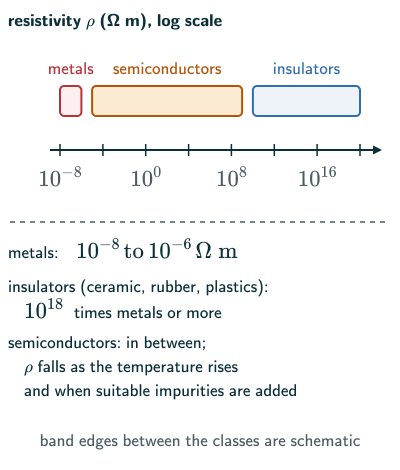
Metals have resistivities of 10−8 to 10−6 Ω m; insulators have resistivities 1018 times greater or more; semiconductors lie in between (NCERT page 90).
In plain words: line up materials by how strongly they resist current. Metals sit at the bottom of an enormous range, insulators at the top, at least eighteen powers of ten higher. Semiconductors sit in the middle, and their resistivity can be changed on purpose, which is why electronics is built from them.
Conductors, semiconductors and insulators
These NCERT ranges illustrate typical behaviour; they are not universal classification boundaries. Resistivity alone cannot identify a material as a semiconductor. The decreasing-temperature trend below applies to intrinsic semiconductors where thermal carrier generation dominates; doped semiconductors can behave differently.
- Conductors (metals): low resistivities, in the range 10−8 Ω m to 10−6 Ω m (NCERT page 90).
- Insulators: materials such as ceramic, rubber and plastics, with resistivities 1018 times those of metals or more (page 90). Applied to the metals’ range, that puts insulators at about 1010 to 1012 Ω m and above (reasoned from NCERT’s figures). NCERT’s chapter summary gives a larger factor for glass and rubber, 1022 to 1024 times (NCERT Summary point 5, page 103), so 1010 Ω m is a rough lower edge, not a sharp boundary.
- Semiconductors: in between. Unlike metals, their resistivity decreases as the temperature rises (page 90).
- The resistivity of a semiconductor can also be lowered by adding small amounts of suitable impurities. This feature is what makes semiconductors useful in electronic devices (page 90).
- The classes match the ideas of conductors and insulators from electrostatics: the lower the resistivity, the more freely charge moves through the material.
Solved examples
Example 1: Sorting by resistivity
Three materials have resistivities 2 × 10⁻⁷ Ω m, 0.5 Ω m and 1014 Ω m. Classify them.
Answer: 2 × 10⁻⁷ Ω m lies in the metals’ range (10−8 to 10−6 Ω m): a conductor. 1014 Ω m is above 1018 times the metals’ range (1010 to 1012 Ω m): an insulator. 0.5 Ω m lies in between: consistent with the semiconductor range in NCERT’s illustrative classification, but the number alone is not proof of semiconductor conduction (NCERT page 90).
Example 2: Two cubes
Find the resistance between opposite faces of a 1.0 cm cube (a) of a metal with ρ = 1.0 × 10⁻⁷ Ω m, (b) of an insulator with ρ = 1.0 × 10¹² Ω m.
Answer: for a cube of side L, R = ρL/L2 = ρ/L, with L = 0.010 m. (a) R = 1.0 × 10⁻⁷/0.010 = 1.0 × 10⁻⁵ Ω. (b) R = 1.0 × 10¹²/0.010 = 1.0 × 10¹⁴ Ω (NCERT Eq. (3.9), page 84).
Example 3: The same voltage, different materials
Two wires of the same size, one of resistivity 1.0 × 10⁻⁸ Ω m and the other 1.0 × 10⁻⁶ Ω m, each have 1.0 V across them. Compare the currents.
Answer: R = ρl/A is 100 times larger for the second wire, so its current is 100 times smaller (NCERT Eqs. (3.3) and (3.9), pages 83–84). Both are metals, at the two ends of NCERT’s range.
Example 4: Heating a semiconductor
A metal wire and a semiconductor sample are both warmed. How does each one’s resistivity change?
Answer: the semiconductor’s resistivity decreases with the rise in temperature (NCERT page 90). A metal’s resistivity increases: its temperature coefficient is positive (NCERT Section 3.8, page 90).
Common mistakes to avoid
Common mistake
Thinking all resistivities rise with temperature
That is true of metals; a semiconductor’s resistivity characteristically falls as the temperature rises (NCERT page 90).
Common mistake
Classifying by resistance instead of resistivity
A long thin metal wire can have a large resistance and still be a conductor; the classes are set by resistivity, which does not depend on size (NCERT pages 84 and 89).
Common mistake
Thinking impurities always raise resistivity
Adding small amounts of suitable impurities lowers a semiconductor’s resistivity; this is how semiconductors are used in devices (NCERT page 90).
Quick revision summary
- Materials are classed by resistivity, in increasing order: conductors, semiconductors, insulators.
- Metals: 10 to 10 Ω m.
- Insulators (ceramic, rubber, plastics): 10 times metals or more.
- Semiconductors: in between; their resistivity falls as the temperature rises.
- Adding small amounts of suitable impurities lowers a semiconductor’s resistivity, which is used in electronic devices.
Formula sheet
- metals: ρ ≈ 10 to 10 Ω m
- insulators: ρ ≥ 10 × metals
- semiconductors: in between
- semiconductors: ρ falls as T rises
- cube of side L: R = ρ/L
Questions students ask
Which metal has the lowest resistivity, and why is copper used for wiring?
Silver has the lowest resistivity of the common metals, 1.60 × 10 Ω m at 20 °C, just below copper at 1.62 × 10 Ω m and well below aluminium at 2.63 × 10 Ω m (NCERT Science Class 10, Chapter 11, Table 11.2). Copper is used for most wiring because it conducts almost as well as silver and is a practical conductor for ordinary wiring; a near-minimum resistivity is useful without requiring silver. NCERT notes that copper and aluminium are the usual metals for electricity transmission lines, and that tungsten, at 5.20 × 10 Ω m, is used for lamp filaments for its high melting point (NCERT Science Class 10, Chapter 11).
What is the resistivity of nichrome, and why is it used in heaters?
Nichrome’s resistivity depends on its grade. Kanthal’s Nikrothal 80 datasheet (updated 2024) gives 1.09 Ω mm/m at 20 °C, or 1.09 × 10 Ω m, about 67 times the copper value in NCERT Science Class 10 Table 11.2. The table’s printed nichrome value, 100 × 10 Ω m, is inconsistent with this standard NiCr grade; use the value specified in a problem or a grade-specific datasheet. Its high resistivity permits a useful heater resistance in a modest wire length; its oxidation resistance and modest temperature variation also suit heating elements (Kanthal, Nikrothal 80 datasheet; see nichrome).
Why do metals, semiconductors and insulators differ so much in resistivity?
The enormous spread in resistivity, a factor of 10 or more between metals and insulators (NCERT page 90), comes mainly from the number density n of free charge carriers in ρ = m/(neτ) (NCERT Eq. (3.27), page 91), not from the time between collisions. A metal has of the order of 10 free electrons per cubic metre (NCERT Example 3.2, page 88), while in an insulator a band gap of more than about 3 eV keeps practically all the electrons bound, and in a semiconductor a smaller gap lets only a few cross at room temperature (NCERT Class 12 Physics Part II, Chapter 14, Section 14.2).
Practice questions
Try each question first, then open the answer to check your working.
-
Q1. Name three insulators NCERT mentions.
Show answerHide answer
Ceramic, rubber and plastics (NCERT page 90).
-
Q2. What range of resistivity do metals have?
Show answerHide answer
10−8 Ω m to 10−6 Ω m (NCERT page 90).
-
Q3. Which feature of semiconductors is used in electronic devices?
Show answerHide answer
Their resistivity can be lowered by adding small amounts of suitable impurities (NCERT page 90).