Wheatstone bridge
NCERT Class 12 Physics Chapter 3 Section 3.13
Quick answer
A Wheatstone bridge is four resistors in a diamond ABCD, with a cell across A and C and a galvanometer across B and D. It is balanced, with no current through the galvanometer, when R2/R1 = R4/R3; then B and D are at the same potential. Varying a known resistance until the galvanometer shows null deflection gives an unknown one, R4 = R3 R2/R1.
With your textbook
NCERT Physics Part I (Class 12), Chapter 3 “Current Electricity”, Section 3.13 “Wheatstone Bridge”, pages 100–102.
Open the official NCERT chapter (PDF, 2.2 MB, ncert.nic.in) (opens in a new tab)
Checked against the 2026-27 reprint on .
What is a Wheatstone bridge?
Wheatstone bridge
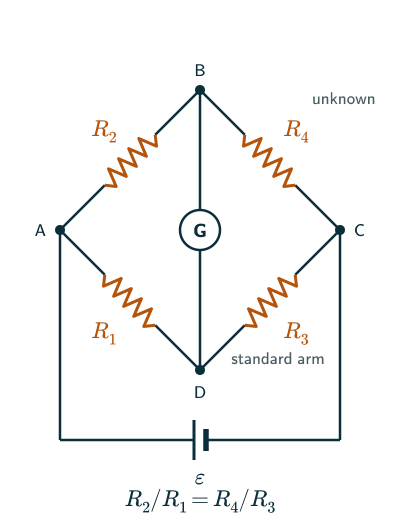
Four resistors R1, R2, R3, R4 form a closed diamond ABCD. A cell is connected across one pair of opposite corners, A and C (the battery arm), and a galvanometer G across the other pair, B and D (the galvanometer arm) (NCERT Section 3.13, page 100; Figure 3.18, page 101). When no current flows through G, the bridge is balanced, and R2/R1 = R4/R3 (NCERT Eq. 3.64(a), page 101):
This last equation relating the four resistors is called the balance condition for the galvanometer to give zero or null deflection.
NCERT Physics Part I (Class 12), Section 3.13, page 101
In plain words: the bridge has two routes from A to C, one through B and one through D. If both routes divide the voltage in the same ratio, then B and D sit at the same potential, and no current wants to cross between them. Finding that balance lets you measure an unknown resistance by comparison.
Balance condition
NCERT takes R2 in AB, R4 in BC, R1 in AD and R3 in DC. The currents are I2 from A to B, I4 from B to C, I1 from A to D, I3 from D to C, and Ig through G. The cell is taken to have no internal resistance (NCERT pages 100–101, Figure 3.18):
- In general all four resistors and the galvanometer carry currents. The case of interest is the balanced bridge, with Ig = 0 (page 100).
- With Ig = 0, Kirchhoff’s junction rule at D and B gives I1 = I3 and I2 = I4 (page 101).
- The loop rule for ADBA gives −I1R1 + 0 + I2R2 = 0, so I1/I2 = R2/R1 (NCERT Eq. (3.62)). For CBDC it gives I2R4 + 0 − I1R3 = 0, so I1/I2 = R4/R3 (NCERT Eq. (3.63), page 101).
- Hence the balance condition (NCERT Eq. 3.64(a), page 101):
Balance condition (NCERT Eq. 3.64(a))
- In words: at balance, B and D are at the same potential, so the potential drops across R2 and R1 are equal (each is IR by Ohm’s law), and so are those across R4 and R3 (reasoned from NCERT Eqs. (3.62)–(3.63)). The balance does not depend on the emf of the cell or on the resistance of the galvanometer.
Finding an unknown resistance
- Put the unknown resistance in the fourth arm, so R4 is unknown. Keep known resistances R1 and R2 in the first and second arms, and vary R3 (the standard arm) until the galvanometer shows null deflection (NCERT page 101).
- The bridge is then balanced, and (NCERT Eq. 3.64(b), page 101):
Unknown resistance (NCERT Eq. 3.64(b))
- A practical device that uses this principle is the metre bridge (NCERT spells it “meter bridge”, page 101).
- A null method like this needs no calibrated meter: the galvanometer only has to show when its current is zero (reasoned from the balance condition).
Solved examples
Example 1: An unknown resistance
A bridge balances with R1 = 10 Ω, R2 = 20 Ω and R3 = 30 Ω. Find R4.
Answer: R4 = R3R2/R1 = 30 × 20/10 = 60 Ω (NCERT Eq. 3.64(b), page 101).
Example 2: An unbalanced bridge (NCERT Example 3.7)
A bridge has AB = 100 Ω, BC = 10 Ω, CD = 5 Ω and DA = 60 Ω, with a 15 Ω galvanometer across BD and 10 V across AC. Find the current through the galvanometer.
Answer: NCERT’s Figure 3.19 labels the currents differently from Figure 3.18: I1 in AB, I2 in AD and Ig from B to D, so BC carries I1 − Ig and DC carries I2 + Ig. The meshes BADB, BCDB and ADCEA give 20I1 + 3Ig − 12I2 = 0, 2I1 − 6Ig − I2 = 0 and 13I2 + Ig = 2 (NCERT page 102). Ten times the second minus the first gives I2 = 31.5Ig; then 13 × 31.5Ig + Ig = 2, so 410.5Ig = 2 and Ig ≈ 4.87 mA, from B to D (NCERT page 102).
Example 3: Making that bridge balance
In Example 2, what value of DA would balance the bridge?
Answer: balance needs AB/BC = AD/DC (the same ratio for both routes), so AD = DC × AB/BC = 5 × 100/10 = 50 Ω. With 60 Ω the ratios are 10 and 12, so the bridge is not balanced, which is why a current flows (reasoned from NCERT Eq. 3.64(a)).
Example 4: A balanced bridge as a network
A balanced bridge has R1 = 2 Ω, R2 = 4 Ω, R3 = 3 Ω and R4 = 6 Ω. Find the resistance between A and C.
Answer: R2/R1 = 2 = R4/R3, so no current flows in BD and the galvanometer arm can be removed. The routes ABC (4 + 6 = 10 Ω) and ADC (2 + 3 = 5 Ω) are in parallel: 10 × 5/15 = 10/3 Ω (reasoned from NCERT Eq. 3.64(a)).
Common mistakes to avoid
Common mistake
Pairing the wrong arms in the balance condition
Each side of R/R = R/R compares the two arms that meet at a battery corner: R and R meet at A, R and R meet at C. Equivalent forms are R/R = R/R (along the routes ABC and ADC) and RR = RR (products of opposite arms). RR = RR is wrong (NCERT page 101).
Common mistake
Thinking the balance depends on the cell or the galvanometer
The condition involves only the four resistances; the emf and the galvanometer’s resistance do not appear (NCERT Eq. 3.64(a)).
Common mistake
Ignoring the galvanometer arm when the bridge is not balanced
The middle arm can be removed only at balance; otherwise it carries a current and Kirchhoff’s rules are needed, as in NCERT Example 3.7 (page 102).
Quick revision summary
A detector null establishes balance only with an energised bridge, positive finite arm resistances and a functioning connected galvanometer. A broken detector or disconnected source also gives zero detector current and is not a valid balance test.
- A Wheatstone bridge: four resistors in a diamond ABCD, cell across AC (battery arm), galvanometer across BD (galvanometer arm).
- Balanced (Ig = 0): I1 = I3, I2 = I4, and R2/R1 = R4/R3; B and D are at the same potential.
- Unknown resistance: R4 = R3 R2/R1, found by varying the standard arm R3 for null deflection.
- The balance does not depend on the emf or the galvanometer; a balanced bridge’s middle arm can be removed.
- The metre bridge uses this principle; an unbalanced bridge needs Kirchhoff’s rules (NCERT Example 3.7).
Formula sheet
- balance: R2/R1 = R4/R3
- unknown: R4 = R3 R2/R1
- opposite arms: R1 R4 = R2 R3
- at balance: Ig = 0, I1 = I3, I2 = I4
- balanced bridge: middle arm carries no current
- NCERT Example 3.7: Ig ≈ 4.87 mA
Questions students ask
When is a Wheatstone bridge most sensitive?
A useful sensitive arrangement generally has the two arms of each route of the same order of resistance; sensitivity also depends on the source and detector resistances: a very unequal ratio, such as 1:100, makes a change in one arm shift the potential between the galvanometer corners far less (beyond the NCERT text, reasoned from Kirchhoff’s rules; the NCERT Laboratory Manual Physics Class XII raises it, Experiment 2, page 33). With a 3.0 V cell and a 40 Ω galvanometer, a 1 % change in a 200 Ω unknown drives about 31 µA with all four arms 200 Ω, but only about 6.6 µA with each route 2.0 Ω then 200 Ω. A larger emf or a more sensitive galvanometer also sharpens the null.
How do you find the equivalent resistance of an unbalanced Wheatstone bridge?
An unbalanced Wheatstone bridge cannot in general be reduced using series and parallel combinations alone, because its middle arm carries a current, so its equivalent resistance is found with Kirchhoff’s rules: put a potential difference V across A and C, find the current I it drives, and Req = V/I, as NCERT does for its cube of resistors (NCERT Example 3.5, page 99). For AB = 1 Ω, BC = 2 Ω, AD = 2 Ω and DC = 1 Ω with 1 Ω in BD, 7.0 V across AC gives, from the junction rule at B and D, potentials of 4.0 V at B and 3.0 V at D above C. So A supplies 3.0 + 2.0 = 5.0 A and Req = 7.0/5.0 = 1.4 Ω, with 1.0 A crossing from B to D.
Who invented the Wheatstone bridge?
The Wheatstone bridge was invented by Samuel Hunter Christie, who described the arrangement in 1833, and made widely known by Charles Wheatstone in 1843, which is how it came to carry Wheatstone’s name (beyond the NCERT text). Wheatstone described it, under the name differential resistance measurer, in his Bakerian Lecture (Philosophical Transactions of the Royal Society, volume 133, 1843), and there credited Christie with the first idea, from Christie’s paper in volume 123 of the same journal (1833). NCERT names the bridge but does not give its history (NCERT Section 3.13, page 100).
What are the applications of a Wheatstone bridge?
A Wheatstone bridge measures an unknown resistance by comparing it with known ones (NCERT Section 3.13, page 101), and through that anything that changes a resistance. The metre bridge uses it to find the resistivity of a wire, and the NCERT Laboratory Manual Physics Class XII suggests using it to follow how a wire’s resistance changes with temperature (Experiment 2, page 34), the principle of resistance thermometers such as the platinum one of NCERT Example 3.4 (page 92). Chemists use a bridge with an AC source to measure the conductivity of an ionic solution, since direct current would change the solution (NCERT Chemistry Part I (Class 12), Unit 2, pages 43–44).
Is the Wheatstone bridge in the NEET syllabus, and are unbalanced bridges included?
Yes, the Wheatstone bridge is in the NEET (UG) 2026 syllabus, which lists “Kirchhoff’s laws and their applications. Wheatstone bridge. Metre Bridge.” in Unit 12, Current Electricity, and the JEE Main syllabus lists the same three topics in its Unit 12. Neither says whether the bridge is balanced, but NCERT Class 12 Physics Part I solves an unbalanced bridge with Kirchhoff’s rules in Example 3.7 (page 102), right after the balance condition (Section 3.13, pages 100–101), so expect both kinds.
Practice questions
Try each question first, then open the answer to check your working.
-
Q1. A bridge balances with R1 = 5 Ω, R2 = 15 Ω and R3 = 8 Ω. Find R4.
Show answerHide answer
R4 = R3R2/R1 = 8 × 15/5 = 24 Ω (NCERT Eq. 3.64(b), page 101).
-
Q2. What is meant by the null deflection of a bridge?
Show answerHide answer
The galvanometer shows no deflection: no current flows through it, and the bridge is balanced (NCERT page 101).
-
Q3. Which arm of a Wheatstone bridge is called the battery arm?
Show answerHide answer
The arm across which the source is connected, AC in NCERT’s figure (NCERT page 100).