Electric currents in conductors
NCERT Class 12 Physics Chapter 3 Section 3.3
Quick answer
In a metal some electrons are practically free to move among fixed positive ions, so the current in a metallic solid is carried by electrons; in electrolytes both positive and negative ions move. With no field the electrons move at random after each collision, so there is no net current. Charges placed at the ends give only a brief current, as redistribution screens the interior field; a cell or battery keeps up a steady field and so a steady current.
With your textbook
NCERT Physics Part I (Class 12), Chapter 3 “Current Electricity”, Section 3.3 “Electric Currents in Conductors”, pages 82–83.
Open the official NCERT chapter (PDF, 2.2 MB, ncert.nic.in) (opens in a new tab)
Checked against the 2026-27 reprint on .
How does a conductor carry a current?
Electric currents in conductors
A charge that is free to move will move when an electric field acts on it, and so make a current. In most matter the electrons stay bound, but metals are different:
In other materials, notably metals, some of the electrons are practically free to move within the bulk material.
NCERT Physics Part I (Class 12), Section 3.3, page 82
These materials are conductors: an applied electric field sets up a current in them (page 82).
In plain words: a metal is a fixed lattice of positive ions with a crowd of loose electrons rushing about among them. Left alone, the electrons go every which way and nothing flows on balance. Apply a field and the whole crowd is nudged one way. That steady nudge is the current, and something has to keep the field going for it to last.
Free electrons in metals
- Free charged particles do exist in nature, for example in the ionosphere, the upper layer of the atmosphere. But in atoms and molecules the electrons and nuclei are bound to each other and cannot move freely (NCERT page 82).
- In bulk matter the molecules are packed so closely (a gram of water has roughly 1022 molecules) that electrons are no longer attached to single nuclei. In some materials the electrons are still bound: they will not accelerate even if an electric field is applied; in metals some are practically free (page 82). Strictly, a field can still displace bound electrons slightly (polarisation), but it produces no free transport through the material (reasoned from NCERT Chapter 2, Section 2.10, pages 65–67).
- In a metallic solid conductor the atoms are tightly bound to each other, so the current is carried by negatively charged electrons moving against a background of fixed positive ions (page 82; compare conductors and insulators).
- In other conductors, such as electrolytic solutions, both positive and negative charges move. NCERT deals only with solid conductors (page 82).
No net current without a field
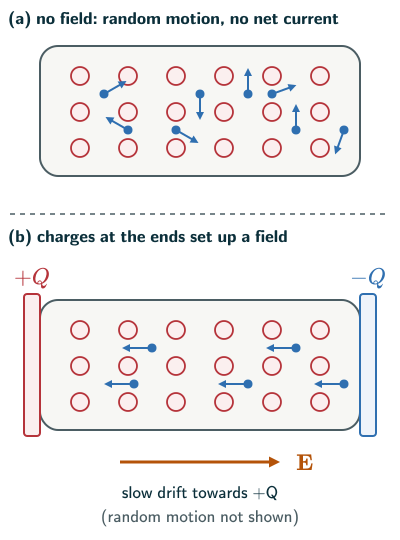
- With no field, the electrons still move because of their thermal motion, and they keep colliding with the fixed ions. In NCERT’s classical collision picture an electron leaves a collision with the same speed as before, but in a completely random direction (page 82).
- So at any moment there is no preferred direction for the electrons’ velocities. On average, as many electrons cross any section one way as the other, and there is no net current (pages 82–83).
Current under an applied field
NCERT imagines a metal cylinder of radius R, with thin discs of a dielectric of the same radius attached to its two flat ends, one carrying +Q and the other −Q (NCERT page 83, Figure 3.1):
- The charges set up a field directed from +Q towards −Q. The electrons are accelerated by it towards +Q, and while they move they make a current (page 83).
- The electrons move to neutralise the charges, so there is a current for a very short while and no current thereafter (NCERT page 83). Strictly, the electrons cannot cross the dielectric discs: they pile up on the metal next to them, and their field cancels the driving field inside the metal, so the charges are screened rather than removed (reasoned).
- If fresh charges are supplied to the ends to make up for those neutralised, a steady field remains in the conductor and the current is continuous (page 83).
- This is not the static case of Chapter 2, where the field inside a conductor is zero because the charges have zero net drift, although microscopic motion continues (electrostatics of conductors). A conductor carrying a steady current has a steady field inside it (NCERT page 83).
- Cells and batteries are the devices that keep up such a steady field; the rest of the chapter is about the steady current a steady field produces (page 83).
Solved examples
Example 1: Why no current flows on its own
The free electrons in a copper wire move at high speeds even with no battery connected. Why is there no current?
Answer: their motion is thermal and random: after each collision with an ion an electron goes off in a random direction, so there is no preferred direction. On average as many electrons cross a section one way as the other, and the net current is zero (NCERT pages 82–83).
Example 2: How many molecules in a gram of water?
Check NCERT’s “approximately 1022 molecules” in a gram of water (molar mass 18 g mol−1, NA = 6.0 × 10²³ mol−1).
Answer: 1 g is 1/18 mol, so the number is 6.0 × 10²³/18 ≈ 3.3 × 10²². That is of the order of 1022, as NCERT says (page 82).
Example 3: The mobile charge in a cube of copper
Copper has about 8.5 × 1028 conduction electrons per cubic metre (NCERT Example 3.1, page 87). How much mobile charge is there in 1.0 cm3 of copper?
Answer: 1.0 cm3 = 1.0 × 10⁻⁶ m3, so it holds 8.5 × 10²² free electrons. The magnitude of their negative charge is 8.5 × 1022 × 1.6 × 10−19 ≈ 1.4 × 10⁴ C. The metal as a whole is neutral, because the fixed ions carry an equal positive charge (reasoned from NCERT page 82).
Example 4: Why the current in NCERT Figure 3.1 stops
Charges +Q and −Q are placed at the ends of a metal cylinder and nothing else is connected. Describe the current.
Answer: the field from +Q to −Q drives electrons towards +Q, giving a current. The redistributed electrons screen the imposed field inside the metal, the driving field dies away, and the current stops after a very short time. A cell keeps replenishing the charges, which keeps the field and the current steady (NCERT page 83).
Common mistakes to avoid
Common mistake
Thinking free electrons are at rest when no current flows
They move fast in random thermal motion; there is just no net flow in any direction (NCERT pages 82–83).
Common mistake
Thinking the positive ions carry the current in a metal
In a metallic solid conductor the ions are fixed; the current is carried by the electrons. Both kinds of charge move only in conductors such as electrolytes (NCERT page 82).
Common mistake
Thinking any field gives a lasting current
A field from fixed charges only gives a brief current, as redistribution screens the field inside the conductor. A steady current needs a steady field, kept up by a cell or battery (NCERT page 83).
Quick revision summary
- A free charge moves when a field acts on it; in metals some electrons are practically free, so metals conduct.
- In metallic solid conductors the current is carried by electrons moving against a background of fixed positive ions; in electrolytes both signs of charge move.
- With no field, electrons move at random after each collision, so there is no net current.
- Charges +Q and −Q at the ends of a conductor give only a brief current, because redistribution screens the interior field.
- A cell or battery keeps up a steady field, and a steady field gives a steady current.
Formula sheet
- no field: random motion, net current zero
- metallic solid conductor: electrons move, positive ions fixed
- electrolyte: both positive and negative ions move
- fixed end charges: brief current only
- steady field (cell, battery): steady current
Questions students ask
Why are metals good conductors of electricity?
Metals are good conductors because some of their electrons are practically free to move through the whole metal, and there are enormous numbers of them: roughly one per atom in copper, about 10 per cubic metre (NCERT page 82; Examples 3.1 and 3.2, pages 87–88). In an insulator the electrons remain bound (NCERT page 82): they can be displaced to polarise the material but do not freely drift through it (reasoned from NCERT Section 2.10). So a field sets a vast crowd of charge drifting in a metal, almost none in an insulator; the classes’ resistivities are compared under conductors, semiconductors and insulators.
Which way does the electric field point inside a current-carrying wire?
Inside a wire carrying a steady current the electric field points along the wire, from higher to lower potential, the direction of the conventional current, and it drives the free electrons the opposite way (NCERT pages 85 and 87). In a uniform wire of length l with a potential difference V across it, the field is uniform, E = V/l (NCERT page 84). It follows the wire round every bend because, beyond the NCERT text, a tiny charge gathers on the wire’s surface when the current starts and steers the field along it (J. D. Jackson, American Journal of Physics, volume 64, 1996).
Are free electrons the same as valence electrons?
Free electrons in a metal are valence electrons that are no longer tied to their own atoms, but not every valence electron is free: NCERT takes copper, with one valence electron per atom, to give roughly one conduction electron per atom (NCERT Example 3.1, page 87), while carbon, in diamond, holds its four bonding electrons so tightly that it is an insulator (NCERT Class 12 Physics Part II, Chapter 14, Example 14.1). In NCERT’s band picture a free electron is one in the conduction band, with a metal having a partially filled band or overlapping valence and conduction bands (Section 14.2). In a semiconductor such as silicon only a few valence electrons break free at room temperature, each leaving a hole (Section 14.3).
Is the net charge of a current-carrying conductor zero?
Yes, the net charge of a wire carrying a steady current is practically zero: inside it, the electrons’ negative charge density cancels the fixed ions’ positive charge density (NCERT Points to Ponder 5, page 105), and a steady current lets no charge pile up anywhere (NCERT page 98). The current comes from the electrons alone, since the ions hardly move, so NCERT works out the current density from the electrons’ charge density, not from the total, which is zero (page 105). Beyond the NCERT text, a very small surface charge, varying along the wire, sits on it while the current flows, so a short stretch is not exactly neutral (J. D. Jackson, American Journal of Physics, volume 64, 1996).
Practice questions
Try each question first, then open the answer to check your working.
-
Q1. Name a place in nature where free charged particles exist.
Show answerHide answer
The ionosphere, in the upper part of the atmosphere (NCERT page 82).
-
Q2. What carries the current in (a) a copper wire, (b) an electrolytic solution?
Show answerHide answer
(a) Electrons, against fixed positive ions; (b) both positive and negative ions (NCERT page 82).
-
Q3. What keeps a steady electric field in a conductor?
Show answerHide answer
A cell or battery, which keeps replacing the charges that the moving electrons neutralise (NCERT page 83).