Temperature dependence of resistivity
NCERT Class 12 Physics Chapter 3 Section 3.8
Quick answer
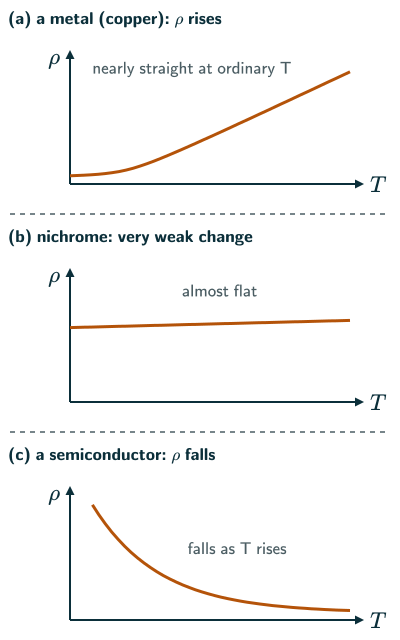
Over a limited range of temperature a metal’s resistivity rises in a straight line, ρ(T) = ρ[1 + α(T − T)], where α, the temperature coefficient of resistivity at T, is positive for metals. Alloys such as nichrome, manganin and constantan change very little, while in the intrinsic thermal-generation regime a semiconductor’s resistivity falls as the temperature rises. From ρ = m/(neτ), heating shortens τ; in metals n stays nearly constant, but in semiconductors n rises faster and ρ falls.
With your textbook
NCERT Physics Part I (Class 12), Chapter 3 “Current Electricity”, Section 3.8 “Temperature Dependence of Resistivity”, pages 90–92.
Open the official NCERT chapter (PDF, 2.2 MB, ncert.nic.in) (opens in a new tab)
Checked against the 2026-27 reprint on .
How does resistivity change with temperature?
Temperature dependence of resistivity
Over a range of temperature that is not too large, the resistivity of a metal rises in a straight line with temperature: ρT = ρ0[1 + α(T − T0)], where α is the temperature coefficient of resistivity (NCERT Eq. (3.26), page 90). Not every material behaves like this:
Unlike metals, the resistivities of semiconductors decrease with increasing temperatures.
NCERT Physics Part I (Class 12), Section 3.8, page 91
In plain words: heat a metal wire and its electrons collide more often, so it resists current more. In an intrinsic semiconductor’s thermal-generation regime heating also frees many more charge carriers, and that wins, so it conducts better when hot. Alloys such as nichrome hardly change at all.
Temperature coefficient of resistivity
For a metal, over a limited range of temperature (NCERT Eq. (3.26), page 90):
Resistivity and temperature (NCERT Eq. 3.26)
- ρT is the resistivity at temperature T and ρ0 at a reference temperature T0; α is the temperature coefficient of resistivity at the reference temperature T, with dimension (temperature)−1 (page 90).
- For metals, α is positive (page 90).
- The equation says the graph of ρT against T is a straight line. At temperatures much lower than 0 °C the real graph bends away from a straight line, so the equation is used only over a limited range around a chosen T0 (NCERT page 90, Figure 3.8).
- Rearranged, α = (ρT − ρ0)/[ρ0(T − T0)]: the fractional change in resistivity per degree (NCERT Summary point 9, page 103).
- NCERT’s worked examples apply the same form to the resistance of a wire, R2 = R1[1 + α(T2 − T1)], with α called the temperature coefficient of resistance (NCERT Example 3.3, page 91). This works because heating changes l/A far less than ρ. Metals expand by roughly 1 to 3 × 10⁻⁵ per °C, silver by 1.9 × 10⁻⁵ per °C (NCERT Class 11, Table 10.1, page 205; see linear expansion). For a silver wire, l grows by a fraction 1.9 × 10⁻⁵ per °C and A by twice that, so l/A falls by about 2 × 10⁻⁵ per °C, some 200 times less than silver’s α of 3.9 × 10⁻³ per °C (Example 3 below). For nichrome the factor is only 10 to 20, which is why NCERT Example 3.3 quotes the temperature coefficient of resistance itself (reasoned from NCERT Eq. (3.9)).
Metals, nichrome and semiconductors
- Nichrome (an alloy of nickel and chromium, with iron in some grades; NCERT, page 90, describes it as nickel, iron and chromium), manganin and constantan show a very weak dependence of resistivity on temperature. They are used in wire-wound standard resistors, whose values must hardly change with temperature (NCERT page 90, Figure 3.9).
- Intrinsic semiconductors in the thermal-generation regime: their resistivity decreases as the temperature rises (NCERT page 91, Figure 3.10).
- Why, from the drift picture: ρ = 1/σ = m/(ne2τ) (NCERT Eq. (3.27), page 91). NCERT gives a classical speed-and-collision explanation (page 91). In a quantum metal, the main temperature-dependent scattering comes from increased lattice vibrations; electron speeds near the Fermi surface do not simply scale as √T.
- In a metal, n hardly depends on temperature, so the fall in τ makes ρ rise (page 91).
- In the thermal-generation regime of insulators and semiconductors, n increases with temperature, and this more than makes up for the fall in τ, so ρ falls (page 91).
Solved examples
Example 1: How hot is a toaster’s element? (NCERT Example 3.3)
A toaster’s nichrome element has a resistance of 75.3 Ω at room temperature (27.0 °C), measured with a tiny current. On a 230 V supply its current settles at 2.68 A. With α = 1.70 × 10⁻⁴ °C−1, find the element’s steady temperature.
Answer: hot, R2 = 230/2.68 ≈ 85.8 Ω. From R2 = R1[1 + α(T2 − T1)], T2 − T1 = (85.8 − 75.3)/
Example 2: A platinum resistance thermometer (NCERT Example 3.4)
A platinum wire has resistance 5 Ω at the ice point, 5.23 Ω at the steam point and 5.795 Ω in a hot bath. Find the bath’s temperature.
Answer: with Rt = R0(1 + αt), the steam point gives R100 − R0 = 100αR0 and the bath gives Rt − R0 = αtR0. Dividing, t = 100 × 0.795/0.23 ≈ 345.65 °C (NCERT page 92), about 3.5 × 10² °C to the precision of the data.
Example 3: The coefficient of silver (NCERT Exercise 3.5)
A silver wire has a resistance of 2.1 Ω at 27.5 °C and 2.7 Ω at 100 °C. Find the temperature coefficient of resistivity of silver.
Answer: α = (R2 − R1)/[R1(T2 − T1)]. Here R1(T2 − T1) = 2.1 × 72.5 ≈ 152 Ω °C, so α = 0.6/152 ≈ 3.9 × 10⁻³ °C−1, referenced to 27.5 °C, not 0 °C (NCERT Eq. (3.26), page 90).
Example 4: A heating element (NCERT Exercise 3.3)
At 27.0 °C a heating element has a resistance of 100 Ω. At what temperature is its resistance 117 Ω, if α = 1.70 × 10⁻⁴ °C−1?
Answer: T − 27.0 = (117 − 100)/
Common mistakes to avoid
Common mistake
Using ρ = ρ[1 + α(T − T)] over any range
It is a straight-line fit for a limited range; far below 0 °C the real graph bends away from it (NCERT page 90).
Common mistake
Giving semiconductors a positive α
For intrinsic semiconductors in this regime, resistivity falls because the carrier-density increase dominates the mobility decrease. Doped semiconductors can show other temperature trends (NCERT page 91).
Common mistake
Using R = R[1 + α(T − T)] when α is quoted for 0 °C
If α refers to 0 °C and R is known at t, the exact step is R/R = (1 + αt)/(1 + αt); the short form is exact within this linear model only with the converted coefficient α = α/(1 + αt), referenced to t. A small temperature interval alone does not make α the correct fractional coefficient at t (reasoned from NCERT Eq. (3.26)).
Common mistake
Taking R at the wrong temperature
In R = R[1 + α(T − T)], R must be the resistance at T, the reference temperature, as in NCERT Example 3.3 (page 91).
Quick revision summary
- Over a limited range, ρ(T) = ρ[1 + α(T − T)]; α is the temperature coefficient of resistivity, in °C or K, positive for metals.
- Far below 0 °C a metal’s ρ–T graph bends away from a straight line.
- Nichrome, manganin and constantan change very little, so they are used in standard resistors.
- Intrinsic semiconductors in the thermal-generation regime: ρ falls as T rises; doped samples need not follow this throughout their range.
- From ρ = m/(neτ): τ falls as T rises; in metals n is nearly constant, so ρ rises; in semiconductors n rises faster, so ρ falls.
Formula sheet
- ρ(T) = ρ[1 + α(T − T)]
- α = [ρ(T) − ρ]/[ρ(T − T)]
- R = R[1 + α(T − T)]
- ρ = m/(neτ)
- metals: α > 0; semiconductors: ρ falls as T rises
Questions students ask
Why does the resistivity of alloys such as manganin and constantan hardly change with temperature?
An alloy’s resistivity changes little with temperature because most of it does not depend on temperature: beyond the NCERT text, the irregular mix of different atoms scatters electrons strongly at every temperature, and in the approximation called Matthiessen’s rule, this fixed part and the temperature-dependent part add (A. Matthiessen and C. Vogt, Philosophical Transactions of the Royal Society, 1864). In a pure metal near room temperature the growing part is nearly all of it. So nichrome’s coefficient, 1.70 × 10 °C (NCERT Example 3.3, page 91), is about a twentieth of copper’s, 3.93 × 10 °C (NBS Copper Wire Tables, 1966), and manganin and constantan suit standard resistors (NCERT page 90).
What is the temperature coefficient of resistance of copper?
The temperature coefficient of resistance of copper is about 3.93 × 10 °C at 20 °C, the value set for standard annealed copper wire and measured between points fixed on a wire free to expand (beyond the NCERT text, US National Bureau of Standards, Copper Wire Tables, Handbook 100, 1966). So a copper wire’s resistance rises by about 0.4 % for each degree: a copper coil of 12.0 Ω at 20 °C has about 12.0 × (1 + 3.93 × 10 × 45) ≈ 14.1 Ω at 65 °C.
What is superconductivity, and how does it differ from an ordinary metal’s behaviour near absolute zero?
Superconductivity is the complete loss of electrical resistance that some materials show below a critical temperature, provided the magnetic field and current remain below their critical limits: beyond the NCERT text, Heike Kamerlingh Onnes discovered it in mercury in 1911, a few kelvin above absolute zero (US Department of Energy, ‘DOE Explains…Superconductivity’). An ordinary metal such as copper behaves differently: cooled towards absolute zero, its resistivity levels off at a small residual value set by impurities and defects, the part Matthiessen’s rule (1864) treats as independent of temperature. A superconductor’s resistance instead drops suddenly to zero, a jump no temperature coefficient describes, and a steady current then flows without loss as heat.
Is temperature dependence of resistance in the JEE Main and NEET syllabus?
Yes, temperature dependence of resistance is in both syllabuses, in Unit 12, Current Electricity: the JEE Main syllabus names “temperature dependence of resistance”, and the NEET (UG) 2026 syllabus has the same words in its Unit 12. NCERT Class 12 Physics Part I treats it as Section 3.8, Temperature Dependence of Resistivity (pages 90–92), with NCERT Examples 3.3 and 3.4 and Exercises 3.3, 3.5 and 3.6. The syllabuses say resistance and NCERT says resistivity, but NCERT’s worked examples apply the same formula to the resistance of a wire (NCERT Example 3.3, page 91).
Practice questions
Try each question first, then open the answer to check your working.
-
Q1. What are the dimensions of the temperature coefficient of resistivity?
Show answerHide answer
(Temperature)−1 (NCERT page 90).
-
Q2. Why are manganin and constantan used for standard resistors?
Show answerHide answer
Their resistivity changes very little with temperature, so the resistance values stay nearly constant (NCERT page 90).
-
Q3. A wire’s resistance is 20 Ω at 20 °C, and α referred to 20 °C is 4.0 × 10⁻³ °C−1. Find its resistance at 70 °C.
Show answerHide answer
R = 20[1 + 4.0 × 10−3 × 50] = 20 × 1.2 = 24 Ω (NCERT Eq. (3.26), page 90).