Cells, emf and internal resistance
NCERT Class 12 Physics Chapter 3 Section 3.10
Quick answer
The emf ε of a cell is the potential difference between its electrodes when no current flows; despite the name it is not a force. The electrolyte has an internal resistance r, so when the cell supplies a current I the terminal potential difference falls to V = ε − Ir, and with a resistor R the current is I = ε/(R + r). In the constant-emf model with r > 0, the largest current, with R = 0, is ε/r; while a cell is being charged, V = ε + Ir.
With your textbook
NCERT Physics Part I (Class 12), Chapter 3 “Current Electricity”, Section 3.10 “Cells, emf, Internal Resistance”, pages 93–95.
Open the official NCERT chapter (PDF, 2.2 MB, ncert.nic.in) (opens in a new tab)
Checked against the 2026-27 reprint on .
What are emf and internal resistance?
Cells, emf and internal resistance
A cell keeps a steady current flowing. Its emf ε is the potential difference between its positive and negative electrodes when no current flows (NCERT Eqs. (3.36)–(3.37), page 94). Despite the name, emf is a potential difference, not a force:
The name emf, however, is used because of historical reasons, and was given at a time when the phenomenon was not understood properly.
NCERT Physics Part I (Class 12), Section 3.10, page 94
The electrolyte inside the cell has a resistance r, the internal resistance. When the cell supplies a current I, the terminal potential difference falls to V = ε − Ir (NCERT Eq. (3.38), page 94).
In plain words: a cell is like a pump that lifts charge through a fixed height, its emf. But some of the lift is used up pushing the current through the cell’s own insides. The more current you draw, the more is lost inside, and the less is left at the terminals.
Emf of a cell
- The source here is a galvanic (electrochemical) cell; an electrolytic cell strictly uses external electricity to drive a reaction. This source cell has two electrodes, positive (P) and negative (N), immersed in an electrolytic solution. Dipped in the solution, the electrodes exchange charges with the electrolyte (NCERT pages 93–94, Figure 3.12).
- The positive electrode develops a potential difference V+ (> 0) relative to the electrolyte next to it (point A); the negative electrode develops −V− (V− ≥ 0) relative to the electrolyte next to it (point B) (page 94).
- With no current, the electrolyte is at one potential throughout, so the potential difference between P and N is V+ + V−, the emf (NCERT Eq. (3.36), page 94):
Emf of a cell (NCERT Eq. 3.36)
- So the emf is the potential difference between the positive and negative electrodes in an open circuit, when no current flows through the cell (NCERT Eq. (3.37), page 94).
Internal resistance
The constant-emf, constant-r model is an approximation over the conditions considered. Real internal voltage losses include effects beyond the electrolyte alone. Short-circuit and maximum-power formulae here assume r > 0; cell chemistry and state of charge can change both parameters.
- Connect a resistor R across the cell. A steady current I flows through R from P to N, and through the electrolyte from N to P (NCERT page 94).
- The electrolyte through which this current flows has a finite resistance r, the internal resistance of the cell (page 94).
- Internal resistances vary from cell to cell; the internal resistance of dry cells is much higher than that of common wet cells. It may be neglected in calculations when ε ≫ Ir (page 94).
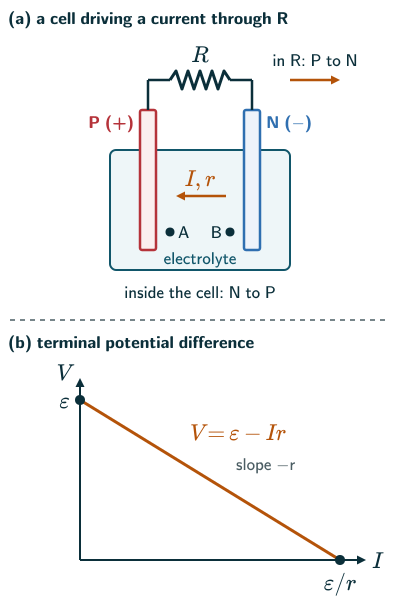
Terminal potential difference
- With a current I, the potential difference between P and N is (NCERT Eq. (3.38), page 94):
Terminal potential difference (NCERT Eq. 3.38)
- The minus sign appears because inside the electrolyte the current flows from B to A, so the potential drops by Ir across the internal resistance (page 94).
- Since V is also the potential difference across R, V = IR by Ohm’s law (NCERT Eq. (3.39)). Combining, IR = ε − Ir, so (NCERT Eq. (3.40), page 95):
Current from a cell (NCERT Eq. 3.40)
- The largest current is drawn when R = 0, a short circuit: Imax = ε/r, and the terminal potential difference is then zero. In most cells the safe current is much lower, to prevent permanent damage (page 95).
- While a cell is being charged, the current is forced through it from P to N, and then V = ε + Ir: the terminal potential difference is more than the emf (NCERT Eq. (3.60), page 97, which gives this when the current through the cell runs from P to N; see labelling cells in Kirchhoff’s rules).
Solved examples
Example 1: The largest current from a car battery (NCERT Exercise 3.1)
A car’s storage battery has an emf of 12 V and an internal resistance of 0.4 Ω. What is the largest current that can be drawn from it?
Answer: Imax = ε/r = 12/0.4 = 30 A (NCERT page 95).
Example 2: Finding R and the terminal voltage (NCERT Exercise 3.2)
A battery of emf 10 V and internal resistance 3 Ω is connected to a resistor, and the current is 0.5 A. Find the resistance and the terminal voltage.
Answer: R + r = ε/I = 10/0.5 = 20 Ω, so R = 17 Ω. The terminal voltage is V = ε − Ir = 10 − 0.5 × 3 = 8.5 V, which is also IR = 0.5 × 17 (NCERT Eqs. (3.38)–(3.40), pages 94–95).
Example 3: Charging a battery (NCERT Exercise 3.8)
A storage battery of emf 8.0 V and internal resistance 0.5 Ω is charged from a 120 V dc supply through a series resistor of 15.5 Ω. Find the terminal voltage during charging, and say why the series resistor is needed.
Answer: the supply drives the current against the battery’s emf, so I = (120 − 8.0)/(15.5 + 0.5) = 112/16 = 7.0 A. While charging, V = ε + Ir = 8.0 + 7.0 × 0.5 = 11.5 V. Without the series resistor the current would be (120 − 8.0)/0.5 = 224 A, far too large; the resistor limits the charging current (NCERT Eq. (3.60), page 97, which gives this when the current through the cell runs from P to N).
Example 4: Emf and internal resistance from two readings
A cell gives 1.4 V across its terminals when it supplies 0.20 A, and 1.2 V when it supplies 0.60 A. Find its emf and internal resistance.
Answer: from V = ε − Ir: 1.4 = ε − 0.20r and 1.2 = ε − 0.60r. Subtracting, 0.40r = 0.20, so r = 0.5 Ω, and ε = 1.4 + 0.20 × 0.5 = 1.5 V (NCERT Eq. (3.38), page 94).
Common mistakes to avoid
Common mistake
Thinking emf is a force
Emf is a potential difference, measured in volts; the name is historical (NCERT page 94).
Common mistake
Taking the terminal voltage as the emf when current flows
V = ε − Ir is less than ε while the cell supplies current; for r > 0, V equals ε when I = 0; an ideal cell with r = 0 has V = ε even while supplying current (NCERT Eqs. (3.37)–(3.38), page 94).
Common mistake
Using V = ε − Ir while a cell is being charged
When the current is forced through the cell from P to N, V = ε + Ir (NCERT Eq. (3.60), page 97).
Quick revision summary
- A cell’s emf ε is the potential difference between its electrodes in an open circuit, ε = V + V; it is a potential difference, not a force.
- The electrolyte’s resistance r is the internal resistance; dry cells have much higher r than common wet cells.
- Supplying a current I: V = ε − Ir and I = ε/(R + r); being charged: V = ε + Ir.
- The largest current, with R = 0, is ε/r; cells are usually limited well below this.
- r can be neglected when ε ≫ Ir.
Formula sheet
- ε = V + V (open circuit)
- V = ε − Ir (discharging)
- I = ε/(R + r)
- largest current ε/r
- V = ε + Ir (charging)
Questions students ask
What is the difference between emf and terminal voltage?
The emf of a cell is the work its source does per unit charge in moving positive charge internally from the negative to the positive terminal, equal to the potential difference between its terminals when no current flows, while the terminal voltage is the potential difference across the terminals, both with current and in an open circuit (NCERT Summary point 2, page 102; Eqs. (3.37)–(3.38), page 94). The emf is set by the cell itself, whatever the external circuit; the terminal voltage depends on the current: V = ε − Ir when the cell supplies current, ε + Ir when it is charged (NCERT Eq. (3.60), page 97). So a 9.0 V battery of internal resistance 1.5 Ω supplying 0.40 A has 9.0 − 0.40 × 1.5 = 8.4 V across its terminals.
Is the internal resistance of a cell constant, and what does it depend on?
The internal resistance of a cell is not a fixed constant, though NCERT’s calculations treat it as one: it is the resistance of the electrolyte between the electrodes (NCERT page 94), so, like a column of solution between two electrodes, R = ρl/A, it grows with the distance between the electrodes and falls with the area of electrode in the electrolyte (reasoned from NCERT Chemistry Part I (Class 12), Unit 2, pages 43–44). It also depends on the nature and concentration of the electrolyte, and it falls as the cell warms, because the conductivity of an electrolytic solution rises with temperature (page 43).
Does the emf of a cell depend on its size?
No, the emf of a cell does not depend on its size or on the amount of electrolyte: it is the sum of the potential differences at its two electrodes, ε = V+ + V− (NCERT Eq. (3.36), page 94), set by the materials, and NCERT Chemistry calls a cell’s emf an intensive parameter (NCERT Chemistry Part I (Class 12), Unit 2, page 40). It does depend on the ion concentrations, which change as the cell is used, and on temperature (NCERT Chemistry, Eq. (2.11), pages 38–39). Beyond the NCERT text, a bigger cell of the same kind has the same emf but more chemicals, so it delivers more charge, and its larger electrodes usually lower its internal resistance.
How do you find the emf and internal resistance of a cell from a graph?
A graph of a cell’s terminal voltage V against its current I gives its emf and internal resistance: since V = ε − Ir (NCERT Eq. (3.38), page 94), points taken with several external resistances lie on a straight line whose intercept on the V-axis is the emf ε and whose slope is −r, and the line would meet the I-axis at the short-circuit current ε/r. For example, a line from 3.0 V at I = 0 down to 2.4 V at 1.5 A gives ε = 3.0 V and r = (3.0 − 2.4)/1.5 = 0.40 Ω, so ε/r = 7.5 A. Plotted against the external resistance R instead, V = εR/(R + r) is a curve that rises from zero towards ε (NCERT Summary point 11, page 103).
Does a voltmeter connected across a cell read its emf?
A voltmeter across a cell reads a little less than its emf, because it draws a small current through the internal resistance: a voltmeter of resistance RV reads εRV/(RV + r) (NCERT Summary point 11, page 103, with the voltmeter as the external resistance). The reading is close to the emf only when RV ≫ r: a 1000 Ω voltmeter across a cell of emf 2.0 V and internal resistance 0.80 Ω reads 2.0 × 1000/1000.8 ≈ 1.998 V. Across a cell that is also supplying a load, the same voltmeter reads the terminal voltage, V = ε − Ir, not the emf (NCERT Eq. (3.38), page 94).
Practice questions
Try each question first, then open the answer to check your working.
-
Q1. A cell of emf 1.5 V and internal resistance 0.5 Ω is connected to a 2.5 Ω resistor. Find the current and the terminal voltage.
Show answerHide answer
I = ε/(R + r) = 1.5/3.0 = 0.50 A; V = IR = 0.50 × 2.5 = 1.25 V (NCERT Eqs. (3.38)–(3.40), pages 94–95).
-
Q2. When is the terminal potential difference of a cell equal to its emf?
Show answerHide answer
When no current flows through it, in an open circuit (NCERT page 94).
-
Q3. Which usually has the higher internal resistance, a dry cell or a common electrolytic cell?
Show answerHide answer
A dry cell (NCERT page 94).