Drift of electrons and the origin of resistivity
NCERT Class 12 Physics Chapter 3 Section 3.5
Quick answer
Drift velocity is the small steady-state average velocity with which the free electrons of a metal move opposite to an applied field E: the field accelerates them between collisions, and collisions randomise the directed motion, so on average they drift at eEτ/m, where the relaxation time τ is the average time between collisions. This drift carries the current and gives j = (neτ/m)E, which is Ohm’s law with conductivity σ = neτ/m. The mobility, the drift speed per unit field, is μ = eτ/m.
With your textbook
NCERT Physics Part I (Class 12), Chapter 3 “Current Electricity”, Section 3.5 “Drift of Electrons and the Origin of Resistivity”, pages 85–89.
Open the official NCERT chapter (PDF, 2.2 MB, ncert.nic.in) (opens in a new tab)
Checked against the 2026-27 reprint on .
What is drift velocity?
Drift of electrons
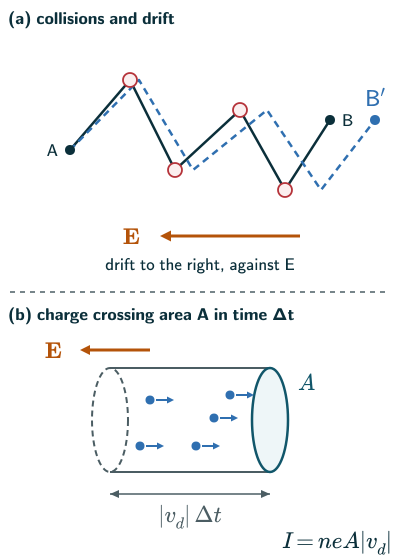
In a field E, each free electron in a metal accelerates between collisions; collisions randomise the directed part of its velocity. An individual electron can slow down if its velocity initially opposes its acceleration. On average the electrons then move with a small, steady velocity opposite to E, the drift velocity vd = −eEτ/m (NCERT Eq. (3.17), page 86). NCERT points out how odd this is:
It tells us that the electrons move with an average velocity which is independent of time, although electrons are accelerated.
NCERT Physics Part I (Class 12), Section 3.5, page 86
The drift carries charge through the conductor, and from it NCERT derives Ohm’s law (pages 86–87).
In plain words: picture a crowd running about at random in a hall with a slight slope in the floor. Everyone keeps bumping into pillars and scattering, but between bumps they all slide a little downhill. The crowd as a whole creeps downhill slowly and steadily. That slow creep is the drift, and it is what carries the current.
Relaxation time
- With no field, the electrons leave each collision in random directions, so the average of their velocities is zero (NCERT Eq. (3.14), page 85).
- In a field E, each electron has acceleration a = −eE/m, where −e is its charge and m its mass (NCERT Eq. (3.15), page 85).
- Take the ith electron at time t. If ti is the time since its last collision and vi its velocity just after it, its velocity now is Vi = vi − eEti/m (NCERT Eq. (3.16), page 85).
- Collisions happen at random times. The average time between successive collisions is τ, the relaxation time; in NCERT’s simple random, memoryless collision model, the average elapsed time ti also equals τ (NCERT pages 85–86).
Drift velocity
Averaging Vi over all the electrons, the vi average to zero and the ti to τ (NCERT Eq. (3.17), page 86):
Drift velocity (NCERT Eq. 3.17)
- Once the transient has settled at constant field and material conditions, this average velocity does not grow with time, even though every electron is being accelerated. This is drift, and vd is the drift velocity (page 86).
- The minus sign means the electrons drift opposite to E, from lower to higher potential (NCERT Example 3.1, page 87).
- Why it stays steady: the field adds directed velocity between collisions, while collisions randomise it; on average it keeps only a steady drift speed (NCERT Example 3.2(b), page 88).
- Between collisions the path is a straight line with no field, but in general a curve when a field acts (NCERT Example 3.2(e), page 88).
- The drift is superposed on the much larger random velocities; the free electrons are by no means all moving the same way (NCERT Example 3.2(d), page 88).
Current in terms of drift velocity
- Take an area A inside the conductor, normal to E, with uniform carrier density and drift. In time Δt, the net number of electrons transported is n|vd|AΔt. Random motion carries electrons both ways; it is not true that every individual electron initially within |vd|Δt crosses the section. The slab in NCERT Figure 3.4 represents average drift transport (page 86).
- The charge crossing in Δt is IΔt, so the current is (NCERT Eq. (3.18), page 86):
Current and drift speed (NCERT Eq. 3.18)
Dividing by A, the current density is |j| = ne|vd| (NCERT Summary point 7, page 103).
- Putting in |vd| = eEτ/m and I = |j|A (NCERT Eqs. (3.19)–(3.21)), and noting that j is along E (NCERT Eq. (3.22), page 86):
- This is exactly Ohm’s law, j = σE, with conductivity (NCERT Eq. (3.23), page 87):
Conductivity from the drift picture (NCERT Eq. 3.23)
- So the resistivity is ρ = 1/σ = m/(ne2τ). The derivation assumes τ and n do not depend on E (page 87).
Mobility
Here μ = eτ/m applies to electrons in the simple model. For another carrier, use its charge magnitude and appropriate mass; μ remains positive.
- Conductivity comes from mobile charge carriers: electrons in metals; electrons and positive ions in an ionised gas; positive and negative ions in an electrolyte (NCERT Section 3.5.1, page 88).
- The mobility μ is the magnitude of the drift velocity per unit field (NCERT Eqs. (3.24)–(3.25), pages 88–89):
Mobility (NCERT Eqs. 3.24–3.25)
- Mobility is positive. Its SI unit is m2/(V s); 1 m2/(V s) = 104 cm2/(V s), the practical unit (page 88).
- So σ = neμ: conductivity is the carrier density times the charge times the mobility (reasoned from NCERT Eqs. (3.23) and (3.25)).
Solved examples
Example 1: Drift speed in a copper wire (NCERT Example 3.1)
A copper wire of cross-section 1.0 × 10⁻⁷ m2 carries 1.5 A. Copper has density 9.0 × 10³ kg/m3 and atomic mass 63.5 u, with about one conduction electron per atom. Find the drift speed, and compare it with the thermal speed of the copper atoms and with the speed at which the field travels along the wire.
Answer: one cubic metre holds 9.0 × 10⁶ g, and 63.5 g holds 6.0 × 10²³ atoms, so n = 6.0 × 1023 × 9.0 × 106/63.5 ≈ 8.5 × 1028 m−3. Then
which is 1.5 divided by (8.5 × 1028) × (1.6 × 10−19) × (1.0 × 10−7), about 1.1 × 10⁻³ m/s, or 1.1 mm/s.
The thermal speed of copper atoms at 300 K, of the order of √(kBT/M), is about 2 × 10² m/s, so the drift speed is only about 10−5 times the thermal speed. The electrical signal propagates as an electromagnetic disturbance, usually at a substantial fraction of 3.0 × 10⁸ m/s; its speed depends on the surrounding dielectric and circuit geometry; the drift speed is smaller by a factor of about 10−11 (NCERT page 87; for the thermal speed, see kinetic temperature).
Example 2: Why a lamp lights at once (NCERT Example 3.2)
If the drift speed is only about a millimetre a second, why does a current start almost the instant a circuit is closed, and how can a small drift speed give a large current?
Answer: the electric field is set up throughout the circuit almost instantly, at about the speed of light, and starts local drift as the signal reaches each part; the current does not wait for electrons to travel from one end to the other, though it takes a little while to reach its steady value. A large current is possible because the number density of free electrons is enormous, about 1029 m−3 (NCERT page 88).
Example 3: Relaxation time and mobility
A metal has n = 8.5 × 1028 m−3 and resistivity 1.7 × 10⁻⁸ Ω m. Find the relaxation time and the electron mobility (m = 9.1 × 10⁻³¹ kg).
Answer: τ = m/(ne2ρ). The denominator is 8.5 × 1028 × (1.6 × 10−19)2 × 1.7 × 10−8 ≈ 3.70 × 10⁻¹⁷, so τ ≈ 9.1 × 10⁻³¹/(3.70 × 10−17) ≈ 2.5 × 10⁻¹⁴ s. Then μ = eτ/m ≈ 4.3 × 10⁻³ m2/(V s) (NCERT Eqs. (3.23) and (3.25), pages 87–89).
Example 4: Drift speed from the field
In the metal of Example 3, what drift speed does a field of 0.10 V/m give?
Answer: |vd| = μE = 4.3 × 10−3 × 0.10 ≈ 4.3 × 10⁻⁴ m/s (NCERT Eq. (3.24), page 88).
Common mistakes to avoid
Common mistake
Confusing the drift speed with the speed of the signal
Electrons drift at about a millimetre a second; the field that starts the current travels along the circuit at nearly the speed of light (NCERT pages 87–88).
Common mistake
Thinking all the free electrons move the same way
The drift is a small average superposed on large random velocities; individual electrons still move in all directions (NCERT Example 3.2(d), page 88).
Common mistake
Thinking a thicker wire always has a smaller drift speed
For the same current, vd = I/(neA) falls as A grows. For the same V across the same length, E = V/l is fixed, so vd = eEτ/m does not depend on A; doubling the length at the same V halves vd (reasoned from NCERT Eqs. (3.17)–(3.18)).
Common mistake
Taking the relaxation time as the time for the current to start
τ is the average time between collisions (NCERT pages 85–86), about 10 s in a metal (Example 3 above); it is not a delay before the current flows.
Quick revision summary
- Between collisions an electron accelerates at −eE/m; collisions randomise its velocity; τ, the relaxation time, is the average time between collisions.
- Averaging gives a steady drift velocity vd = −eEτ/m, opposite to E, independent of time after the transient at fixed conditions.
- Current: I = neA|vd|; with |vd| = eEτ/m this gives j = (neτ/m)E, which is Ohm’s law with σ = neτ/m.
- Mobility μ = |vd|/E, so μ = eτ/m, in m/(V s); σ = neμ.
- Drift speeds are about 1 mm/s, far below thermal speeds and the speed of the field along the wire.
Formula sheet
- vd = −eEτ/m
- I = neA|vd|
- σ = neτ/m, ρ = m/(neτ)
- μ = |vd|/E = eτ/m
- σ = neμ
Questions students ask
How does drift velocity change with temperature?
In a metal kept in the same electric field, the drift speed falls as the temperature rises: |vd| = eEτ/m, and heating shortens the relaxation time τ, because the electrons collide more often (NCERT Eq. (3.17), page 86, and page 91). The mobility falls in the same proportion. If instead the same current is kept flowing through the same wire, the drift speed hardly changes, because I = neA|vd| and n in a metal does not depend on temperature to any appreciable extent (NCERT Eq. (3.18), page 86, and page 91); the field, and the potential difference needed, rise instead.
What is the difference between drift velocity and mobility?
Drift velocity is the average velocity the free electrons actually gain in a particular field, so it depends on the field as well as on the material (NCERT Eq. (3.17), page 86), while mobility is the drift speed per unit field, μ = |vd|/E = eτ/m, a positive property of the carriers in a material at a given temperature (NCERT Eqs. (3.24)–(3.25), pages 88–89). In NCERT’s model τ does not depend on E (page 87), so the mobility stays the same whatever field is applied, while the drift speed grows in proportion to it. The conductivity is σ = neμ, so for the same carrier density, carriers twice as mobile conduct twice as well.
How does the drift speed compare with the random speed of the free electrons?
The drift speed is only a tiny fraction of the free electrons’ random speed: NCERT’s Example 3.1 compares the drift with the thermal speed of the copper atoms (NCERT page 87), but the far lighter electrons move much faster. Beyond the NCERT text, NCERT’s rough rule there, a speed of the order of √(kBT/m), with m now the electron’s mass, gives about 7 × 10 m s at 300 K, and quantum theory gives copper’s conduction electrons speeds up to about 1.6 × 10 m s (Ashcroft and Mermin, Solid State Physics, 1976, Table 2.1). Those random velocities average to zero and carry no current (NCERT page 85), so the current comes from the slow drift alone.
Are drift velocity, mobility and relaxation time in the JEE Main and NEET syllabus?
Drift velocity and mobility are named in both syllabuses: Unit 12, Current Electricity, of the JEE Main syllabus begins “Electric current: drift velocity, mobility and their relation with electric current”, and the NEET (UG) 2026 syllabus lists the same topics at the start of its Unit 12. Relaxation time is not named in either, but it belongs to the same NCERT section, Section 3.5 of NCERT Class 12 Physics Part I (pages 85–89), because the drift velocity, eEτ/m, and the mobility, eτ/m, are both written with it (NCERT Eqs. (3.17) and (3.25)).
Practice questions
Try each question first, then open the answer to check your working.
-
Q1. In which direction do the free electrons in a wire drift, relative to the field?
Show answerHide answer
Opposite to the field, from lower to higher potential (NCERT Eq. (3.17), page 86; Example 3.1, page 87).
-
Q2. A wire with n = 8.0 × 1028 m−3 and cross-section 2.0 × 10⁻⁶ m2 carries 3.2 A. Find the drift speed.
Show answerHide answer
vd = I/(neA). Here neA = 8.0 × 1028 × 1.6 × 10−19 × 2.0 × 10−6 = 2.56 × 10⁴ C m−1, so vd = 3.2/(2.56 × 104) = 1.25 × 10⁻⁴ m/s (NCERT Eq. (3.18), page 86).
-
Q3. What is the SI unit of mobility?
Show answerHide answer
m2/(V s) (NCERT page 88).