Electrical energy and power
NCERT Class 12 Physics Chapter 3 Section 3.9
Quick answer
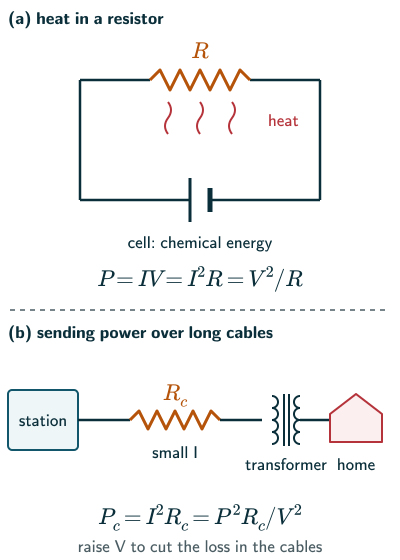
Charges flowing through a potential difference V lose potential energy, and in a purely resistive conductor their collisions turn it into heat at the rate P = IV = IR = V/R. The source that keeps the current flowing, such as a cell, supplies this power. For power sent through long cables, the loss in the cables falls as 1/V for a given power, so power is transmitted at very high voltage and stepped down by a transformer in AC systems.
With your textbook
NCERT Physics Part I (Class 12), Chapter 3 “Current Electricity”, Section 3.9 “Electrical Energy, Power”, pages 92–93.
Open the official NCERT chapter (PDF, 2.2 MB, ncert.nic.in) (opens in a new tab)
Checked against the 2026-27 reprint on .
What is electrical power?
Electrical energy and power
When a current I flows through a purely resistive conductor with a potential difference V across it, electrical energy is turned into heat at the rate P = IV (NCERT Eq. (3.32), page 92). For a resistor this is P = I2R = V2/R, the “ohmic loss” (NCERT Eq. (3.33), page 93). NCERT gives the everyday example:
It is this power which heats up, for example, the coil of an electric bulb to incandescence, radiating out heat and light.
NCERT Physics Part I (Class 12), Section 3.9, page 93
In plain words: charges flowing “downhill” through a potential difference lose potential energy. In a vacuum they would simply speed up, but in a wire they keep colliding with atoms and hand the energy over as vibration, that is, heat. The power is the energy handed over each second.
Power dissipated in a resistor
- Let a current I flow from A to B, so V(A) > V(B) and the potential difference is V = V(A) − V(B) > 0. In a time Δt a charge ΔQ = IΔt goes from A to B, and its potential energy changes by ΔUpot = −IVΔt, a loss (NCERT Eq. (3.28), page 92).
- If the charges moved without collisions, they would gain this as kinetic energy, ΔK = IVΔt (NCERT Eqs. (3.29)–(3.30)). But they move with a steady drift velocity: at each collision they share the energy with the atoms, which vibrate more vigorously, and the conductor heats up (page 92).
- So the energy dissipated as heat in Δt is ΔW = IVΔt (NCERT Eq. (3.31)), and the power is (NCERT Eq. (3.32), page 92):
Power dissipated (NCERT Eqs. 3.32–3.33)
- I2R and V2/R follow from Ohm’s law, V = IR (NCERT Eq. (3.33), page 93).
- Where the power comes from: a steady current needs an external source, and that source supplies the power. In a circuit with a cell, the cell’s chemical energy supplies it for as long as it can (NCERT page 93, Figure 3.11).
- Units: power in watts, 1 W = 1 V × 1 A = 1 J s−1; electrical energy is often billed in kilowatt hours, 1 kWh = 1000 W × 3600 s = 3.6 × 10⁶ J (reasoned from W = Pt; compare power).
Power loss in transmission lines
- Power P is to be delivered to a device R at receiving-end voltage V through connecting cables of resistance Rc. Then P = VI (NCERT Eq. (3.34), page 93), so the current is I = P/V.
- The power wasted in the cables is (NCERT Eq. (3.35), page 93):
Power lost in the cables (NCERT Eq. 3.35)
- For a given power, the waste is inversely proportional to V2. Transmission cables are hundreds of miles long, so Rc is considerable; to cut the loss, they carry power at very high voltages, hence the danger signs on transmission lines (page 93).
- Such voltages are not safe to use, so at the other end for AC transmission a transformer lowers the voltage to a value suitable for use (page 93).
Solved examples
Example 1: A heater
A heater rated 1000 W works on 230 V. Find the current it draws and its resistance.
Answer: I = P/V = 1000/230 ≈ 4.35 A, and R = V2/P = 2302/1000 = 52.9 Ω (NCERT Eqs. (3.32)–(3.33), pages 92–93).
Example 2: A bulb on half the voltage
A bulb is rated 60 W at 220 V. Taking its resistance as fixed, what power does it take on 110 V?
Answer: R = 2202/60 ≈ 807 Ω. On 110 V, P = V2/R = 1102/807 ≈ 15 W: half the voltage gives a quarter of the power (NCERT Eq. (3.33), page 93). A real filament runs cooler on 110 V and so has a lower resistance, which makes the power noticeably more than this (reasoned from NCERT Section 3.8).
Example 3: Why transmit at high voltage
A town needs 100 kW through cables of total resistance 0.50 Ω. Find the power wasted in the cables if the receiving-end load voltage is (a) 1000 V, (b) 10 000 V.
Answer: (a) I = P/V = 100 A, so Pc = I2Rc = 1002 × 0.50 = 5000 W, 5 % of the power. (b) I = 10 A, so Pc = 102 × 0.50 = 50 W. Ten times the voltage cuts the loss a hundredfold (NCERT Eq. (3.35), page 93).
Example 4: Energy used
A 1.5 kW heater runs for 2.0 hours. How much electrical energy does it use, in kWh and in joules?
Answer: W = Pt = 1.5 kW × 2.0 h = 3.0 kWh = 3.0 × 3.6 × 106 J = 1.08 × 10⁷ J (from NCERT Eq. (3.31), page 92).
Common mistakes to avoid
Common mistake
Using P = IR and P = V/R as if they disagree
They are the same power, related by V = IR. For resistors in series (same I), use IR; in parallel (same V), use V/R (NCERT Eq. (3.33), page 93).
Common mistake
Thinking the higher-wattage bulb is always brighter
For comparable incandescent bulbs at rated voltage, the 100 W bulb is generally brighter; watts alone do not compare brightness across different lamp technologies. In series both carry the same current, so P = IR is larger for the larger resistance: taking each resistance as fixed, a 60 W, 220 V bulb (807 Ω) glows brighter than a 100 W, 220 V one (484 Ω), about 23 W against 14 W when the pair is put on 220 V (reasoned from NCERT Eq. (3.33), page 93).
Common mistake
Thinking high-voltage transmission wastes more power
For a fixed power, a higher V means a smaller current, and the loss IRc = PRc/V falls as 1/V (NCERT Eq. (3.35), page 93).
Common mistake
Forgetting where the energy comes from
The heat in a resistor is supplied by the source that keeps the current flowing, such as a cell’s chemical energy (NCERT page 93).
Quick revision summary
- Charge ΔQ = IΔt falling through a potential difference V loses potential energy IVΔt; collisions turn it into heat.
- Power dissipated: P = IV = IR = V/R, the ohmic loss; 1 W = 1 V A.
- The source that keeps the current flowing, such as a cell, supplies this power.
- Power lost in transmission cables: Pc = IRc = PRc/V, so power is transmitted at high voltage; in AC systems a transformer lowers the voltage for use.
- 1 kWh = 3.6 × 10 J.
Formula sheet
- P = IV
- P = IR = V/R
- ΔW = IVΔt
- Pc = I2 Rc = P2 Rc/V2
- 1 kWh = 3.6 × 10 J
Questions students ask
What is Joule’s law of heating, and is it in the Class 12 NCERT book?
Joule’s law of heating says that a steady current I through a resistance R for a time t produces heat H = IRt, proportional to the square of the current, to the resistance and to the time (NCERT Science Class 10, Chapter 11, Section 11.7, page 189). NCERT Class 12 Physics Part I derives the same result in Chapter 3 without the name, ΔW = IVΔt = IRΔt (NCERT Eqs. (3.31) and (3.33), pages 92–93), and calls it Joule heating in Chapter 7 (NCERT page 179). For example, 0.20 A through 150 Ω for 5.0 minutes produces 0.20 × 150 × 300 = 1800 J.
Why does a heater’s element glow while the cord connecting it stays cool?
A heater’s element glows while its cord stays cool because the two are in series and carry the same current, so each produces heat at the rate P = IR (NCERT Eq. (3.33), page 93), in proportion to its resistance: the element is a long, thin wire of a high-resistivity alloy, while the cord’s copper wires have only a tiny resistance (reasoned from R = ρl/A, NCERT Eq. (3.9), page 84). At 8.0 A, for example, a 30 Ω element takes 8.0 × 30 ≈ 1.9 kW, but a cord of 0.050 Ω in all takes only 3.2 W, spread along its whole length. NCERT Science Class 10 asks the same question (Chapter 11, page 190).
How does a fuse use the heating effect of current?
A fuse contains a conducting element in series with a circuit; sufficient overcurrent heats it until it opens the circuit (NCERT Science Class 10, Chapter 11, page 190). At fixed resistance, doubling current quadruples the heating rate. Opening is not instantaneous at any current above the rating: it follows the fuse’s time–current behaviour. A 2.0 kW load at 230 V draws about 8.7 A; choosing 10 A is only a classroom estimate. Actual selection also depends on voltage rating, starting current, opening time and breaking capacity (Eaton, Fuse FAQs).
Can P = IR give the power taken by an electric motor?
No, P = IR gives only the part of a motor’s power that becomes heat in its windings; a DC motor takes P = IV, because charges passing through any device lose potential energy at the rate IV (beyond the NCERT text, reasoned from NCERT Eqs. (3.28) and (3.32), page 92). V/R does not apply, since a turning motor has V ≠ IR; the rest of IV becomes mechanical work and other losses. For example, a 12 V DC motor drawing 2.0 A takes 24 W; if its windings have 1.0 Ω, they heat at 2.0 × 1.0 = 4.0 W, so at most 20 W becomes work. On AC mains a motor takes VI cos φ.
Practice questions
Try each question first, then open the answer to check your working.
-
Q1. A 10 Ω resistor carries 2.0 A. Find the power dissipated.
Show answerHide answer
P = IR = 2.0 × 10 = 40 W (NCERT Eq. (3.33), page 93).
-
Q2. Why are high voltages used for power transmission?
Show answerHide answer
For a given power the current is smaller, and the loss in the cables, PRc/V, falls as 1/V (NCERT Eq. (3.35), page 93).
-
Q3. What supplies the energy dissipated in a resistor connected across a cell?
Show answerHide answer
The chemical energy of the cell (NCERT page 93, Figure 3.11).