Metre bridge and the resistivity of a wire
Beyond NCERT In the JEE Main and NEET syllabus; the Class 12 book has no section for it.
Quick answer
A metre bridge is a Wheatstone bridge in which two of the arms are the two parts of a uniform wire 1 m long. With a known R in one gap and the unknown S in the other, a jockey finds the balance point l cm from the end next to R, and S = R(100 − l)/l. The resistivity then follows from ρ = πdS/(4L), with the length L and the diameter d of the wire measured.
What is a metre bridge?
The principle behind it
A metre bridge is a Wheatstone bridge in which two of the four arms are the two parts of one uniform wire, 1 m long. NCERT names it at the end of the Wheatstone bridge section:
A practical device using this principle is called the meter bridge.
NCERT Physics Part I (Class 12), Section 3.13, page 101
At balance the bridge condition, R2/R1 = R4/R3 (NCERT Eq. 3.64(a), page 101), becomes a ratio of two lengths of wire that can be read straight off a metre scale.
The aim is to find the resistance of a given wire with a metre bridge, and from it the resistivity of its material.
Both the JEE Main 2027 and the NEET (UG) 2026 syllabuses list this under Unit 20, Experimental Skills: “The resistivity of the material of a given wire using a metre bridge.” The NCERT textbook gives the bridge principle (Section 3.13, pages 100–101; see Ohm’s law for R = ρl/A) but not the laboratory method, so this page describes the standard method.
A Wheatstone bridge with a uniform one-metre wire
- A uniform wire AC, 100 cm long, is stretched along a metre scale between two thick copper strips. A third, straight strip between them leaves two gaps, one on each side of it: a resistance box R goes in one gap and the unknown wire S in the other. B is a terminal on this middle strip, between the gaps.
- A galvanometer joins B to a jockey D, a sliding contact that touches the wire at any point. A cell and a key are joined across A and C.
- Because the wire is uniform, the resistance of any length of it is proportional to that length (R = ρl/A, NCERT Eq. (3.9), page 84). So the two parts of the wire, AD and DC, act as two arms of the bridge whose resistances are in the ratio of their lengths.
- The copper strips have negligible resistance, so only R, S and the two parts of the wire count.
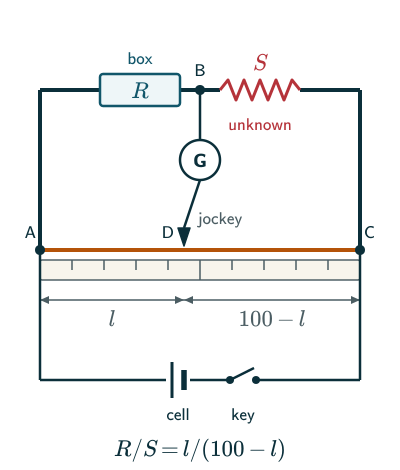
Balance length and the unknown resistance
- Close the key and touch the jockey to the wire at different points until the galvanometer shows no deflection. Let the balance point D be l cm from A.
- The four arms are R (AB), S (BC), the wire AD (length l) and the wire DC (length 100 − l). By the balance condition, R/S = (resistance of AD)/(resistance of DC) = l/(100 − l) (reasoned from NCERT Eq. 3.64(a) and Eq. (3.9)):
Unknown resistance from the balance length
- Repeat for several values of R, so that the balance point falls at different places, and take the mean of the values of S.
End corrections
- The ends of the wire, where it joins the copper strips, add a little resistance, and the scale’s zero may not lie exactly at the end of the wire. These act like small extra lengths at A and at C, the end corrections (standard laboratory practice).
- A balance point near the middle limits relative length errors and reduces end effects (equal end corrections cancel at the exact midpoint, but unequal ones can leave a bias). Choose R to bring l between about 30 cm and 70 cm, as the NCERT Laboratory Manual (Physics, Class 12, Experiment 2) advises in its procedure and precautions (pages 30 and 32).
- A common check is to interchange R and S and repeat: the balance point moves to about 100 − l. The mean of the two values of S cancels the leading contribution from unequal end corrections to first order at the two ends, such as a scale zero that is not quite at the end of the wire; equal end corrections matter least when the balance point is near the middle (reasoned from the balance condition).
- Near the middle, a given error Δl in locating the balance point also gives the smallest percentage error in S: from S = R(100 − l)/l, ΔS/S = Δl/l + Δl/(100 − l), which is least at l = 50 cm. This minimises the relative error from a fixed length-reading uncertainty; galvanometer sensitivity is related but also depends on the circuit resistances (reasoned from the balance relation).
Resistivity from the resistance, length and diameter
Before locating the null, check that touching the jockey near opposite ends gives opposite galvanometer deflections; this checks the circuit is working (NCERT Laboratory Manual, Experiment 2). Apply meter zero corrections, take diameter readings in perpendicular directions, and measure only the test-wire length between its terminals.
- Measure the length L of the unknown wire between the terminals of its gap with the metre scale, and its diameter d with a screw gauge at several places, taking the mean.
- Its cross-section is A = πd2/4, and from S = ρL/A (NCERT Eq. (3.9), page 84):
Resistivity from the bridge
- Precautions (standard laboratory practice): keep all connections tight and clean; press the jockey gently and do not slide it along the wire, which would scrape it and spoil its uniformity; pass the current only while taking a reading, so the wires do not heat up, since resistivity changes with temperature (NCERT Section 3.8, page 90).
Solved examples
Example 1: The unknown resistance
With R = 4.0 Ω in the left gap, the bridge balances at l = 40.0 cm. Find S.
Answer: S = R(100 − l)/l = 4.0 × 60.0/40.0 = 6.0 Ω (reasoned from NCERT Eq. 3.64(a)).
Example 2: Interchanging R and S
After the first reading (R = 4.0 Ω, l = 40.0 cm), R and S are interchanged and the balance point is found at 59.8 cm from A. Find the mean value of S.
Answer: now S is in the left gap, so S/R = 59.8/40.2 and S = 4.0 × 59.8/40.2 ≈ 5.95 Ω. With the first value, 6.0 Ω, the mean is about 5.98 Ω. The interchanged point is 0.2 cm short of 100 − 40.0 = 60.0 cm, which is consistent with unequal end corrections in this model; reading error or nonuniform wire can also shift it. Interchanging reduces leading unequal-end error but does not exactly eliminate every systematic error.
Example 3: Resistivity of the wire
The unknown wire of Example 1 (S = 6.0 Ω) is 0.50 m long and 0.40 mm in diameter. Find its resistivity.
Answer: A = πd2/4 = 3.14 × (0.40 × 10−3)2/4 ≈ 1.26 × 10⁻⁷ m2. Then ρ = SA/L = 6.0 × 1.26 × 10−7/0.50 ≈ 1.5 × 10⁻⁶ Ω m (NCERT Eq. (3.9), page 84), just above the range NCERT gives for metals, 10−8 to 10−6 Ω m (page 90).
Example 4: Which measurement matters most?
In Example 3, d is read to ±0.01 mm, L to ±0.1 cm and S is known to ±1 %. Estimate the percentage error in ρ.
Answer: to first order, the maximum fractional uncertainty is Δρ/ρ ≈ ΔS/S + 2Δd/d + ΔL/L = 1 % + 2 × 0.01/0.40 + 0.1/50 = 1 % + 5 % + 0.2 % = 6.2 %. In this example the diameter uncertainty, which enters twice, dominates (see combination of errors).
Common mistakes to avoid
Common mistake
Measuring l from the wrong end
Measure l from the end of the wire on the side of the gap that holds R. If R and S are swapped, the length to use changes too.
Common mistake
Accepting a balance point near one end
Near the ends the end corrections matter most, and a given error in reading l gives the largest percentage error in S; adjust R to bring the balance point near the middle.
Common mistake
Sliding the jockey along the wire
Scraping the wire makes it non-uniform, so its resistance is no longer proportional to length; touch and lift the jockey instead.
Quick revision summary
- A metre bridge is a Wheatstone bridge whose two lower arms are the parts AD and DC of a uniform 1 m wire.
- At balance, R/S = l/(100 − l), so S = R(100 − l)/l, with l in cm from the end next to R.
- End corrections come from the joins at the ends of the wire; keep l near the middle, and interchange R and S to reduce unequal end errors to first order.
- Resistivity: ρ = πdS/(4L), with d from a screw gauge; the diameter, squared, carries the largest error.
- Press the jockey, do not slide it; pass the current only while reading.
Formula sheet
- balance: R/S = l/(100 − l)
- S = R(100 − l)/l
- ρ = πdS/(4L)
- error: Δρ/ρ = ΔS/S + 2Δd/d + ΔL/L
- best balance point: near the middle of the wire
Questions students ask
Is the metre bridge deleted from NCERT Class 12, and is it in the JEE Main and NEET syllabus?
The metre bridge is still in both syllabuses, though the current NCERT Class 12 book only names it: the JEE Main syllabus and the NEET (UG) 2026 syllabus list “Metre Bridge” in Unit 12 and, in Unit 20, “The resistivity of the material of a given wire using a metre bridge.” NCERT Class 12 Physics Part I mentions it in one line near the end of its Wheatstone bridge section (page 101), and the experiment is Experiment 2 of the NCERT Laboratory Manual Physics Class XII (pages 28–35). The potentiometer, by contrast, is in neither syllabus and has no section in the 2026–27 NCERT Chapter 3.
How are the end corrections of a metre bridge found?
The end corrections of a metre bridge are found by treating them as extra lengths α and β of bridge wire at the two ends, so that the balance condition becomes R/S = (l + α)/(100 − l + β), and taking two balances with known resistances, the second with them interchanged (beyond the NCERT text, reasoned from the balance condition). With 3.0 Ω in the left gap and 2.0 Ω in the right, say the balance is at 60.4 cm, and at 40.1 cm with them interchanged: then 1.5(39.6 + β) = 60.4 + α and 59.9 + β = 1.5(40.1 + α), which give α = 0.5 cm and β = 1.0 cm. These are then added to the two lengths in every later reading.
Why is a metre bridge not suitable for very low or very high resistances?
A metre bridge is unsuitable for a very low resistance because the resistances of the copper strips, terminals and leads, which the balance condition leaves out, are then no longer small beside it: if they add 0.02 Ω in the gap, a 0.50 Ω wire is measured 4 % too high (reasoned from the balance condition; the NCERT Laboratory Manual Physics Class XII lists these end resistances among the sources of error and sets this very question, Experiment 2, pages 33–34). For a very high resistance, the known resistance must be about as high to keep the balance point near the middle, and then so little current reaches the galvanometer through them near balance that the null point cannot be found sharply.
How is a metre bridge different from a Wheatstone bridge?
A metre bridge is a Wheatstone bridge in a practical form, not a different circuit: two of its arms are the two parts of one uniform wire, so balance is found by moving a jockey along it and the ratio of those arms is read as a ratio of lengths, l/(100 − l), whereas in NCERT’s Wheatstone bridge all four arms are resistors and the standard arm is varied (NCERT Section 3.13, page 101). That makes the ratio continuously adjustable with one known resistance, at the cost of end corrections and the need for a uniform wire. For why a bridge beats the ammeter–voltmeter circuit, see the Ohm’s law experiment.
Why is it called a metre bridge, and is it spelt ‘metre’ or ‘meter’?
The metre bridge is so called because its bridge wire is one metre long, so the balance length is read straight off a metre scale, from 0 to 100 cm. Both spellings name the same instrument: NCERT Class 12 Physics Part I prints “meter bridge” (page 101), while the JEE Main syllabus, the NEET (UG) 2026 syllabus and the NCERT Laboratory Manual Physics Class XII write “metre bridge”, the British spelling. The 1 m length is only a convenience: for a wire of length L the balance condition keeps its form with 100 replaced by L, and the manual asks what changes with a 50 cm wire (page 34).
Practice questions
Try each question first, then open the answer to check your working.
-
Q1. With R = 10 Ω, a metre bridge balances at 55.0 cm from the end next to R. Find S.
Show answerHide answer
S = R(100 − l)/l = 10 × 45.0/55.0 ≈ 8.2 Ω.
-
Q2. Why should the balance point lie near the middle of the wire?
Show answerHide answer
There equal end corrections cancel in the ideal model (unequal ones may not), and a given error Δl in reading the balance point gives the smallest percentage error in S, since ΔS/S = Δl/l + Δl/(100 − l) is least at l = 50 cm.
-
Q3. Why must the wire of a metre bridge be uniform?
Show answerHide answer
So that the resistance of each part is proportional to its length (R = ρl/A, NCERT Eq. (3.9), page 84), which turns the bridge ratio into a ratio of lengths.