Magnetic force and the Lorentz force
NCERT Class 12 Physics Chapter 4 Sections 4.1–4.2
Quick answer
A charge q moving with velocity v through a magnetic field B feels a force of size |q|vB sin θ, where θ is the angle between v and B, at right angles to both v and B; with an electric field as well, the total is the Lorentz force F = q(E + v × B). The magnetic force is zero for a charge at rest or one moving along or against B, and it does no work. In a uniform external field, a straight wire carrying a current I feels F = I l × B, with l pointing along the current.
With your textbook
NCERT Physics Part I (Class 12), Chapter 4 “Moving Charges and Magnetism”, Sections 4.1–4.2 “Introduction” and “Magnetic Force”, pages 107–111.
Open the official NCERT chapter (PDF, 3.7 MB, ncert.nic.in) (opens in a new tab)
Checked against the 2026-27 reprint on .
What is the magnetic force?
The Lorentz force
A charge q moving with velocity v through an electric field E and a magnetic field B feels the force F = q[E + v × B] (NCERT Eq. (4.3), page 109). NCERT names it after the physicist who first wrote it down:
This force was given first by H.A. Lorentz based on the extensive experiments of Ampere and others. It is called the Lorentz force.
NCERT Physics Part I (Class 12), Section 4.2.2, page 109
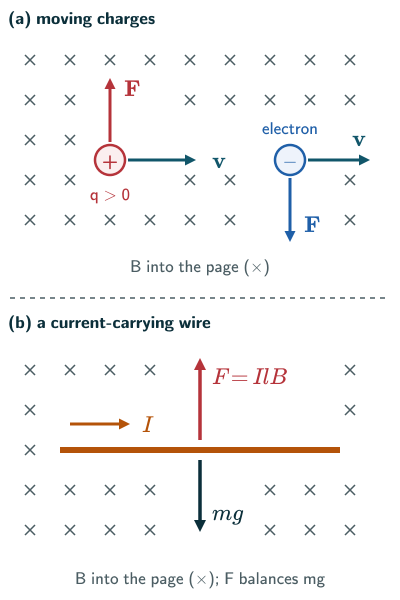
The part q(v × B) is the magnetic force. It acts only on a moving charge, and it is always at right angles to both the velocity and the field.
In plain words: an electric field pushes on a charge whether it moves or not. A magnetic field ignores a charge at rest, and pushes a moving charge sideways, never forwards or backwards. A wire carrying a current is full of moving charges, so it feels this sideways push too.
Sources and fields
- In Chapter 1, a charge Q produces an electric field E = Qr̂/(4πε0r2) (NCERT Eq. (4.1)), and a charge q placed in it feels F = qE (NCERT Eq. (4.2), page 109). See the electric field for why the field is more than a calculating device.
- The field is real: it can carry energy and momentum, and it takes a finite time to set up. In this chapter the fields are taken not to change with time (page 109).
- Just as static charges produce an electric field, currents or moving charges produce, in addition, a magnetic field B(r), a vector field defined at each point in space (page 109).
- Experimentally, magnetic fields obey the principle of superposition: the field of several sources is the vector sum of the fields of each source (page 109).
- NCERT’s convention for directions at right angles to the page: a dot (⊙) is a current or field coming out of the page, a cross (⊗) one going into it, like the tip and the feathered tail of an arrow (page 108).
Magnetic field, Lorentz force
Here q is a signed charge; force magnitudes use |q|. The magnetic part alone does no work on a classical point charge; an electric field or another force can still change its speed. All fields and velocities must refer to the same inertial frame.
When a charge q moves with velocity v where there are both fields, the total force on it is (NCERT Eq. (4.3), page 109):
Lorentz force (NCERT Eq. 4.3)
The magnetic part, q(v × B), has three features (NCERT pages 109–110):
- It depends on q, v and B. The force on a negative charge is opposite to that on a positive charge.
- Because it is a vector product, it is zero when v and B are parallel or antiparallel, and it acts sideways, perpendicular to both v and B. Its direction follows the screw rule or the right-hand rule for a vector product (NCERT Figure 4.2).
- It is zero for a charge at rest: only a moving charge feels the magnetic force.
If θ is the angle between v and B, the size of the force is (NCERT page 110):
Size of the magnetic force
- It is largest, |q|vB, when the charge moves at right angles to the field (reasoned from sin 90° = 1).
- Because the force is always at right angles to the velocity, it does no work on the charge and cannot change its speed, only its direction (NCERT Summary point 1, page 132; see motion in a magnetic field).
- Seen from a frame moving with the charge, the magnetic part of the force vanishes and an electric field accounts for the motion instead; NCERT notes that this shows electricity and magnetism are linked, and does not go into details (NCERT Points to Ponder 3, page 134).
Unit of magnetic field: the tesla
- Put q, F and v all equal to one in F = qvB sin θ: the field is 1 SI unit when a charge of 1 C moving at 1 m/s at right angles to it feels a force of 1 N (NCERT page 110).
- From [B] = [F/qv], the unit is the newton second per coulomb metre, N s C−1 m−1, called the tesla (T) after Nikola Tesla (1856–1943) (page 110). Since 1 A = 1 C s−1, this is also 1 N A−1 m−1 (reasoned).
- The dimensions of B are [M T−2 A−1] (NCERT table, page 134).
- The tesla is a large unit. A smaller non-SI unit, the gauss (G), is often used: 1 G = 10−4 T (page 110).
- The earth’s magnetic field is about 3.6 × 10⁻⁵ T (page 110); NCERT Example 4.1 rounds it to about 4 × 10⁻⁵ T (page 111).
Magnetic force on a current-carrying conductor
NCERT extends the force on one charge to a straight rod carrying a steady current I in a uniform external magnetic field (NCERT page 110):
- The rod has length l and cross-section A, with n mobile carriers per unit volume, each of charge q. So it holds nlA carriers, each moving with the average drift velocity vd.
- In an external field B, the total force on them is F = (nlA)qvd × B.
- Now nqvd is the current density j, and |nqvd|A is the current I. Moving the vector sign from j to the length gives (NCERT Eq. (4.4), page 110):
Force on a straight conductor (NCERT Eq. 4.4)
- Here l is a vector of size l, the length of the rod, pointing along the current. The current I itself is not a vector (page 110).
- l points along the current even though the carriers are electrons: for them q is negative and vd points against the current, so qvd, and with it j, points along the current (reasoned).
- B is the external field, not the field made by the rod’s own current (page 110).
- The size of the force is IlB sin θ, with θ the angle between the wire and the field (reasoned from NCERT Eq. (4.4)).
- For a wire of any shape, split it into short straight pieces dlj and add the forces I dlj × B; in most cases the sum becomes an integral (page 110).
- In a uniform field the pieces dlj add up to the straight line from one end of the wire to the other, so a bent wire feels the same force as a straight wire joining its ends, and a closed loop feels no net force (reasoned from the sum on page 110; NCERT gives F = 0 for a loop in a uniform field in Summary point 10, page 133).
Solved examples
Example 1: A wire held up by a magnetic field (NCERT Example 4.1)
A straight wire of mass 200 g and length 1.5 m carries a current of 2 A. A uniform horizontal magnetic field at right angles to the wire (NCERT Figure 4.3) holds it in mid-air. Find the size of the field.
Answer: the magnetic force IlB acts upwards and must balance the weight: mg = IlB, so B = mg/(Il) = 0.2 × 9.8/(2 × 1.5) ≈ 0.65 T (NCERT page 111). Only the mass per unit length, m/l, matters, and the earth’s field is ignored.
Example 2: Electron and proton (NCERT Example 4.2)
A magnetic field is along the positive y-axis and a charged particle moves along the positive x-axis. Which way is the Lorentz force on (a) an electron, (b) a proton?
Answer: v × B points along x̂ × ŷ = ẑ. So (a) on an electron the force is along −z, and (b) on a proton it is along +z (NCERT page 111).
Example 3: Force on a proton at an angle
A proton moves at 2.0 × 10⁶ m/s at 30° to a field of 0.50 T. Find the magnetic force on it.
Answer: F = qvB sin θ = 1.6 × 10−19 × 2.0 × 106 × 0.50 × 0.50 = 8.0 × 10⁻¹⁴ N, at right angles to both the velocity and the field (NCERT page 110).
Example 4: A semicircular wire
A wire bent into a semicircle of radius 0.10 m carries 2.0 A in a uniform field of 0.50 T at right angles to the plane of the semicircle. Find the net force on it.
Answer: in a uniform field the bent wire feels the same force as the straight diameter joining its ends, of length 2 × 0.10 = 0.20 m. So F = IlB = 2.0 × 0.20 × 0.50 = 0.20 N, at right angles to that diameter (reasoned from NCERT Eq. (4.4) and the sum on page 110).
Common mistakes to avoid
Common mistake
Expecting a force on a charge at rest or moving along the field
The magnetic force is qvB sin θ: it is zero when v = 0 and when the velocity is parallel or antiparallel to B (NCERT pages 109–110).
Common mistake
Using the same direction for an electron as for a proton
The force on a negative charge is opposite to that on a positive charge moving the same way. Find v × B, then reverse it for an electron (NCERT page 109).
Common mistake
Including the wire’s own field in F = Il × B
B in NCERT Eq. (4.4) is the external field, not the field produced by the current in the wire itself (NCERT page 110).
Quick revision summary
- Moving charges and currents produce a magnetic field B, a vector field that obeys superposition.
- Lorentz force: F = q(E + v × B); the magnetic part has size |q|vB sin θ and acts at right angles to both v and B.
- The magnetic force is zero for a charge at rest or moving along or against B, reverses for a negative charge, and does no work.
- 1 T = 1 N s C m; 1 G = 10 T; the earth’s field is about 3.6 × 10 T.
- Straight conductor: F = Il × B, with l along the current and B the external field; a closed loop in a uniform field feels no net force.
Formula sheet
- F = q(E + v × B)
- F = |q|vB sin θ
- F = I l × B
- F = IlB sin θ
- 1 T = 1 N s C m = 10 G
Questions students ask
What is the difference between electric force and magnetic force on a charge?
The electric force on a charge, qE, acts whether the charge moves or not and points along E (against it for a negative charge), while the magnetic force, qv × B, acts only on a moving charge, at right angles to both v and B (NCERT pages 109–110). The magnetic force also depends on the speed and direction of motion, as qvB sin θ, and is zero for motion along the field. Being always sideways to the motion, it only turns a charge, while an electric force can also speed it up or slow it down (NCERT page 112).
What is the difference between magnetic field and magnetic force?
The magnetic field B is a vector field that currents, moving charges and magnets set up at every point around them, measured in tesla, while the magnetic force is the push, in newtons, that a moving charge or a current feels in that field: qv × B on a charge and Il × B on a straight wire (NCERT pages 109–110). The field is there whether or not anything is placed in it to feel it. Unlike the electric force, the magnetic force never points along the field: it is at right angles to B, so a moving charge is pushed across the field lines, not along them.
Is the Lorentz force the same as Lenz’s law?
No, the Lorentz force and Lenz’s law are different ideas: the Lorentz force, F = q(E + v × B), is the force on a charge in electric and magnetic fields (NCERT Chapter 4, page 109), while Lenz’s law gives the direction of an induced current, which opposes the change in flux that produces it (NCERT Chapter 6, Section 6.5, page 160). They meet in motional emf: the Lorentz force on the free charges of a moving rod drives the induced current, and the force Il × B on that current opposes the rod’s motion, as Lenz’s law requires (beyond the NCERT text, reasoned from NCERT pages 162–163).
If the magnetic force does no work, how does it move a current-carrying wire in a motor?
A current-carrying wire in a motor is moved by the magnetic force, yet that force still does no net work: the energy comes from the source driving the current (beyond the NCERT text, reasoned from NCERT Eq. (4.3)). Each charge in the moving wire has its drift along the wire plus the wire’s sideways motion, and the force qv × B, at right angles to the total, has two parts: one pushes the wire sideways and does positive work, the other pushes back against the current and does an equal negative work. That backward push is a motional emf, and the work the source does against it equals the work done on the wire.
Can Fleming’s left-hand rule be used to find the direction of the Lorentz force?
Yes, for the magnetic part of the Lorentz force; an electric force qE must be added separately. Fleming’s left-hand rule gives the same direction as the cross product in F = Il × B: hold the thumb, forefinger and middle finger of the left hand at right angles, point the forefinger along the field and the middle finger along the current, and the thumb gives the force (NCERT Class 10 Science, Chapter 12, page 203). For a single charge, point the middle finger along the velocity of a positive charge, but opposite to it for an electron. The rule is set up for a current at right angles to the field; at other angles, apply it to the part of B at right angles to the motion, or use the right-hand rule for v × B given on this page (NCERT Class 12, page 110).
Which chapter covers the Lorentz force, and is it in the JEE Main and NEET syllabus?
The Lorentz force is in NCERT Class 12 Physics Part I, Chapter 4, Moving Charges and Magnetism (Sections 4.1–4.2, pages 107–111), and it is in both exams, though neither syllabus uses the name. Unit 13, Magnetic Effects of Current and Magnetism, of both the JEE Main and the NEET (UG) 2026 syllabus lists “Force on a moving charge in uniform magnetic and electric fields”, which is F = q(E + v × B), and the force on a current-carrying conductor in a uniform magnetic field, F = Il × B. The circles and helices this force produces are in NCERT Section 4.3, Motion in a Magnetic Field (pages 112–113).
Practice questions
Try each question first, then open the answer to check your working.
-
Q1. An electron moves at 3.0 × 10⁶ m/s at right angles to a field of 0.20 T. Find the size of the magnetic force on it.
Show answerHide answer
F = qvB = 1.6 × 10−19 × 3.0 × 106 × 0.20 ≈ 9.6 × 10⁻¹⁴ N (NCERT page 110).
-
Q2. Why does a magnetic field not change the speed of a charged particle?
Show answerHide answer
The magnetic force is always at right angles to the velocity, so it does no work; it changes only the direction of motion (NCERT Summary point 1, page 132).
-
Q3. A wire 0.50 m long carries 4.0 A parallel to a uniform field of 0.30 T. What force acts on it?
Show answerHide answer
None: with the wire along the field, θ = 0 and IlB sin θ = 0 (reasoned from NCERT Eq. (4.4), page 110).