Ampere’s circuital law
NCERT Class 12 Physics Chapter 4 Section 4.6
Quick answer
For steady currents in vacuum, Ampere’s circuital law says that the line integral of B round any closed loop equals μ times the current passing through the loop, with the sign set by the right-hand rule. For a long straight wire, a circle of radius r round it gives B × 2πr = μI, so B = μI/(2πr), with the field lines circling the wire. Inside a thick wire carrying a uniform current the field rises in proportion to r.
With your textbook
NCERT Physics Part I (Class 12), Chapter 4 “Moving Charges and Magnetism”, Section 4.6 “Ampere’s Circuital Law”, pages 117–121.
Open the official NCERT chapter (PDF, 3.7 MB, ncert.nic.in) (opens in a new tab)
Checked against the 2026-27 reprint on .
What is Ampere’s circuital law?
Ampere’s circuital law
Take any closed loop and add up the part of the magnetic field along the loop, element by element, all the way round. Ampere’s circuital law says this sum, the line integral of B round the loop, equals μ0 times the current passing through the loop (NCERT Section 4.6, pages 117–118). NCERT relates it to the laws you already know:
Ampere’s law is to Biot-Savart law, what Gauss’s law is to Coulomb’s law.
NCERT Physics Part I (Class 12), Section 4.6, page 119
In plain words: walk round any closed path in a magnetic field and keep a running total of how much of the field points along your path. The total depends only on the current threading through your path, not on the shape of the path. When the path is chosen to match the symmetry of the currents, that total gives the field almost at once.
Statement of the law
- Take an open surface with a boundary C, with a current passing through the surface. Split the boundary into small elements dl, and at each take the tangential component of the field, Bt. Add the products Bt dl = B·dl all round the boundary (NCERT pages 117–118, Figure 4.12).
- In the limit of many small elements the sum becomes a line integral, and Ampere’s law states (NCERT Eq. [4.13(a)], page 118):
Ampere’s circuital law (NCERT Eq. 4.13(a))
- I is the total current through the surface. Sign: curl the fingers of the right hand in the sense in which the boundary is traversed; the thumb gives the direction in which the current counts as positive (page 118).
- Simplified form. Often the loop, called an amperian loop, can be chosen so that at each point B is either tangential to it with a constant non-zero size B, or normal to it, or zero. If L is the length on which B is tangential in the chosen traversal direction (opposite-directed portions need minus signs) and Ie the current enclosed, then (NCERT Eq. [4.13(b)], page 118):
Simplified form (NCERT Eq. 4.13(b))
- Ampere’s law is not new in content: it follows from the Biot–Savart law and expresses the same physics, just as Gauss’s law follows from Coulomb’s law (NCERT page 119; Points to Ponder 4, page 134). Like Gauss’s law, it relates a field on a boundary to the source inside it.
- In this vacuum form, I includes all enclosed current, and the magnetostatic version holds for steady currents that do not change with time (page 119).
- It holds for any loop, but it gives the field easily only when there is enough symmetry. For example, it cannot be used to get B = μ0I/(2R) at the centre of a circular loop (NCERT page 120).
- Currents outside the loop do not appear on the right-hand side, although they do change B at points on the loop; their contributions to the integral round the loop add up to zero (reasoned from the law).
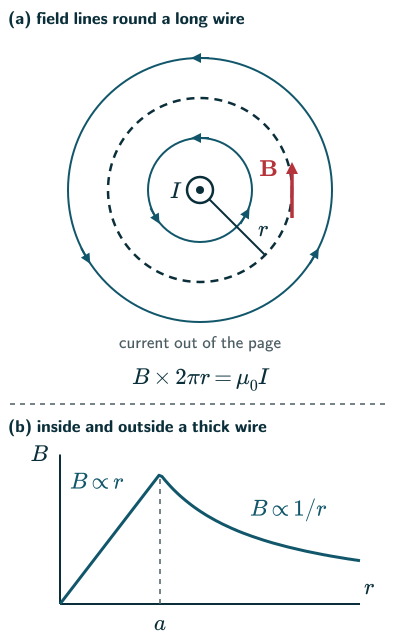
Field of an infinitely long straight wire
- For a straight infinite wire carrying a current I, take the amperian loop to be a circle of radius r centred on the wire, at right angles to it. The field is tangential to the circle and the same all round it, so the left side of the law is B × 2πr (NCERT page 118):
Field of a long straight wire (NCERT Eq. 4.14)
- Cylindrical symmetry: the field has the same size at every point of the circle, so it depends on only one coordinate, r (NCERT page 119).
- Field lines are circles round the wire, the same circles traced by iron filings in NCERT Figure 4.1(c). Magnetic field lines form closed loops, unlike electric field lines, which start on positive charges and end on negative ones. This explains Oersted’s observations (page 119).
- Finite field: although the wire is infinite, the field at a non-zero distance is finite; it is proportional to I and inversely proportional to r, and tends to blow up only when we come very close to the wire (page 119). Strictly, that happens only in the ideal zero-radius filament model; for a wire of finite radius the field stays finite, as the thick-wire result below shows (reasoned).
- Right-hand rule for a straight wire (NCERT page 119):
Grasp the wire in your right hand with your extended thumb pointing in the direction of the current. Your fingers will curl around in the direction of the magnetic field.
NCERT Physics Part I (Class 12), Section 4.6, page 119
- There are two right-hand rules: this one, and the one for the axis of a current loop. Fingers and thumb swap roles between them (NCERT footnote, page 119).
- Inside a thick wire of radius a carrying a uniform current I, an amperian circle of radius r < a encloses only Ie = Ir2/a2. Then B(2πr) = μ0Ir2/a2, so B = μ0Ir/(2πa2), rising in proportion to r. Outside, r > a, the field is μ0I/(2πr), as for a thin wire (NCERT Example 4.7, Eqs. [4.15(a)]–[4.15(b)], pages 119–120). The field is largest at the surface, r = a (NCERT Figure 4.14).
- NCERT slip: page 118 says the straight-wire case “is exhibited in the Example 4.8 below”; the straight-wire example that follows is Example 4.7 (page 119); Example 4.8 (page 122) is about a solenoid.
Solved examples
Example 1: Inside and outside a thick wire (after NCERT Example 4.7)
A long straight wire of radius 2.0 mm carries 10 A spread uniformly over its cross-section. Find the field at 1.0 mm, 2.0 mm and 4.0 mm from its axis.
Answer: with μ0/2π = 2 × 10⁻⁷ T m A−1, inside, B = μ0Ir/(2πa2) = 2 × 10−7 × 10 × 0.0010/(0.0020)2 = 5.0 × 10⁻⁴ T at 1.0 mm. At the surface, B = μ0I/(2πa) = 2 × 10−7 × 10/0.0020 = 1.0 × 10⁻³ T. Outside, at 4.0 mm, B = 2 × 10−7 × 10/0.0040 = 5.0 × 10⁻⁴ T (NCERT Eqs. [4.15(a)]–[4.15(b)], page 120).
Example 2: A long straight wire (NCERT Exercise 4.2)
A long straight wire carries 35 A. Find the field 20 cm from it.
Answer: B = μ0I/(2πr) = 2 × 10−7 × 35/0.20 = 3.5 × 10⁻⁵ T (NCERT Eq. (4.14), page 118).
Example 3: Direction of the field (NCERT Exercise 4.3)
A long straight wire in a horizontal plane carries 50 A from north to south. Find the size and direction of the field 2.5 m east of the wire.
Answer: B = 2 × 10−7 × 50/2.5 = 4.0 × 10⁻⁶ T. With the thumb pointing south, the fingers curl so that on the east side of the wire they point vertically upwards (right-hand rule, NCERT page 119).
Example 4: Below a power line (NCERT Exercise 4.4)
A horizontal power line carries 90 A from east to west. Find the field 1.5 m below it.
Answer: B = 2 × 10−7 × 90/1.5 = 1.2 × 10⁻⁵ T. With the thumb pointing west, the fingers point towards the south below the wire (right-hand rule, NCERT page 119).
Common mistakes to avoid
Common mistake
Counting currents outside the amperian loop
Only the current passing through the loop goes on the right-hand side. Outside currents still change B on the loop, but their contributions to the line integral add up to zero. So a zero line integral does not mean B is zero on the loop: B = 0 follows from this reduction only when symmetry makes the field tangential with the same signed component all round it (reasoned from NCERT Eq. [4.13(a)], page 118).
Common mistake
Using μI/2πr inside a thick wire
Inside a wire carrying a uniform current only part of the current is enclosed, so B = μIr/(2πa), which rises with r (NCERT Example 4.7, page 120).
Common mistake
Mixing up the two right-hand rules
For a straight wire the thumb points along the current and the fingers give B; for a loop the fingers follow the current and the thumb gives B (NCERT footnote, page 119).
Quick revision summary
- Ampere’s law: the line integral of B round a closed loop equals μ times the current through it, with the sign set by the right-hand rule.
- With a well-chosen amperian loop it reduces to BL = μIe; it holds for steady currents and follows from the Biot–Savart law.
- Long straight wire: B × 2πr = μI, so B = μI/(2πr), circles round the wire, cylindrical symmetry; direction by grasping the wire with the thumb along the current.
- Thick wire of radius a with a uniform current: B ∝ r inside, B ∝ 1/r outside, largest at the surface.
- The law holds for every loop but gives B easily only for symmetric currents (not, for example, at the centre of a loop).
Formula sheet
- ∮ B · dl = μI
- BL = μ0 Ie
- B = μI/(2πr)
- inside a uniform wire: B = μIr/(2πa)
- B ∝ r inside, ∝ 1/r outside
Questions students ask
What is the difference between the Biot–Savart law and Ampere’s circuital law?
The Biot–Savart law gives the field of each small element of a current, to be added up over the whole circuit, while Ampere’s circuital law relates the line integral of B round a closed loop to the current through it (NCERT pages 113 and 118). For steady currents they hold the same physics: Ampere’s law can be derived from the Biot–Savart law, as Gauss’s law from Coulomb’s law (NCERT Points to Ponder 4, page 134). In use, the Biot–Savart law works for any shape, such as a loop or a short straight piece, but needs an integration, while Ampere’s law gives B quickly only where symmetry makes it constant along a loop: a long straight wire, a thick wire, a long solenoid (NCERT page 120).
What is the difference between Gauss’s law and Ampere’s circuital law?
Gauss’s law relates the electric flux through a closed surface to the charge inside, ϕ = q/ε0 (NCERT Chapter 1, page 30), while Ampere’s circuital law relates the line integral of B round a closed loop to the current through it, ∮ B·dl = μ0I (NCERT page 118): one sums over a surface, the other along a curve. Both link a field on a boundary to the source inside, and both give the field easily only for a symmetric choice of surface or loop (NCERT pages 118–119). Gauss’s law for magnetism is different again: zero magnetic flux through any closed surface (NCERT Chapter 5, page 143).
Why can Ampere’s circuital law not be used to find the field of a finite straight wire?
Ampere’s circuital law cannot give the field of a finite straight wire because the law holds only for steady currents round complete circuits, and a finite piece is not a whole circuit (beyond the NCERT text, reasoned from NCERT pages 118–120). For the whole circuit the law still holds on a circle round the piece, but the rest of the circuit makes B vary round it, so it cannot be taken out as B × 2πr. The piece’s own field, from the Biot–Savart law, is the same all round but does not obey the law alone: opposite the middle of a piece twice as long as r, it is about 71% of μ0I/(2πr).
Why did Maxwell modify Ampere’s circuital law?
Maxwell modified Ampere’s circuital law because, as ∮ B·dl = μ0I, it holds only for steady currents and contradicts itself when a current changes, as while a capacitor charges (NCERT Chapter 8, Section 8.2, pages 202–203). A loop round the wire bounds both a flat surface the current crosses and a pot-shaped surface between the plates that it does not, so the law gives two different fields at one point. He added a displacement current, ε0 dΦE/dt, to the conduction current, giving the Ampere–Maxwell law (NCERT pages 203–204), which reduces to this law for steady currents.
Are Ampere’s law, Ampere’s circuital law and Ampere’s force law the same thing?
Ampere’s law and Ampere’s circuital law are two names for the same law, ∮ B·dl = μ0I: NCERT uses both (NCERT pages 117–118), and the JEE Main and NEET (UG) 2026 syllabuses write “Ampere’s law” (Unit 13). Ampere’s force law is a different result: the law of the force between current-carrying wires, which Ampere studied from 1820 to 1825 and published in 1827 (NCERT pages 118 and 122). For two long parallel wires it makes parallel currents attract and antiparallel currents repel.
Which applications of Ampere’s circuital law are in the JEE Main and NEET syllabus?
Two applications of Ampere’s circuital law are named in both syllabuses: Unit 13 of JEE Main and of NEET (UG) 2026 lists “Ampere’s law and its applications to infinitely long current carrying straight wire and solenoid”, which NCERT Class 12 Physics Part I covers in Sections 4.6 and 4.7 (pages 117–122). The field inside and outside a thick wire, NCERT Example 4.7, uses the same method on a straight wire. The toroid, done with Ampere’s law in older NCERT editions, has no section in the current book, which names it only in passing (NCERT Examples 5.1 and 5.3, pages 140 and 144), and neither syllabus lists it.
Practice questions
Try each question first, then open the answer to check your working.
-
Q1. Find the field 5.0 cm from a long straight wire carrying 15 A.
Show answerHide answer
B = μI/(2πr) = 2 × 10−7 × 15/0.050 = 6.0 × 10⁻⁵ T (NCERT Eq. (4.14), page 118).
-
Q2. An amperian circle surrounds two long wires carrying 3 A and 5 A in opposite directions. What is the line integral of B round it, in terms of μ?
Show answerHide answer
Count the 5 A direction as positive, that is, traverse the circle the way the right-hand fingers curl when the thumb points along the 5 A current. The enclosed current is then 5 − 3 = 2 A, so the integral is μ × (2 A) = 8π × 10−7 T m ≈ 2.5 × 10⁻⁶ T m. Traversed the other way it is −μ × (2 A) (NCERT Eq. [4.13(a)] and its sign rule, page 118).
-
Q3. For a long straight wire, how does the field change if you go three times as far from it?
Show answerHide answer
It falls to one-third, since B ∝ 1/r (NCERT page 119).