Experiment: resistance and figure of merit of a galvanometer
Beyond NCERT In the JEE Main and NEET syllabus; the Class 12 book has no section for it.
Quick answer
In the half-deflection method a cell, a high resistance R and the galvanometer, of resistance G, are joined in series and the deflection θ is noted; a shunt S across the galvanometer is then adjusted to halve the deflection, neglecting source internal resistance, giving G = RS/(R − S), close to S when R is large. The figure of merit, the current per division, is k = ε/[(R + G)θ], where ε is the cell’s emf. It is the reciprocal of the current sensitivity.
What is this experiment?
The principle behind it
In a moving coil galvanometer the deflection φ is proportional to the current I (NCERT Eq. (4.26), page 130). NCERT measures how responsive it is by the current sensitivity:
We define the current sensitivity of the galvanometer as the deflection per unit current.
NCERT Physics Part I (Class 12), Section 4.10, page 130
The figure of merit is the reciprocal of the current sensitivity measured in divisions per ampere: the current needed for a deflection of one division. Because the deflection is proportional to the current, halving the current through the coil halves the deflection, and this lets you find the coil’s own resistance as well.
The aim is to find the resistance G of a galvanometer by the half-deflection method, and its figure of merit k, the current per scale division.
Both the JEE Main 2027 and the NEET (UG) 2026 syllabuses list this under Unit 20, Experimental Skills: “Resistance and figure of merit of a galvanometer by half deflection method.” The NCERT textbook gives the galvanometer’s theory (Section 4.10, pages 129–132) but not the laboratory method; this page follows the NCERT Laboratory Manual (Physics, Class 12), Experiment 6, pages 53–58.
Half-deflection method
Use a zero-corrected, linear deflection scale and a stable low-voltage laboratory source. The half-deflection result requires R > S > 0 and negligible source internal resistance; if that resistance is r, replace R by R + r. Here k denotes current per division, not the torsional spring constant k used in the galvanometer theory lesson.
Circuit. A cell of emf ε, a key K1, a high resistance box R and the galvanometer G are joined in series. A low resistance box S, the shunt, is joined across G through a second key K2 (NCERT Laboratory Manual, Experiment 6, page 53, Fig. E 6.1).
Step 1. With K2 open, take out a high resistance from R (a few kilohms) and close K1. Adjust R until the deflection θ is large but on the scale, and an even number of divisions. A large θ keeps the reading error, about half a division, a small fraction of it. The current is I1 = ε/(R + G), taking the cell’s internal resistance as negligible (Ohm’s law).
Step 2. Close K2 and, keeping R fixed, adjust S until the deflection falls to θ/2. Now G and S are in parallel, and the current through G is half its earlier value.
Result. Without the shunt, I1 = ε/(R + G). With the shunt, G and S in parallel have a combined resistance GS/(G + S), so the cell drives I = ε/[R + GS/(G + S)], and the share through G is IS/(G + S) = εS/[R(G + S) + GS]. Setting this equal to I1/2 gives 2S(R + G) = R(G + S) + GS, that is RG = RS + GS, or G(R − S) = RS (NCERT Laboratory Manual, Experiment 6, Eqs. (E 6.2)–(E 6.9), pages 54–55):
Galvanometer resistance (half deflection)
- When R is much larger than S, G is close to S. That is why R is kept large: then adding the shunt hardly changes the total current, and nearly half of it goes through each branch.
- The error in taking G = S follows from the formula: G − S = S2/(R − S), so (G − S)/G = S/R. With R = 100S, the shortcut is 1 % low (reasoned from G = RS/(R − S)).
- Repeat for several values of R and take the mean of G.
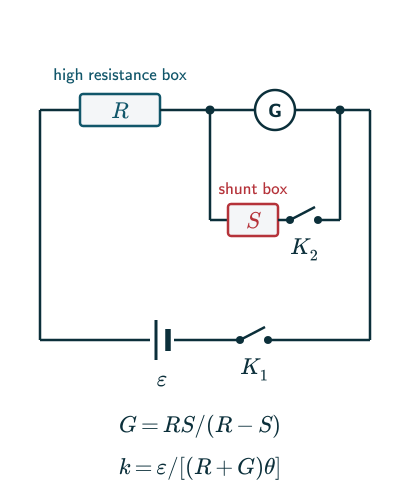
Figure of merit: current per division
- The figure of merit k is the current that gives a deflection of one division. From Step 1, a current ε/(R + G) gives θ divisions, so:
Figure of merit
- Its unit is ampere per division. It is the reciprocal of the current sensitivity in divisions per ampere: a smaller k means a more sensitive galvanometer (reasoned from NCERT Eq. (4.27), page 130).
- The emf ε of the cell must be known, for example estimated with a high-resistance voltmeter across the otherwise open cell, allowing for any residual loading, and the cell should keep a steady emf while the readings are taken (NCERT Laboratory Manual, Experiment 6, pages 56–57).
- Repeat for several values of R; k should come out the same each time, since θ is proportional to the current (NCERT Eq. (4.26)).
- Precautions: keep all connections tight; start with the largest resistance in R, so that the galvanometer is not overloaded; take deflections of even numbers of divisions, so that θ/2 is a whole number; do not change R between Step 1 and Step 2 (NCERT Laboratory Manual, Experiment 6, pages 56–57).
Solved examples
Example 1: Resistance of the galvanometer
With a 2.0 V cell and R = 4900 Ω the deflection is 20 divisions. With a shunt of S = 50 Ω the deflection falls to 10 divisions. Find G.
Answer: G = RS/(R − S) = 4900 × 50/4850 ≈ 50.5 Ω. The simple estimate G ≈ S = 50 Ω is 1 % low.
Example 2: Figure of merit
For Example 1, find the figure of merit and the current sensitivity.
Answer: k = ε/[(R + G)θ] = 2.0/(4950.5 × 20) ≈ 2.0 × 10⁻⁵ A per division, or 20 µA per division. The current sensitivity is 1/k ≈ 5.0 × 10⁴ divisions per ampere.
Example 3: Checking the half deflection
Show that with S = 50 Ω the current through G in Example 1 is half its value without the shunt.
Answer: without the shunt, I1 = 2.0/(4900 + 50.5) ≈ 4.04 × 10⁻⁴ A. With it, G and S in parallel give 50.5 × 50/100.5 ≈ 25.1 Ω, so the total current is 2.0/4925.1 ≈ 4.06 × 10⁻⁴ A, and G takes the fraction 50/100.5 of it: ≈ 2.02 × 10⁻⁴ A, half of I1 (reasoned from Ohm’s law).
Example 4: From figure of merit to an ammeter
The galvanometer of Example 1 has 30 divisions on each side of zero. What shunt turns it into an ammeter reading up to 3.0 A?
Answer: the full-scale current is 30k ≈ 6.06 × 10⁻⁴ A. The shunt must carry the rest at the same potential difference: rs = IgG/(I − Ig) = 6.06 × 10−4 × 50.5/(3.0 − 0.0006) ≈ 0.010 Ω (reasoned from Ohm’s law).
Common mistakes to avoid
Common mistake
Taking G = S without checking R
G ≈ S only when R is much larger than S; otherwise use G = RS/(R − S).
Common mistake
Changing R after closing the shunt key
R must stay fixed between the two readings, or the half deflection no longer compares the same currents.
Common mistake
Confusing figure of merit with sensitivity
The figure of merit is current per division; the current sensitivity is divisions per unit current. A smaller figure of merit means a more sensitive galvanometer.
Quick revision summary
- Circuit: cell, key, high resistance R and galvanometer G in series; shunt S across G through a second key.
- Without the shunt: deflection θ for I1 = ε/(R + G). With the shunt adjusted for θ/2: G = RS/(R − S), close to S when R ≫ S.
- Figure of merit k = ε/[(R + G)θ], the current per division; the current sensitivity is 1/k.
- Keep R large and fixed, use even deflections, and repeat for several R.
- Full-scale current = k × number of divisions; it sets the shunt or series resistance for conversion.
Formula sheet
- G = RS/(R − S) ≈ S (R ≫ S)
- k = ε/[(R + G)θ]
- current sensitivity = 1/k
- I1 = ε/(R + G)
- full scale: Ig = k × divisions
Questions students ask
Is the half-deflection method in NCERT, and is it in the JEE Main and NEET syllabus?
The half-deflection method is not in the NCERT Class 12 Physics textbook, which gives only the galvanometer’s theory (Section 4.10, pages 129–132), but it is Experiment 6 of the NCERT Laboratory Manual Physics Class XII (pages 53–58), and both syllabuses list it: item 12 of Unit 20, Experimental Skills, of JEE Main and NEET (UG) 2026 reads “Resistance and figure of merit of a galvanometer by half deflection method.” Converting the galvanometer into an ammeter or a voltmeter, the Laboratory Manual’s next experiment, is not in that list, though the conversion itself is in Unit 13 (see conversion to an ammeter).
Can a galvanometer’s resistance be found with a one-third deflection instead of a half?
Yes, a galvanometer’s resistance can be found from any fraction of the first deflection: if the shunt S brings the deflection down to a third, with R unchanged, the same working as for a half gives G = 2RS/(R − 2S), close to 2S when R is large (beyond the NCERT text, reasoned from Ohm’s law; the NCERT Laboratory Manual Physics Class XII sets this question, Experiment 6, page 58). For n > 1 and R > (n − 1)S, a fall to 1/n of the deflection gives G = (n − 1)RS/[R − (n − 1)S]. For example, with R = 8000 Ω, a fall to one third at S = 40 Ω gives G = 2 × 8000 × 40/7920 ≈ 80.8 Ω.
How are G and the figure of merit found from a graph of 1/θ against R?
A graph of 1/θ against the series resistance R, from the readings without the shunt, is a straight line of slope k/ε that cuts the R-axis at R = −G, because ε/(R + G) = kθ gives 1/θ = (k/ε)(R + G) (beyond the NCERT text, reasoned from the figure-of-merit relation; the NCERT Laboratory Manual Physics Class XII suggests this graph, with R along the x-axis, Experiment 6, page 58). So k is the slope times ε, and extending the line back to where 1/θ would be zero gives G without any shunt, a check on the half-deflection value. A fit can reduce random scatter but does not remove systematic errors; the distant intercept may have a large uncertainty, and the reciprocal transformation gives unequal uncertainties. If source resistance r is significant, the R-axis intercept is −(G + r).
Practice questions
Try each question first, then open the answer to check your working.
-
Q1. In a half-deflection experiment R = 6000 Ω and the half deflection comes at S = 60 Ω. Find G.
Show answerHide answer
G = RS/(R − S) = 6000 × 60/5940 ≈ 60.6 Ω, close to S = 60 Ω since R ≫ S.
-
Q2. Why should the deflection taken in Step 1 be an even number of divisions?
Show answerHide answer
So that half of it is a whole number of divisions, which can be read without estimating between marks.
-
Q3. A galvanometer has a figure of merit of 10 µA per division. What current gives a deflection of 25 divisions?
Show answerHide answer
I = 25 × 10 µA = 250 µA = 2.5 × 10⁻⁴ A.