The moving coil galvanometer
NCERT Class 12 Physics Chapter 4 Section 4.10
Quick answer
A moving coil galvanometer is a coil of N turns in a radial magnetic field: the torque NIAB is balanced by a spring’s counter-torque kφ, so the deflection φ = (NAB/k)I is proportional to the current. A small shunt in parallel turns it into an ammeter and a large resistance in series turns it into a voltmeter. Its current sensitivity is NAB/k and its voltage sensitivity NAB/(kRG), where RG is its resistance.
With your textbook
NCERT Physics Part I (Class 12), Chapter 4 “Moving Charges and Magnetism”, Section 4.10 “The Moving Coil Galvanometer”, pages 129–132.
Open the official NCERT chapter (PDF, 3.7 MB, ncert.nic.in) (opens in a new tab)
Checked against the 2026-27 reprint on .
What is a moving coil galvanometer?
The moving coil galvanometer
A moving coil galvanometer (MCG) is a coil of many turns, free to turn about a fixed axis in a radial magnetic field of approximately constant magnitude at the coil’s active sides. A current through the coil gives it a torque NIAB, a spring twists back, and damping lets the coil settle at a deflection φ proportional to the current (NCERT Section 4.10, pages 129–130). Sensitive instruments can reach full-scale deflection at currents of order microamperes, though the actual range depends on the instrument (page 130). With a small shunt in parallel it becomes an ammeter; with a large resistance in series it becomes a voltmeter (NCERT Summary point 11, page 133). On its sensitivity NCERT notes:
A convenient way for the manufacturer to increase the sensitivity is to increase the number of turns N.
NCERT Physics Part I (Class 12), Section 4.10, page 130
In plain words: the galvanometer is a current loop held by a spring. The magnetic torque on the loop grows with the current, the spring resists more the further it is twisted, and the pointer stops where the two balance, so the angle tells you the current.
Coil in a radial magnetic field
- The coil turns about a fixed axis between the curved poles of a permanent magnet. A cylindrical soft iron core inside the coil makes the field radial and also stronger (NCERT page 129; Figure 4.20, page 130).
- A current I gives the coil a torque τ = NIAB (NCERT Eq. (4.20) with N turns, page 129). Because the field is radial, the plane of the coil always lies along the field, so sin θ = 1 at every deflection, where θ is the angle between the normal to the coil and the field (page 130).
- A spring Sp gives a counter-torque kφ, where k is the torsional constant, the restoring torque per unit twist. In equilibrium kφ = NIAB, so (NCERT Eq. (4.26), page 130):
Deflection of a moving coil galvanometer (NCERT Eq. 4.26)
- The bracket NAB/k is a constant for a given galvanometer, so the deflection is proportional to the current and the scale can be made even (reasoned from NCERT Eq. (4.26)).
- As a detector, as in the Wheatstone bridge, the pointer rests in the middle of the scale and swings right or left depending on the direction of the current (page 130).
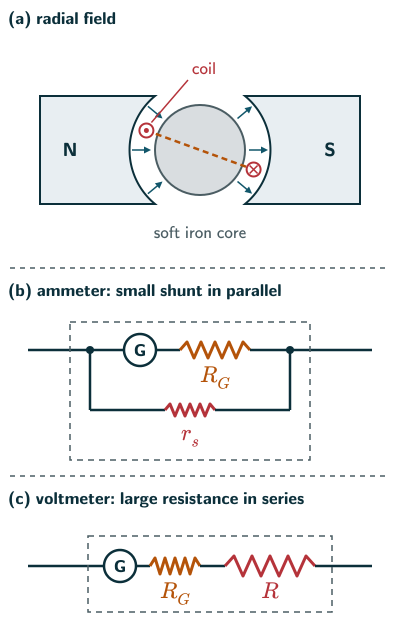
Conversion to an ammeter with a shunt
The range-extension formula assumes I > I_g. The voltmeter series-resistance formula below requires V ≥ I_gR_G; a negative required resistance signals that this conversion cannot provide the requested range.
- A sensitive galvanometer cannot directly measure ordinary ampere-scale currents, for two reasons: it reaches full-scale deflection at a current of the order of a microampere, and, being connected in series, its large resistance would change the current it is meant to measure (NCERT page 130).
- A small resistance rs, the shunt, is joined in parallel with the coil, so that most of the current goes through the shunt. The combination has resistance RGrs/(RG + rs) ≈ rs when RG ≫ rs (NCERT page 130, Figure 4.21).
- If rs is small compared with the resistance of the rest of the circuit, putting the ammeter in changes the current very little (page 130).
- Choosing the shunt (beyond NCERT, from Ohm’s law): if the galvanometer gives full scale at Ig and the ammeter must read up to I, the shunt carries I − Ig at the same potential difference, so IgRG = (I − Ig)rs, and rs = IgRG/(I − Ig).
Conversion to a voltmeter
- To measure the potential difference across part of a circuit, the voltmeter is joined in parallel with it, and it must draw a very small current; usually the disturbance is kept below one per cent (NCERT page 131).
- So a large resistance R is joined in series with the galvanometer, and the voltmeter’s resistance is RG + R ≈ R, large (NCERT page 131, Figure 4.22).
- Choosing the series resistance (beyond NCERT, from Ohm’s law): for a full-scale reading V at the full-scale current Ig, V = Ig(RG + R), so R = V/Ig − RG.
- Range raised n times (beyond NCERT, from the two formulas above): for an ammeter reading I = nIg, rs = RG/(n − 1); for a voltmeter reading nIgRG, R = (n − 1)RG.
- An ideal ammeter would have zero resistance and an ideal voltmeter infinite resistance (reasoned; NCERT Example 4.12(c) uses an ideal ammeter).
Current sensitivity and voltage sensitivity
When comparing changes in N, hold A, B and the spring constant k fixed. Doubling the coil wire length at the same gauge approximately doubles its resistance; a fixed total piece of wire cannot also preserve the area per turn when N doubles.
- The current sensitivity is the deflection per unit current (NCERT Eq. (4.27), page 130):
Current sensitivity (NCERT Eq. 4.27)
- The voltage sensitivity is the deflection per unit voltage. With V = IRG, where RG is the galvanometer’s own resistance (NCERT Eq. (4.28), page 131, writes it as R):
Voltage sensitivity (NCERT Eq. 4.28)
- As NCERT notes, more turns N raise the current sensitivity (page 130). Increasing B or A, or using a weaker spring (smaller k), also works (reasoned from NCERT Eq. (4.27)).
- Doubling N doubles the current sensitivity, but it also roughly doubles the length of wire and so the resistance. The voltage sensitivity then stays unchanged (NCERT page 131). So, as NCERT notes, the change needed to make an ammeter is different from the change needed to make a voltmeter (page 131).
Solved examples
Example 1: Galvanometer, ammeter or ideal ammeter (NCERT Example 4.12)
A 3.00 V cell drives current through a 3.00 Ω resistor and an ammeter. Find the current if the ammeter is (a) a galvanometer of resistance 60.00 Ω, (b) the same galvanometer with a 0.02 Ω shunt, (c) an ideal ammeter.
Answer: (a) the total resistance is 63 Ω, so I = 3/63 ≈ 0.048 A. (b) The shunted galvanometer has (60 × 0.02)/(60 + 0.02) ≈ 0.02 Ω, the total is 3.02 Ω, so I = 3/3.02 ≈ 0.99 A. (c) I = 3/3 = 1.00 A. This is an ideal resistance-loading calculation; part (a) could overload a real sensitive galvanometer. The shunt makes the circuit current nearly the undisturbed value (NCERT pages 131–132).
Example 2: Two meters compared (NCERT Exercise 4.10, page 135)
Meter M1 has R = 10 Ω, N = 30, A = 3.6 × 10⁻³ m2, B = 0.25 T; meter M2 has 14 Ω, 42 turns, 1.8 × 10⁻³ m2, 0.50 T, with the same spring. Find the ratios of (a) current sensitivity, (b) voltage sensitivity, M2 to M1.
Answer: (a) (42 × 1.8 × 10−3 × 0.50)/
Example 3: Making an ammeter
A galvanometer of resistance 50 Ω gives full-scale deflection at 2.0 mA. What shunt makes it an ammeter reading up to 1.0 A?
Answer: rs = IgRG/(I − Ig) = 0.0020 × 50/(1.0 − 0.0020) ≈ 0.10 Ω (beyond NCERT, from Ohm’s law, as shown above).
Example 4: Making a voltmeter
The same galvanometer is to read up to 10 V. What series resistance is needed?
Answer: R = V/Ig − RG = 10/0.0020 − 50 = 4950 Ω (beyond NCERT, from Ohm’s law).
Common mistakes to avoid
Common mistake
Putting the shunt in series
The shunt goes in parallel with the galvanometer, so that most of the current bypasses the coil; the large resistance for a voltmeter goes in series (NCERT Figures 4.21–4.22).
Common mistake
Expecting more turns to make a better voltmeter
Doubling N doubles the current sensitivity, but the resistance doubles too, so the voltage sensitivity is unchanged (NCERT page 131).
Common mistake
Forgetting why the field is radial
The radial field keeps the plane of the coil along the field at every angle, so τ = NIAB without a sin θ and the deflection is proportional to I (NCERT page 130).
Quick revision summary
- A coil in a radial field (soft iron core) feels τ = NIAB at every angle; a spring balances it, kφ = NIAB, so φ = (NAB/k)I.
- Ammeter: a small shunt rs in parallel, total resistance ≈ rs; rs = IgRG/(I − Ig).
- Voltmeter: a large resistance R in series, total ≈ R; R = V/Ig − RG.
- Current sensitivity φ/I = NAB/k; voltage sensitivity φ/V = NAB/(kRG).
- More turns raise the current sensitivity but not the voltage sensitivity, since the resistance rises too.
Formula sheet
- kφ = NIAB
- φ/I = NAB/k
- φ/V = NAB/(kRG)
- shunt: rs = Ig RG/(I − Ig)
- voltmeter: R = V/Ig − RG
Questions students ask
Are the moving coil galvanometer and its conversion to an ammeter and voltmeter in the JEE and NEET syllabus?
Yes, the moving coil galvanometer, its sensitivity and its conversion to an ammeter and a voltmeter are in both syllabuses: Unit 13 of the JEE Main syllabus lists “Moving coil galvanometer, its sensitivity and conversion to ammeter and voltmeter”, and Unit 13 of NEET (UG) 2026 has almost the same words. NCERT Class 12 Physics Part I covers them in Section 4.10 (pages 129–132). Finding a galvanometer’s resistance and figure of merit by the half-deflection method is listed separately, in Unit 20, Experimental Skills, of both.
Why can a moving coil galvanometer not measure alternating current?
An ordinary moving coil galvanometer does not directly indicate the magnitude of rapidly alternating zero-mean current because its torque, NIAB, reverses with the current: on 50 Hz mains it would push the coil one way and then the other a hundred times a second, too fast for the coil and pointer to follow, so they respond only to the average torque, zero over a cycle (beyond the NCERT text, reasoned from NCERT page 130 and the zero average of an alternating current). The pointer stays near zero, perhaps quivering; sufficiently slow current reversals can be followed by the pointer. Meters for alternating current rectify it before it reaches a moving coil, or use a movement whose deflection does not reverse with the current.
What would happen if a galvanometer’s magnetic field were uniform instead of radial?
In a uniform field a galvanometer’s scale would not be even: with the plane of the coil along the field at zero deflection, a deflection φ turns its normal to 90° − φ from the field, so the torque falls to NIAB cos φ and the balance becomes kφ = NIAB cos φ (beyond the NCERT text, reasoned from NCERT Eqs. (4.21) and (4.26)). Equal steps of current would then give smaller and smaller steps of deflection, and a deflection of 60° would need twice the current it needs in a radial field, since cos 60° = 0.5. The deflection could never reach 90°, where the torque would vanish.
Which has the highest resistance: a galvanometer, an ammeter or a voltmeter?
Of a galvanometer and the ammeter and voltmeter made from it, the voltmeter has the highest resistance, the ammeter the lowest and the galvanometer lies in between: the shunt brings the ammeter’s resistance down to RGIg/I, while the series resistor raises the voltmeter’s to V/Ig (reasoned from NCERT pages 130–131). For a galvanometer of 80 Ω giving full scale at 0.50 mA, a 0–1 A ammeter has 0.040 Ω and a 0–15 V voltmeter 30 kΩ. The larger an ammeter’s range, the lower its resistance, so for conversions of the same movement a milliammeter has a lower resistance than a microammeter; unrelated instruments need not follow that ordering (the NCERT Laboratory Manual Physics Class XII sets both questions, Experiment 6, page 58).
What are the SI units of the current sensitivity and voltage sensitivity of a galvanometer?
The current sensitivity of a galvanometer, NAB/k, is measured in radians per ampere (rad A) and its voltage sensitivity, NAB/(kRG), in radians per volt (rad V), being deflections per unit current and per unit voltage (NCERT Eqs. (4.27)–(4.28), pages 130–131). They follow from the torsional constant k in N m rad (NCERT table, page 134): m × T/(N m rad) = rad A, as 1 T = 1 N A m. In the laboratory, deflections are read in scale divisions, so the current sensitivity is given in divisions per ampere, the reciprocal of the figure of merit.
Practice questions
Try each question first, then open the answer to check your working.
-
Q1. A galvanometer coil has 100 turns of area 2.0 × 10⁻⁴ m2 in a radial field of 0.50 T, and a spring of torsional constant 1.0 × 10⁻⁶ N m per radian. Find its current sensitivity.
Show answerHide answer
φ/I = NAB/k = 100 × 2.0 × 10−4 × 0.50/(1.0 × 10−6) = 1.0 × 10⁴ rad/A, that is 0.01 rad per µA: a current of 100 µA turns the coil through 1 rad (NCERT Eq. (4.27), page 130).
-
Q2. Why must an ammeter have a small resistance and a voltmeter a large one?
Show answerHide answer
An ammeter goes in series, so a large resistance would change the current; a voltmeter goes in parallel, so a small resistance would draw current and change the voltage being measured (NCERT pages 130–131).
-
Q3. How is the neutral position of a galvanometer’s pointer arranged when it is used as a current detector?
Show answerHide answer
In the middle of the scale, so that it can swing either way depending on the direction of the current (NCERT page 130).